

The following is a transcript of an episode of The Vilest Rag, The Ubyssey's podcast. You can also listen to the full audio on Spotify or Apple Podcasts.
[THEME MUSIC]
Sophie Clark
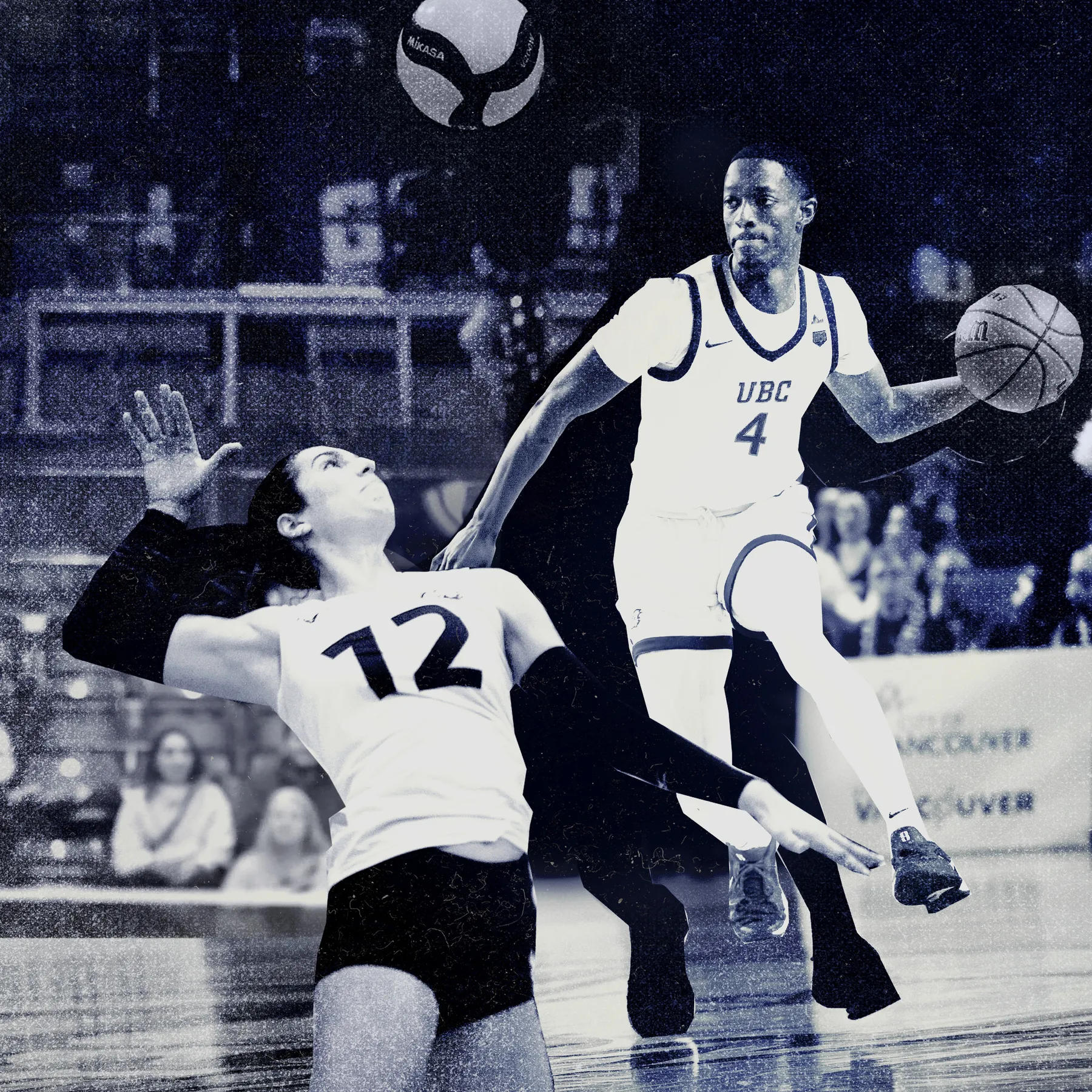
This is The Vilest Rag. I'm your host Sophie Clark, and you're listening to a podcast brought to you by The Ubyssey, UBC's student newspaper. UBC athletics is full of a range of talent, competing in 14 different sports at a high level, and producing career athletes time and time again. It's Monday, Oct. 26, and I'm speaking to Ian Cooper and Sofia Campanholo, The Ubyssey's deputy sports editors, about the upcoming season of court sports, a coach's impact on a team, players to watch, and why you should head to War Memorial Gym this fall.
[THEME MUSIC]
Welcome to the podcast, Ian and Sofia — glad to have you on, or have you back. We're talking about both women's volleyball and men's basketball, since both seasons are starting pretty much imminently. Women's is starting on Friday, Oct. 23, and if I'm correct, men's basketball starts Oct. 29.
Ian Cooper
Yeah, next Thursday.
Sophie Clark
Okay. How long have you two been reporting on your respective beats, and what made you want to cover that beat specifically?
Sofia Campanholo
I've been covering women's volleyball — this is going to be my second year doing it. I started last year; before that, I was covering men's soccer two or three years ago. When someone came in and wanted to do men's soccer, I figured I could do women's volleyball. I liked volleyball, but I didn't really watch it that much, and I realized I actually really like it. Even though I like soccer more, I think reporting on volleyball is actually better, because there's so much happening all the time and it's easier to pay attention. I really like all the players, and I really like the coach, so I decided to continue it this year, even though I had the opportunity to switch to soccer.
Ian Cooper
My first ever article for The Ubyssey was probably in my first or second month of first year — I wrote a season preview back then. At the time it was maybe 400 words, and it covered
Sophie Clark
The men's and the women's team in one article?
Ian Cooper
Yeah. That was also my only experience talking to the old men's basketball coach, Kevin Hanson — I spoke to him on the phone for one of my first interviews. Between then and last year, I don't think I did anything else with men's basketball; I was just on and off doing whatever, not too much. Then when I joined last year, we were running a program called the Contributing Journalist Program, where you picked a beat in sports and covered it. I started on men's volleyball because that was what was available, but it wasn't my favourite thing to cover — I just had less interest in the subject matter. Then the old men's basketball reporter quit, so I took her job, and I've been doing it since. It's been a bit over a year, maybe a bit less — I want to say I picked it up around November or December last year.
Sophie Clark
Are either of you avid players of the sport you're covering? Not at an intense level, but casually.
Sofia Campanholo
I'm not, but Ian is.
Ian Cooper
I play basketball. I'm in a sports psychology class right now, and the professor's always like, "Does anybody have a story they want to tell relating to the topic?" I did that last week — the unit was on aggression in sport. I told a story about how I got suspended from an intramural basketball game last year for cursing out a referee. I was playing, jumped up to grab a rebound — which is when you clear a missed shot off the basket — and somebody elbowed me in the face. It wasn't that bad; I've had an actual fat lip before, and this wasn't that, but I did get hit, and I was pretty upset.
There's more emphasis if I curse here, so: I told the ref, "Hey, why are you even here? Why don't you do your fucking job?" I got a technical, and then I had to go explain myself after — UBC Intramurals has this whole disciplinary process I had to go through. What I did was obviously inappropriate, but I read the whole thing, and they've got some pretty wild protocols in there for what happens when a player punches a ref. So that's clearly happened before.
Sofia Campanholo
Every rule is there because someone made it necessary.
Ian Cooper
Anyway, I guess the point is, yeah, I play basketball. I'm not too good, but I definitely get out there.
Sofia Campanholo
I do like to play volleyball, and I'm better at volleyball than I am at soccer, which is funny because everyone else I've played both sports with is way better at soccer than me. I'm just not very coordinated with my feet. I'm not good at soccer, but I really like to play volleyball — I just don't think I have the height.
Ian Cooper
It's huge in Brazil too, right?
Sofia Campanholo
The Brazilian women's volleyball team is very, very good. Italy and Brazil are the best two countries — also Canada.
Ian Cooper
So yeah, we're fans of our sports, and we play them.
Sofia Campanholo
Have you played basketball or volleyball, Sophie?
Sophie Clark
No, I've never really been a team sports person, to be honest — not that I don't like working as a team. I think it's partly my hand-eye coordination. I feel like people with glasses sometimes really struggle with that, and my depth perception is also pretty off. You don't want to see me play volleyball.
Ian Cooper
And you've got different vision in each eye.
Sofia Campanholo
You actually just made me realize I've never really thought about the fact that I never see players with glasses.
Ian Cooper
There's one WNBA player, Allisha Gray, who wears protective goggles — she hurt her eyes at one point and started wearing them. She doesn't have any actual vision impairments; she just wears them now.
Sophie Clark
I feel like I've definitely seen more of that in basketball, and also at the college level. Sofia, the women's volleyball team is coming off a pretty great season — last year they had a fantastic regular season, but fell short comparatively in the playoffs. Can you briefly take me through last season and where you left off as a reporter?
Sofia Campanholo
Yeah, sure. Last season they didn't lose a single home game during the regular season, which was very cool — I still have to watch a game here at War Memorial and interview the coach and players after a loss, because I don't think that's happened. They finished second, just after the Alberta Pandas, who are right now probably the best team in the country — they won both Canada West and nationals last year, so they've been very good. What was really interesting last season is that UBC lost their Canada West semifinal to Trinity Western, and then lost their first national game against Trinity Western too — so both championships, they got eliminated by the same team. Trinity Western is by far their biggest provincial rival; it's a very big rivalry.
Something else interesting compared to this season: they only lost one player, which is kind of insane. Because they're coming back with almost the same team, I don't think they'll have as much trouble figuring out what went wrong last year. That's where things were left off — when we're recording this podcast, the first game hasn't happened yet, but I think it's going to be a good season.
Sophie Clark
For men's basketball, the team had an interesting last season with a new coach and lots of young players, but they ultimately lost to Laval in a consolation semifinal in the playoffs. Can you give listeners an overview of last season's ups and downs?
Ian Cooper
Yeah, I think all things considered, last season actually went pretty well. A constant theme when you talked to people on the team and the coaches was that they had a real chip on their shoulder — like, "fine, we lost some players from last year, but we're not a bad team by any means" — and they backed it up.
They had nearly identical results to the year before, and they lost Adam Olsen, who's probably their best player. He went south to play Division 1 basketball, and he's performing at a high level — he's averaged more points since switching than he did here, which, to me, is kind of indicative that they weren't using him properly. Whenever you see something like that, you immediately think it has to do with coaching.
So they brought in a new head coach who probably runs a system Adam actually would have thrived in — much more based on three-point shooting, speed and pace — and I think if he'd stayed another year, they probably would have done even better. But he left, and the new coach, Phil Jalalpoor, who's really big on player development, took the group he had and brought them back to the exact same place they were the year before — both years, they made the Canada West final, and lost in pretty close games.
But last season, there were a lot of big wins in terms of getting the most out of some players. One, Nylan Roberts, went from being a 16-per-cent three-point shooter in his first year to 37 per cent, which is a very good number, especially in Canada. They took this guy from first year, doubled his minutes and his production — he averaged about four times as many points a game — and this year he's probably their best player.
They still had some veterans around — Nikola Guzina was probably their best player last year, and he was still there (he's since graduated) — but I think they positioned themselves really well for this season. They also had some big wins, though you're right that the season was a bit up and down. There were some losses that didn't really make sense — they dropped back-to-back games to Thompson Rivers, which shouldn't really happen, since TRU finished the year something like 14-14.
Then they also played probably their best game of the year, winning in overtime in the Canada West semifinal — they beat Victoria, which they hadn't done in a long time, since Victoria usually has their number and is consistently the best program in the country. Then at U Sports, in their first game — I think they could have won it — UBC lost to a very good team. They went in as a five seed, played the four seed, and played a close game. So there's a lot of positives, and I think this year they're probably flying a bit under the radar because they lost another good player, but based on how this coach runs things, I don't think that'll be a problem.
Sofia Campanholo
I just wanted to add a quick note about last season — something that was sad to watch, as someone who's been following the team closely, is that at nationals, the game they lost against Trinity Western, which dropped them to fifth place, was the first time in almost two years they'd lost in three consecutive sets. Even when they lost throughout the year, they'd always put up a fight and win at least one set. That was the first time in almost two years they didn't win a single set in a game. So I'm curious to see how they're going to come out for these first few games back, considering that happened in one of their last games and eliminated their chance at nationals — especially since most of the players on that team won nationals in 2023 and 2024, before this happened. I'm just curious to see.
Sophie Clark
Ending on a sad note like that can impact players, either positively or not — I think a successful season or a disappointing one can both be motivating. To that effect, how much does last season impact the next?
Ian Cooper
I think a lot, if I had to guess. We're not elite athletes, but it always comes up when you're interviewing them at the start of the season, based on whatever happened the year before. I think it's always in the back of your mind — you see it a lot in professional sports too. If you're defending champions, that's an added layer of pressure, pushing you to back it up, because you don't want to fall short. But if you feel like you underperformed last year, I think that's also always on your mind, and it motivates you to work that much harder.
Sofia Campanholo
Yeah, 100 per cent, I agree with that. I think what makes UBC teams some of the best in the country in so many sports is that they're not the kind of teams to get worse because they're losing, if that makes sense. A lot of teams, when they lose a very important game, get upset and kind of give up, but UBC teams aren't like that. For women's volleyball, I think the fact that they went so long without losing straight sets means that even when they're losing in a game, they still make sure they get somewhere.
Comparing last season to now, from what I hear from them, I honestly think being upset about what happened last season is even bigger motivation than if they'd won and ended the season on a good note. I don't know exactly about men's basketball, since they had a lot of people graduating, but for women's volleyball, they have so many fifth years right now, and a lot of fourth years who may be gone too — but at least four or five fifth years, if I'm not mistaken. For a lot of them, having ended last season that way, knowing it's their last year, I think they're going to be very motivated in the same way.
Ian Cooper
We were just talking about this, but one of women's volleyball's best players last year — it was supposed to be her fifth year, but she only ended up playing four or five games because she was injured, and now she's back. So it's double that for her.
Sofia Campanholo
Yeah, I actually found out Akash is a seventh year — because of COVID. This is going to be her seventh year at UBC. We were all very sure she was graduating; me and Caleb were even talking about it, like, "we're going to have to put a note on all my articles," because every time I'd write "now that Lucy and Akash are graduating," and then — no, actually, she's not. Doug even talked to me about her — he said U Sports has a rule that if you miss most of the season because of an injury and it's supposed to be your last year, you can still stay and play another year. She's also a very good player. The team also had Aimee Skinner, who had an injury and didn't play most of the season — she's also going to be back. So a lot of familiar faces returning.
Ian Cooper
Akash is one of the best servers in the country too, so that's just another thing for the team to have.
Sophie Clark
With eligibility — you mentioned U Sports has a rule about injury and playing again — do a lot of players choose to do a fourth year versus a fifth year strictly because of injury, or is there more to it?
Ian Cooper
I can actually answer this. U Sports allows five years of eligibility, essentially, so you get five years to play while finishing your undergrad. I don't know the exact reasoning, but I'd presume it's that if you're an athlete, you're taking fewer courses, so you need the extra time to finish your degree. But you can also redshirt, or be injured. Men's basketball has two players this year who'll be first-year standing but were practicing with the team all of last year without playing a game.
Sophie Clark
Not because they're bad — obviously they're recruited because they're good — but because there were already so many starters and fifth years, giving them another year gives these younger players an opportunity.
Ian Cooper
Exactly. I don't actually know entirely why people redshirt — sometimes you're just injured and it works out. They have two redshirts on the team this year who'll be travelling with them. I don't know why, but presumably it's something to do with roster size — I'm pretty sure the full team can have 12 players, which is where they're at right now, but you can have two redshirts on top of that, bringing the count to 14, though only 12 are actually playing. Next year those slots would presumably open up. The point is, you get five years of eligibility, and it gets really weird sometimes — we don't always know exactly who's doing what. Brian Wallack was here for about seven years. Akash is here for seven now, and she'll have technically played in six, but last year she barely played — I think it was about three games.
Sofia Campanholo
The only thing I'd add is, from a quick conversation I had with the coach a few days ago, and something we've talked about in the office — on top of the fact that they have to train and play and be students, UBC is also one of the hardest schools in the country in many ways. I'm pretty sure this isn't just a women's volleyball coach thing; I'd assume most coaches have to really think about that.
For example, when you're recruiting a player, you also have to look at their school records, because you need to know whether they're going to be accepted into UBC. So they also have to factor in the academic side, not just the athletic side, and I think that's part of why it's hard for a player not to stay here for five years.
Sophie Clark
That makes sense. What does preseason training entail for a sports team? I haven't endured a preseason, and I'm pretty unfamiliar with athletic training in general — what does that look like?
Ian Cooper
We're kind of blind to that side of things too. I spoke to a player today who talked about how they did a training camp this year, which is pretty standard in professional basketball — before the season, you spend two weeks as a team, working out together and doing everything together. I went to War Memorial the other day for an intramural meeting — not because I got in trouble, we actually had to go —
The men's basketball team was, I guess you could call it practicing, but it really was more like some form of torture. They were running suicides, and it was very, very intense — a lot of screaming, a lot of heaving. So it's definitely no joke.
Sofia Campanholo
Same as Ian, I don't know a ton, but what I do know is that the preseason usually runs for a few weeks between the end of summer training and the start of classes. They use that time to train really intensely, two to three times a day. It's also a good window to shuffle the roster and positions — especially with rookies — to figure out who's working best, and who the coach is thinking about putting in for the first game.
Then there's usually more intense training, and in the preseason they frequently have exhibition matches — for those who don't know, those don't count toward Canada West or U Sports standings, but they're a way for teams to prepare and see where they still need to improve. Women's volleyball played two exhibition games, against Mount Royal and the Calgary Dinos — they'll actually be playing the Dinos again for their first weekend back. UBC won 3-0 in both of those games.
Ian Cooper
Men's basketball played a bunch of games this preseason too, and did very well — 5-1, 6-1, something like that.
Sophie Clark
Both of you have written pieces on the teams' coaches — Doug Reimer of women's volleyball, who's been coaching the team for nearly 30 years, and Phil Jalalpoor of men's basketball, who's only been head coach for a season. What is a coach's role in cultivating a promising team, and how have they impacted their teams?
Ian Cooper
Frankly, I think it's everything. Especially at this level, you can have players who are big difference-makers, but a lot of it comes down to the system and how you run things — especially in college, I think playing as a team is so much more important. You're not usually running the offence through just one person. You can, but it's not usually what makes the best teams the best — this is just observational, and in the States that's definitely not always true.
Thinking about the most successful college basketball teams recently — Purdue made it to the national championship game. They had Zach Edey, who was seven-foot-four and around 300 pounds — he averaged a huge number of points and rebounds and won national player of the year. That's an example of running it through one player, but I think a lot of the time, what makes programs good year over year is teamwork and people buying into their role.
Looking at UConn on the women's basketball side, they've now won 12 national championships. Say what you will about Geno Auriemma, but he's clearly figured out a way to get players to buy into that system, and it works for winning championships. He'll take a group of top-10 recruits, and no one is being selfish about their role.
I think that's really important, and it clearly shows, because on paper, last year the men's basketball team wasn't supposed to perform as well as they did, and they did — and I think a lot of that comes down to coaching, player development and the system they were running.
Sophie Clark
I want to ask a bit more about Phil — I know you wrote a piece about it — but what prompted the shift between coaches? You said Coach Hanson was the coach for a long time.
Ian Cooper
It was kind of smoke and mirrors — we didn't really know exactly why he left, or who fired who, or if he quit. He's up to stuff now; he's part of a team putting together a bid for a WNBA franchise in Vancouver, which I'll be writing about at some point. Anyway, Phil got appointed interim head coach — I think he'd been assistant head coach before that. Everyone I spoke to had heaps of praise for him; it's really clear he cares a lot about his players and how to get the most out of them and make them better. For people who played under both systems, that was the biggest difference.
I think it really complemented the group he was working with, but he was also holding people accountable and got everyone to buy into the way he wanted them to play — faster, I guess is the best way to put it. I can't remember who said it exactly, but someone in the article I wrote said something like, "in his mind, the more possessions we can get, the more points we can put on the board."
So he wasn't trying to slow things down. Even today, when I spoke to Edouard Gauthier, who was their backup point guard last year and is going to be starting this year, he mentioned they only have a few set plays — actions you'd call after a timeout, say — and that it's really more of a foundation of a system. They're encouraged to play with a lot of freedom, move the ball, and play without many restrictions.
For a team whose identity this year is all about being young, it's clearly working — in preseason, some of the games they played, the other team still scored a lot, but they scored more, and they've had some really high-scoring outings: 96 points, 95, 104, 90, 95. Those are big numbers for 40-minute basketball games. Whatever he's doing is working.
Sophie Clark
I know Phil played for UBC — is it common for coaches to come from the program they end up coaching?
Ian Cooper
Here, yeah. I don't know about other places, but women's basketball's lead assistant coach this year is Jess Hanson, Kevin Hanson's daughter, who played at UBC too. Last year, another of the women's assistant coaches had played there as well. And this year, on the men's team, one of the new assistant coaches was on the team last year as a player.
Sofia Campanholo
Same with soccer — the current coach is Mike Mosher, and before him, his father. Mike played under his father at UBC, and when he graduated, he became assistant coach to his father, who eventually stepped down, and Mike took over as head coach. So that's definitely common at UBC — if you search a coach's last name, you'll find a lot of ties. This isn't about men's basketball, but because of a piece I did about their history, the first UBC men's soccer team was in 1921, if I'm not mistaken — I can fact-check that in five minutes, but I'm like 99 per cent sure that's what I found. Fred Hume, UBC's athletics historian, told me, and I confirmed it was true. So they've been around for more than 100 years.
Ian Cooper
That's wild.
Sofia Campanholo
I know. I have a lot of thoughts about Doug — I really like him, and I think it's such an interesting comparison, having men's basketball with a coach who's been here for one season, and then women's volleyball, where the coach has been here for nearly 30. I think that really shows a coach can be very good, but just not be a fit for that program in a way — I don't know if that makes sense.
To go from no national titles for 30 years to winning six in a row is, to me, insane. When I did my profile on Doug and talked to the players, they talked a lot about how much he cares — about them, and about the sport — and because he loves it so much, he's able to transmit that to the players, which makes them more motivated to play and to be better.
Something I still remember is that team captain Issy Robertshaw said he always talks about psychological safety, and that it's something he wants to have on his team — meaning he wants players to feel comfortable speaking up when they don't agree with something, or just have ideas. They also talked about how he plans trips for the team, sometimes without even being there himself, because he wants the team to be very connected.
I think he's a strict coach — they all say his practices are very detailed, and he knows exactly what they're going to be doing that day. But at the same time, he's not the kind of coach to get angry at players if they have a bad day. I think that really shows why they keep doing so well year after year under him — but yeah, he's a great coach.
Sophie Clark
You mentioned earlier that volleyball has many returning fifth years, but men's basketball lost quite a few seniors from last season. How has that impacted these teams — men's basketball specifically — this year, and for both of you, who are the players we should look out for?
Ian Cooper
For men's basketball, they lost three players out of their starting lineup. Off the top of my head, the main three were Nikola Guzina, their starting centre; Tobi Akinkunmi, their team captain and a starting forward; and Holt Tomie, their starting point guard. Those roles have to be filled by people who were already here last year, but I think it shouldn't be a huge issue given how things have worked out.
They'd kind of been developing some players off the bench last year, getting them ready for bigger roles — Zeru Abera and Edouard Gauthier are going to step into the backcourt. When I talked to Edouard today, he was really excited, because he and Zeru had been coming in off the bench together last year and finished second and third on the team in assists — they almost tied, with Edouard one ahead on the season. Now they're coming in together with that same chemistry, but in an increased role. Karan Aujla is coming in to play the starting centre role, and Nylan Roberts is staying in the starting lineup.
They've been tweaking the starting lineup, and I'm sure it'll keep changing to address whatever needs come up. Edouard pointed out a redshirt from last year, Frank Linder, who, in Edouard's words, "we weren't expecting to have this big a role this year, but in his first game, he was picking everybody up full-court and had three steals." In his second game, at Saskatchewan, he played himself into the starting lineup, and he's been starting the last two games and doing really well. So those are probably the biggest names to watch: Edouard, Zeru, Frank Linder.
Also Raj Dhadda — he was the player who made that game against Winnipeg so electric, hitting game-tying three-pointers. He's an excellent shooter, though he's struggled a bit in the preseason — he's two-for-17 on threes, which is about 11 per cent. But as they say in basketball, a shooter's going to shoot, and it'll come back around eventually. There are just a lot of really young players, and I'd encourage people to go watch the games and decide for themselves who they like to watch.
Sofia Campanholo
For women's volleyball, it's an interesting position, because, like I said, they only lost one player who graduated. That player, Lucy Barowski, was in many ways the best player on the team — she's now playing in France, and she was probably the best player in Canada, having been on Team Canada for a long time. She was an incredible outside hitter, and I think she's going to be missed. At the same time, like I said, a lot of players had injuries — Aimee Skinner, Akash — so even though they were technically still here at UBC, we didn't really get to watch them last year. I think those are two good people to watch for this season. A few days ago I talked to some of the players — Jocelyn Lenarcic and Issy Robertshaw — and to Doug Reimer, about Lucy being gone and the process of, in a way, replacing her. I didn't really want to use that word, but even Doug said, "No, that's a good word for it."
[MUSIC INTERLUDE]
Ian Cooper
This is actually an interesting thing — the UBC athletics comms and PR people we work with are great, and they want us to act with a certain level of professionalism, which we take seriously. We don't go over their heads to put in interview requests; they schedule everything for us. But they're also like, "We think it's cool that you get to have this experience and be young alongside the athletes." There's a certain level of comfort that comes with being asked questions by another student, and I think it opens up a lot in terms of what we're able to get. My conversation with Edouard today was very conversational.
Sofia Campanholo
Shout out Stu and Jeff.
Sophie Clark
I also think that's reflected in your writing. Even on the same beat, your individual voices still come through, but I think it's also because you can be that much more personal about it — you've both been reporting on this for a while, so you're familiar with the players, the coaches, their style of playing.
Ian Cooper
Also because we interact with these people regularly — even if it's not our own beat, everybody's had a class with a varsity athlete. I guess we go to UBC — they're very real athletes, very serious, but there's also a level of familiarity that's nice. It's not like we're at Duke, where my friend was in class with Cooper Flagg — how's anybody in that class ever getting any work done? That guy's got millions of Instagram followers. That's not the situation we're in. We can appreciate how good these people are without being infatuated, and I think that part of it is really cool.
Sofia Campanholo
The team has good enough players to deal with this loss. I'm honestly very curious to see how it'll be without Lucy — and even more curious to see, even though I won't be at UBC anymore, how it'll be next year, since a lot of them will be graduating. Doug's already talked to me a bit about preparing for those fifth years graduating — he said that when he was recruiting rookies, he was specifically looking for players in the positions that last year's fourth years, now fifth years, play. I think he was looking for one or two middle blockers, and a setter as well.
Archived Recording 1
Rowan Brumwell, setter — she's coming in partly because we'll graduate both our setters in the next two years. Abby Chan, middle, we picked up a bit later, and she was rolling — they were teammates on the Thunder Volleyball Club that won the national championship. I don't know if that matters. And Mila Kosoric, a strong outside hitter from Calgary, Alberta, playing on a very strong club team there.
Sofia Campanholo
Not only were they looking for rookies in those positions, but he also said those are the aspects of play he wants to improve the most — the setting and serving weren't as great as they'd like. Jocelyn also talked about blocking. So long story short, I think it's so interesting that they already have a mentality of preparing for something a year out, and are already looking for players who can do that.
As for who to watch right now, I'd say most of the fifth years — Jocelyn, and I'm not sure if captain Issy Robertshaw is a fifth or fourth year, but either way she'll be graduating soon too. Also Akash, because she's an awesome player we didn't really get to see last year, when we all thought she'd be graduating but wasn't. A lot of the main players on the roster right now are going to be graduating soon, so I think both Jocelyn and Issy said they're very hungry to have a really good season and take it to the next step they didn't reach last year.
Sophie Clark
Earlier this year, our editorial board wrote a piece on game attendance and community building in sports. I wanted to know what your pitches are to the student community on why they should go to War Memorial over the next few months, and why it's worth paying attention to the sports program here at UBC.
Ian Cooper
I'm writing an article on War Memorial Gym, which is where the court sports — volleyball, basketball — are played at UBC. It's old, and it shows, but it's not destitute — not horrible by any measure, just an old building. UBC has released plans on what they want to do to renovate or rebuild it, but they haven't really materialized. The point I'm making is, when I went to McGill, the gym they use was pretty disappointing and depressing.
McGill is a whole other story — they cut a bunch of varsity sports programs, which was a big deal — but where we have Rec North, SRC and War Memorial, they just have one gym. I went in to play basketball with a friend, since it's open to the public and varsity athletes. It was dusty, with those pullout bleachers you'd see in a high school gym, and the three-point line and court felt closer together — literally like a high school gym. UBC has nice facilities, there's popcorn at the games, and there are always seats. It's also free, which — fine, we don't go to Duke with Cooper Flagg, but it also means you don't have to camp in line for tickets the way you do at Duke.
You can come to these games on a Friday or Saturday. I think if you're a sports fan, sometimes you just want to see something in person, and it shouldn't really matter who's playing — it's cool to learn about new things. Whatever sport you're into, we probably have it. I've never been to a hockey game, but I'd also encourage people to go, because Doug Mitchell is a very nice, newer facility.
Sofia Campanholo
Doug Mitchell is awesome — most students here have probably been to a concert there.
Ian Cooper
Yeah, we've all used that space, and there's a sports event happening there pretty much every weekend. I just think it's an underutilized resource, especially at a school where everyone spends all week talking about how miserable they are during midterm season — and it's raining, and it's literally right next to the bus loop. You could just be heading home and, I don't know, do yourself a favour and make the impulse decision to walk in and see what's going on. If it's a Friday or Saturday, there's probably something for volleyball or basketball — sometimes four games in one day, if they're scheduled together. I don't know if they always do that.
Sofia Campanholo
Before I say my thoughts on that, you should talk briefly about
Ian Cooper
Oh my god — so, on War Memorial showing its age, last year UBC was playing UNBC, and maybe we can link this video — I was there, and one of those foam ceiling panels (if you look up in the gym, some of them are already kind of falling off) fell out of the ceiling onto the court during the game. I'm not kidding — it maybe missed a UNBC player by five or six inches. It almost hit someone in the head, and that was actually the inspiration for an article. Anyway, this is me underselling the facility — I actually think it's nice, and intimate. It seats about 3,500, I think, but it's one bowl of seating, so you can get very close to the court without issue. It's just cool, a lot of fun. When I go cover games, I don't really think of it as work — it's more like, okay, I'm going to go watch a basketball game.
Sofia Campanholo
I'm on the editorial board too, so we did a lot of research on attendance — War Memorial, like you said, is about 3,000-and-something capacity, and so many times there are literally 200 people at a game. I'm going to repeat a lot of your points, but I think they're important. First of all, it's free. Thousands of people live on this campus, and then go back to their dorms and do nothing all weekend. You could be bored and think, "I have 10 different sports I could go watch right now." You can go. You can be there for 30 minutes.
Ian Cooper
Yeah, and you can doom-scroll at the game too, if you really want to — or not, and actually get into it. It's right next to the bus stop — that's why I don't get it. Maybe there just aren't enough signs.
Sofia Campanholo
No — on our editorial board, we talked about this, because my thought process was that UBC really needs to do something about this. It's right next to the bus stop, thousands of people pass through there every day, and there's no sign saying, "These are the games this weekend, come watch for free." They don't put anything up. I promise you, if we walked by right now, there's a volleyball game happening, and people are walking right past it because there's nothing outside saying, "Come in and watch." UBC, do something.
Sophie Clark
I follow the UBC Thunderbirds, but I feel like the football team and the men's hockey team get marketed the most, honestly — and I'm also a bit of a victim to this. I keep telling myself, "I'm going to go to at least one rugby game this year," and now I'm pretty sure women's rugby has ended, or is ending soon. Last year I wanted to go to more games in general — I think I went to a total of four, which isn't great, but it's such a fun thing to do with friends, and it's genuinely easy to get into. Like you said, there's a sport for everyone — surely everyone dabbles in watching at least one sport at home, whether it's basketball or volleyball or whatever. It's always a good energy.
Ian Cooper
I don't think this is us trying to be insensitive to people's time — we get that people are busy — but it's also true that we're all guilty of making time in our day to lie horizontally on the couch scrolling our phones. This is probably the easiest way to avoid that. It's actively engaging, it has a similar effect, but you can also zone out while still being engaged with what's happening in front of you. The more people who are there, the bigger the difference it makes — you want energy and a good crowd, and the players respond to it too. It's an easy fix, it just requires buy-in from everyone.
Sofia Campanholo
It's so interesting to me — I do think people want to go to Homecoming because it's one of the only games you actually have to pay for, and it's the game with the highest attendance.
Sophie Clark
Honestly, there's nothing really different about it compared to any other football game — well, we have Homecoming, and then we have the Winter Classic.
Ian Cooper
Basketball has Courtside Night, and volleyball has Pride Night.
Sophie Clark
I do think they need to market these things better.
Ian Cooper
That's our biggest thing. I don't know if you saw, they did a country night for football — I don't know how many people actually went, but I saw a lot of girls in cowboy hats at the bars after, so clearly people went. That felt like more of a theme than Homecoming, which is literally just a game they pick, and you have to pay to sit on the grass. We were all there — you can generate that kind of scarcity. They could do this for basketball too, 100 per cent.
Sofia Campanholo
Not even online marketing — just put things up in person. Put something on campus, by the bus loop, literally right there, saying, "Free, come tonight and watch a volleyball or basketball game." During playoffs, for example, they're always giving out free T-shirts — I have like five different shirts I got for free.
Ian Cooper
I have this sticker on my laptop — oh my god. Women's basketball playoffs last year, Canada West, they were doing this thing where if UBC won, everyone got free Popeyes. I was like, great. UBC lost — that was the last home game of the season — but they already had all these coupons, so that game was pretty well attended, and on the way out they were still handing out free Popeyes coupons. I took like four. There's stuff to be had, you guys.
Sofia Campanholo
Our point here is, if you're on campus and have nothing to do, a good use of your time would be to go to literally any UBC game happening at the moment. Most of our teams at UBC are among the top five in the country — so many of these players go on to join national teams for their sports. Just give it a chance. I've literally been to a soccer game while I had an essay to do, saw a game was happening, and did my essay while kind of watching, because it's free, and you can just be there watching sports. You can go alone, go with friends, stay for an hour and leave, show up late — you can really do anything. We have Doug Mitchell, Thunderbird Stadium, War Memorial — so many venues, so many teams, and it's free. I think you can appreciate an athlete the same way you appreciate an artist performing live.
Sophie Clark
It's cool to see and appreciate an athlete doing something they're really good at. When I'm there and the energy's good and I'm with friends, I find it pretty captivating — it's a good time.
Ian Cooper
I always bring friends along now when I go cover games. Unless it's football and you're in the press box, it's just "show up and sit anywhere and watch" — I take notes, but it's like, "hey, who wants to come? I'm going."
Sofia Campanholo
Same for soccer, even though that's at Thunderbird Stadium — I don't love being in the press box, I'd rather be among people. But I just wanted to say, it's very true that when you see people who are actually good at what they do, it's always so clear to me — UBC's level is high. They're playing better than some teams I've seen that are actually professional. There's always at least one player on every team I watch where I think, this person's going to have a good career, because they're that good. Go to games.
Ian Cooper
Yeah, people should check it out. If there's a takeaway from this, that's it.
Sophie Clark
Well, thank you guys so much. I also want to give credit to Abbey, who wrote the piece with you, Sofia, and Jasdeep, who's going to write the preview piece with you, Ian — you're just the representatives of those pieces, but obviously you wrote them too. Thank you both so much for coming on.
Ian Cooper
There will be games every week.
Sofia Campanholo
Until the end of March — there's literally always going to be something happening.
Sophie Clark
Thank you guys so much.
Ian Cooper
Yeah, thanks, Sophie.
Sofia Campanholo
Thank you.
[THEME MUSIC]
Sophie Clark
Before we go, let's take a look at this week's stories.
In News, AMS reporter Reese Harper writes on the VP Admin's email to Solidarity for Palestinian Human Rights, Chabad UBC and Israel on Campus, asking them to remain peaceful ahead of the Oct. 7 vigil. In Arts and Culture, book critic Beck Chi reviews Zadie Smith's panel at the Chan Centre. In Sports, football reporter Caleb Peterson analyzes the Thunderbirds' rough win in Regina. In Opinion, guest contributor Tyler Luft discusses the importance of physical note-taking and learning in classrooms. You can find all these stories and more at ubyssey.ca, which publishes every day.
In today's episode of The Vilest Rag, you heard from Ian Cooper and Sofia Campanholo, The Ubyssey's deputy sports editors, and myself, Sophie Clark, The Ubyssey's audio producer.
This episode was edited by Lily Growe, and the music is by Dylan Fitzhenry.