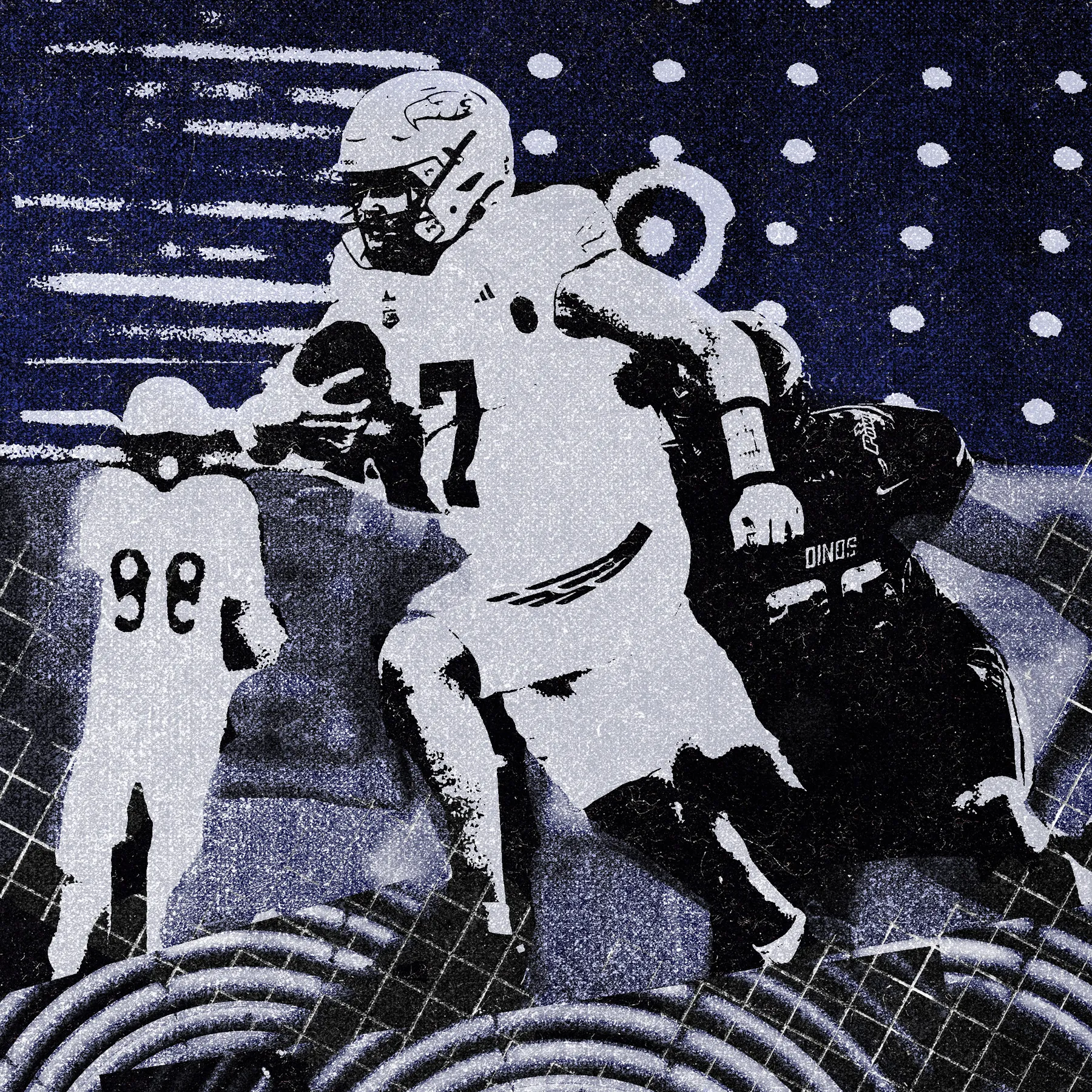


The following is a transcript of an episode of The Vilest Rag, The Ubyssey's podcast. You can also listen to the full audio on Spotify or Apple Podcasts.
[THEME MUSIC]
Sophie Clark
This is The Vilest Rag. I'm your host Sophie Clark, and you're listening to a podcast brought to you by The Ubyssey, UBC's student newspaper.
[Archived Recording 1]
Football culture is huge across North America, both in national leagues and at the university level; it's a culturally significant sport at our own school. UBC's Thunderbirds football has had its share of tribulations over the years, after a tough rebuilding season last year. Despite a rough start, players and coaches remain optimistic about the upcoming schedule in Canada West, with hopes for improvement. Today, I'm talking to Caleb Peterson, The Ubyssey's Sports Editor and football reporter, about the recent turnover in UBC's football program, and the changes that need to be made to come out on top.
Hi, Caleb. Welcome back to the podcast.
Caleb Peterson
Hello. Thank you for having me.
Sophie Clark
This is your second time being interviewed — well, actually, technically it would be your third, but you've also hosted before, so this is exciting. Today we're talking about football.
Caleb Peterson
Yeah, my favourite thing.
Sophie Clark
This is your first year reporting on UBC football as your beat. Previously you covered men's hockey, last year — why the switch?
Caleb Peterson
Yeah, so it's my first year reporting on football as my beat in the system we've had, but I've covered football for the paper since about my first year — I've been doing it for a while. Football has always been my favourite sport. I grew up liking hockey, but when I was about 10 years old I got really into football. I started watching the Seahawks — my favourite team, you can see that if you walk into the office — and I started watching them the year they won the Super Bowl. So I was pretty hooked. That was 2013. Going into UBC and starting to write for the paper, I knew that was something I really wanted to do. So in November of my first year, I went out and covered a game against Saskatchewan, and that was a fantastic game. Saskatchewan was the number one team in the country at that point, UBC decidedly wasn't, but UBC won this back-and-forth game on the last second. Just the rush of it all — going out and interviewing the coach — I left that stadium and thought, "This is what I want to do." So I covered it on and off from there.
We had a different system back then, where stories were on a pitch list and you could pick up whatever you liked. So it was a bit of a competition between me and another reporter to get the football stories, but I covered it whenever I could and was quick to respond to the pitch list. I was doing it on and off for the first three years, and then in my fourth year I became sports editor. The other reporter, Annaliese, was the person I was always competing with for football — I gave her the beat that year and took a step back to focus on editing, covering men's hockey instead, since I love that too. But this year Annaliese graduated, and I thought, it's my last year here, I'm not letting anybody else take this — it's my turn again. So I'm very happy to be back on the beat. I love doing men's hockey, but football is it. There's nothing like it. It's the best sport in the world.
Sophie Clark
It's interesting, because I grew up watching football — the NFL, then college football — and when I came here last year, I knew we had a football team, but I didn't realize how huge it was for the school. It was pretty exciting; a few of my friends have said, "Oh my gosh, we're getting the American football experience," and I'm like, "yeah, I guess so." It's always such a fun game to watch, and I like it because I understand it, which makes it more fun. Before we talk about the first games of this season, I want to talk about the last two seasons and how they've impacted last year's team and this year's team. What kind of player and coach turnover did they have, and how much does that affect a football team?
Caleb Peterson
Yeah, this is going to get me talking for a long time. With the football team, at least in my time here, I feel like they've had two arcs. The first was when I first got there — they had a bunch of young, up-and-coming players, especially on offence, who really took them places. Their quarterback was Garrett Rooker. He's fantastic — I believe he was recruited from Texas. Prototypical great quarterback: some mobility, but otherwise just really accurate down the field. Really great player.
They had Isaiah Knight at running back — he's now in the CFL with Edmonton, on their practice squad I believe, but he was quite good. They had really great receivers, too. They got Sam Davenport from SFU when that football program shut down, and he was their number one receiver for a couple of years. Shemar McBean was another great receiver — when I first started covering him he was in his second year, and he really burst onto the scene, always making the big play. Edgerrin Williams was another guy, really shifty. So they had massive skill players on offence.
On the offensive line, they had Theo Benedet and Giovanni Manu, probably the two best offensive linemen in university football in the country at the time — you can tell, because they're both in the NFL now. Benedet is still with the Chicago Bears; Manu was drafted in the third or fourth round by the Detroit Lions, and he's still on the team a few years later. Their defence was really good too — a bunch of CFL draft picks came out of that group, like Ryan Baker and Lake Corte-Moore, who was another one in my first year. So they had a lot of talent, and it all came up around the same time.
When I started watching, they were all in their second year, and it took a bit of time to gel. The year I first watched, they had a middling season — they went 4-4 — but the year after, they really put it all together. That team went all the way to the Vanier Cup, the national championship for football in Canada, with quite a run through the playoffs to get there: they beat Alberta on a last-second play, then lost to Montreal in the Vanier Cup. Playing teams like Montreal is a real jump in competition — the Quebec teams, Montreal and Laval, are quite good. UBC lost by a touchdown, an unfortunate result, but by far the best team UBC has ever had. That was the 2023–24 season. That core group of guys started getting whittled down after that year.
They lost both their tackles — Benedet and Manu went to the NFL that offseason. They still had their core skill players on offence: Rooker, Knight, Davenport, McBean. But that last year was a bit bumpy, and I don't know if that's partly because of what they lost on the offensive line — that was a big part of it — but they just couldn't stay consistent. They made the playoffs, and since it was the last year for all of these guys, it was kind of one last hurrah. In their first playoff game, against Saskatchewan — who's been a perpetual thorn in UBC's side, they can never seem to beat them — UBC had a massive lead in the fourth quarter, up by two scores with about a minute left. Saskatchewan scored a touchdown, got an onside kick, scored another touchdown, and won the game — 14 points in 60 seconds, I believe.
That was the craziest thing I've seen covering UBC sports in my five years here — the craziest result I've ever seen. Frankly, I don't think the team has recovered since. That was probably the last time they were a legitimate contender, and that was about two years ago now. Because they lost that game, they lost all of those players too — Rooker, Davenport and Knight all graduated the same year. McBean stayed one more year but graduated after that season. So you lose all those players on offence, and you also start losing coordinators. The head coach is Blake Nill — he's been here forever, came from Calgary about 12 years ago; I think this is his 12th season.
Offensive coordinator Stevenson Bone left to become head coach of Alberta — who we'll talk about later — and their defensive coordinator, Pat Tracey, moved to special teams coordinator. So going into last season, you have this scenario where you're coming off probably one of the most devastating losses in the program's history — one last shot with a core group of guys, and you lose it in the final minute of the game. After that game, I remember talking to Coach Nill, and there was a quote that really struck me — I'm paraphrasing, you can go read the article — but essentially he said a loss like that starts being a culture issue, and the culture starts with me. Pretty stark assessment.
So after that loss, you have to recover — but you also lose all your players and both your coordinators. Going into last year, they had a new quarterback, a new top receiver, a new running back and a new offensive coordinator — that offensive coordinator is now Khari Jones, a very decorated football mind. He was a CFL head coach for multiple years, most recently, I believe, with Montreal. He was originally hired as UBC's quarterbacks coach, but about two days after he was hired, Stevenson Bone left for Alberta, and Jones became the offensive coordinator instead. That wasn't the original plan — Coach Nill described it as something that happened at the 12th hour. On defence, they promoted Noah Cantor, previously the defensive line coach — Coach Nill described it as investing in a really talented younger coordinator, but there's still some adjustment involved. You're dealing with potentially entirely new systems on both sides of the ball and entirely new players.
So last year was very much an adjustment year. They went into it with their new quarterback, Drew Viotto. He'd spent multiple years in the NCAA and wasn't quite able to break through there, transferred around, and then came back to Canada — even though he's Canadian, he told me this was his first time playing Canadian football. He'd played in Ontario under American rules, so it was an adjustment for him too. New starter after three years away, new rules, a bunch of new players, especially on offence, in key roles. They had a great first game against Manitoba, winning 21–9, and then the season just fell apart. You could see they weren't experienced — they didn't have the players in place. They couldn't run the ball; they were the worst rushing team in the country.
Nobody was really able to replace the production of Isaiah Knight and Dane Kapler, his backup in previous years, who'd also left. Last year was really just everything falling apart around them, and they snuck into the playoffs — quite the feat, and a minor miracle on a couple of fronts, since they'd won their first game comfortably.
The other two wins came against Calgary — who missed a field goal in the final seconds at homecoming, if people were there last year — and then in their final game of the season, against Regina, this year's homecoming opponent, they pulled off a crazy comeback, took the game to overtime, and won on a last-second field goal. Two very statistically improbable, if not impossible, wins, and they needed both to sneak into the playoffs. Then they got crushed by Saskatchewan, which wasn't a surprise. This is why I said I'd talk forever.
Roster turnover has defined this team, which is why I say there've been two arcs — the Rooker era, very offence-centric, with him at quarterback and all those skill positions, and then such a stark reset last season, with new coordinators and new players at the skill positions, that you're going into a new arc with Viotto and some other players coming up who I'm sure we'll talk about later. That was the hope going into this year — last year was, as Coach Nill put it, paying their dues and resetting — so the hope was that the team would look better this year, having weathered the changes after losing all those players.
Sophie Clark
As you were just saying, they had massive turnover last year. I'm curious about UBC football's recruitment process — how players get scouted to play here, and how trades from other schools or the transfer portal factor in. How has that worked out for them?
Caleb Peterson
It's a little different than in the NCAA. With NIL now, you see a lot more transfers there, a lot more people bouncing from school to school. Not to say it doesn't happen in Canada — anybody who follows UBC women's basketball, especially after losing their Rookie of the Year, Keira Daly, to McMaster, knows it happens — but it's not as much of a thing here. In Canada, typically you're recruited to a team and you play there for four or five years. So it's really about recruiting at the level of going out and finding young talent. That's how they restock their roster.
I think UBC is more creative in how they recruit than a lot of other teams — Coach Nill talked about this in his interview with me for our season preview. Other Canada West teams tend to recruit a lot more locally; for Saskatchewan, it's mostly Saskatchewan and Alberta players — probably 60-something per cent of their roster is from the immediate area. UBC recruits from BC, but they're also not afraid to go to other provinces and even into the States. In this year's recruiting class, they got three guys from a prep school in North Carolina, and Rooker, remember, was from Texas. They recruit from a wide variety of areas, and I think that's part of what makes the program unique.
Coach Nill always gives credit to their recruiting coordinator — he holds another position on staff too, but Shomari Williams is the coach who does a lot of the recruiting. In any interview with Coach Nill, whenever you're talking about young players or recruiting, he'll say you've got to talk about Shomari Williams — that's the guy who makes it all happen. Obviously Coach Nill is involved too, but a lot of the credit goes to Coach Shomari. He's the recruiting coordinator and linebacker coach. Usually they'll bring in a huge class of first-years, and that's how they restock the roster, but they're also very open to getting players through more unique routes.
Take their quarterback this year, Drew Viotto — he came from the NCAA, so he was a transfer into UBC. He was originally recruited to the University of Minnesota, was there for a year, and then, I believe, the coach who'd recruited him left the staff, so he didn't get much of a chance to start. He went to Eastern Michigan — a similar thing happened, and he didn't get much of a chance there either. I believe he was briefly with Missouri State after that, though I don't think he played a snap for them, before deciding to come to UBC.
They have some creative ways to get new players in the building. It's not like NCAA football, where teams bolster their rosters with a lot of transfers — U Sports doesn't quite work that way, so you're usually building a roster more traditionally. But yeah, I think UBC is quite creative in how they recruit, and, as Coach Nill always says, a lot of that credit goes to Coach Shomari Williams. That's how they do their recruiting, from what I understand.
Sophie Clark
It's interesting — I'm from the Island, and there's not a huge football program there. There are football teams, but not at a lot of the high schools, especially in the northern part of the island; I remember some people from my high school went and played football in Nanaimo. So I think it'd be difficult if you were recruiting from just one specific area. I want to get into the season opener you attended at the University of Calgary, which they unfortunately lost despite having beaten Calgary 23–22 last year. Take us through that game — was it a Calgary improvement, or did UBC fall short?
Caleb Peterson
I think it's a bit of both. Going into that game — talking again about the arc of the team — last year was viewed as more of an adjustment year: these players and coaches needed to get their feet under them and gain the experience to improve. That was the theory, especially for Viotto, getting more experience under center and in the Canadian game. You saw it toward the end of the season — he said it took him until about week four or five to feel like the game was slowing down for him, and they performed better down the stretch: they played Regina close, played really close against Manitoba, and lost to Saskatchewan still, but no UBC team has really been able to beat Saskatchewan as long as I've been here.
That was the theory, and interviewing people before that first game for the preview I did, there was a lot of optimism — people were hopeful they'd get more wins and look a lot better than last year. Then, against Calgary, I went in person — I'm from Calgary, so I went to the game at McMahon — and they really fell short. It was clear from the jump that every part of the operation looked out of whack. Their special teams were horrendous: they return the opening kick to about the eight-yard line, get five yards from there, go three-and-out, and punt back to Calgary. Calgary has a short field, and scores a touchdown. The same thing happens on the next drive — backed up in their own end, three-and-out, kick to Calgary.
Calgary has a short field again, and before you know it — halfway through the first quarter — they're down 14–0. It only took about seven and a half minutes for all of their optimism to dissipate, because once you're playing from behind, everything you wanted to do as a team is immediately out the window. They wanted to run the ball — the worst rushing offence in the country last year, and they'd talked a lot about improving the run game now that they had healthy running backs. Riley Michaud was someone they were really looking forward to at running back; they ran him twice, and on his second attempt he fumbled the ball, and they essentially shelved him for the rest of the game — he got maybe three more carries.
They put everything on Drew Viotto's arm, and I thought he played decently for a first game — a couple of drives where he looked really good — but when you're throwing 47 times, you're going to have some stinkers, turn the ball over, and be inconsistent, especially in a first game where you're leaning on him that much. So the whole team kind of fell apart on that front. The defence looked okay at points, but they were getting beat underneath — screens, dump-offs, the run game. All these little things came together, and it was the same inconsistencies from last year popping up again.
The run offence was bad last year and continued to be bad — they couldn't run the ball. The run defence was bad last year too; it was a bit better against Calgary, but combined with how they were getting beat in the short passing game, it didn't really matter. Calgary wasn't doing anything spectacular on offence — they weren't pushing the ball downfield much, and UBC didn't really let them get downfield — but it didn't matter in the end, because when you're routinely giving up five to ten yards a play, it adds up regardless. The passing offence still looked as inconsistent as last year.
The one real positive on offence was Viotto's connection with receiver Trey Montour, who's a special player — an athletic freak at the position, I think the best receiver in Canada West — and their connection is still great. He had a great game against Calgary, but that's really the only thing the offence had, same as last year: Montour was great, but really the only thing they had. So there was a lot of talk of "we're going to be better, we're going to be better," and then you watch the first game and it's literally the same team you saw the year before. Not a lot of hope coming out of that game, given how they played.
You come out of that thinking it's going to be a long season if this continues, especially with a rough schedule ahead. Calgary was a team they'd beaten last year — a close game, one they arguably shouldn't have won, since Calgary missed a very makeable field goal at the end. But coming out of this one, you're thinking: we beat this team last year, we were supposed to be better this year, and we just lost by 25 points, 32–7. What's happening here? I think that was a real soul-searching moment — you thought this team had a certain identity, and now you really don't know what to think of them, given how poorly they played in that first game.
Sophie Clark
You mentioned UBC has a tough schedule ahead. I don't know what makes Saskatchewan and Regina so hard to beat — I know you said Canada West is tough, but why them specifically?
Caleb Peterson
Yeah, they're both very good programs. They play Regina at homecoming, and then they have Saskatchewan twice down the stretch and Regina again after homecoming. We'll talk about the Alberta game later — that happened yesterday as of this recording — but after that, coming down the stretch, they have Regina, then Manitoba, which is a more beatable team than Saskatchewan, Calgary or Regina. Calgary might have been the one where you think, okay, we can maybe beat them, but then you lose by 20 to 25 points. So looking at that stretch, it's rough — maybe two wins, maybe three if you can eke one out.
As for why Regina and Saskatchewan are so good, it's hard to say exactly — I think they get a lot of really good local players, and their coaching has been fantastic for a while. They're just incredibly consistent. UBC has peaks and valleys — at their peak they can outplay Saskatchewan or anybody in Canada West — but Saskatchewan is this constant force, always pumping out CFL players, always with a great base of incoming talent. Same with Regina. I think it's because the football culture in Saskatchewan is quite good, more so than in BC — part of why UBC has to recruit outside the local area is that the football pipelines are just better there. That's part of why both teams are so good.
I believe they met in the Hardy Cup last year, the Canada West final. So if you want to win Canada West, you pretty much have to go through Regina and Saskatchewan, and by some poor luck of the schedule, UBC has to go through both of them twice. That's rough, coming down the stretch. It's part of why, after the Calgary game, you look at Alberta as an opponent and see they went 1-7 last year — their only win was against UBC, at perhaps the lowest point of the Thunderbirds' season. Alberta is really the only weak link in the conference, I think. Calgary, as we saw, can beat anybody on any given day; same with Manitoba, who just beat Saskatchewan in week one — they're only a year and a bit removed from going 7-1 and being the best team in the conference in the regular season. And Regina and Saskatchewan we've already talked about.
So the thought going into yesterday was, if UBC somehow lost to Alberta — a team that had also just gotten blown out by Regina — they wouldn't have much of a shot the rest of the season. Losing to Alberta puts you at 0-2, facing the worst part of your schedule, having already lost to the worst team in the conference. So yeah, it was very much a must-win game against Alberta, mostly because of how the schedule sets up down the road, like you said.
Sophie Clark
So they lost their first game against the University of Calgary 7–32, but last night against U of A they won 43–10 — a huge difference. What changed in last night's game, both defensively and offensively?
Caleb Peterson
I don't think it's an exaggeration to say literally everything. Though again, there's a big grain of salt here — Alberta isn't a very good football team. They got a new quarterback transferred in from the NCAA, like Viotto, so they were maybe expected to be a bit better, but they were terrible last season, and in their two games so far this year they've lost by 30-plus points both times. So, not a very good team. Still, UBC immediately looked better and solved almost every issue I'd had with them. Their issue last game, against Calgary, was starting poorly on special teams, poor field position, couldn't run the ball. Against Alberta, they kick off, pin Alberta back, get a three-and-out, and get the short field themselves — literally the opposite of what happened against Calgary. Coach Nill had told me after the Calgary game that they wished they'd had more of a run emphasis than they showed.
They wanted more of a run emphasis, and they came out and ran the ball six straight times. It was clear they'd watched the tape from the Calgary game and decided to do the exact opposite of everything they did there — way too pass-heavy against Calgary, so this time they came out and ran the ball hard. That was immediately the biggest difference for me — they really committed to that style, and it worked. Their running game against Calgary had been pretty ineffective.
The big change was Riley Michaud, who'd started at running back against Calgary, getting less playing time in favor of their rookie running back — one of the guys from North Carolina we talked about earlier. Marvin Larozar started the game and gave the best performance I've ever seen by a Thunderbird in my five years watching the team. He was incredible — incredibly athletic, incredibly fast. You can see it on the field: he takes one step, cuts through the hole, and every defender's angle is immediately wrong, because he's already three steps further along than where they thought he'd be. Having him in the backfield changed so much for UBC — on the first drive, they run it and score immediately.
You start to see Larozar really pop off, for lack of a better word — he gets to the edge of the red zone, takes it, shifts around the entire defence, cuts to the outside, and scores a 30-yard touchdown. It's like, whoa, where was this explosive play last game? They're up 7–0. The defence comes through again with another three-and-out, giving UBC another short field. They keep running the ball, and eventually, on a drive late in the first quarter, they start mixing in play-action passes, faking the run.
Against Calgary, you can't run a play-action game if nobody thinks you're actually going to run the ball — you can't fake a run and expect anyone to bite. But because they'd run the ball about 90 per cent of the time here, Viotto can pull it back and find Montour wide open for an easy 48-yard touchdown, going up 14–0. So immediately everything clicks into place, in large part because they actually committed to the run — and it worked, because of how talented Larozar is. On defence, I think there was also quite a big difference.
Coach Nill mentioned they changed the game plan a bit. Against Calgary, they were really focused on not getting beat over the top, so they played a lot of deep shell coverage and let Calgary have the underneath stuff — I didn't love watching that game, because they got cut up underneath. But against Alberta, they dropped a safety into the box and played more single-high, and they were able to rally and tackle the short stuff — even letting the catch happen, they'd tackle it quickly and keep it short. I also think they used pressure really well, sending people on blitzes.
Alberta's quarterback didn't play well against pressure. When they only sent a three-man rush, he was able to pick them apart a bit, but whenever they sent pressure strategically, they forced bad throws and overthrows. So it was just a better-called game on defence, too. Every single flaw from the Calgary game — special teams, the run game, the run defence, defending the short passing game — was better against Alberta. Even though Alberta's a worse team, even though it's not a very good football team, by halftime UBC was up 30–3. That's what good teams do against bad teams, and UBC looked like a good team — again, in large part thanks to Larozar.
[MUSIC INTERLUDE]
So Larozar had four touchdowns in the game. He had 285 yards on the ground, which is the fifth-most all time in a single game by a Thunderbird. And in reality, he'd played against Calgary, but he wasn't really the starting running back — essentially, in his first game as a starter for the Thunderbirds, he's already breaking records. In the post-game interview, Coach Nill said, "There aren't that many transfers in U Sports, but if an American school sees something like that, they're going to get him. I don't know how much longer he's going to be with UBC — so cherish him this season while you can, because he's something special." I don't know if you can expect that from him every game, but once you see him play, you kind of know why he's so special.
That was that game, and it really sets up a really interesting homecoming, because you have these two very disparate results where the team almost played like a mirror image of itself — are they the team that couldn't run the ball, got cut up underneath on defence, and looked completely ineffective, or are they the team that's a monster on the ground and can whip teams by 30 points? Regina will be the measuring stick for that at homecoming. I love that this is the homecoming game, because I think it's the inflection point for where the season goes. If UBC gets blown out by Regina, I think that's a sign they need more time and probably aren't ready for the big time.
If UBC goes in and plays close, or even beats Regina, that's a sign they may have something here, because people are really starting to develop into their roles. Even in the Alberta game there are still some flaws — it wasn't Viotto's best game, and I don't think Montour will end up being the only receiver doing anything — but things looked better, and it'll be interesting to see where this team's identity goes from here, especially next game.
Sophie Clark
Clearly there aren't a lot of games in a season — if their record was 3-6, they'd have played only nine games. So how detrimental is every game to their playoff chances, and also to their general development as a cohesive team?
Caleb Peterson
In the regular season you play eight games, and then however many more if you make the playoffs. Like you said, last year they went 3-5 in the regular season, then lost in the playoffs — you really don't get that many opportunities. Their season's already a quarter over, even though it basically just started. So yeah, every result is really impactful. Canada West has six teams in the conference, and the top four make the playoffs, so there's a bit of wiggle room — you just have to stay above a couple of teams, which is why UBC made the playoffs last year: they beat out Calgary for that last spot, again because of that missed field goal. But even so, coming in fourth means you have to play the top team, Saskatchewan, in the first round, and that doesn't help anybody.
So you really want to get ahead in the standings where you can. Canada West is very competitive — other than Alberta, every team right now is at a similar level, and anybody can beat anybody on a given day. When you only play eight games, and play some of these top teams multiple times, each game really matters. That's why this game against Regina matters — going into week four against Manitoba at 2-1, you're looking to assert yourself at the top of the conference, because Regina is the only team currently 2-0. Saskatchewan lost to Manitoba, then beat Calgary, so Saskatchewan and Calgary are both 1-1; UBC is 1-1; Manitoba is 1-1; Regina is 2-0 — the team at the top of the conference.
If UBC wins this game somehow, they come out of it leading Canada West — a better place than you could ever hope to be. Lose it, and you're at 1-2, knowing you still play Regina once more and Saskatchewan twice more, with your playoff hopes on the line. You can very easily go from looking down at everybody else to fighting it out with Calgary or Manitoba for that last playoff spot. That's part of why I love football — the NFL obviously plays more games, but football seasons are usually short, which means every game means more. As much as I love hockey, when you're playing 82 games a season in the NHL, each game doesn't carry the same stakes.
Each football game has massive stakes, which is why you could tell Coach Nill was still thinking about some of the decisions from the Calgary game a week later. There was one point where he was backed up in his own end and thought about taking a safety in that game, decided not to, and Calgary drove down and scored a touchdown on them. In a similar situation against Alberta, he took the safety. You can tell some of these decisions from past weeks really compound and weigh on them, because each game means so much. That's why this homecoming game will mean so much — every game really counts for a lot, especially in a conference as competitive as Canada West.
Sophie Clark
You talked about standout quarterback Drew Viotto and receiver Trey Montour, and about the new rookie. Viotto and Montour must have had their ups and downs last season — what should we look forward to seeing from them, and who else should we look out for this season?
Caleb Peterson
Yeah, on offence it's Viotto and Montour, really the whole team — Viotto had his ups and downs, but Montour has just been spectacular throughout. I think no matter what, he'll have a great game against Regina. Against Calgary, when the team wasn't playing particularly well, he still had over 100 yards — 124 yards on 11 catches — and he was still the leading receiver against Alberta, even though that game was more about the run. So in terms of what to expect from them, expect a lot of passes to Montour. That's how the offence has run.
I think they'll try to play more like they did against Alberta — very run-heavy, lots of Larozar, lots of play action when they can fit it in, faking the run and going to somebody like Montour. In terms of who else to look for on offence, it's really been those three players throughout the season. Going into the year there was a lot of praise for the receiver room — a hyper-athletic group with a lot of players who could make an impact — but to be honest, we haven't seen that yet. Owen Herle and Kai Rawnsley, who I believe may have unfortunately been injured in the last game, and a couple of others in the receiving corps have had maybe a flash here or there, but it's really just been Montour so far.
I think they'll try to open things up for some of those guys and spread the ball out more. But if the passing game is any indication, it's a lot of Viotto to Montour, and a lot of Larozar runs. If a receiver breaks out in the next game, that'll be news — good news, because they could diversify a bit more and not have to worry about teams doubling or tripling Montour. So the players to watch on offence are those three, but keep an eye out for a receiver breaking out, given how highly they were talked about before the season.
On defence, it's more about how they played as a unit. I thought Aaron Parker, the defensive lineman I interviewed for the piece, played quite well against Alberta and got a sack. Darrien Brown, in the secondary, got an interception in that game too — he also had one in last year's homecoming game, which helped seal things for UBC. Derek Durand is another standout — another one of the North Carolina players, a rookie linebacker who's played quite well in the couple of games he's had. So there are a few standout players on defence.
The defence is really young, and right now they're just trying to play as a unit, more cohesively, sticking to their assignments — there aren't a couple of star players really standing out yet, but they're trying to work well together, so keep an eye on those guys. I think the biggest indicator of success on defence will be the broader things: are they stopping the run, are they rallying and tackling on the short passes. That's the biggest thing to watch for.
[Archived Recording 3]
Yeah, I'd definitely go to the homecoming game. It's always cool to see people show up, whether they're there for the football or not — I know I might be in the minority in being there solely for the football, but stick around too. I know some people go, get their photos, and leave, but I think it'll be a good, competitive football game, so I'd encourage you to stick around. I think the result of this game will be an inflection point for the rest of their season — if they can prove they can hang with some of the upper-crust teams, that bodes well going forward. But if they lose, or if it's not particularly close against Regina, then maybe it's yet another adjustment year, which isn't what they're looking for.
Sophie Clark
I went last night, and it was very exciting — even more so with a high-stakes game on top of the homecoming theme, which is high-stakes in itself. I hope people check it out and stick around. Thank you so much for coming on and talking about football.
Caleb Peterson
For sure, any time. I'm always happy to talk about football.
Sophie Clark
Before we go, let's take a look at this week's top stories.
In News, reporter and copy editor Saba Majd writes on new, government-suggested overdose prevention guidelines for universities and colleges, and how UBC is approaching a potential program. In Arts and Culture, editor Jack Paransky reviews a local staged production of "Once More with Feeling," an episode of the '90s hit show Buffy the Vampire Slayer. In Sports, women's soccer reporter Maia Cesario previews the upcoming season for the women's soccer team, coming off an almost undefeated year. You can read all of these pieces at ubyssey.ca, which publishes daily.
In today's episode of The Vilest Rag, you heard from Caleb Peterson, The Ubyssey's Sports Editor, and myself, Sophie Clark, The Ubyssey's Audio Producer. This episode was edited by Sophie Clark, and the music is by Dylan Fitzhenry.
This transcript has been lightly edited for clarity.