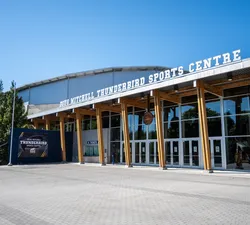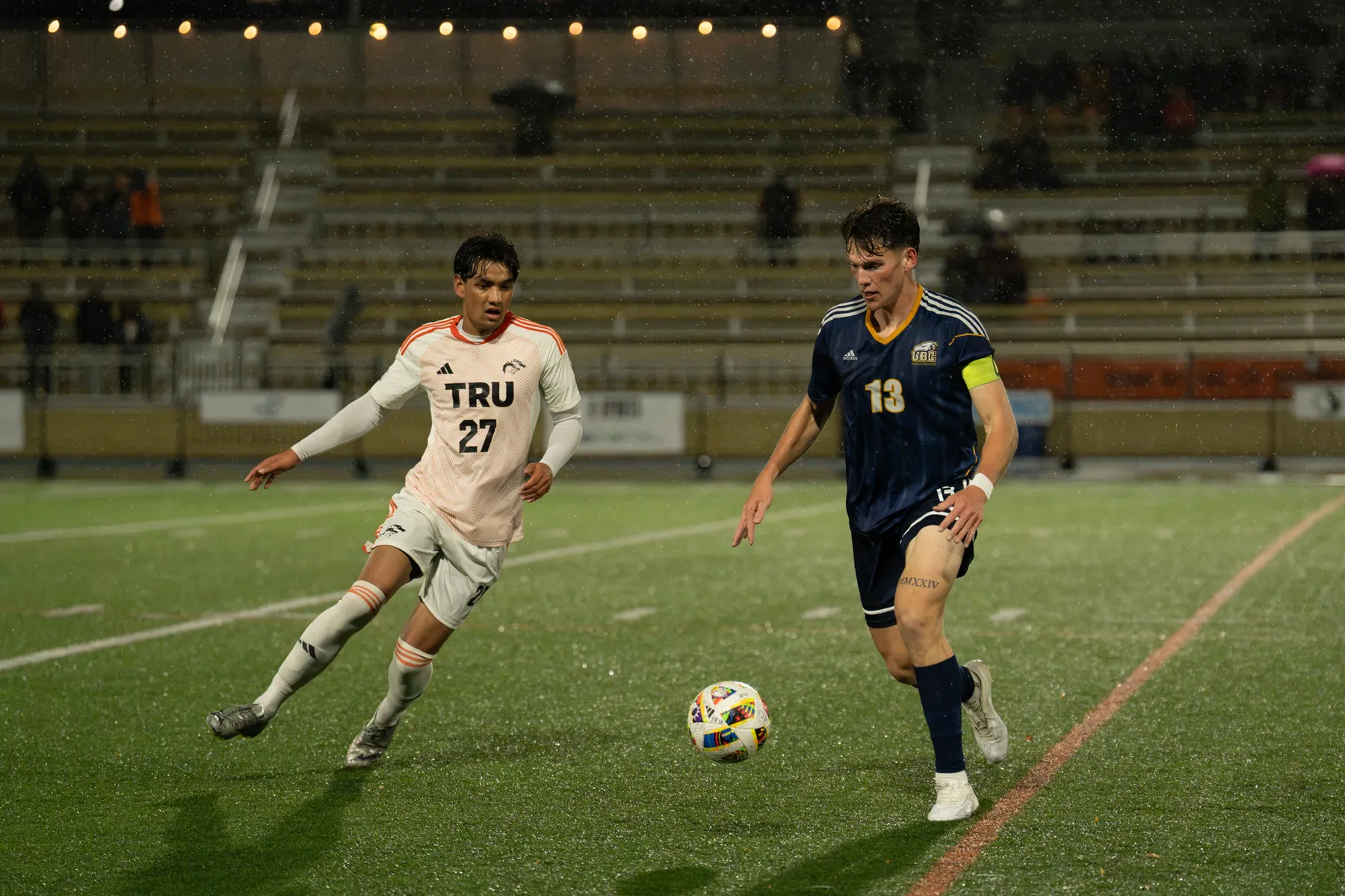



On a cold, rainy Friday night in Kamloops, we were promised a tale of two cities. It was the team with the most shots against a team with a great shot-conversion rate. Dominance versus precision. Flair versus efficiency.
If there was any moment for any team to end the T-Birds' immortal run, it would have been there, against the Pacific Division's second-place team, the Thompson Rivers WolfPack.
UBC's high draws against Victoria and two-win UNBC were not signs of a dominant team. The T-Birds had been reliant on Luke Norman's individual brilliance, but that could not be their get-out-of-jail-free card forever. If they were to lose, it would be here.
Not a chance.
Though they were 11 men, head coach Mike Mosher's team looked like a single organism, in a prime example of transition-phase-oriented soccer, gaining a 4–0 victory without the opponent securing a single shot on target. To quote the great Adebayo Akinfenwa, "One word to describe them — pure class." A match against a second-place team is rarely this one-sided.
As substitutes on both teams huddled in heated blankets, under benches with barely enough cover to shield them from heavy rain, the play was as sloppy as the weather. The first five minutes were trench warfare: long-ball Hail Marys from one side to the other in hopes of reaching the target man — Max Comsia.
One bad step on the wet field sent Lucas Dasovic out with an injury in just the third minute. Those who dared to tiki-taka in this weather gave up on that idea very quickly, with the exception of Luke Norman, of course.
The midfielder was on the hunt in the first half. Multiple whimsical flicks and desperate shots amounted to nothing in the early minutes. His wastefulness overshadowed his artistry — for now.
As the weather inhibited short passing, Norman struggled to communicate, and Comsia, though deadly in the box, did not contribute much to build up play. But this is where the complete nature of UBC's system came into play — they easily shifted their focus to the wings.
The Liverpool legend Jamie Carragher once said, "[If you're] a fullback, you're either a failed winger or a failed centre-back." Oliver Herbert and Eric Kim, both nominally midfielders, rediscovered themselves on the sides in this match. In a 4–0 victory, it's easy to focus on just the strikers, but those two are the Thunderbirds' engine. They carry the piano so that others may get the chance to play.
Letting him play as an inverted fullback —a right-footed left-defender — enabled new possibilities. On one hand, it opened up space for Markus Rukavina to hug the sideline whenever Herbert underlapped. On the other, it created an overload in the middle, which allowed both Norman and Nadeau to either drift wide or run into channels without fearing a counter.
Enough combinatorics for a math major's thesis.
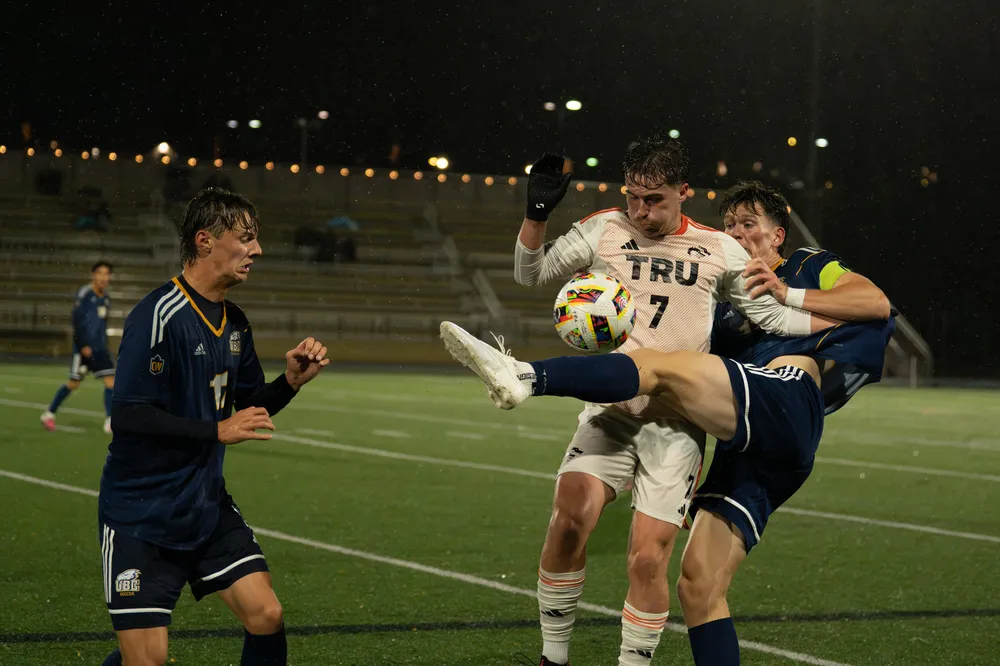
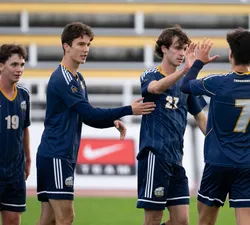
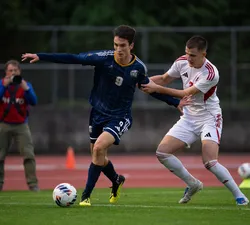
The Thunderbirds battled hard against the Wolfpack on a cold, rainy Friday night.
Transition-phase soccer shifts the question from the empirical to the semantic. Rather than discussing what makes a good defensive midfielder, or whether wingbacks should defend or attack, the question instead becomes: what is a position?
Coach Mosher's setup exemplified this tactical conundrum. Defenders Eric Lajeunesse and Joshua Tomé would make plays and Kim would run into the box, while Henri Godbout, the star winger, tracked back.
His decision was a wake-up call for the Thunderbirds.
The previously lethargic Comsia started leading the pressing line. Brennan Fuerst, who had been near-invisible prior, would dictate tempo and distribute perfect passes pitch-wide. And instead of taking 30-yard driven shots, Norman passed.
In the 27th minute, his chest-level pass flew right to the wing as Godbout took one touch to glue the ball to his foot.
He first shifted his balance from the left to the right. The defender stumbled. He shifted again. The defender stumbled again.
The move was reminiscent of Ronaldo in his early United days. Such frivolous trickery is often forbidden by modern-day coaches. But some players do not play by human rules. They are apostles of the beautiful game. One lunge forward into a sliding pass found Comsia on the five-metre mark.
It seemed as though Godbout's heroics would go to waste, as Comsia, the lone striker, had two defenders blocking him. However, instead of firing immediately, he braced himself, used his physique, and waited. His shot nutmegged the defender for a 1–0 lead.
After the goal, UBC started resting on their laurels. Keeper Jack Garner was looking shakier in buildup play. Lajeunesse's long-balls were no longer finding Comsia, and the fullbacks were still overextended.
It was here that a seasoned viewer might have started to grow skeptical. It seemed as though the Thunderbirds have not learned from their previous upsets, which begs the question — if they still open themselves up to counters, how are they supposed to face much tougher opponents in nationals?
The answer? Joshua Tomé.
After Dasovic's injury in the third minute, Tomé was called into action. The unlikely sub understands space like very few defenders at this level of play do. His zone-defending — based on restricting the attacker's movement possibilities while buying time for others to track back into defence — was enough to single-handedly stop multiple counterattacks. His reading of the game made up for Lajeunesse's more aggressive positioning.
Even as UBC gave them a window, TRU couldn't adapt. Despite the unfavourable weather conditions, they kept distributing the ball out of the back, hoofing it forward in anticipation of the Thunderbirds' structured press. They were completely off-balance, and the scent of a second goal was hanging in the air.
In the 41st minute, as an ordinary corner set up by Herbert floated to the far post, Rukavina — who had went unnoticed the entire game — was left unmarked.
Watching soccer, especially as a long-time enjoyer, it can be easy to think to yourself, "I could've done better."
Plays like this break that illusion.
With no time to make a decision and infinite adrenaline, in a penalty-box skirmish, there is no room for creativity. The equation is simple: if you touch the ball and lower your forehead enough, you'll score.
Rukavina operates on a different wavelength. He simply sees chances others do not — and perhaps never will. The kind of chances that make up for ghosting a half.
The winger gently head-tapped the ball in the direction of Comsia, who volleyed it with full force for his second of the game.
The 'Birds were up 2–0, not for the first time in this season, and not the last. This style, however, might never be replicated again.
As the first half closed, it seemed like it couldn't get any worse for the WolfPack.
It could.
Comsia, who scored a brace in just 45 minutes, came off for Theo Afework. To deny a striker in motion his possible hat-trick might seem cruel, but such a decision produced a test of an entirely different system.
Afework trades physicality for pace and hold-up play for deep playmaking drop-ins. This opens up an angle for a more possession-based system: instead of feeding the ball to Comsia, the wingers and midfielders receive space for link-up play.
The transitions, already too fast for TRU, became even swifter.
As the weather conditions relaxed, UBC allowed themselves more creativity: one-two exchanges, first-touch passes, and back-heel magic. Lajeunesse ceased his long-balls and held up the defensive shape.
At that point in the game, a single player stuck out like a sore thumb: the right-back Kim. His game was simply "proper" — fast-track backs, not much help in the offence, but no substantial flaws: covering the width for Godbout's cut-ins seemed like enough.
Soccer players, however, do not like to go unnoticed.
In the 62nd minute, Herbert received the ball deep in midfield, as his back was turned to the opposition goal. Terrible idea.
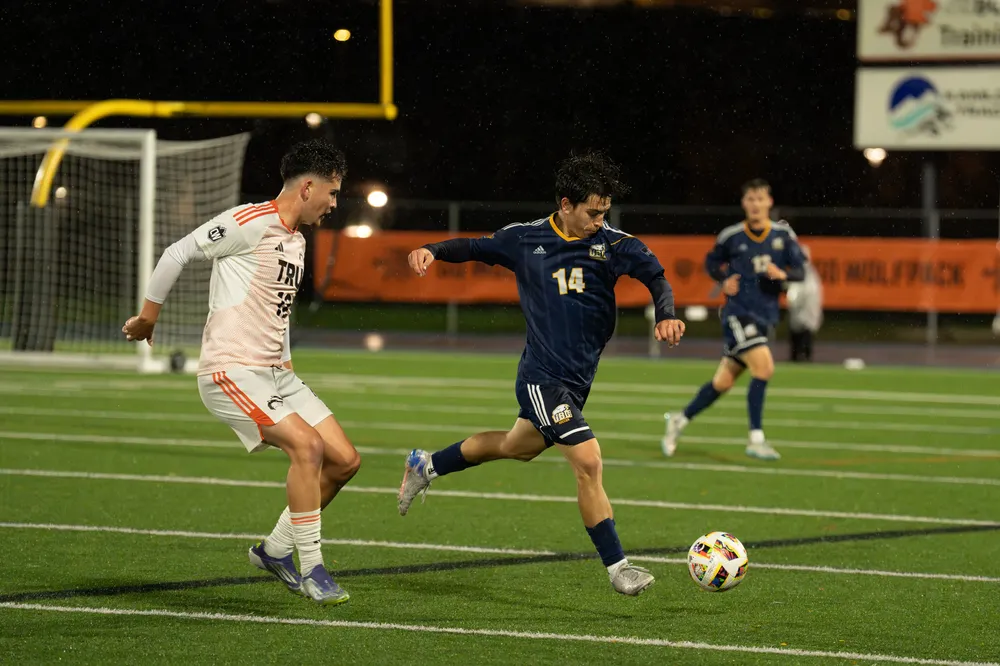
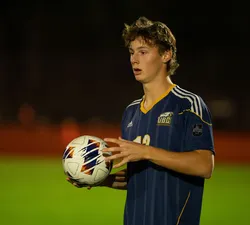
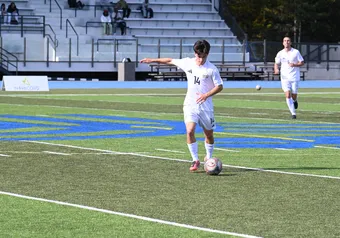
Oliver Herbert (#14) dribbles the ball.
Three TRU players immediately pressed him. If he were to lose possession, it would be a five-on-three counterattack for the WolfPack — a near-guaranteed goal.
Herbert gambled on the turn and disengaged two opponents at once — with ice in his veins. A long pass to the wing found the overlapping Kim, who rushed across the sideline. Two body-feints later, he was in the penalty box, as his low cross found Rukavina for an easy tap-in. 3–0.
The third goal marked the point at which the WolfPack seemingly gave up the hunt, taking off three of their key players in the following minutes. UBC, however, was not done yet. Not while Eric Kim was on the field.
Less than 10 minutes later, Kim picked up a free ball midway on the pitch and began to rush. One signature body feint to the inside. A look at the goal and a look down on the ball. To all those watching, it was clear. Such a rally could not finish in any other way than 4–0.
On his weak foot, as a wide defender, he drilled a curved shot into the top left corner from over 20 yards out.
The rest is silence.
This encounter between UBC and TRU in Kamloops might be one of the most bizarre games of the season. Dismissing it as a statistical outlier would be detrimental — a bulldozing of this calibre is never an accident, and the WolfPack are one of the most competent West Coast teams out there. With this win under the T-Birds' belt, what does the future hold, so shortly before playoffs?
The battle of the goalkeepers is still underway. Garner and Roko Vukic have played five games each this season so far and both have shown moments of greatness and unpredictability at the back. If UBC wants to think about a national title seriously, one of them must fully take over to become a backline leader. The confidence a strong goalie instills in his defensive line is a game-changer.
There are two ways to ameliorate the famously high UBC defensive line: lower it before playoffs or hope one of the players has the game of his life. Against the WolfPack, Tomé brought back the security the Thunderbirds lacked in many prior games. Having three competent centre-backs in a double CB system is a godsend — and it ensures that the plan for next year, after Lajeunesse's eligibility ends, is covered.
In the attacking half, as this match demonstrated, Mosher can utilize both a Comsia-centric and Afework-centric model. The two halves against TRU looked like two entirely different teams. Not better or worse; just better-suited to different situations. This is an edge very few other teams will have, if any.
Transition-phase soccer is effective, yet unexplored and modern, especially at the collegiate level. Time will tell whether it can stand against opponents from the East Coast. There is, however, a light at the end of the tunnel: that positive change, even if slowly, is on its way.