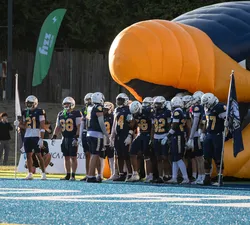

After the game, head coach Blake Nill called it "as frustrating a win as I have had in my career." It's an apt description.
For much of the match, the Thunderbirds looked aimless. Their defence allowed Regina to march down the field on their opening drive, and their offence went stagnant for most of the game. At one point, they went eight straight drives without points, with six of those drives consisting of four plays or less.
They had a back-breaking interception returned nearly 40 yards that was punched in for a Regina touchdown. On two trips inside the Regina 10-yard line, they came away with only one pitiful point, a rouge off a missed field goal. It was the recipe for a loss.
But they won the game.
UBC won their homecoming matchup 25–20, the stiffest test they've faced all year, against the No. 4 team in the country, the Regina Rams. It's the kind of thing they would have barely dared to dream about mere weeks ago. So why doesn't it feel like it?
Heading into this game, it felt like a win — or even a close game — would have served as a statement. Regina was 2–0, the top team in Canada West, coming off a season where they nearly won the conference. UBC was 1–1, with their only win being against a pitiful Alberta team. The prior season, the 'Birds barely snuck in the playoffs and got crushed in the first round. They were, rightly so, massive underdogs.
And they pulled the upset. They got their statement win. But even now, long after the clock hit zero, it's unclear what their statement was.
The 'Birds exposed so many fatal flaws in this game that would have likely killed them on any other night. They made careless mistakes. They left points on the field.
But, again — they still won. To look at this result another way, what if the team hadn't made those mistakes? What if a few more plays had broken their way? Would they have won ... convincingly?
"Regina's a very good team, but I'm just saying, if we capitalize on our opportunities, the game's a lot different," Nill said.
Their ceiling is so high. And their floor is so low. Even heading in, they had a 25-point loss to their name and a 33-point win. With such disparate results, it felt like one more game, a test against a true conference juggernaut, would define this team. Either they'd prove to be a contender, or they'd wilt. Instead, they're elusive as ever.
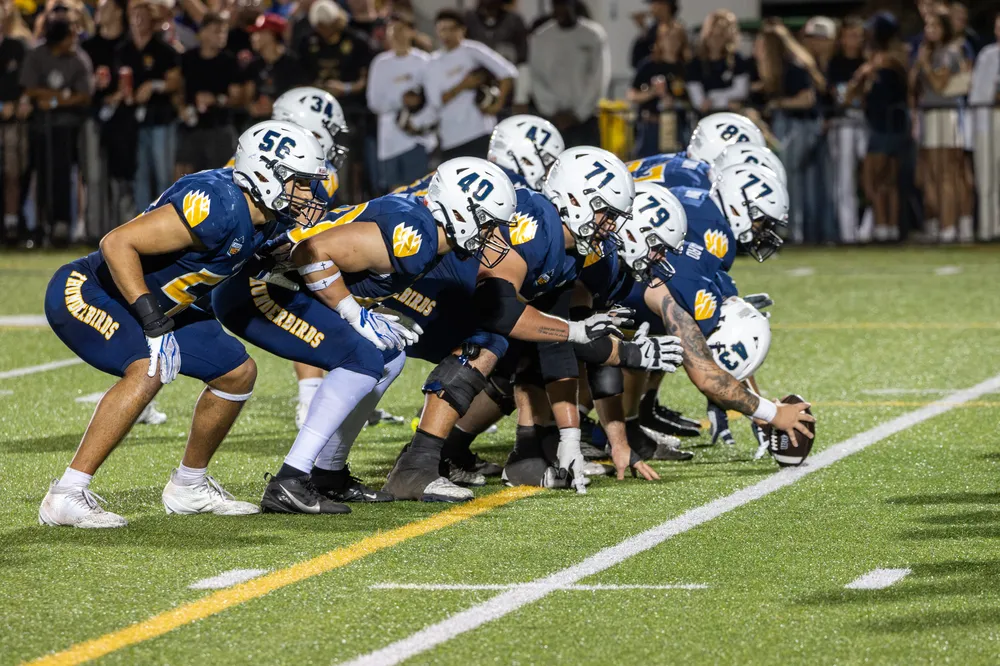
This team has been a confounding watch all year. Even in a win, this team's identity remained elusive.
What was written on the page couldn't be clearer. With this win, the UBC Thunderbirds are tied for the No. 1 spot in Canada West. But the subtext is a lot richer than that. Regardless, they're 2–1.
"I've told them since the start of camp: 'we are talented,'" Nill said. "I've coached 35 years. I know when we're pretenders, and I know when we have a chance ... this team has a chance."
If there's one thing to take away from this performance, it's that UBC's defence is for real.
This game was a mess, but that was mostly because of the T-Birds' inconsistent offence. Aside from an opening drive touchdown, where Regina marched the ball 86 yards on 11 plays, UBC gave up nothing. The other three scoring drives the 'Birds gave up were mostly because their offence had put them in a bad place. The Rams would score a touchdown and two field goals following their opening drive — but the longest of those three drives was only 42 yards. The other two were less than 25.
The T-Birds were fundamentally sound; they tackled well, they were tight in coverage, and they stopped the run. Even while pulling back on their blitz-heavy tendencies that had found success, they still held up, forcing incompletions even while only sending a three-man rush at Regina quarterback Noah Pelletier.
This was made even more impressive by how shorthanded the unit was heading into homecoming. One of UBC's top defensive players on the line, Deacon Sterna, has been out with an injury since the Calgary game. Another stalwart up front, Clark Leonard, was also out. They didn't fare any better in the secondary, with both Darrien Brown and Isaiah Thomas out too. It didn't matter.
For UBC's defensively-minded head coach, it was an impressive outcome for a young defensive staff, led by defensive coordinator Noah Cantor. "They took a step forward," said Nill. "This whole year's been a step forward on defence."
It's not an exaggeration — just look at the numbers this unit is putting up against the run. Last year, ground games in Canada West ate the 'Birds up. They finished as the fifth-worst run defence in the country, giving up 170 yards per game on the ground. Now, while it's still early, after three games, they're the fifth-best against the ground game, giving up nearly 100 yards less per game.
That's despite facing off against one of the best running teams in the country, Regina, who ran for 202 yards against Alberta and 254 yards against Manitoba. The 'Birds barely let them past the century-mark, with the Rams only picking up 103 yards on the ground throughout the game. It's a stark turnaround, and the most impressive improvement the team has made from last season.
UBC's defence was the reason they won this game. When the offence struggled early, defence kept the Rams off the scoreboard. The game was always in reach, and it was because of them. "We didn't have their back in the first half," said quarterback Drew Viotto. "They stayed strong the whole game."
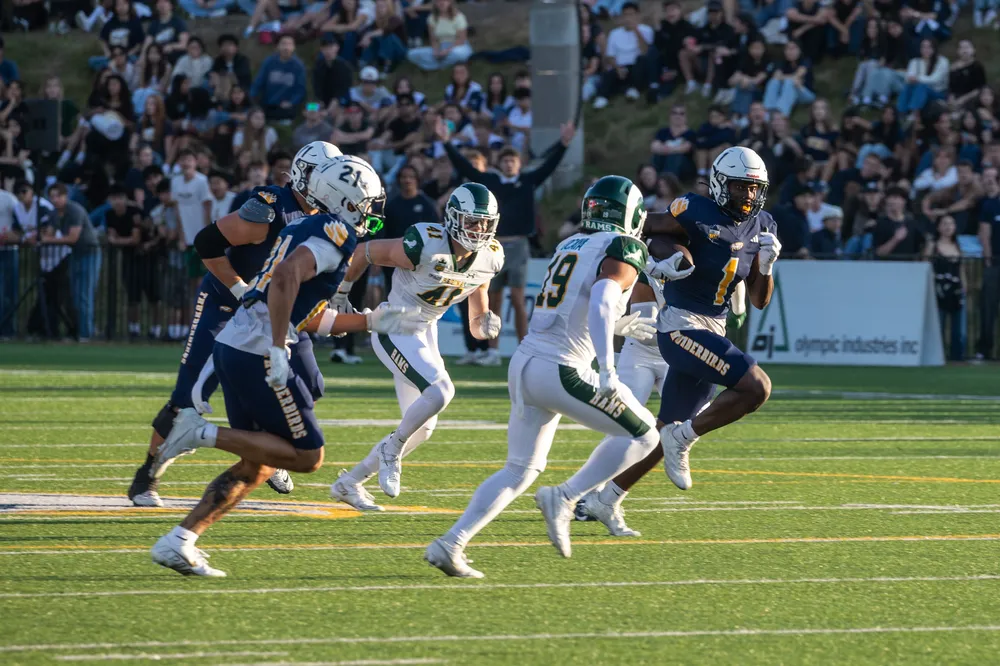
While Marvyn Larozar (#1) put up big numbers, the offence struggled for most of the game,
But while the defence should get the credit for this game, the offence is what will get all the attention. For reasons both good and bad.
The statistics tell one story. They scored 25, and had 431 total yards. Not a bad showing. But the game didn't reflect this. For half of the game, they were invisible. For another quarter of the game, they showed promise, but killed themselves with mistakes and wasted opportunities.
But in the remaining time they had on offence, there were fireworks.
UBC's first three drives demonstrate this well. On number one, they got off to a fast start, with rookie back Marvyn Larozar continuing his torrid start to the season. He burst onto the scene last week with a 285-yard game, scoring four touchdowns against Alberta in a historic performance. Against Regina, it didn't take long for him to prove that showing wasn't a fluke.
Three plays in, Larozar found an edge, stepped past a diving tackler, and took it down the sideline for a massive 54-yard run. He had three of those breakaway runs against Alberta, and it only took him halfway through the first quarter to get another. After Regina's early blow, UBC was set to punch back. But they wasted it.
With a 2nd and goal from the three-yard line, Viotto threw the ball to his favourite target, receiver Trey Montour. It's a connection that's usually a sure bet, but this time, Montour wasn't able to come down with the catch in tight coverage. One more incompletion later, and it was a turnover on downs. A potential seven points, off the board.
The following drive, whatever spark Larozar had provided had completely died. While they got a field goal, mostly thanks to a long return by Josh Martin, it was a quick, uninspiring two-and-out. But then came the fireworks.
On the next drive, it was Larozar time again. In one of the most impressive runs you'll ever see in U Sports football, Larozar slammed into a pile of bodies on a 2nd and two. It's a play you'll see a million times in football: ramming the ball forward behind your line for the couple of yards needed for a first down. Typically, the back will just dive forward once they have the requisite yardage.
But as he told us last game, Larozar isn't a typical back.
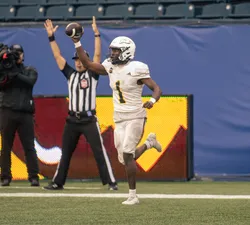
He somehow kept his feet while being crushed in between the offensive and defensive lines for nearly four full seconds, bursting out of the pile with nearly as much speed as he had entered it. Nobody was catching him. Larozar had done it again, sending the packed homecoming crowd into a frenzy with a 70-yard score.
"I just kept my legs moving," said Larozar. "Coach [Brian] Brady, he's always talking about keeping your legs moving and driving through the fire. Trust in your line, keep it moving, and eventually something's gonna happen."
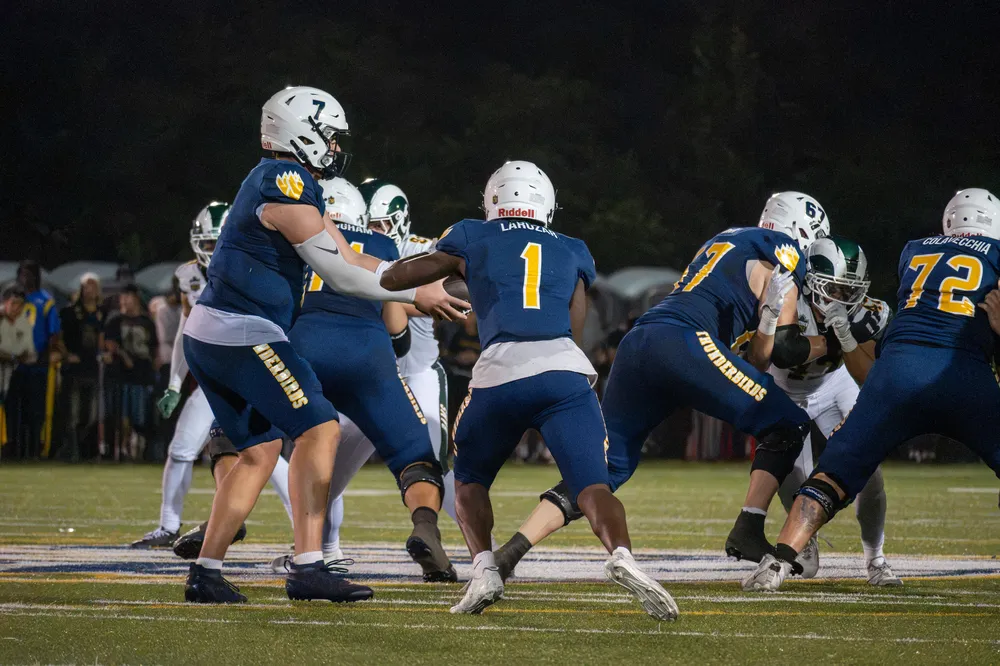
Outstanding rookie back Marvyn Larozar (#1) wasn't a fluke. He had an exceptional homecoming game, his second-straight 200 yard performance.
It seemed like an early coronation for UBC. Regina couldn't stop Larozar, and UBC's defence had clamped down on the Rams' offence. It was time to build their lead. But instead, the momentum from Larozar's touchdown was squandered as UBC's offence began to fall apart, in both the pass and the run game.
Unlike Alberta, who seemed unable to clamp down on Larozar no matter what they tried defensively, Regina found success by keying in on UBC's star running back. It worked. They essentially committed entirely to stopping the run, bringing extra defenders into the box, and rallying to No. 1. Over the next two quarters, Larozar went quiet, averaging only 2.7 yards per carry on nine attempts.
Some of this was because of Regina's sound defensive adjustment, but UBC's uninspired play calling also played a role. Larozar is an incredibly versatile back. When you get him in space, he's going to make a play, whether from a handoff or catching the ball out of the backfield. "I'm just all around an athlete, and that's why Coach Nill wanted me to come here," said Larozar. "I'm very versatile when it comes to football. I'll play anywhere." But through the second and third quarters, offensive coordinator Khari Jones and his staff weren't using that versatility.
During that stretch, most of Larozar's runs came on first down and were some variation of an inside zone play. Up the middle, between the tackles. It's how Larozar scored his first touchdown, but you can't just wait for lightning to strike twice.
After the 70-yard score, UBC went eight consecutive drives without points. Five of those started with a Larozar run of less than five yards. To call it predictable would be an understatement.
"You're giving [Larozar] opportunities hoping that [he'll hit a] home run, right? He's gonna have his share of strikeouts or marginal gains, that's for sure," said Nill. "If we can just balance our attack, we're gonna be fine."
Because Larozar wasn't getting gains on first down, it forced Viotto into tough second-and-long situations nearly every time he dropped back to pass. He struggled. There were a couple of balls that sailed high, some that went behind his targets — he wasn't settling into a rhythm, and it was easy to see why. Nearly every time he came out on the field, he had one play to bail out a poor first-down run, before being booted back to the sideline. At the end of the half, Viotto was 3/9 for only 25 yards.
"We have to get our passing game going," said Nill. "We have to get [Viotto] going. If [Viotto] is struggling, our whole team struggles."
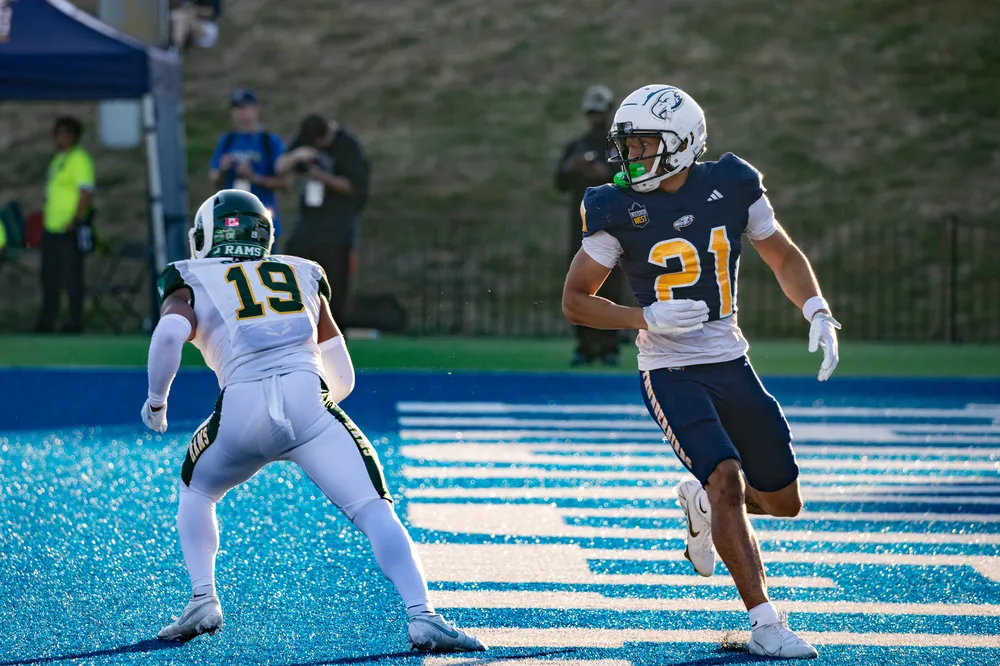
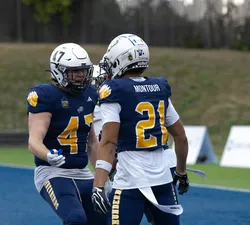
Even as UBC's passing game has struggled this year, receiver Trey Montour (#21) has produced. But at homecoming, even Montour was quiet.
The worst moment of the game for the offence came during this eight-drive dry spell, with Viotto's worst throw of the game. Rolling out to his left on a 2nd and 6, he tried to fit a throw to a tightly covered Ben Gutek on the sideline. Gutek almost hauled it in, but Regina's defence immediately contested the throw, popping it back into the air. After a couple bobbles, Regina defensive back Carson Sombach was there to swallow it up, taking the interception back to the six-yard line, where the Rams' offence would soon punch it in for a major.
That score put Regina up 20–10 by the end of the half, and that score would hold for much of the third quarter.
By then, the game had settled into a predictable rhythm. The T-Birds' defence would stave off the Rams' attack, forcing them into a two-and-out, and then the UBC offence would run into a wall, going two-and-out. It looked like the game would end as a punt-fest, with Regina slowly draining the life out of the 'Birds to cap an underwhelming contest.
Then, just as it seemed like the pyrotechnics had been stashed away for good, the fireworks came back.
Near the end of the third quarter, the offensive staff finally pulled out of their 'first-and-Larozar' play-calling tendency, and it worked. First, they emptied the backfield with motion to get Montour open up the middle. Then, they used play-action to their advantage to get Zach Patfield open deep for a long gain. They were finally moving the ball again. This time, they'd pay it off.
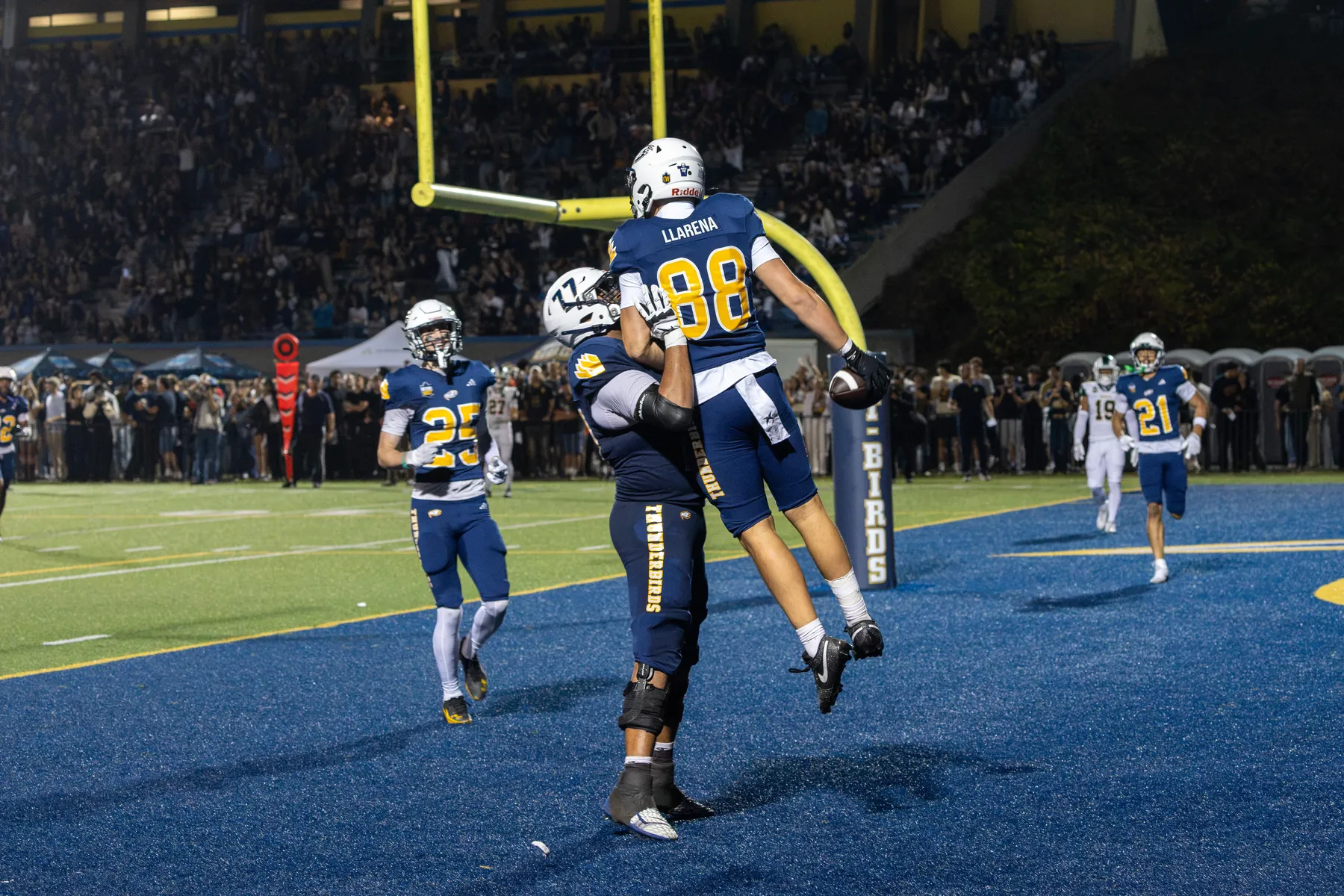
On an impressive heave, rolling left and throwing right, Viotto tossed up a 50/50 ball for his big rookie tight end, Santiago Llarena. It was a bit of a risky decision, but his tight end made him right with an incredible catch, boxing out the defender for a touchdown, putting UBC back in the game at 20–17. Llarena had been the source of much preseason excitement, and he delivered at the best possible time.
"He's a very talented rookie," said Viotto. "I got all the trust in the world in him. I knew he was gonna make that play when I threw it up to him."
The 'Birds were back in the game, and it was because of their offence. They kept on pushing — with their quarterback starting to get hot. On a crucial second-down play in Regina territory, he used his legs for the first time in the game, stepping up and through the pocket for a first down scramble. On the tackle, his helmet popped off, and he took the opportunity to amp up the crowd. "I gotta do what I gotta do to get a first down," he said. He was feeling it.
Apparently, so was Khari Jones. After a run of uninspired play-calling, Jones was in his bag in the fourth quarter, punching in a score off perhaps his best-designed play of the season. With Viotto's passing threat reestablished, Jones used that tendency to his advantage, faking like Viotto was heading right on a designed rollout before handing the ball off to Larozar cutting in the other direction. That moment of hesitation from Regina's defence was more than enough for UBC's speedy back to catch the Rams flat-footed for a 22-yard go-ahead score.
"Coach Khari [is] a mad scientist when it comes to scheming up plays," said Larozar. "We were doing a certain play every time where they had to respect it, and they weren't expecting the touchdown play. It's really the coach."
Up 24–20 with 12 minutes left in the game, UBC had completely re-grabbed momentum. After a loss had felt inevitable, a win was in reach. But then, their flaws started to come back.
On the third straight solid drive from UBC's offence, their special teams let them down, with a missed field goal from only 14 yards out costing them what would have been a critical seven-point lead. With the Rams getting the ball at their own 25-yard line with 1:43 left, they didn't just have the chance to tie the game. They could win it.
After holding all night, UBC's defence started to show cracks in the foundation. Regina methodically moved the ball down the field, inching closer to the end zone. A potential horror story was looming for UBC.
To fire the crowd back up with this incredible comeback, only to waste it in the final moments? It was unthinkable.
But thankfully for UBC, it didn't become reality. With the ball on the 22-yard line for the final play of the game, Regina was intercepted in the end zone. While penalties called the interception back, offsetting Regina's infractions backed the Rams up more than 20 yards past where they had started the previous play. Their Hail Mary fell short. UBC clinched the win. Somehow.
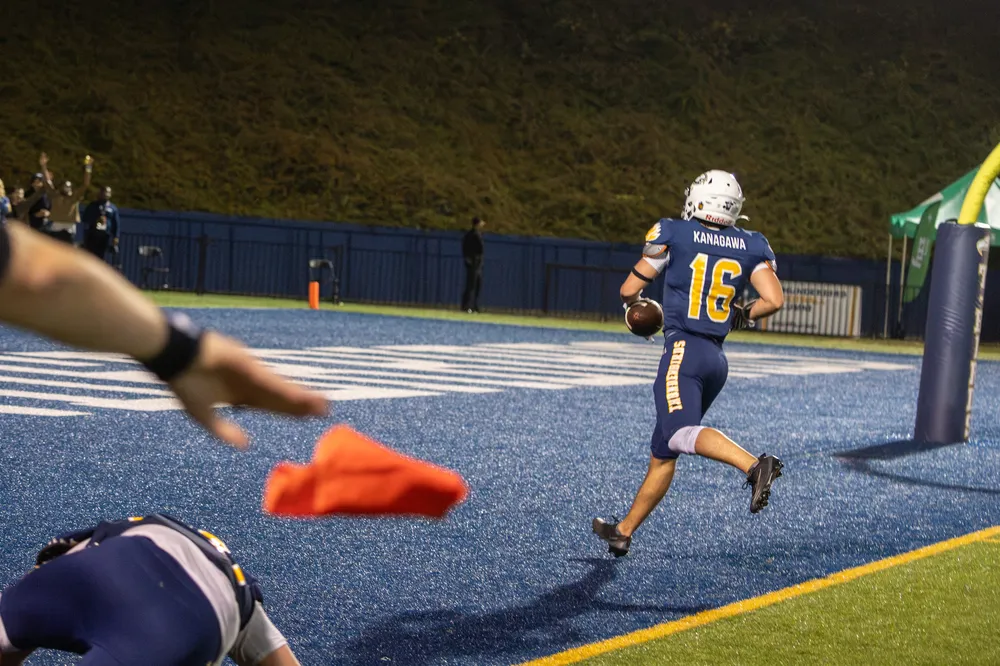
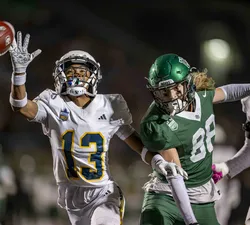
For a moment, it looked like Niko Kanagawa had ended the game with an interception. Penalties took the pick off the board, but UBC still sealed it.
Coming into this one, the worry was that UBC was an inconsistent mess, and that because of that, they wouldn't be able to hang with a conference titan.
Turns out, they can compete with the best of the conference. They're still an inconsistent mess.
If they put it all together, as we saw in flashes throughout this one, they will be great. Conference-winning great. But if they don't, they look broken.
It's once again, as it seems to always be with this team, about inconsistency, more so in this game than others. In some ways, it's a microcosm of what this program has been. After the Alberta game, Nill lamented that his team "[hasn't] been able to play 60 minutes." That was about more than just one game. It was about the last two and a half years.
It's probably why Nill spoke with so much conviction after the game — perhaps one of the most inconsistent of his UBC tenure, at least on offence.
"If they choose to be more consistent, they will be," he said. "It's focus. It's belief, right? If they want that, they want it."
So, after a game that should have defined this team, should have given us something to point to and say 'this is who the 2026 Thunderbirds are,' we still have no answers. So maybe it's time to stop trying to define them.
Maybe it's time to stop trying to put this team in a box, to stop assigning them labels, to stop determining whether they're a contender or a pretender, vacillating between last year's flaws and this year's growth.
Because at some point, the team's going to have to provide a definition themselves.