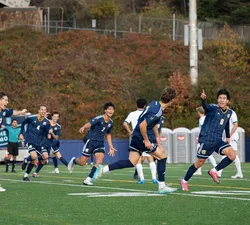


This Friday, the UBC Thunderbirds found themselves in a position they have become familiar with this season: behind.
The No. 1 team in Canada West eventually walked away with a 3–2 victory over the MacEwan Griffins at Thunderbird Stadium, extending their unbeaten record to 8–0–2. The scoreline does not tell the entire story.
For most of the match, UBC controlled possession, created chances, and looked like the stronger team. Yet, twice, MacEwan found a way through the Thunderbirds' defence. Twice, UBC had to respond. And twice, they did.
That ability to recover is one of the 'Birds greatest strengths — but it may also be hiding one of their biggest problems.
“We know we're good players, but it's almost like every time we get scored on, it's been a wake-up call this year,” said Luke Norman, who scored twice and assisted on the other goal. “But that shouldn't be the case.”
He's right.
The Thunderbirds have enough attacking talent to turn games around, but relying on that talent will become much more dangerous when the stakes get higher. They'll face tougher competition than the winless Griffins, who are last in the Prairie Division — and they'll need to step up.
But at least at the start of the game, UBC looked like the juggernaut they should be.
Within the first 15 minutes, Norman had already taken three shots, including two that were saved by MacEwan goalkeeper David Sithole. His third attempt, a header, didn't even bother Sithole. The shots lacked quality, but it didn't seem to matter — their strategy is to throw shot after shot at the net.
So the pressure continued. Max Comsia sent a header over the net; Nicolas Nadeau had a shot blocked; and Henri Godbout forced another save from Sithole.
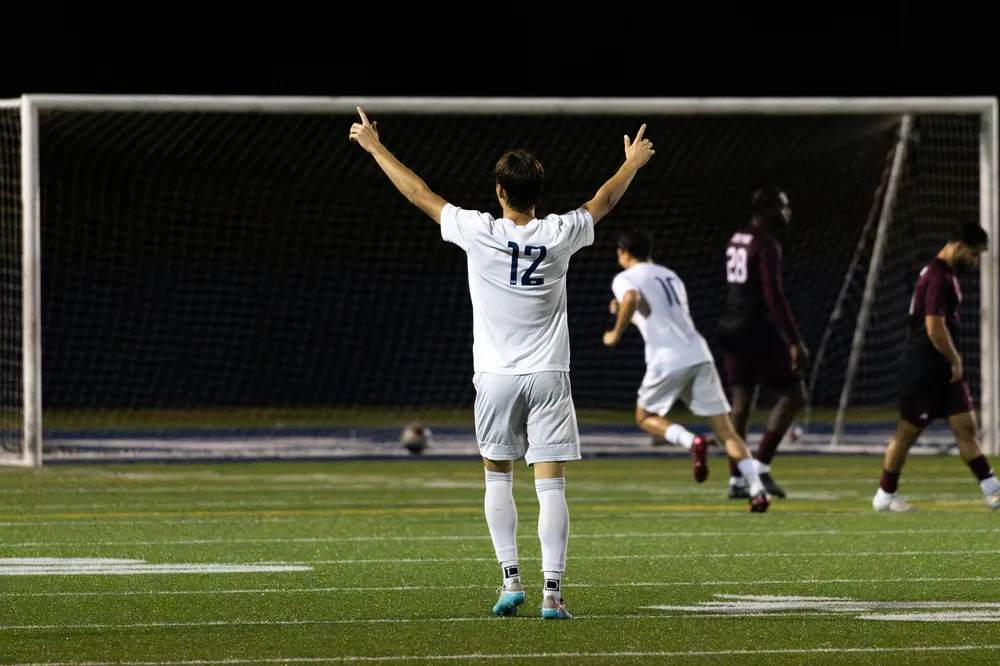
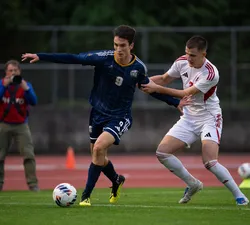
Nicolas Nadeau (#12) and the T-Birds got pressure and controlled possession, but the goals didn't follow.
The Thunderbirds were doing almost everything right — except the part that mattered most: scoring. MacEwan, meanwhile, was waiting.
The Griffins entered the game without a single win this season. But their record did not mean they were going to sit quietly and allow UBC to control the match. They were dangerous in transition, a problem head coach Mike Mosher's team has been struggling to deal with.
"I would like to see us stop giving away such silly goals," he said. "Every other game, we give away a goal in transition, and you know every team's looking for it, [and] yet we we give the ball away needlessly."
That frustration became reality in the 34th minute.
UBC had spent much of the opening half controlling the ball, but one misplaced sequence was enough. Godbout attempted to dribble past two players and was stopped by a third. The T-Birds regained possession, but Brennen Fuerst tried to dribble forward and lost the ball. Seven seconds later, it was in UBC's net.
Macky Mahfouz received the ball and finished from a tight angle into the far corner, shocking the home crowd.
The goal was not the result of MacEwan dominating UBC. The Thunderbirds had controlled the game — and still conceded.
That is the problem UBC has been unable to completely eliminate.
A team can dominate possession and still be vulnerable if it loses the ball in the wrong place. In fact, having most of the ball can make those moments even more frustrating. The Thunderbirds are often pushing numbers forward, meaning a mistake can leave space behind them for opponents to exploit.
But UBC did not panic. With virtually the last kick of the first half, Norman finally got his reward.
He had already taken four shots before the ball fell to him inside the penalty area. His first touch was not perfect, but he did not have time to think about it.
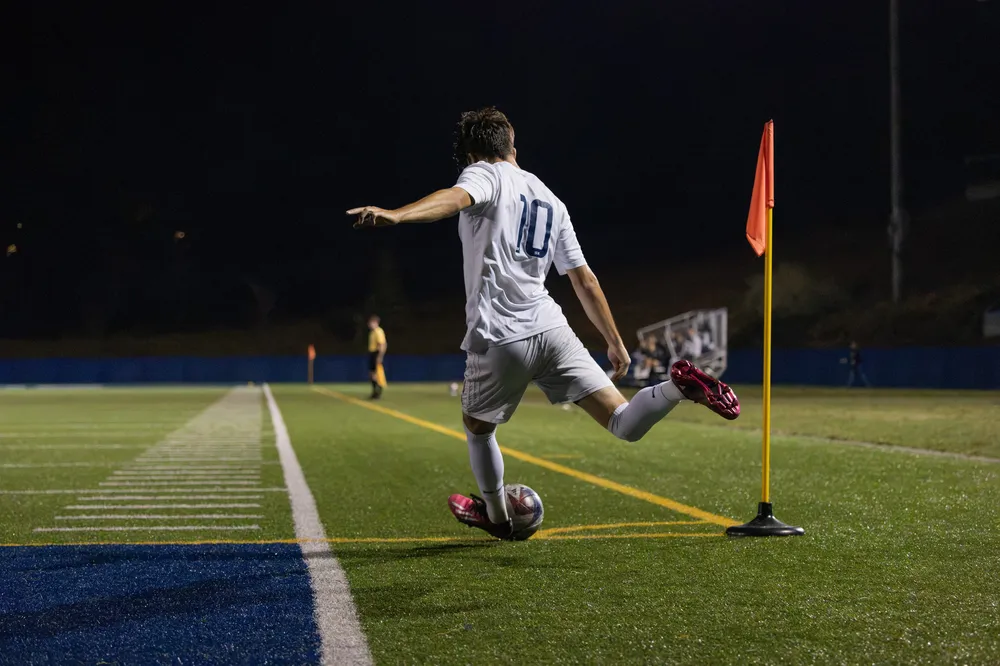
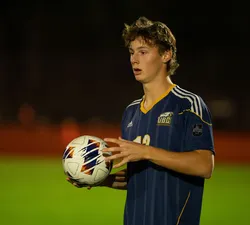
Luke Norman (#10) had an exceptional game, with two goals and an assist.
“I just need to hit it,” Norman said. So he did. The ball went in, and UBC went into halftime level.
For a team that had spent most of the half creating chances without finishing them, the timing could not have been better.
It was also an important moment psychologically. The Griffins had managed to frustrate the Thunderbirds, survive wave after wave of attacks, and take a lead despite spending much of the half without the ball. If the Griffins could have carried that advantage into the dressing room, the second half would have looked very different. Instead, UBC made sure the game started over at 1–1.
That T-Birds momentum carried over, because the second half began almost exactly as the first ended.
Two minutes after the restart, Norman made beautiful dribbles as he quickly passed through almost the entire Griffins line and played the ball to Markus Rukavina, who finished in front of the goal to put UBC ahead 2–1. The connection between the two players was a bright spot in the game, as they seemed to understand where the other was going before the ball even arrived.
“Markus is one of my favourite players to play with,” Norman said. “The way he sees the game is very similar to me.”
Still, the Griffins were not going to let UBC win that easily. To their luck, the 'Birds gave them a chance. Only a few minutes after Rukavina's goal, UBC defender Lucas Dasovic slightly kicked the foot of a MacEwan player inside the penalty area, rewarding them with a penalty.
UBC's goalkeeper Roko Vukic did what he could, jumping to the right to try to stop a Griffins midfielder's kick. But Ali Yildiz was too fast, and Vukic wasn't able to stop it.
It looked like UBC would have to settle for yet another draw.
Many teams would get frustrated after this, but fortunately for the 'Birds, Mosher's coaching allows them to stay in control amid adversity. "When you get into trouble, you have that confidence that you can go and find goals," Mosher said.
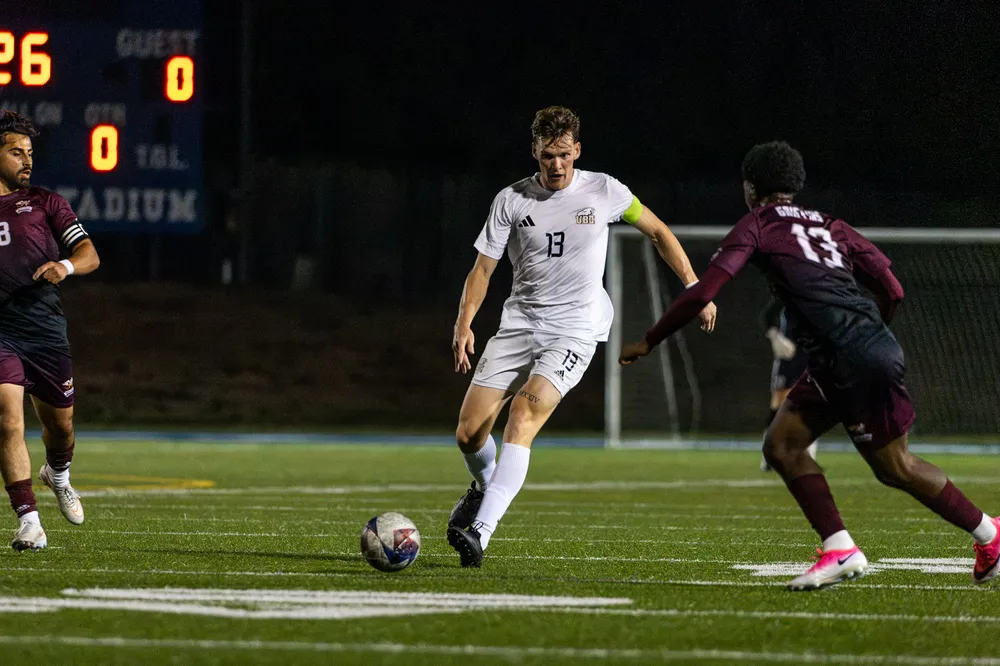
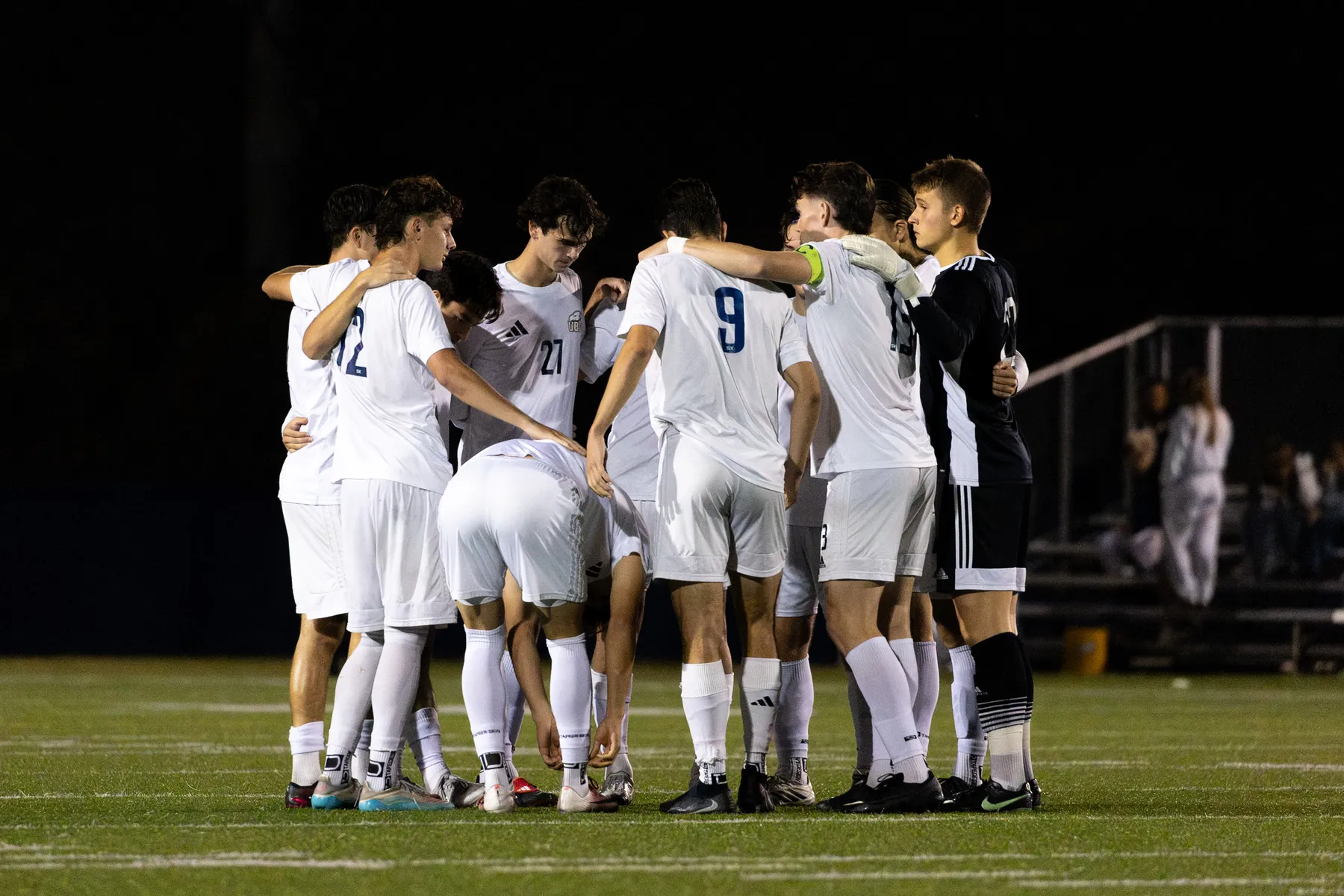
Captain Eric Lajeunesse's (#13) T-Birds continue to play well when they're behind — but they probably shouldn't be getting behind in the first place.
This was proven only four minutes after the penalty, with the Norman–Rukavina duo again coming up huge. Rukavina decided to return the favour Norman did for him in the first half. As Rukavina found Norman inside the box, he did not hesitate, blasting the ball past Sithole to give UBC a 3–2 lead.
Once again, the Thunderbirds had been given a reason to panic. Once again, they responded almost immediately.
But there was an important difference between this response and the problems that preceded it: this time, UBC's attack was actually producing the quality it needed. That had not been the case for much of the match.
“We definitely could have done better,” Norman said. “We had too many chances that we didn't capitalize on.”
Mosher was even more critical. “Not good enough quality,” he said. "We had the ball a lot ... and the quality was really poor."
The Thunderbirds were getting into wide areas and creating opportunities for crosses and cutbacks, but the final delivery was often inaccurate. Balls went behind the goal, straight into Sithole's hands, or won by MacEwan defenders. “It's just got to be more thoughtful,” Mosher said. “We are lumping balls in without really a thought.”
That lack of precision nearly cost UBC more than once. Sithole was one of the biggest reasons MacEwan remained in the game. He saved Norman's early efforts, denied Godbout, and made another important stop on substitute Sebastian Agerskov in the 90th minute.
UBC had enough opportunities to make the game considerably more comfortable. Instead, the Thunderbirds were still fighting for the result in the final minutes.
The numbers reflected the strange nature of the match. UBC repeatedly forced MacEwan into defensive positions, but possession alone did not translate into control of the scoreline. Every time UBC failed to turn another opportunity into a goal, MacEwan remained within striking distance. That is what made the game dangerous.
The Griffins did not need to dominate for 90 minutes. They only needed UBC to make a few mistakes. And they did.
The players clearly trust their ability to create goals. They do not appear to collapse when the opposition scores. Instead, conceding seems to increase the urgency of their attack. There is a difference between responding well to a problem and preventing it from happening — Norman knows that. “Especially today, we should be able to put our foot on the gas and not concede for us to go and start pushing,” he said.
That is where the difference between this UBC team and the one that will eventually enter the playoffs becomes important. Right now, UBC can afford to make mistakes. They have players capable of fixing them.
They have Norman, who can score twice after missing several chances. They have Rukavina, who can both score and create. They have Godbout, Comsia, Nadeau, and a midfield capable of keeping possession and generating opportunities. But the playoffs will not necessarily be so forgiving.
“When you get to the biggest games of the season in the playoffs, you can't concede two goals. You can't,” Mosher said. “You can't expect to go and score three goals every game.”
He has a point. A 3–2 win keeps UBC unbeaten. It gives them three points in the race for the top playoff seeding. It also shows that the Thunderbirds can withstand pressure and respond when a game becomes uncomfortable.
But it does not erase the mistakes that made the game uncomfortable in the first place. The biggest positive from Friday may therefore not have been the three goals, but the response after each setback.
The Thunderbirds never allowed the Griffins to hold their lead for long. That mentality matters. But the game also showed that UBC's attack cannot be the only thing carrying it through difficult matches. The opportunities were there, but the finish was not.
Even after taking the lead, UBC continued to give the Griffins opportunities to remain involved. Friday felt less like a victory and more like a warning.
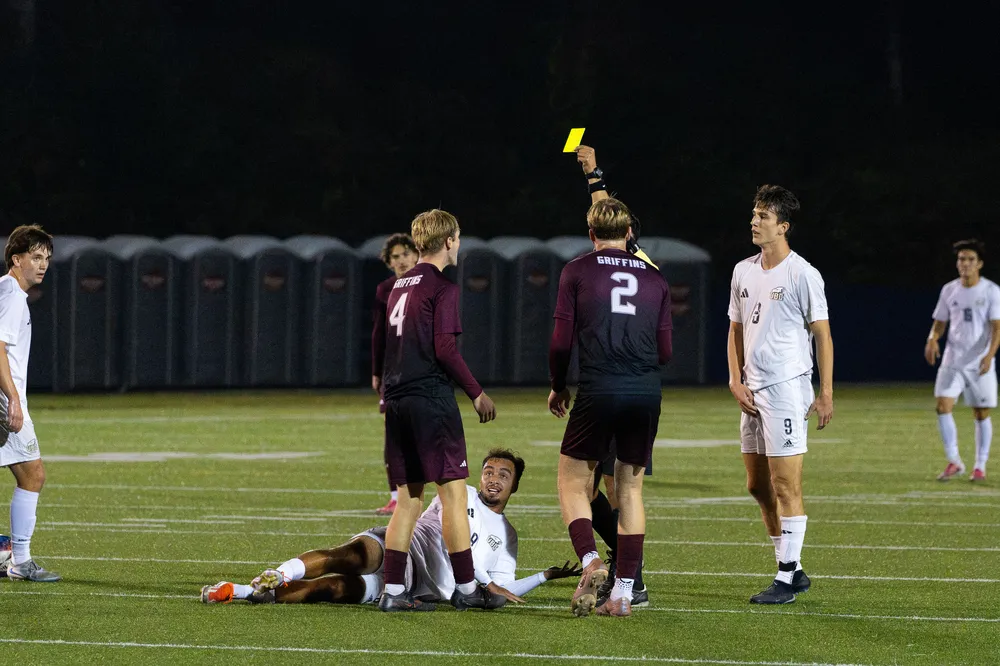
When MacEwan began playing a man down, UBC began to live up to their potential — but it took much too long.
The final minutes offered a glimpse of what UBC can look like when the game is finally under control. MacEwan was tired, UBC continued creating chances, and the Griffins eventually finished the game with 10 men after Liam Van Laar received a second yellow card in stoppage time.
The Thunderbirds have now gone 10 games without a loss, and they have repeatedly demonstrated that conceding a goal does not mean conceding the game. The question is whether that resilience will be enough when there is no room for error.
Against MacEwan, UBC had enough attacking quality to overcome them. Against a top playoff team, one transition could be enough to change everything.
For now, though, the Thunderbirds remain unbeaten.
They survived a game that, on paper, should have been easier than it was. They created enough chances to win. They responded every time the Griffins challenged them. And Norman and Rukavina once again showed why their understanding in attack can be so dangerous.
But UBC does not need to prove that it can come back from behind. It has already done that enough times.
Now, it needs to prove that it can stop putting itself there in the first place.