
That's one hell of a way to rebound.
After an embarrassing start to the season last week in Calgary, falling 32–7 to the Dinos in a game UBC never had much of a chance to win, the T-Birds looked like a completely different team on Friday evening, whipping the lowly Alberta Golden Bears 43–10.
It was a remarkable effort, and not just because of the lopsided scoreline. It was because Football flipped the script on all of their most notable flaws from the prior week in Calgary.
After an abysmal performance on special teams gave the Dinos multiple short fields for easy scores, UBC's kick coverage unit instead looked incredibly sound against Alberta, wrapping up and preventing extra yards. After Calgary ran on the T-Birds at will and tore them apart in the short passing game,against Alberta, UBC's defenders rallied to tackle and allowed minimal yards-after-catch.
But most importantly, a running game that looked dead on arrival last week turned in one of the best performances on the ground in program history.
And while this 33-point victory was a team effort, the focus afterward was rightfully on one man: rookie running back Marvyn Larozar.
Larozar ran for 285 yards on 22 carries and scored four rushing touchdowns in the process. Those numbers were good enough for the fifth-most rushing yards in a game in UBC history, and for a team that had the worst running game in the country last year, every yard mattered.
While Larozar looked promising in the T-Birds' week one performance — particularly as a contributor in the pass game, mostly catching screens out of the backfield — this kind of performance came out of nowhere. Larozar was ineffective on his five carries against the Dinos, gaining only 11 yards. Nobody could have imagined that he would top that number more than 25 times over.
To say Larozar had a breakout game would be accurate, but it doesn't quite capture the magnitude of it. The packed crowd at Thunderbird Stadium witnessed a special performance. It's not normal to break program records in what was, essentially, a player's first start. But despite that, after the game, Larozar remained humble.
"At the end of the day, it's not all me. It's my line, it's my teammates, it's God," said Larozar. "I came out [to UBC] super early ... to work with the boys and really have an impact on the field, and I'm so thankful that's paying off so far."
To say it paid off would be an understatement. Larozar's performance on the ground was a massive factor in a win his team sorely needed.
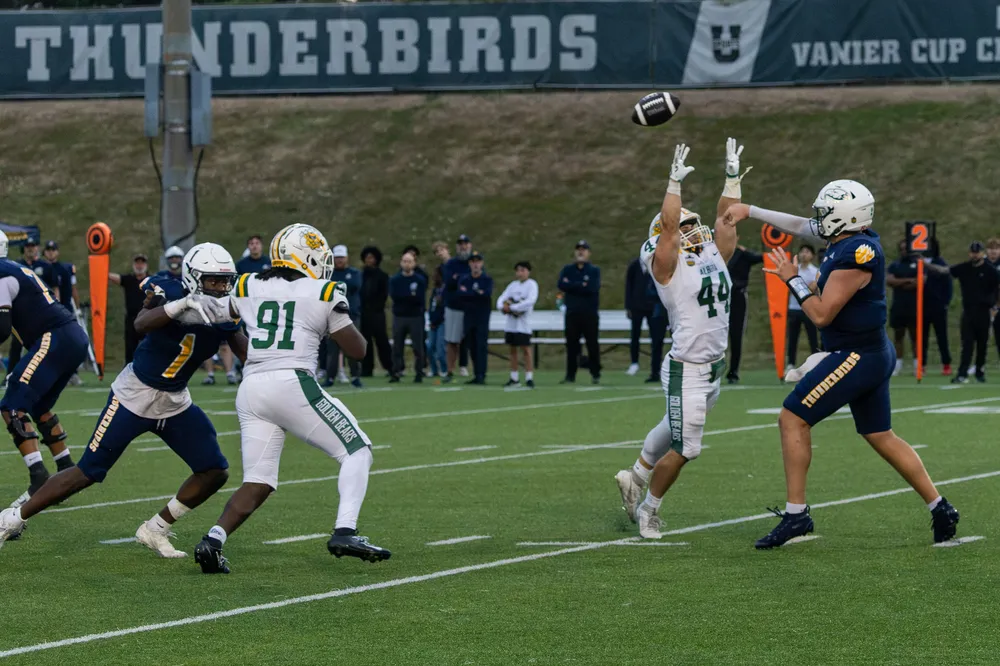
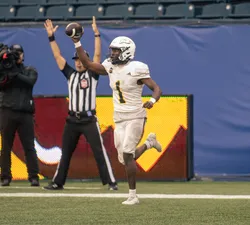
Larozar (#1) wasn't the only reason UBC blew out the Golden Bears, but he was the main reason. After more than a year of searching for a ground game, UBC seems to have finally found one.
The loss to Calgary was a gut-punch. Following an offseason full of hope and visions of improving on a season that could be chalked up to a transition year, everything fell apart, and many of the issues the team assumed would have been fixed with more experience were still present. While one game isn't enough to extrapolate from, it put them in a disadvantageous position going down the stretch.
In the final four weeks of their schedule, UBC will play arguably the conference's two best teams, Saskatchewan and Regina, three times. Calgary, while improved from last year, was a beatable opponent. They proved that last year, winning 23–22 against the Dinos at homecoming. Instead, they started this season 0–1.
This made the game against Alberta even more important. The Golden Bears, as of now, are the weak link in the conference. They went 1–7 last year, and opened this season being blown out by Regina 39–8. They're a team UBC should have beaten. But if they couldn't, the situation would be dire. They'd be two games in the hole in a competitive conference, having lost the closest thing on their schedule to an easy win. If they lost to Alberta, their season might have been essentially over before it even started.
The game against the Golden Bears also served as a referendum on the character of the team, in a way. If the T-Birds could bury the issues from last year that resurfaced in the Calgary game, they could write them off as an aberration. If they couldn't, it would be a damning reprisal of the previous disappointing year.
But with a 33-point win, they responded emphatically. They looked much more like the team that had been talked up before the first kickoff — a team that could contend in Canada West. But why hadn't they started that way? Why did they look lost against Calgary and dominant against Alberta?
Head coach Blake Nill had one potential answer. While other teams, including the Dinos and Golden Bears, were scheduled to play a preseason exhibition match to warm up for the year, UBC was not. For Nill, that was the "thorn in [his] side" that led to many of their issues last week.
"You can't replicate the physicality or the speed that's required within your team [without exhibition play]," he said. "We tried, but when we were in Calgary last week, it took us a quarter to even know where we were."
Heading into week two, however, they were warmed up. And they had a laundry list of issues to address.
The most essential of these was the run game. In part because of its ineffectiveness, in part because of an early fumble by running back Riley Michaud, and in part because they were down early, UBC ran the ball only five times in the first half against Calgary. On Friday, the T-Birds matched that number in their first five plays.
After regretting the lack of emphasis on the run against Calgary, Nill and his staff chose to run the ball six straight times to start the game against Alberta. It was a clear tone-setter. Even if those runs hadn't worked, they might have kept running the ball anyway. It was about establishing an identity, and for Nill, that meant "get[ting] back to playing the kind of football that [he's] basically known for, starting up front and being able to run the football."
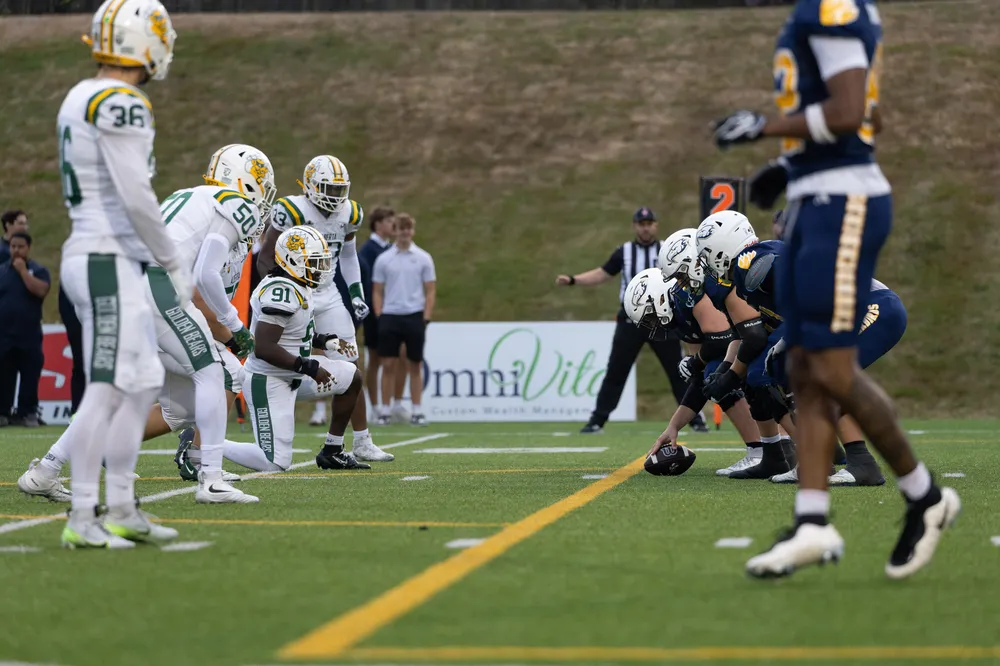
While Larozar's standout performance made it easier to do so, after a poor showing against Calgary, UBC needed to establish the run against Alberta, regardless of the results.
And they did. That's because of Larozar — who didn't even need all six of those runs to make an impact. On his third rush of the game, after following his blocks, he stopped on a dime after gaining about five yards, immediately changing direction to get to the corner, outflanking multiple flat-footed Golden Bears defenders for a spectacular 30-yard touchdown.
It's hard to get those kind of explosive plays from your running game. Larozar made it look easy. Of his eventual four touchdown runs on the day, that 30-yard scamper would be his second-shortest. It's a home-run-hitting ability that you don't see from running backs at this level, and according to Larozar, it's because he's "not a regular running back."
"I'm tall. I have long legs," he said. "Most people don't really understand the way I move, and because of these long legs, whenever I come towards you, you're scared."
His other two touchdowns looked similar to his first. At the end of the second quarter, he took off from close to midfield on a 46-yard run, using his speed to burst through the line and put UBC up 30–3. He was fast there. He might have been even faster on his last touchdown scamper.
With four minutes left in the third quarter, great blocking along the offensive line gave him a massive lane, and he hit the hole like a track star.In a couple of seconds, he had already outpaced the Alberta secondary on his way to a 57-yard score — the kill shot that put the 'Birds up 36–10.
"His pads are square, he runs very low to the ground and he typically makes the first guy miss," said Nill. "[Opponents] typically don't get a clean shot at him until he's three or four yards into the [defensive] backfield."
And by then, it's typically too late. His three long touchdown runs were the highlights, but the skill that led to them — his burst and acceleration, paired with a pinpoint-precise ability to change direction — were present every time he touched the ball. He was a threat to score on every play.
Thanks to Larozar, the team's biggest weakness had become its biggest strength. He's a special player, and with his talent, Nill believes it might not be long before American schools start calling.
"They're gonna know about him, right? ... I'm just gonna enjoy having him here now and do what we can to keep him happy about his UBC decision," he said.
Larozar's play in the run game didn't just help the team's rushing numbers. It opened up windows in the pass game as well. Against the Dinos, quarterback Drew Viotto had to put the team on his shoulders. UBC threw the ball 47 times, and while there were times when he looked great, the workload caught up to him with some preventable mistakes, especially near the end of the game.
But with the run game pulling its weight, not only did it take pressure off Viotto, it also allowed him to have more space downfield to find receivers, with Alberta moving closer to the line to stop Larozar.
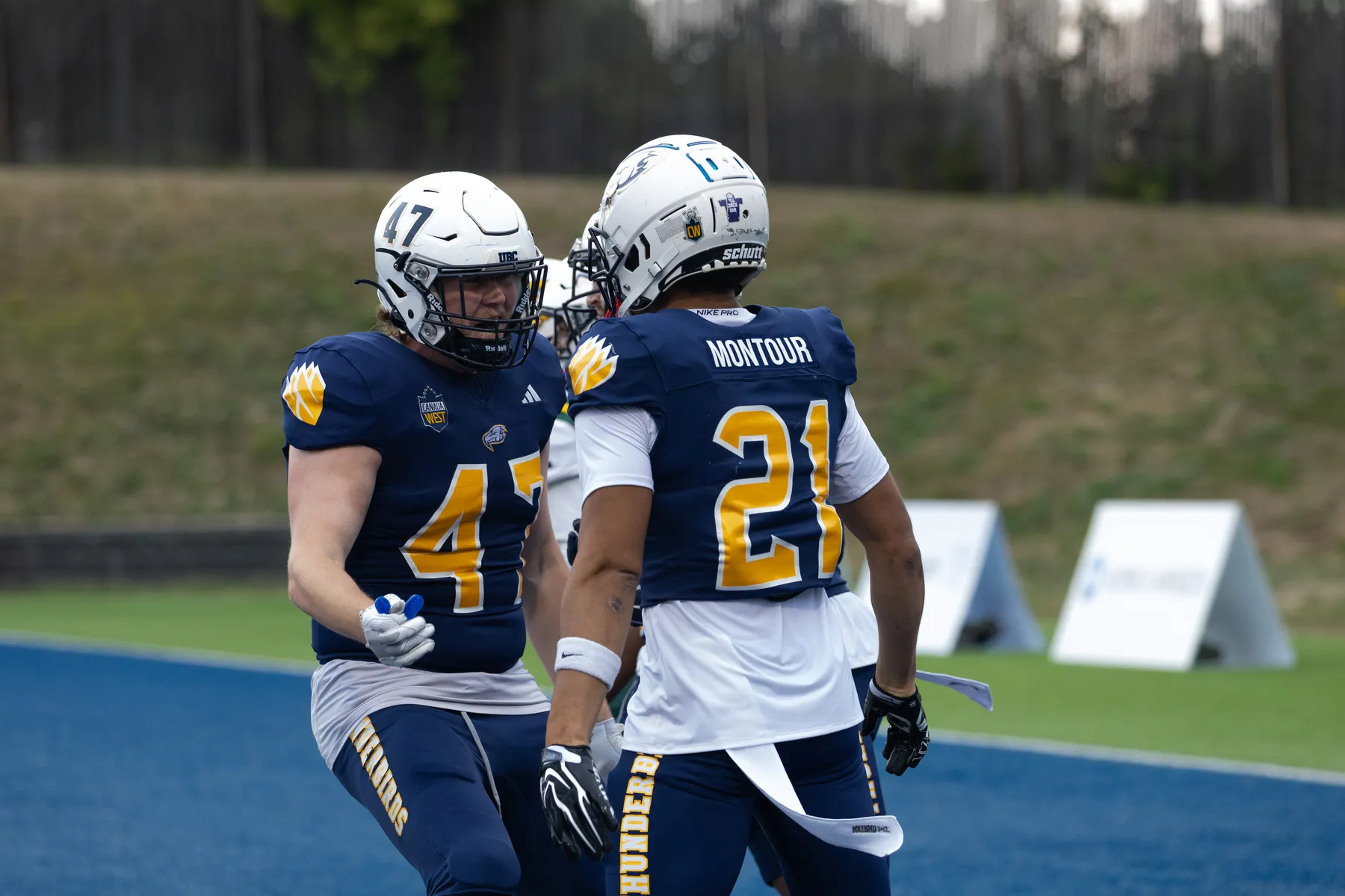
This was clearest on UBC's second touchdown. After an opening three drives that featured nine runs to only two pass attempts (one of which was a screen to Larozar), the coaching staff finally let Viotto cook. He took the snap and immediately rolled right, uncorking a fantastic tight-window throw to his favourite target, Trey Montour, for a 48-yard score that put them up 14–0.
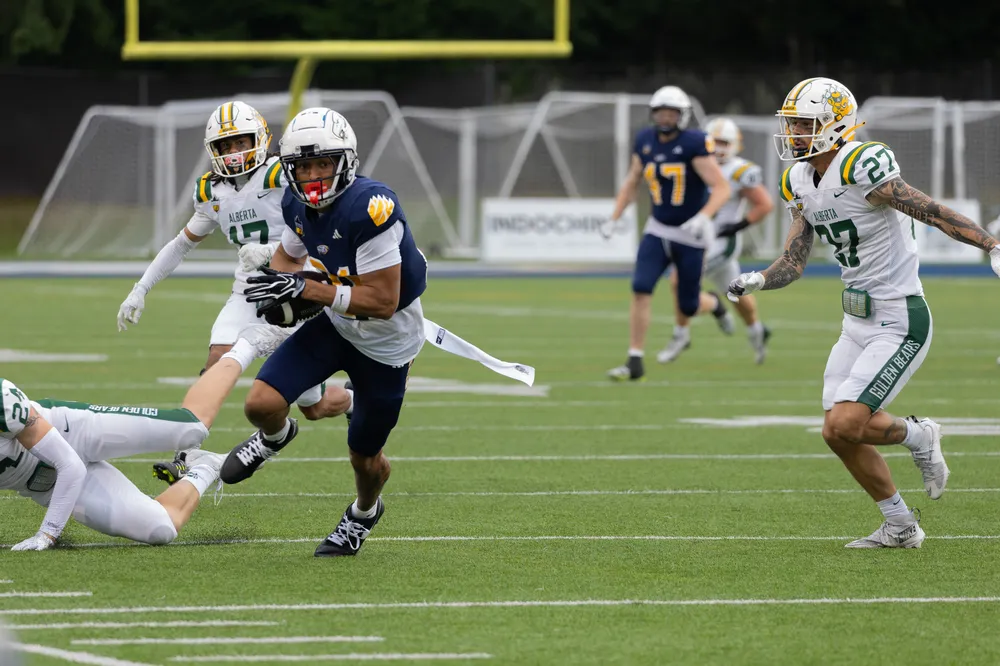
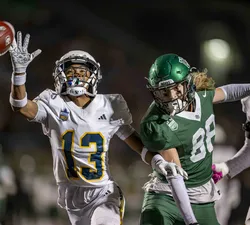
Trey Montour (#21) continued his exceptional campaign against Alberta despite a lack of emphasis on the passing game, highlighted by a 48-yard touchdown off an impressive catch-and-run.
That play was the highlight for a UBC passing game that was still up-and-down throughout. Viotto threw for a pedestrian 169 yards, and Nill sees room for improvement through the air, saying "we have the skill set to throw the ball and the [offensive] line to throw the ball ... we gotta continue to grow [there]." The team didn't need their quarterback to play hero on Friday though, and while there's room to grow, it's easier to improve when you have support from the run game.
But while the offence was clearly the focal point throughout the game, they wouldn't have been able to establish their early lead without some much-improved play from their special teams and defence. The first Larozar touchdown was assisted by a short field, provided by excellent kick coverage, a great return by Kai Rednour-Bruckman, and crucially, a two-and-out by their defence.
Their defensive performance, like much of UBC's game, was the polar opposite of what they did against Calgary. In week one, they gave up touchdowns on their two opening drives. In week two, they notched two straight two-and-outs before defensive back Darrien Brown grabbed a critical interception on Alberta's third drive.
Much of this improvement came from a renewed commitment to cutting off the short passing game. The Dinos picked the T-Birds apart underneath, so against the Golden Bears, they adjusted. Nill and defensive coordinator Noah Cantor moved one of their safeties down into the box, "switch[ing] to make sure a guy was in proximity to play the dump game." It left them more vulnerable downfield, but while the Golden Bears got a few deep passes on them, it didn't make up for how much they were being stifled closer to the line of scrimmage.
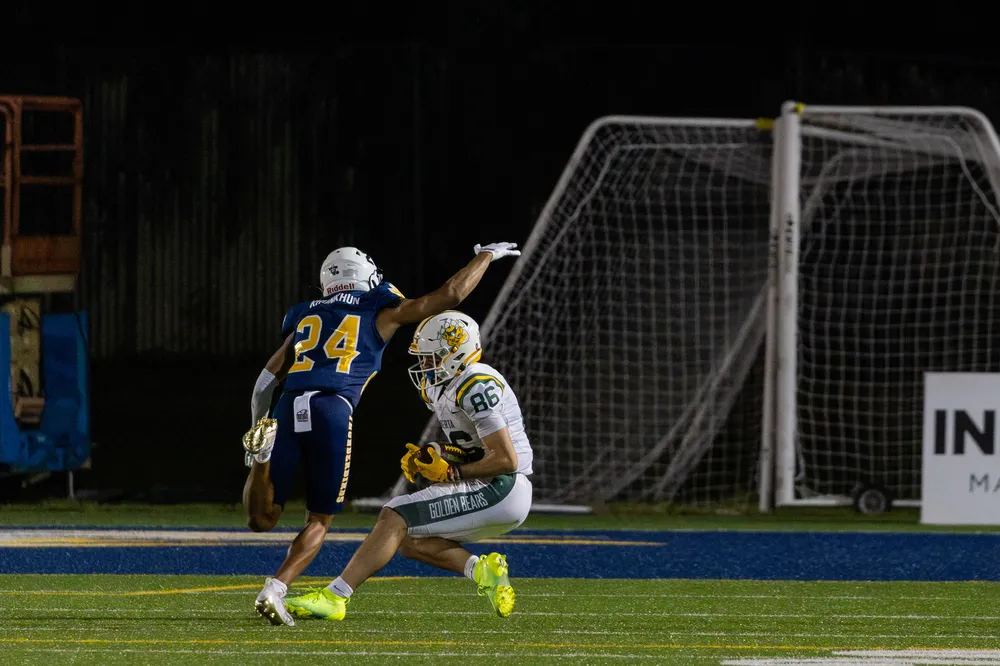
UBC's defence was able to rally and tackle much better here than they did against Calgary, mostly neutralizing the dump-offs and screens that killed them in their opener.
Another key on defence was something that carried over from the prior week: well-timed pressure. At strategic moments throughout the game, Cantor would have his defence crowd the line of scrimmage to step up against Alberta quarterback Christian Veilleux, a pressure package that worked wonders. Aaron Parker, the only T-Bird with a sack in the game, credited the versatility of teammate Clark Leonard for the success of UBC's blitz game.
"Moving [Leonard] to Will gave us edge pressure [that] is unmatched in Canada West," he said. "We're trying to get after that quarterback."
And even with only one sack, they did. Veilleux, a highly-touted transfer from the NCAA — who spent time with Penn State, Pittsburgh and Georgia State, and saw action with all three programs — didn't perform well when the 'Birds sent the blitz. The Alberta signal-caller looked off throughout the game, often sailing throws and missing his targets. More often than not, those misses came when UBC sent extra pressure.
Veilleux looked his best when UBC dropped into coverage and only sent a three-man rush. With the extra time, he could showcase his accuracy and pick apart UBC's soft zone coverage, leading to a few impressive completions between levels of the defence.
But as a whole, because Alberta couldn't consistently pick up the short gains, those one-off moments didn't faze the 'Birds like they might have the prior week. The unit is clearly starting to gel.
"[The] focus this week was being assignment sound," said Parker. "I think this week, compared to last, we did a lot better at that. I'm sure there might be some issues here and there, but overall I think it was a lot better day for us."
With this dominant win in the rearview, the T-Birds will now be facing the ultimate litmus test: a homecoming matchup with the Regina Rams. While they've staved off some of the early doubts, they still haven't quite solidified who they are.
They've presented two deeply conflicting results, both of which could be written off if you squint hard enough. Perhaps they're a great team that got bit by the lack of a preseason contest early. Perhaps their success against Alberta was a mirage, brought on by the relative weakness of the competition. Against Regina, the only undefeated team left in Canada West, they'll find out who they are.
"The Saskatchewan programs are very difficult, and they've been at or near the top for the last three or four years," said Nill. "They're just tough, they're a test, and I'm looking forward to it."
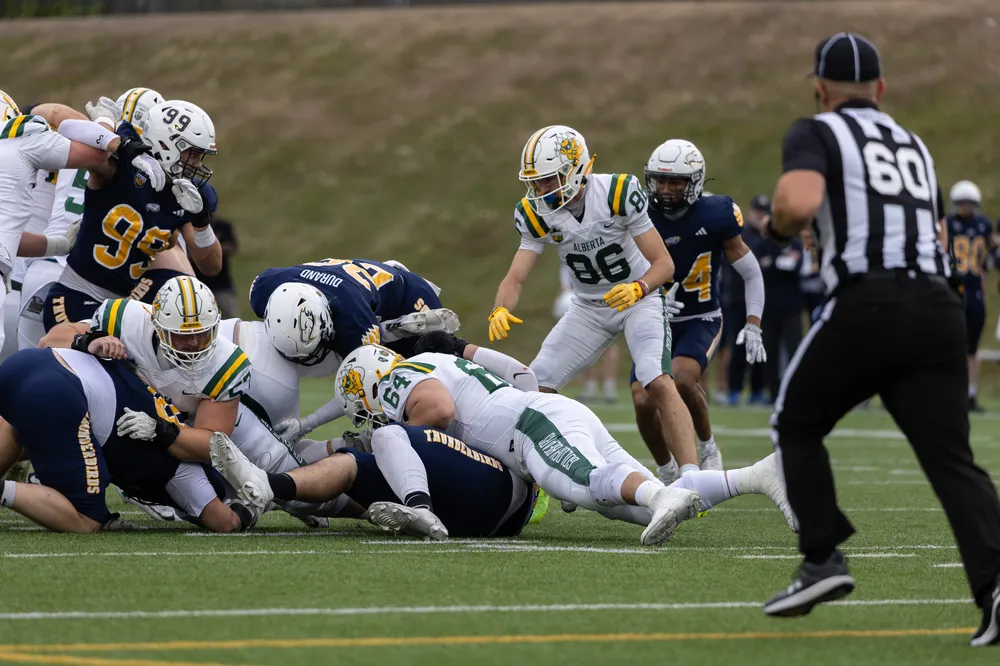
The team's upcoming game against Regina will be a test of UBC's identity. Are they a contender? Or do they still have work to do?
But they are beatable. Just ask last year's T-Birds — as poor as they were for most of the year, they pulled off an incredible overtime comeback victory against the Rams in Regina to make the playoffs in their most recent matchup.
How this team is viewed will be indelibly shaped by how they perform at homecoming — if they beat Regina this Friday, they absolutely deserve to be taken seriously as a top contender in the conference. They'll be tied for the top spot in Canada West if they win. If they lose, however, the doubts will come back louder than ever as they stare down the barrel of that tough final stretch of the season.
At the start of the year, the message for the team was about consistency. They had streaks of greatness last year, they just needed to put it all together. Two weeks in, the message hasn't changed.
"We haven't been a top five program consistently for [about] two and a half years, but there's times where we have been," said Nill. "We can play as well as anyone, but we haven't been able to play 60 minutes like that."
What better way to achieve that than by beating one of the most consistent teams in Canada West in front of a massive homecoming crowd?
We'll find out next week if they're up to the task.