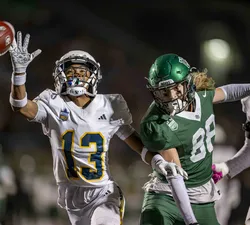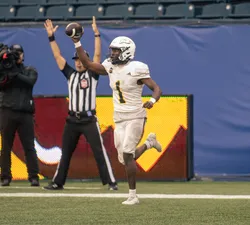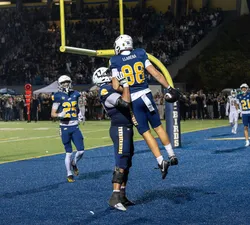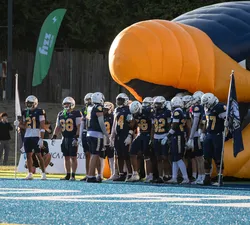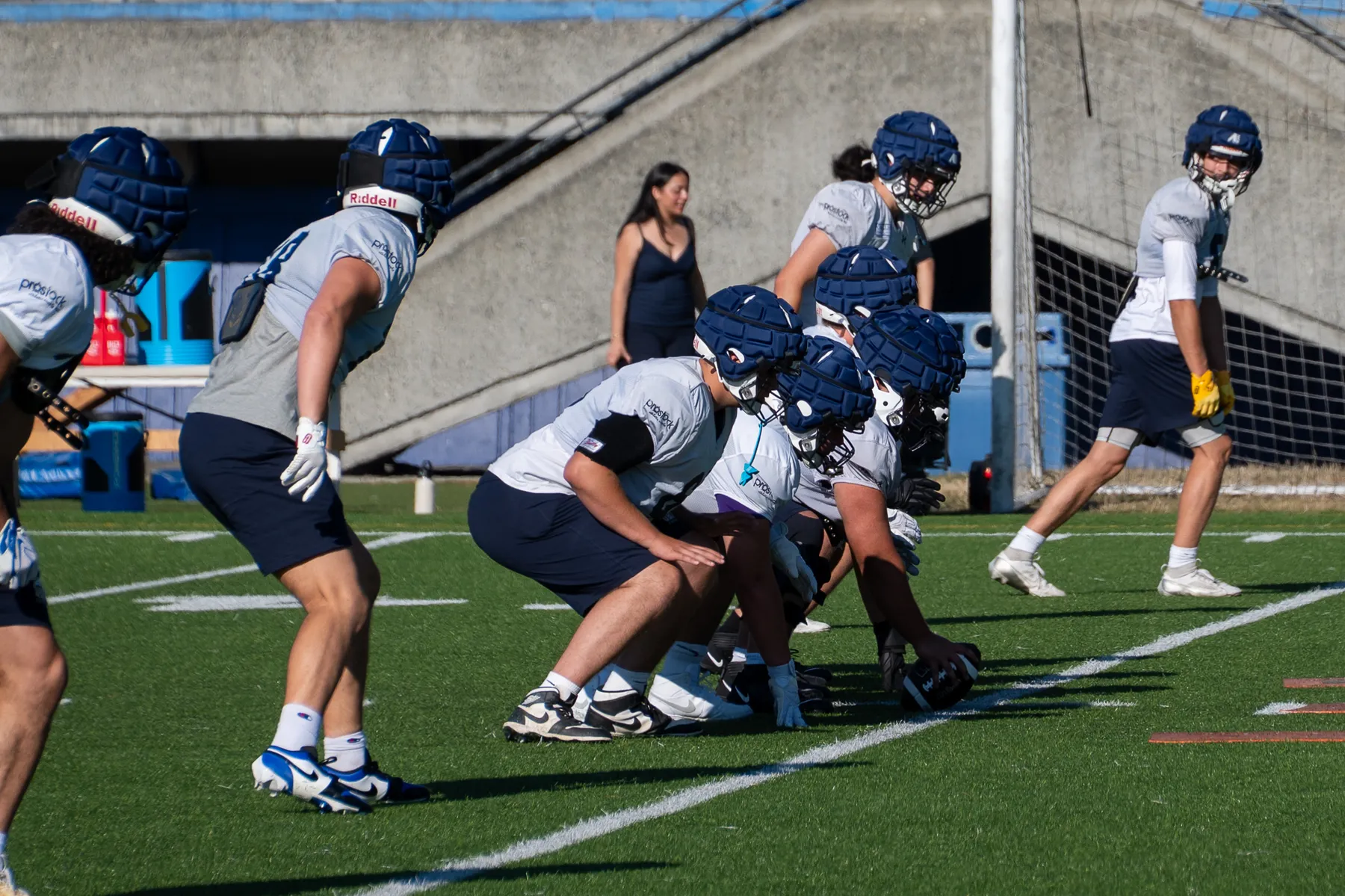

This time last year, Football was ahead of schedule. Against the Manitoba Bisons — who had been the best team in the conference the year prior — the Thunderbirds were dominant, crushing them 21–9 in a game where they never trailed. It was a cathartic arrival for a team with plenty of rookies and young players. If that was how they could play against the finest competition in Canada West, the sky was the limit.
The following week, they lost by 37.
The bottom quickly fell out on a team without the requisite experience to compete at this level of football. Including that 37-point loss — a 51–14 showing against Saskatchewan — the T-Birds lost five of their next six games, with their only win coming by one point against Calgary at UBC's Homecoming. The season was salvaged by a miraculous comeback win against Regina in the final week of the season, punching UBC's ticket to the playoffs, but they were swiftly ousted by Saskatchewan in the first round.
It was a puzzling and largely frustrating season. Their 3–5 record was the team's worst since COVID-19 cancelled the 2020–21 season. For head coach Blake Nill, while the early success in the Manitoba game had him thinking that they had "dodged a bullet," as the year went on, that assessment changed.
"It quickly became apparent that we were gonna have to pay our dues," he said.
But even in their free fall, there was promise. In the final weeks of the season, a T-Birds team that had flatlined against tough competition early was now putting up a fight. They kept Saskatchewan within a couple scores in their second meeting. They only lost to Manitoba by four in their rematch. And in the aforementioned miracle win against Regina, the 'Birds handed one of the top teams in the country only their second loss of the season. The flashes of talent were there, but the consistency was lacking.
So, the question going into this season is: who are the real T-Birds? Are those moments of success representative of greater potential or are they just another mirage?
For those in the locker room, it's clear. There's genuine optimism in the air heading into this year — more than just the typical fresh-start highs.
"I feel like we can accomplish whatever we feel we can," said starting quarterback Drew Viotto. "I think we're more than capable of competing for the Hardy Cup."
Of course, every player is going to believe in their team at the start of a season, but this team might actually have a case here. That argument starts with an examination of why UBC, a perennial playoff contender for much of the decade, looked like anything but the year prior.
The best season of Thunderbirds football in the 2020s was the 2023–24 team, a group that routinely crushed their in-conference competition, cruising to the Vanier Cup before losing by a touchdown to Montréal. While UBC's defence was spectacular that year — a top-ten unit in the country — it was their offence that carried the way.
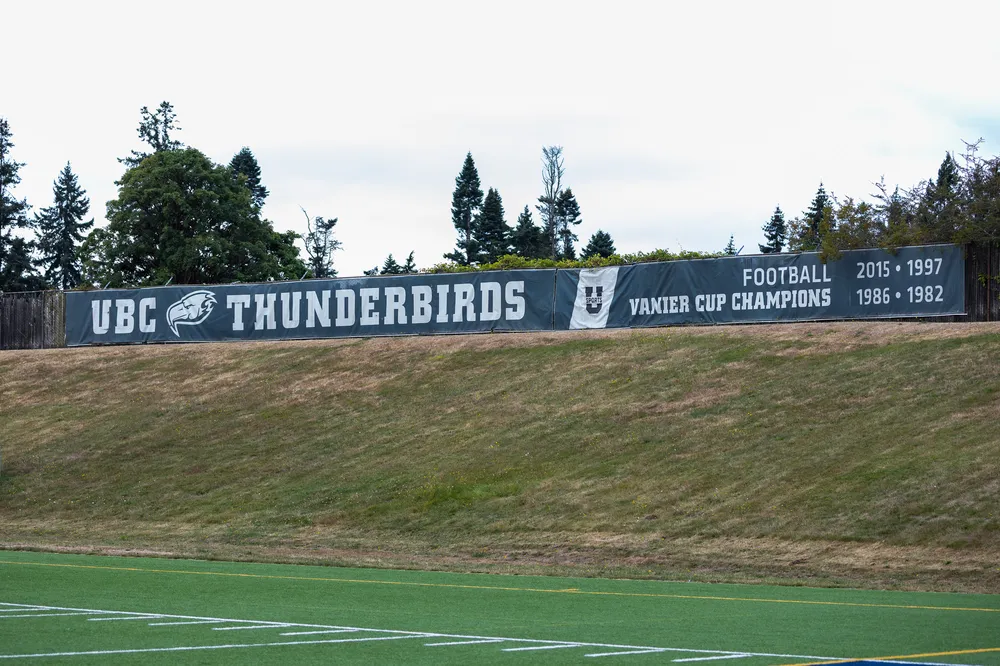
While the 2023–24 T-Birds didn't add to the team's four national championships, they were the best team the program has had this decade.
That group, the third-best in Canada, was led by their skill positions, with Garrett Rooker at quarterback, Isaiah Knight at running back and Sam Davenport at receiver. Before last season, all three graduated, leaving Nill and his staff with the unenviable task of replacing most of his team's offensive production in a single off-season.
To make things even more difficult, that turnover extended to the sidelines. Offensive coordinator Stevenson Bone, who had held the position since 2022, left to become the head coach at Alberta, while longtime defensive coordinator Pat Tracey, who had helmed that side of the ball since 2016, changed roles to become UBC's special teams coordinator.
Bone's departure in particular left Nill and the T-Birds scrambling. Needing a replacement at the "12th hour" for Bone, the team turned to former CFL head coach and quarterback Khari Jones to fill in as offensive coordinator, despite being originally hired as the team's quarterbacks coach just two days before Bone took the Alberta job. While Jones brought "boatloads of professional experience" and "an incredible knowledge of the game," he didn't have any experience coaching university football.
It was more turnover in an already tumultuous off-season. But more than anything, the most difficult change to endure for the team was the loss of their star, Rooker, at the game's most important position.
"Football is a quarterback-driven game," said Nill. "Last year, we had to replace a quarterback who had been one of our strengths in the last few years."
To start last year, Viotto was brought in to be that replacement, earning the starting job out of camp in his first year of eligibility. Yet, while it was his first year at UBC, he had plenty of prior experience.
Viotto started his collegiate career in the United States, specifically in NCAA Division I football, joining the University of Minnesota Golden Gophers out of high school. Unfortunately, his time in the NCAA didn't go the way he planned. He left Minnesota after one year, transferring to Eastern Michigan, before transferring again to head to Missouri State University. He didn't play a game there. Instead of transferring a third time, he chose to return home, to Canada.
However, while Viotto is a Canadian quarterback, the Canadian game was foreign to him when he joined UBC last off-season. He grew up playing football in Ontario — but played by American rules. So when he saw live game action for the first time in three years in that opening game against Manitoba, it was his first time experiencing the wider field, the extra defender and the overall speed of the Canadian game.
Viotto struggled early on. In the middle of Saskatchewan's 51–14 blowout of the T-Birds, Viotto was pulled in favour of backup quarterback Derek Engel, who would start the next two games before Viotto got the starting job back. It was more adversity for a player who had already faced plenty. But he didn't let it faze him.
"I took it as: 'let me take a back seat for a couple of games and just learn and see it from a different perspective,'" Viotto said. "The back-and-forth stuff with Derek, I feel like he handled it great, I handled it great. We still have a great relationship to this day."
Those early-season struggles at the quarterback position compounded problems for the Thunderbirds. Everything in football is symbiotic. When one part of the operation breaks down, everything does. So, when the 'Birds couldn't move the ball through the air, their ground game suffered as well. "When teams know you can't throw the football as effectively ... they load up to stop the run," said Nill.
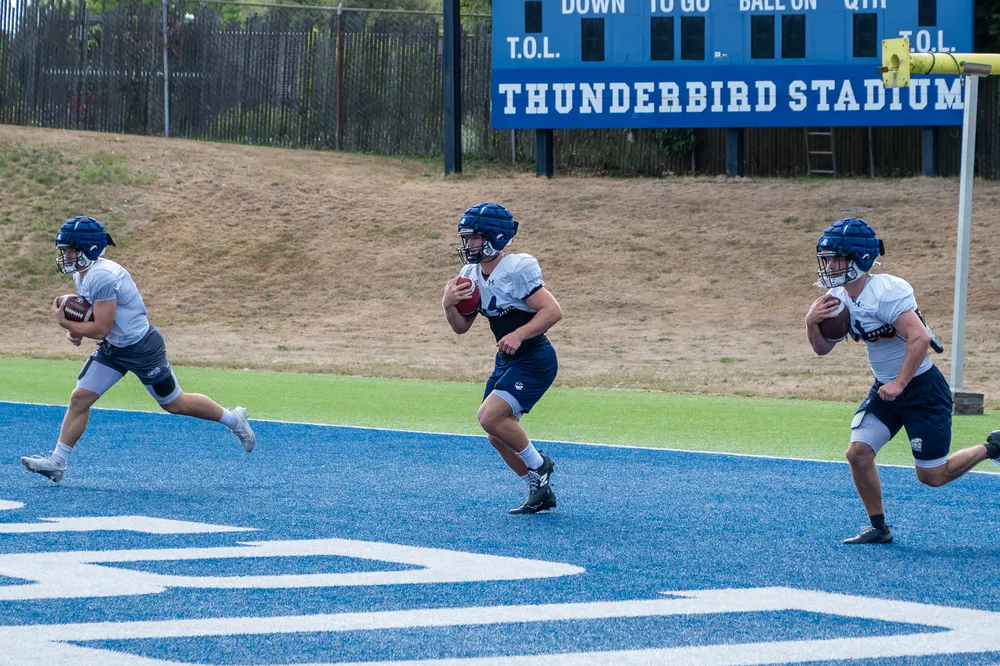
As UBC's passing game improves, the team hopes that more avenues can be open for their run game, which was the worst in the country last year by yards per game.
Combined with the loss of Knight and UBC's productive backup running back Dane Kapler, this led a unit that was a top-ten ground game two seasons prior to plummet to the worst in the country last year. In 2023–24, they averaged 171.4 rushing yards per game. Last year, they only averaged 72.4.
The offence, especially through the first five weeks, was essentially a non-factor. But down the stretch, things started to click.
Viotto grew into his role as the starter. He admitted that it took until about "week four or five" for the game to start slowing down — and that was evident in his performance. Even in a loss, he torched Manitoba in their week six rematch, throwing for 473 yards and three touchdowns, earning Canada West Offensive Player of the Week honours.
The run game, while still subpar, had at least one solid week thanks to the return of running back Riley Michaud from injury, who rushed for 88 yards against the sixth-best rush defence in the country, Saskatchewan. Again, the moments were inconsistent. But they were there.
"[This year], Riley Michaud is at full strength. Opposition teams know we can throw the ball," said Nill. "The [offensive] line is a year older. All of that points to ... a more effective year running the football."
The theory is that, while the roster from last year is mostly unchanged, the experience they gained from the prior season is what will make a difference. The talent was there — but they didn't always know how to use it. For Nill, this is a problem that compounds considering how UBC constructs their roster. While many of UBC's athletes come from out-of-province, for other Canada West schools, Nill estimates that local talent makes up about "60 to 70 per cent" of their roster. UBC is drawing from a broader pool of talent, but they also typically need more time to "get their feet wet again."
This year, however, they haven't needed that adjustment period. At training camp, Nill was impressed with the team's focus and intensity, with his squad showing up in "spectacular condition."
Their goal at the start of the season is to see "how fast [they] can go from zero to 100." Having roster consistency helps with that. It starts with Viotto at quarterback, but extends to the rest of the roster and staff.
"I feel a lot better than I did last year, primarily because my quarterback has another year," said Nill.
While much of the focus has been on the offence, because of the big-name losses they sustained, the same struggles with consistency apply to the defence as well. They may not have faced the same mass departures the offence had, but there has been a slow talent drain. Prominent players like Kyle Samson, Ryan Baker, Jerrell Cummings, Jaxon Ciraolo-Brown and more all departed over the last few years, leaving the defence to the hands of younger, more inexperienced players. And just like the offence, while there were flashes of potential, there wasn't consistency, especially in stopping the run.
"We had times where we were on it and we were really great against the run ... and there [were] times where that just wasn't the case," said fourth-year defensive lineman Aaron Parker. "I think it's gonna come down to the consistency of our players, doing our assignments and just playing football."
Their run defence gave up 170 yards per game on the ground last year, fifth-worst in the country. When asked about his defence's performance against the run, Nill noted that it had been a "big focus" at camp, and that it was mostly about fixing the fundamentals: players lining up correctly, knowing their roles and communicating.
The antidote to those issues seems to be the same pill the offence is taking: another year for new players in a new system. The changes on the coaching staff are especially pronounced on the defensive side, mostly because of Tracey's long tenure in the coordinator role before Cantor took over. While Nill and his staff are making efforts to "surround [Cantor] with veteran coaches" — including Tracey — to help with the transition, a coordinator change after nearly a decade of the same voice is still a significant adjustment for UBC's defence.
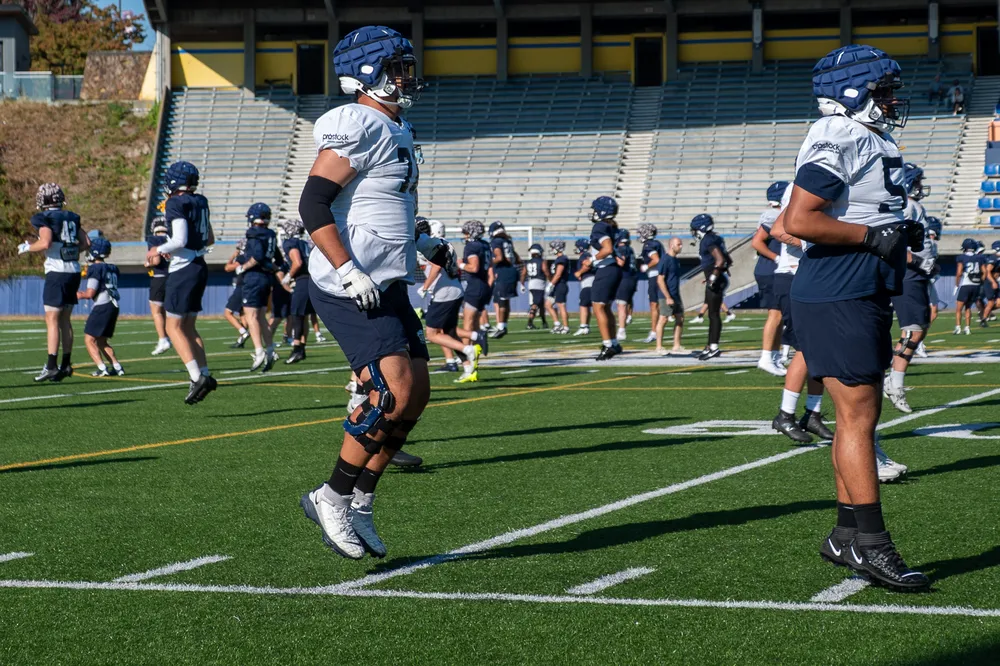
Both UBC's offence and defence hope that the cure to what ailed them last year is, simply, time and experience.
Parker has worked closely with Cantor — his former defensive line coach — since he joined the team in 2023, and he spoke very highly of UBC's second-year coordinator. "I have a really good relationship with him, so do all of our guys on the [defensive] line," he said. For Parker, one of the most significant improvements he expects to see from the defence as a whole is in their communication.
He remarked that last year, there were times when, between the defensive line, the linebackers and the defensive backs, the team wasn't on the same page. Players within a position group might have known their assignments, but they weren't always on board with those at different levels of the defence. During camp this year, however, things have changed.
"This year, a lot of that has been nullified," said Parker. "[That's] because of the experience Coach Cantor's gotten from the last year."
While there's likely to be improvement from both units, for Nill, defence is where "[they've] got to make [their] biggest gains." There's a sense that while the defence can elevate themselves to a formidable unit next year, the offence has a chance to be something special.
Not just because of the experience Viotto gained last year, but also because of the unit that might be the team's strongest: their receivers.
While the team is losing Shemar McBean, their leading receiver from last year, the young core of playmakers they have in place, led by last year's breakout star Trey Montour, is looking promising. Nill, Viotto and Parker all pointed to their wideout group as one of the more impressive on the team — which is good news for Viotto. "They're all big, fast, strong," he said. "I'm excited to throw to these guys."
It's not a stretch to say that this year, the team will be better than they were last year. But how that will manifest is an open question.
Football, in Canada West, is a bloodbath. While the other Canadian conferences in Ontario and Quebec may boast better top-end talent, in Canada West, each team is always within striking distance of each other. " I feel like [Canada] West is the best conference," said Viotto. "From top to bottom, anyone can win any week, so we gotta play our best." There's a chance that, even if the team improves, they have a similar or worse record just because the competition last year was so high.
While they'd love to go on a run and win seven or eight games, the better barometer for the team's success might be how well they compete. Last year, in their six losses, they fell by an average of 18.5 points — nearly three touchdowns per game. Even if the wins don't come, lowering that number will be crucial for this team's long-term development. You can't get obliterated every game.
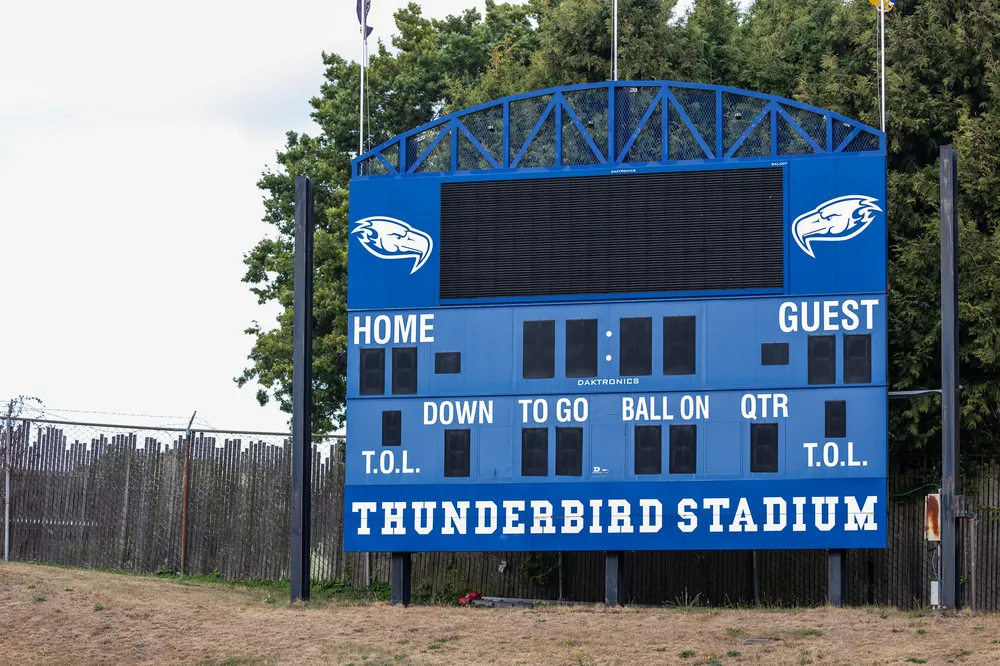
Strictly judging this year's team by their wins and losses might not be fair. In a conference as competitive as Canada West, it'll be more about how they perform in context.
Parker made an interesting comparison to describe this year's team. He joined the team in 2023–24, and while he didn't get much playing time, he witnessed first-hand what greatness looks like. "Being a part of that environment [is] really a different perspective ... [to see] how much work goes in to making a championship team," he said. While the team has yet to play their first game, Parker is beginning to see some of that championship DNA returning.
"I think that we are very close to what our '23 team kind of felt like in [terms of] closeness and all of that other stuff that comes with it," said Parker. "My expectations are high this year."
It's a high, and admirable, bar to reach for. But perhaps a more apt comparison might be the team from the year before: the 2022–23 season.
In that year, the team went 4–4, only one win better than the year prior, and only one win better than the 2025–26 team. But the core of a fantastic team was starting to emerge. After three straight close losses, the team ripped off a three-game winning streak that included a 35–29 win against the No. 2 Saskatchewan Huskies, their first loss of the year.
It was the first or second year for many of the core offensive players that would make up the Vanier Cup team, Knight and Rooker in particular — the two players whom UBC has struggled the most to replace. It's hard not to see parallels to this team.
The 2022–23 team didn't go to the Vanier Cup. They didn't win the conference. But they showed tremendous progress, even with a subpar record, and that's what this year's team should be hoping for.
This time, however, they need it to be real progress. Not just a mirage.