
Maya Tommasi (she/her) writes Powers that Be, a column covering political ideas. She is a third-year political science student and holds a previous degree in psychology. Her email is m.tommasi@ubyssey.ca.
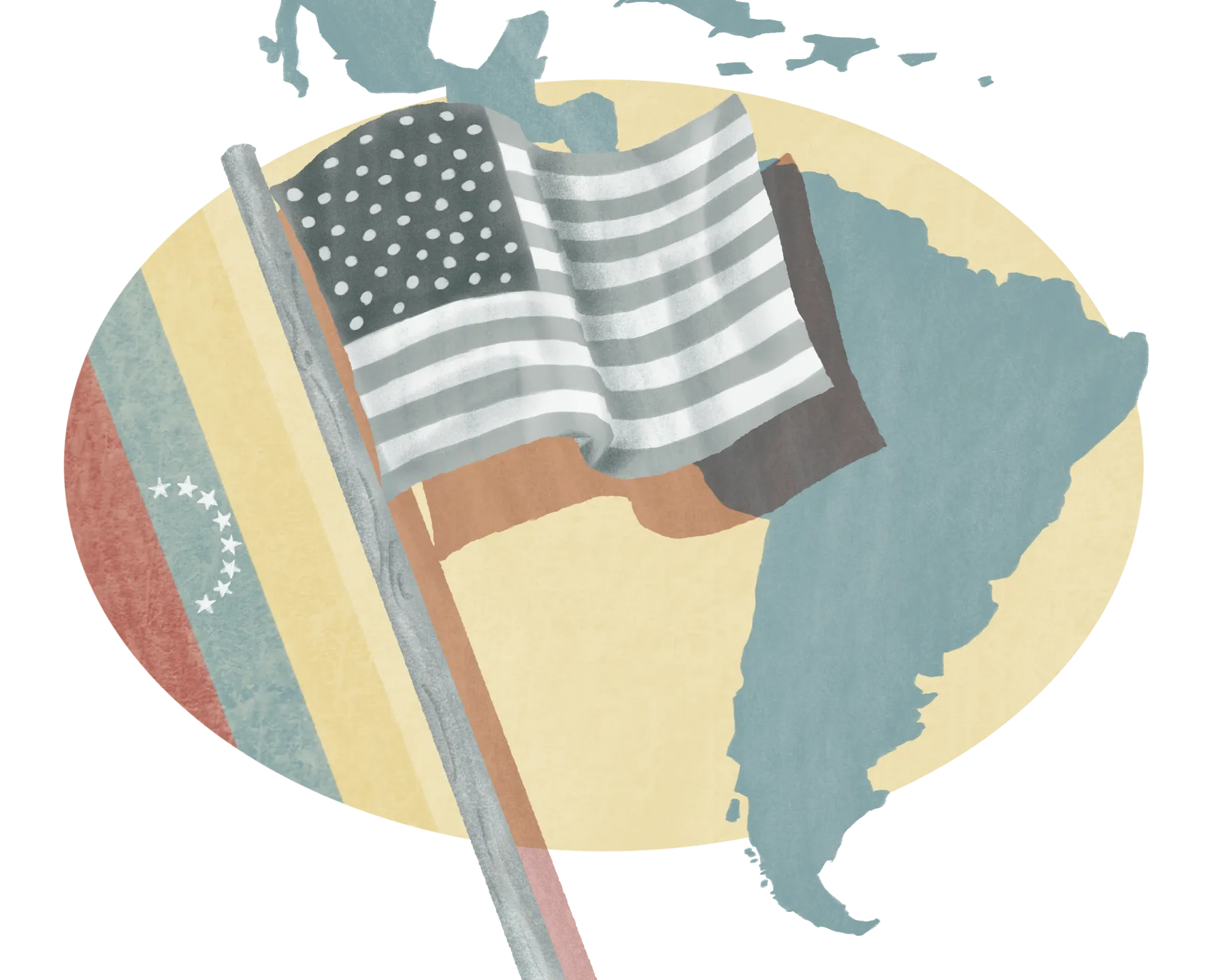
If your politics are anything like mine, you were left in horror at the atrocious act of imperialism — a clear breach of international law — that was the United States’ capture of Venezuelan President Nicholás Maduro last month. Especially since it happened in a region with a long history of bloody US interventionism, often with dire consequences.
Being Latina, it sent shivers down my spine. It had nothing to do with democracy. It was clearly a political move: Trump secured Venezuelan oil and satisfied his base, delivering a big win to anti-socialist and conservative Latinos who helped deliver his electoral victory. In an equally egregious move, he justified this kidnapping not as a defence of democracy but with sham accusations of “narcoterrorism,” creating a precedent that he could use to attack his enemies regardless of their democratic credentials — like Columbia’s President Gustavo Petro or Mexico’s President Claudia Sheinbaum. And while he hasn’t done so (yet), he could potentially replace deposed governments with American puppet governments who serve not the interests of the people but those of America. It would hardly be the first time.
Most readers likely support this sentiment. Regardless of where you come from, far-right imperialism coming out of the US does not bode well. Even if, selfishly, it is only because of his similar threats to Canadian sovereignty. But we should not lose sight of why we think this way. Otherwise, we risk having our anti-imperialist politics morph into exactly what it seeks to oppose.
In all my years since moving here, I’ve noticed a trend. At first, it was intriguing. I’ve since come to find it concerning. The way that most Westerners, crucially including leftists, talk about my home continent is exclusively framed through the lens of North American politics. Our politics are simplified to an extension of Western foreign politics, never granted any complexity.
I remember being taken aback by how different the conversation about Latin American politics was when I first came to Canada. I had grown up surrounded by people who villainized leftist governments in my home country; here, I was presented with a different narrative: US imperialism had caused the poverty and the struggles of our continent.
At first, I was confused, then enamoured. But as the years passed, I became more critical.
It all started in 2018. Two years after Trump's election, we elected our own despot, Jair Bolsonaro. Quickly named the “Trump of the Tropics,” the similarities were unmistakable. He was a far-right populist, harking back to an imaginary glorious past, labelling the opposition enemies of the state and demonstrating clear hostility to the media and democratic institutions. While close allies, they were not the same. Compared to Trump’s first term, Bolsonaro was much more authoritarian. (Trump’s second term, I’d argue, has surpassed Bolsonaro’s initial authoritarianism, but I fear so would a second Bolsonaro term).
Bolsonaro’s imagined past was not a racist American suburban one, but a military dictatorship. Famously, the man came into prominence by glorifying one of the most abhorrent torturers of the Brazilian military regime, Carlos Alberto Brilhante Ulstra, whom he exalted because of his role in torturing former Brazilian President Dilma Rousseff. He celebrated the anniversary of the military coup which extinguished our democracy 60 years ago. And famously, his son, also a politician, threatened Brazil’s Supreme Court judges.
Bolsonaro’s rise to power in Brazil was clearly facilitated by Trump, from his legitimizing of anti-democratic rhetoric, explicit support from himself and allies (see Bannon), or even just perfecting an authoritarian playbook. His economy minister was clearly recreating 1980s American neo-liberalism, which he learned from the infamous Chicago School. But the Bolsonaro phenomenon was an essentially Latin one — his rhetoric worked because of our militaristic history, political turmoil and our specific ilk of social conservatism. The Trump connection, while important, can only be one of the many factors contributing to his rise.
By consistently framing Bolsonaro as a Brazilian version of Trumpism, overplaying its similarities, or simply seeing it as a part of a global far-right movement led by the West, we flattened non-Western complexities and agency. And in doing so, it treats our continent as exactly what we are not — an extension of American politics.
I could continue to describe how the same phenomenon applies to the Partido dos Trabalhadores or PT (Workers’ Party), which I (like many other Brazilians) voted for in the same way as many of you might have voted for a Canadian party you didn’t completely agree with. And in the same way you might roll your eyes at an American singing Trudeau or Carney’s praises despite little familiarity with their governments, I might do the same to Canadians singing Lula’s praises.
In the case of Maduro, this goes beyond interpersonal frustration or political disagreement. His government was authoritarian. He persecuted journalists and opponents, and has been accused of rigging an election. Meanwhile, his economic mismanagement – compounded by American sanctions – led a once-booming economy to ruin. This doesn’t make Trump’s actions any less heinous, but neither does American imperialism erase Maduro’s actions.
My first point has hopefully been made obvious by now. Latin politics is not an extension of Western politics. As is true of all politics that do not pertain to this place. Even incidentally speaking as though this were the case is tacitly supporting an imperialist lens.
This is not to say that one cannot be anti-imperialist or critical of American (or any other) acts of imperialism. Obviously not. I started this column by doing that. My intention was not solely to make it clear that I am anti-imperialist and oppose Trump’s actions, but also to show how we can frame opposition to US politics. Imperialism is bad not only because it is authoritarian. Maybe it's also bad, more importantly, because of its material harm to people affected — people whose material well-being should also matter when they aren't explicitly linked to Western foreign policy.
The consequences of our positions are not simply political. They’re also interpersonal. Many Venezuelans oppose, and even hate, Maduro — and not just right-wingers. In a touching article in Folha de São Paulo, a Brazilian newspaper of record, Venezuelan author, screenwriter, leftist and former Chavista María Elena Morán writes that despite her leftist views and horror at Trump’s imperialist violence, she simultaneously felt relief at Maduro’s removal. Her story is not unique. Every Venezuelan I’ve personally met has expressed deep opposition to Maduro, regardless of where they fell on the political spectrum. Many of whom are or were students at this very university — our colleagues and friends. To vilify them feels wrong, especially at a time when there is so much hostility against our Latin American community.
If we look at the comment sections of articles reporting on Venezuelans celebrating Maduro’s kidnapping, you will find people either deriding them or implying they represent Venezuelan people as a whole. Not only are these clear oversimplifications, they both implicitly degrade and silence the very subjects of Trump’s actions, Venezuelans.
Compare this with how we talk about American and European politics, where we are much more likely to understand the circumstances of, say, Mamdani’s election or the rise of the Rally National in France or the AfD in Germany. Many of us are aware of how economic stagnation in eastern Germany or young disillusioned working-class voters in France contributed to the far-right’s rise. Can we honestly claim most of us have comparable knowledge of the factors leading to Bolsonaro's rise or the situation in Venezuela, bar, of course, that Bolsonaro was Trump-like and Venezuela’s struggles are tied to US imperialism?
If we are to be anti-imperialist, we should be able to set lofty goals. At the very least, we should be capable of a political analysis which escapes the exclusivity of a Western lens. We have to incorporate the complexity of global politics. How do we escape Western imperial domination while so often replicating a Western-centric approach to our global understanding of politics? If we are to overcome imperialism, we should be able to understand the basic priorities, positions and political dynamics outside the West.
This is an opinion essay, and a part of a regular column. It reflects the columnist’s views and may not reflect the views of The Ubyssey as a whole. Contribute to the conversation by visiting http://ubyssey.ca/pages/submit-an-opinion/.