Solomon Yi-Kieran (any/all) is the Vice President, External of the Alma Mater Society.
When I ran to be AMS VP External, a question students asked me throughout the campaign was “how are you actually going to get the SkyTrain to UBC?” The provincial government first committed to this project in 2008, and since then, 17 years of AMS VP externals and UBC administrators have advocated year after year after year for the SkyTrain to finally be extended.
Despite this, government delays and a lack of political, media and community attention have stalled this project time and time again. It became clear to me that old approaches are not working, and students wanted to know what I would do differently. So when my friend Vedin joked to me about marching for the SkyTrain, like the Great Trek of 1922 that built UBC’s Point Grey campus after years of government delays, I immediately saw an opportunity to bring UBC students together and demand real progress on the SkyTrain to UBC.
In my view, if students want the SkyTrain to happen, we can’t rely on AMS lobbying alone or passively wait for the government to act. We need to make our voices heard and demand action together by signing the SkyTrain to UBC petition — and showing up to the rally on October 1.
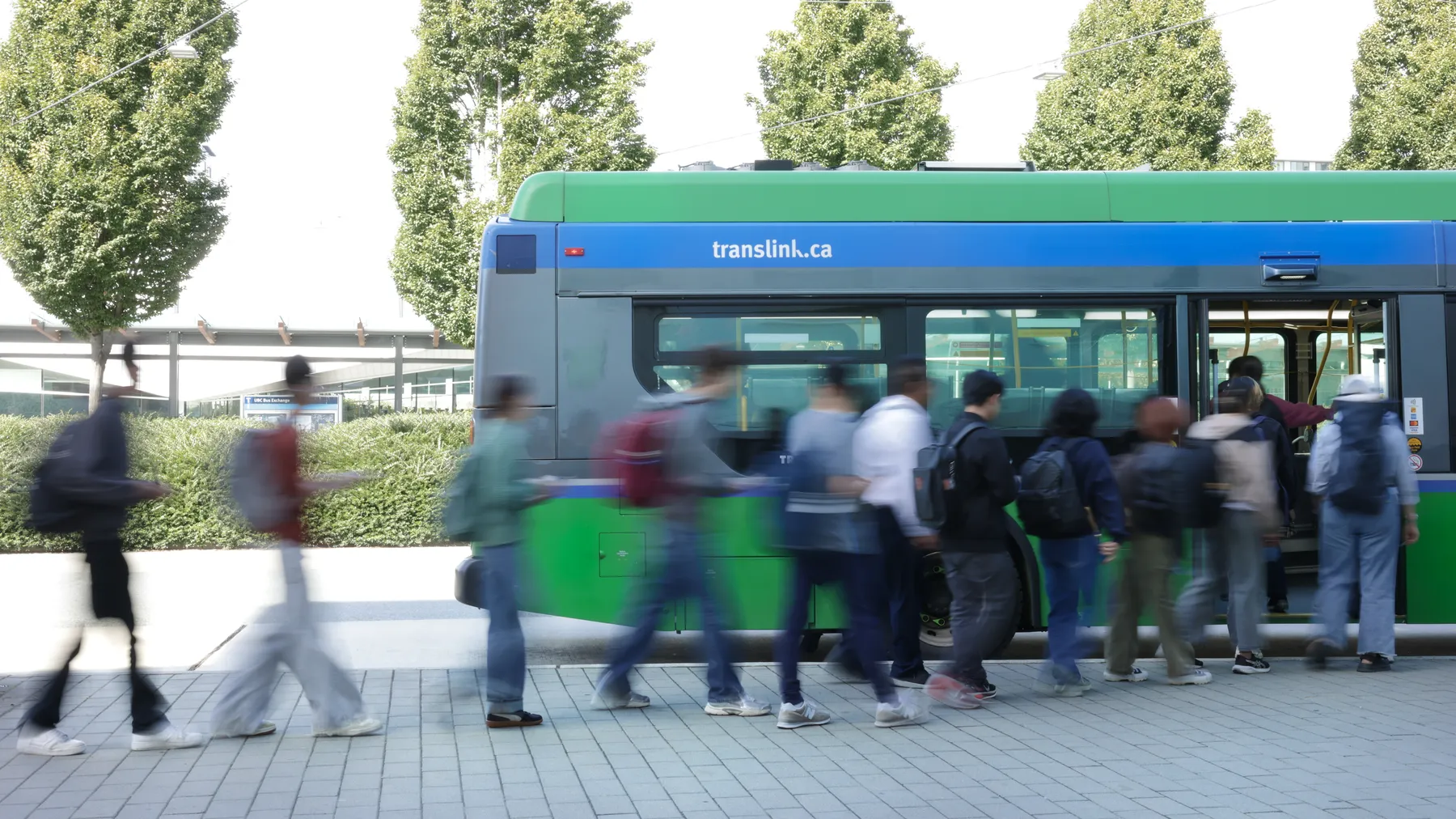
The importance of the SkyTrain to UBC is nearly undeniable. Currently, over 37 per cent of students who commute spend over an hour commuting to campus each way, every day. When over 11,000 UBC students live in faraway cities like Surrey, New Westminster, Coquitlam and North Vancouver, it’s not hard to see why this would be the case. Currently, there are almost no areas outside of the City of Vancouver where students can commute to UBC in under an hour. In fact, almost all of East Van is at least an hour commute to campus.
The SkyTrain to UBC would reduce the majority of commutes by 30 minutes each way. Nearly all commutes from Vancouver and Burnaby would be cut to 30–45 minutes. Students in North Vancouver, New Westminster, Surrey, Richmond and Coquitlam would be able to reach UBC in under one hour.
A UBC SkyTrain is also the only transit infrastructure that can adequately handle the massive ridership demand along Broadway. The UBC Bus Loop is the busiest bus loop in Metro Vancouver that doesn’t have any rapid transit — which should come as no surprise if you’ve ever been passed up by an overloaded 99 or crammed into an R4 like a sardine. The corridor it serves is the busiest transit route in the US and Canada, with 165,000 daily boardings and more than half a million annual pass-ups. The Millennium Line extension, opening in 2027, stops at Arbutus Street; this is a half-measure and at peak hours it will strand over 4,000 commuters half an hour away from UBC and fail to substantially improve commutes for students. Only a SkyTrain to UBC will have the capacity and speed needed to properly service commuters along this route.
Shorter commutes would mean more time on campus for clubs, parties and events. As a commuter school, UBC suffers from a lack of on-campus culture. And it’s not hard to see why given students need to commute for hours every day on top of studying and work. A SkyTrain to UBC would also make it easier for students to go to Vancouver for restaurants, concerts, museums and the attractions the city has to offer.
Up to 32 per cent of commuters drive to campus either alone or in a carpool. A SkyTrain would ensure transiting from cities like Coquitlam and Surrey takes similar — if not less — time compared to driving. Getting cars off the road is essential to combating climate change and decreasing emissions. A SkyTrain to UBC would mean thousands of commuters don’t need to sit in traffic, and save some of the furthest-commuting students up to $340 of gas per month, while also reducing strain on Metro Vancouver’s road systems.
With this in mind, readers may ask themselves: If the SkyTrain to UBC would save students up to an hour of commuting a day, save $340 a month on gas, improve campus culture, decrease emissions and create more housing for the entire community, then why hasn’t the project been built yet?
In the 17 years since the provincial government took the lead on the project (with many projecting a 2020 completion date), there’s been no shortage of evidence and voices in favour of the project. In 2012, the City of Vancouver’s UBC Rapid Transit Study found that a SkyTrain to UBC was the most efficient transit option to meet demand. The City of Vancouver’s Transportation 2040 plan and Translink Mayors’ Council Regional Transit Investments report both set the UBC SkyTrain as a key transit priority. In 2019, Vancouver City Council endorsed the UBC SkyTrain extension project. In 2021, the federal and provincial governments each agreed to fund 40 per cent of the business case for the extension, with UBC administrators projecting the case’s release within a year, by 2022.
So why, despite all the support regionally and from the community, has nothing happened? I was 3 years old when the government first got involved; how have students been waiting 17 years for this clearly important project? Why did it take the federal and provincial governments 13 years just to come to a funding agreement for the business case, and how is it that the business case is another 3 years delayed?
The simplest answer is that the SkyTrain to UBC simply hasn’t been a government priority. Without consistent community petitioning, the SkyTrain to UBC has received minimal media attention, limited political attention and has fallen to the wayside.
That’s where the importance of student action comes in. When advocating for student issues, our biggest strength is that we can channel the combined voice of more than 60,000 UBC students to fight for the causes that will benefit our community. If the SkyTrain to UBC hasn’t been receiving attention, then let’s create that attention in a way that’s impossible for the government to ignore.
As of writing this article, the SkyTrain to UBC petition has over 14,000 signatures. Seeing so many students and community members voice their support has been vital for building up the necessary attention; the petition has already appeared in two newspaper articles, has received letters of support from the University Neighbourhood Association (representing the 15,000 residents of Wesbrook Village and other on-campus neighbourhoods), the Association of Academic and Professional Staff at UBC, other student unions and is making its way to the City of Vancouver with a motion we’re bringing forward with Councillors Lucy Maloney and Sean Orr.
Throughout September, my team and I will be boothing across campus, doing lecture announcements and meeting students where they’re at to hear their thoughts and collect their signatures.
Perhaps even more importantly, on October 1, we are planning a large-scale rally for the SkyTrain. Beginning at 2 p.m. just outside of the Nest, there will be a free BBQ and live music performances. If you care about cutting commute times, if you care about making UBC accessible, if you care about getting the SkyTrain, then I invite you to show up. Having a large crowd of students show up for the SkyTrain will prove to the media and policymakers that the SkyTrain to UBC is an issue of regional importance that cannot face any further delays.
As a student, your voice will fundamentally determine whether the provincial government listens to our advocacy. We will be taking the petition to meetings with Premier Eby, to the Legislative Assembly in Victoria, to City Hall and to lawmakers in Ottawa. There is no doubt in my mind that the petition and rally are just the first step, but at every step along the way, your voice and your signature will be what brings the attention that the SkyTrain to UBC deserves.
We’ve waited for 17 years for the SkyTrain, and I don’t want UBC students to have to wait another 17 more. If you want to cut commute times and finally get the SkyTrain, then let’s tell the government to release the timeline, release the business case and to release funding for the project.
Make sure to sign the petition (ams.ubc.ca/skytrain) and make sure to join us outside the Nest on October 1.
This is an opinion essay. It reflects the contributor’s views and does not reflect the views of The Ubyssey as a whole. Contribute to the conversation by visiting ubyssey.ca/pages/submit-an-opinion.