
Mark Shieh, founder of a non-profit developer, approached the UBC Learning Exchange in Vancouver's Downtown Eastside in 2018 with a “vision” to transform it. He proposed that the LE could play a pivotal role in anchoring a new mixed-use development that would provide 118 social housing units and a community amenities. After close to a decade of development consultation and intervention from government partners, construction for the expanded LE broke ground last month.
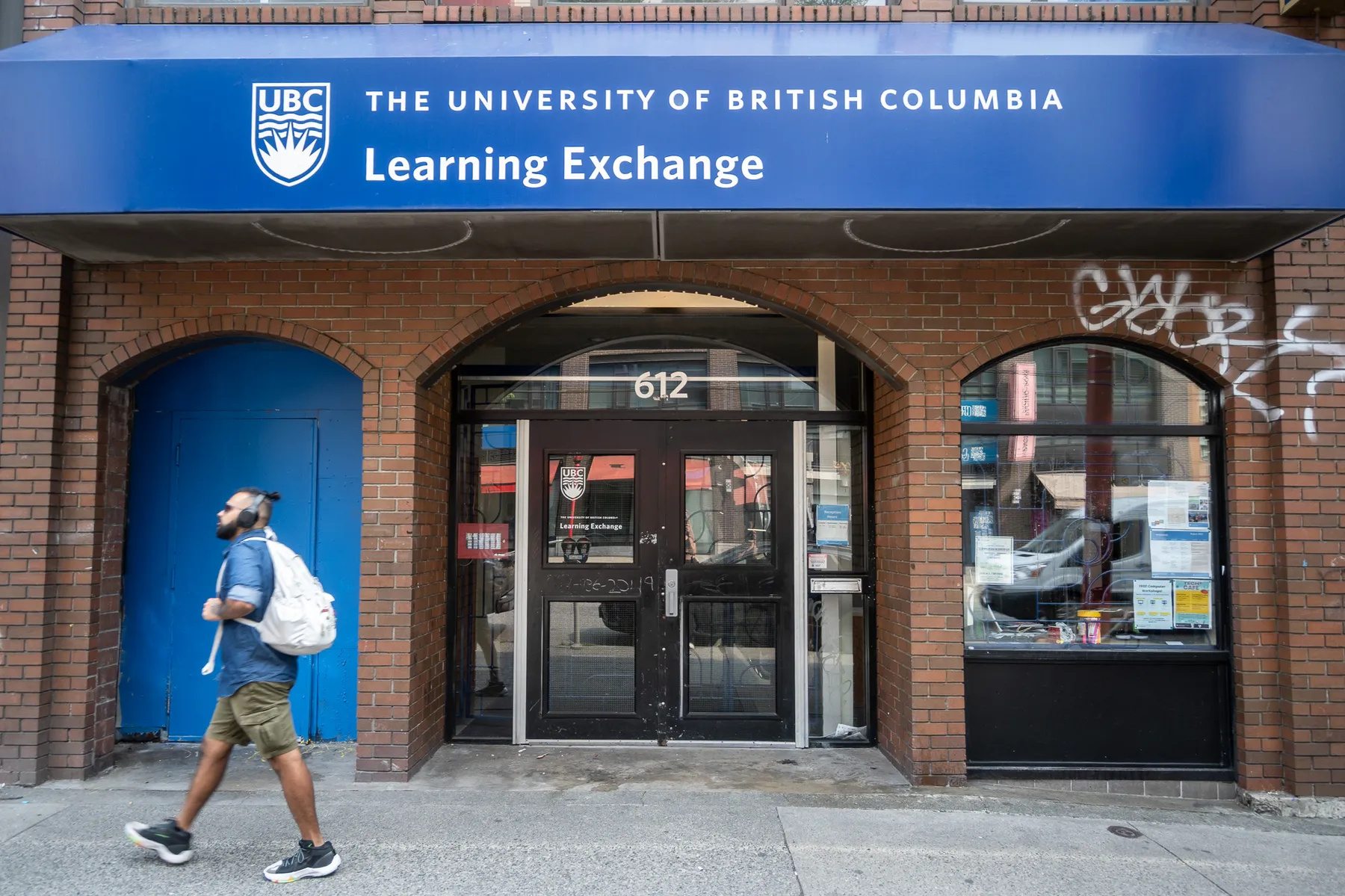
UBC announced plans to move the LE at 612 Main St. to a new site at 315 Main St. on Aug. 11. The move is an effort to continue developing community engagement and research at the LE.
Their current location occupies 8,407 square feet and has run since the late 2000s. The new building will include 118 social housing units, a roughly 1,700 square feet non-profit owned and operated community theatre, and commercial space, among other uses. The 10,500 square feet new LE will occupy two floors on East Cordova Street.
Proximity to other programs in the buildings will allow for collaboration in LE programming, with a possibility for the LE to use the community theatre space for holding larger community events.
The LE was first opened in 1999 under then-UBC President Martha Piper, with a mandate to promote dialogue and community engagement through research. Nowadays, they offer digital literacy and English courses as well.
There is a large amount of academic research connected to the DTES, the LE aims to ensure such research supports the community tangibly. The LE's community use grew in the 2000s, with a significant increase in users after it became independent from the UBC Community Learning Initiative in 2011 and obtained a new academic director position.
In an interview with The Ubyssey, current LE Director Kathleen Leahy said that the centre’s mandate is underpinned by a need to share knowledge and an understanding of the barriers in education access some in the Eastside face, namely negative experiences with traditional education.
The LE also provides specialized support to ensure that communitybased research conducted by UBC students is responsive to specific vulnerabilities in the DTES. Currently, the LE works with 76 community partners to provide these services.
The expansion will be a collaboration between the City of Vancouver, BC Housing, the Canada Mortgage and Housing Corporation, MAC Development and Housing Society, and UBC. Contributions to the project total $96 million. UBC is contributing $12.5 million in funding.
In an email to The Ubyssey, UBC’s VP Finance & Operations Office said that the investment is restricted to funding the immediate purchase of space and construction of the LE, but no long-term operational funds are attached.
The project is being delivered through multiple federal and provincial housing programs, including the provincial BC Builds program, introduced in 2024, and the federal Affordable Housing Fund. The AHF is a federal program previously part of the National Housing Co-Investment Fund and part of a $16.1 billion program to provide accessible housing to marginalized individuals, those with disabilities, and women and children fleeing family violence who need accessible housing.
The federal government is the largest contributor to the project, providing $41.9 million through the AHF. Financing through the AHF is upfront, without the CMHC taking on any long-term operating responsibilities of the units it invests in.
The fund is also part of a federal housing program — the National Housing Strategy — that committed $75 billion for housing. This program is no longer accepting applications and has spent billions through various housing funding programs in British Columbia throughout the past half-decade. Following the expiry of the National Housing Strategy, federal planned spending on affordable housing is expected to decline with an additional 56 per cent federal spending reduction for social housing financing between 2025–26 and 2028–29.
Lastly, the City of Vancouver is contributing $14.5 million in land lease contributions and $2.7 million in waivers. This contribution likely comes through removing all Development Cost Levy (DCL) charges against the project given it satisfies conditions that 20 per cent of its residential floor area be allocated for below-market rental housing. DCLs are a mechanism to assist with financing community infrastructure such as libraries and childcare, in addition to critical infrastructure such as transportation across Vancouver.
Leahy said that LE programming will include integration with the wider development, providing opportunities for initiatives like a “maker space” — a place for arts and cultural programming, as well as a small teaching kitchen that is planned to involve UBC students from land and food systems (LFS).
A roof deck atop the project — which in architectural drawings from 2022 featured an array of utilizations, including a contemplative maple garden, dining space, and urban agriculture area — is also being eyed for LE programming.
Leahy also spoke about the possibility of UBC history students developing exhibitions on Asian-Canadian and Japanese history in the DTES.
The new site at 315 Main St. has had historical importance for Japanese- and Chinese-Canadians since the late 19th century. For instance, Yamane Rooms operated during the 1930s and the Golden Harvest Theatre ran Hong Kong films between 1974 and 1981. The latter’s cultural value was one of Mark Shieh’s primary motivations in his 2018 conversations with the LE — he wanted to maintain arts spaces in the Downtown Eastside that could emulate what Golden Harvest had once offered. The new proposed community theatre was referenced throughout development planning as “New Harvest,” drawing to the site’s history.
During early planning in 2021, the project's developer Happy Harvest set out a plan to "explore" the integration of a learning centre with "B.C.'s leading universities." The centre’s public-facing frontage was to be on East Cordova Street, with a high level of public accessibility to support the other planned community uses of the site. Tomo Spaces — part of Happy Harvest — was founded in 2005 by Mark Shieh and his partner Leslie Shieh.
A major design consideration for the project was fostering a “living heritage” concept that involved the recognition of 20th century buildings on the property, including a municipality-designated heritage building, constructed in 1913, at 305 Main St. It has since been demolished. Happy Harvest proposed to incorporate "heritage cast iron columns" from the original site.
A learning centre was viewed by Happy Harvest as a way to promote dialogue and community-based knowledge-building through an “exchange” which prioritized cultural heritage over the physical value of historic buildings at the site — this proposal has remained in place since 2022.
In order to facilitate the development and eventual use of the space, tenants had to be relocated from 20 existing municipally-designated Single Room Accommodation (SRA) units — nine at 307 Main St. and eleven at 172 East Cordova Street.
The demolition of SRA units was approved upon the condition of Happy Harvest entering a housing agreement to deliver the 118 social housing units planned for the development. Existing eligible tenants residing in the SRA units would also retain the ability to return to 315 Main St. following redevelopment of the units.
A city-wide replacement of municipal Single Room Occupancy (SRO) units, which include SRAs, began in the 1990s in an effort to regulate their conversion and demolition, and to ensure housing affordability. This effort was driven by the decline in municipal public health enforcement of SRO and SRA building conditions since the 1970s and a desire to protect against the utilization of units for commercial purposes that would undermine their affordability.
The LE project is moving ahead at a time when zoning policy on land development and delivery of affordable housing in the DTES has been subject to municipal changes.
In December 2025, Vancouver City Council approved amendments to the Downtown Eastside/Oppenheimer District Official Development Plan (DEOD ODP). The amendments, according to a municipal staff report presented to city council, aim to increase viability for inclusionary housing, which in turn seeks to correct for a lack of market rental growth and the financial inability of non-profits to effectively deliver social housing in the DTES.
The DEOD plan amendments allow for potential increases in height and building density in the area. The changes reduce the 60 per cent social housing requirement and the 40 per cent market rental policy in new DEOD residential projects to a 20 per cent minimum and 80 per cent, respectively. Additionally, the amendments trim replacement requirements for SRA rooms from a 1 for 1 basis to either a 50 or 80 per cent replacement rate.
The approved amendments have faced criticism from residents, city councillors, and community organizations in the DTES over potential displacement and in opposition to the increased leverage for-profit developers would have over housing. To some, they fail to understand the lived experiences and social realities of those in the neighbourhood.
The LE development is situated inside the DEOD and was approved in 2022 under the Social Housing or Rental Tenure (SHORT) program, three years before the DEOD amendments were considered. UBC is not directly involved in the social housing delivery aspect, which achieves both a 1 for 1 replacement of all SRA units on site and 100 per cent social housing delivery.
At a time of policy change in the district, the development of the future LE exceeds current municipal zoning policy expectations for the area through concentrating social housing and non-profit community services.
“With the changes to the DEOD that are likely to be implemented, because this project started before then, we are benefiting from that time,” Leahy said. She added that it was “very clear” during early consultations that community members wanted sustainable affordable housing to be delivered, and that there was “never any interest” in delivering the project privately.
Leahy said that when the proposal was put forth to UBC executives, it was resolved that only an affordable and community-centred development could support the LE’s work. She added that the LE would likely have been unable to independently finance a project for a new space, and hoped that the new development could generate positive renewal.
”It is allowing us to make sure we are good neighbours, we’re doing things in a progressive way, but at the same time, we’re meeting the need to have the land change to a permanent home … that integration is very exciting.”
In 2025, 315 Main St. was sold to a new private investor for $14.5 million under approved development plans issued in 2022. Happy Harvest had owned at least two of the five parcels that comprise the redevelopment site since 2015.
The 2018 proposal through Happy Harvest switched stakeholdership in 2023, with the MAC Development and Housing Society now acting as a primary housing operator alongside many others.
Construction on the new site is expected to be completed in 2029.
Through this partnership, MAC has entered into a 99-year lease with the municipal government regarding the 118 social housing units at 315 Main St. In a statement to The Ubyssey, the LE said they have worked with Happy Harvest and MAC to design and build the 10,000 square feet, purpose-built space.
The LE’s current operating site at 612 Main St. was sold for $2.5 million in June 2026 as a redevelopment property. Construction on the new site is expected to be completed in 2029.