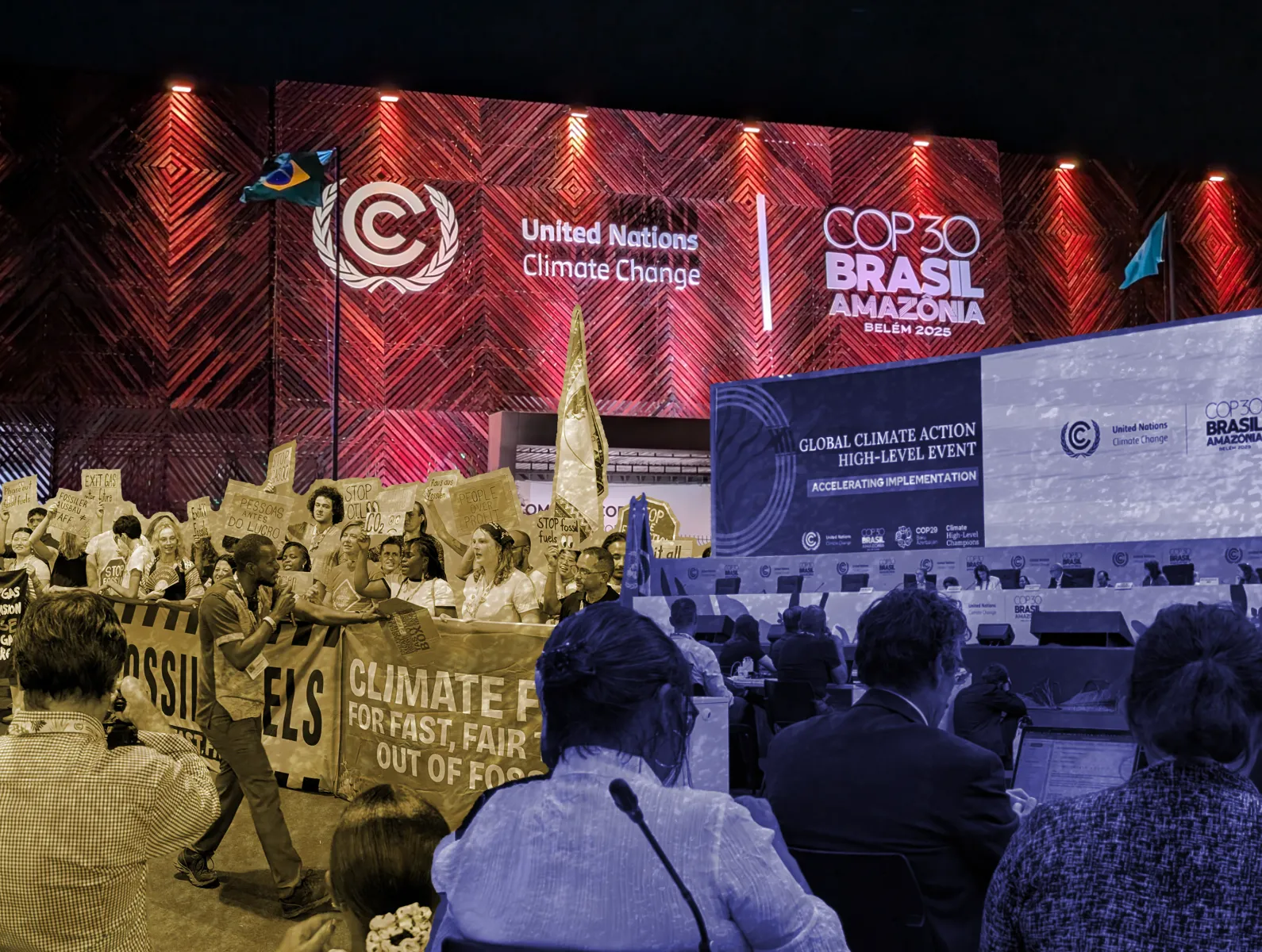

UBC recently sent 14 students, staff and faculty — some attending in-person and others virtually — to COP30, held in Belém, Brazil from Nov. 10 to 22.
COP, an acronym for Conference of the Parties (COP), is the main international climate summit convened under the United Nations Framework Convention on Climate Change (UNFCCC).
Some delegates who attended COP30 in person, such as Dr. Vikramaditya Yadav, an associate professor in the department of chemical and biological engineering at UBC, described the experience as “both intimidating [and] eye-opening.”
“This [conference] is a serious gathering. People really are debating and some of them have not slept for a couple of days. That's the level of dedication and focus they bring,” Yadav said.
The UNFCCC, adopted in 1992, is a global treaty designed to coordinate international efforts to reduce greenhouse gas emissions and prevent climate change. At COP meetings, countries review progress on climate commitments, negotiate decisions on mitigation, adaptation, climate finance and technology transfer, and collaborate with scientists, civil society and other stakeholders to advance global climate action.
As UBC delegates hold official observer status, their role was to observe the ongoing negotiations while also attending events, discussions, panels and plenaries linked to the research areas most relevant to each delegate.
Yadav, with expertise in industrial and environmental biotechnology, brought a practically driven perspective to the conference.
“I was looking a lot at the energy transition and climate technologies, so I attended a lot of these side events and national pavilions to see what’s the state of technologies all around the world … I [also] spent quite a bit of time in the formal discussion on the carbon market handle because that was something I have a lot of interest in,” said Yadav.
“The goal is to bring all of these learnings back to campus, and there is a very dedicated push towards actually trying to come up with some sort of formalized mechanism to impart this knowledge back to the community,” Yadav added.
Canada was one of the nations awarded Fossil of the Day, an award presented by the Climate Action Network, a global coalition of environmental organizations. The award highlights countries that are obstructing climate action or making the weakest progress toward global climate goals. This marks the first time in more than a decade that Canada has received this designation.
The Climate Action Network stated that Canada received the award in response to the federal government’s recent rollback of longstanding climate policies, its silence on key COP30 negotiations and its failure to advance new climate finance commitments. These actions — along with a push for LNG expansion and disregard for Indigenous rights — underscore a decline in Canada’s recent climate leadership, the organization said.
“I would not view getting Fossil of the Day as necessarily a slap in the face. I think this is just a wakeup call for the country,” said Yadav. “We really need to start thinking about how best to achieve [climate action] as a country,” and figure out how UBC can play a role in that.
One of the challenges for UBC observers during the conference was that many of the negotiations took place behind closed doors. Dr. Kathryn Harrison, a UBC professor of political science and an in-person delegate, noted that a draft agreement document on climate action was not released until the last few days of the conference, making it especially difficult for delegates to understand the progress and direction of the discussions.
As well, Canadian delegates did not receive a lot of information about Canada’s global climate change positions. “The Government of Canada only did one briefing for the Canadian delegation … it was actually quite difficult to know what was happening,” Harrison said.
Also putting a wrench in plans was a fire in one of the pavilions of the COP30 venue which prompted a full evacuation. Thirteen people were treated for smoke inhalation, and the blaze was extinguished in about six minutes after fire crews and security responded.
“[The fire] in the building kind of shut everything down … a day was lost,” said Harrison.
Beyond the conference’s roadbumps, Harrison was disappointed with state commitments to meet their climate goals. In accordance with the Paris Agreement — an international treaty in which countries commit to strengthen climate action — each country party to the agreement is required to prepare, communicate and maintain successive Nationally Determined Contributions (NDCs) — plans to cut emissions and adapt to climate change — every five years, including in 2025. However, “[countries] did so very late this year and did not really increase their ambition very much beyond business as usual,” Harrison said.
“They did a little bit, but not with the scale of ambition that we need to limit warming well below two degrees Celsius.”
Despite these challenges, the diversity of delegates at the conference was a hopeful sign to Yadav. This year’s COP included many Indigenous voices from all around the world, creating an environment which Yadav said allowed more diverse perspectives and fostered more inclusive and culturally informed discussions on climate action.
“There were a lot of Indigenous Canadians, Australians, Brazilians … there were a lot of protests by some of these, not just climate groups, but also Indigenous protests [in previous years] who were worried about them not being included in these climate discussions,” Yadav said.
Youth participation in the conference has also increased, with this year marking one of the largest delegations of youth leaders from around the world.
“One feedback to UBC [would be to] send more student delegates than we already do because this is where the future is going,” Yadav said. “On campus, if you look at the energy, this is palpable. People care about these conferences so might as well get more people involved.”
While countries tried to agree on action limiting the use of fossil fuels at the conference, only limited progress was made. Many countries pushed for a clear commitment to take action on fossil fuels, but others resisted any direct mention of them in the agreement. In the end, an agreement made at the conference only included an indirect reference to the “UAE Consensus,” the COP28 deal in Dubai that had already promised a transition away from fossil fuels. Rather than explicitly naming fossil fuels, the text acknowledged that earlier commitment in careful language, allowing the talks to move forward and avoid collapse.
Moving forward, the COP30 presidency will lead two voluntary parallel initiatives to halt deforestation and transition away from fossil fuels. This roadmap will gather stakeholders to outline possible steps and strategies, and set goals for future action.
UBC delegates will take the lessons learned from COP30 and use it to inform their own work. Now back from the conference, Harrison plans to follow how the presidency-led initiatives advance, with a particular interest on how “fossil fuel exporting nations engage constructively there, and especially Canada, because Canada was very silent on these issues.” This future work is important, she explained, considering the results of the conference.
“COP30 was pretty disappointing. The outcome was pretty disappointing,” she said.