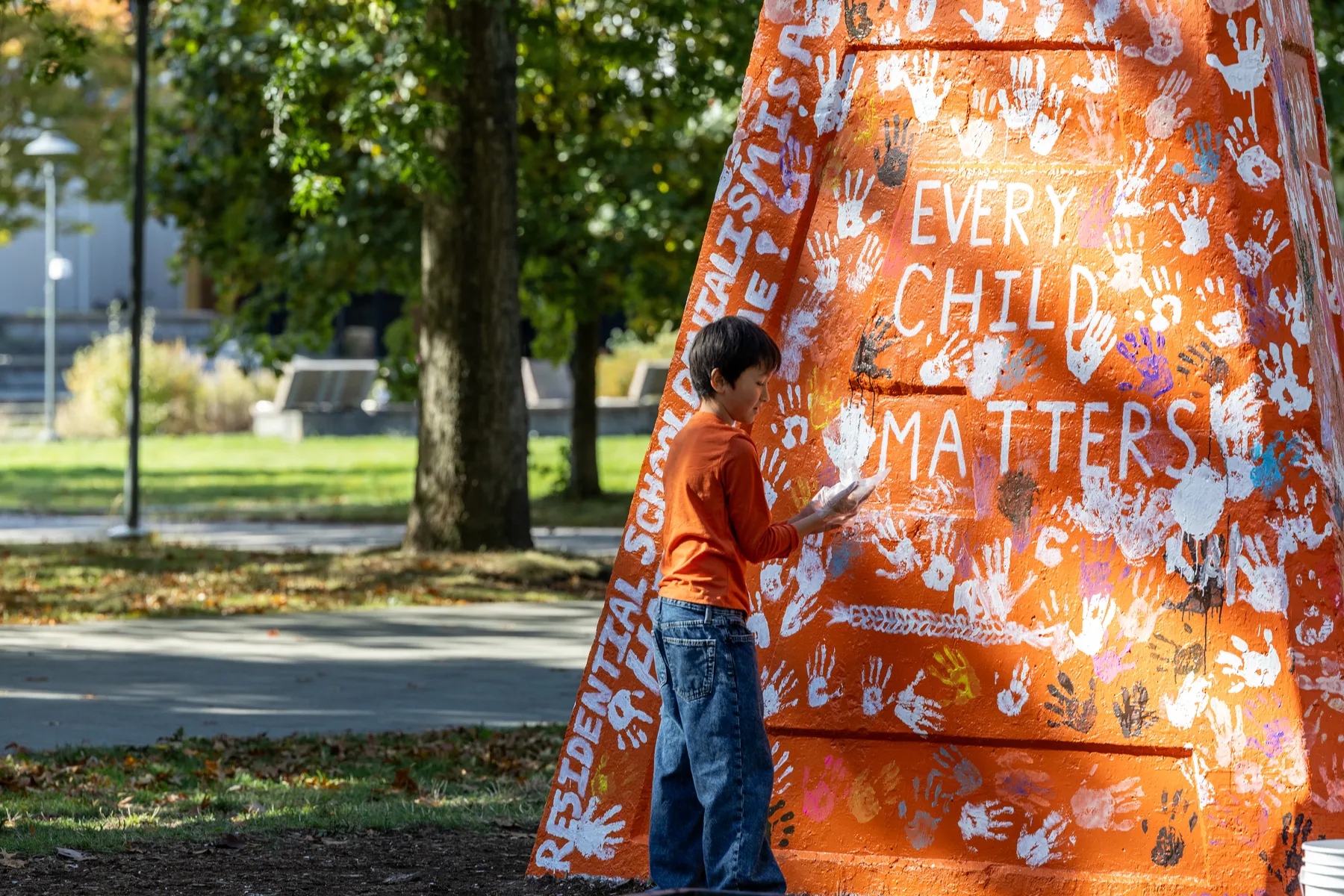


As Pacheedaht ElderBill Jones looked out to hundreds of people wearing orange shirts at this year's Intergenerational March, he thought he was seeing flowers.
"I realize now, looking at you, it is you. You are the flowers of truth and reconciliation, and you are the spreaders of truth," he said to the crowd gathered yesterday outside UBC's Indian Residential School History and Dialogue Centre.
Over the course of the afternoon, Elder Bill delivered two speeches that set the tone for the rest of the event. He spoke about the importance of reconciliation in the current political climate, and shared his vision for the role of youth in the process. "It took me a long time, 86 years ... or whatever it was, to realize that, yes, the youth are the flower of the future."
"We are in very ... tough times right now," he said. "We're struggling to deal with right-wing politicians and criminals that want to bring us down."
He touched on the issues Indigenous communities are facing as he outlined a path towards the future — a path of hope.
The march was first held in 2021, the same year the National Day for Truth and Reconciliation was established as a statutory holiday. According to UBC's AVP, Indigenous Affairs Clifford Atleo Jr., it was "initially a student-led initiative.”
“I don't think many people know this, but it's not an 'official' UBC event … It grew up sort of organically,” he said in an interview with The Ubyssey.
Each year, the march begins at the Indian Residential School History and Dialogue Centre and ends at the Reconciliation Pole. The theme for 2026 was "listening to the land." Starting at noon, the community saw performances from the Moon Tide Reconciliation dancers and L'il Bear (Aileen Michel), among others.
"We'd like to invite you to stand with us in thanks of the four directions — the north, east, south, west — the directions of the emotion, spirit, culture, and song; the identity of who we are as a peoples from the world community," one of the Moon Tide drummers said. "[Because] this didn't just happen here. It happened all over the world, and we celebrate with you the strength of our ancestry."
Auntie's Favourite Drum Group, a student collective on campus, performed three pieces. "We wanted to come sing and share some good medicine," Jazmine Andrew of the Lil’wat Nation said before sharing the "Women's Warrior" song from her home. "This song is calling on and honouring our women, our life-givers, for strength. It felt like a fitting song to share today."
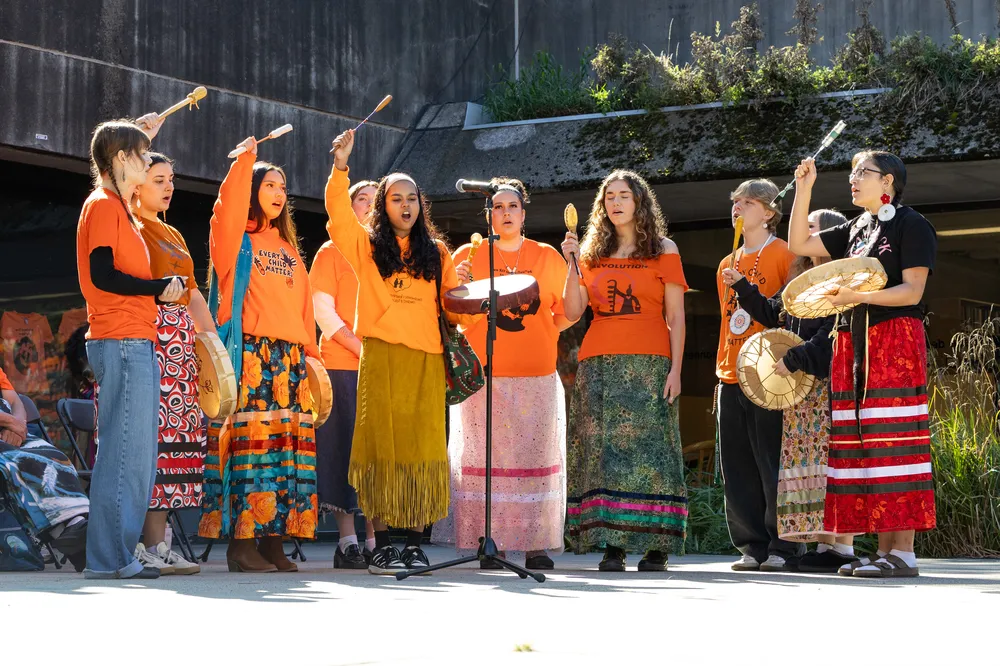
The Aunties Favourite Drum Group performing in the 'amphitheatre' below the clock tower.
After the performances, volunteers guided the walk along Main Mall. Catherine McInnis, a volunteer and a UBC engineering academic advisor, has attended the Intergenerational March since its inception. This year, she also brought her mother and son. "We're [an] intergenerational team."
For her, the event was an opportunity to listen to residential school survivors and reflect on advancing reconciliation. Speaking about the commemoration, McInnis' mother said that attending alongside her grandson was meaningful.
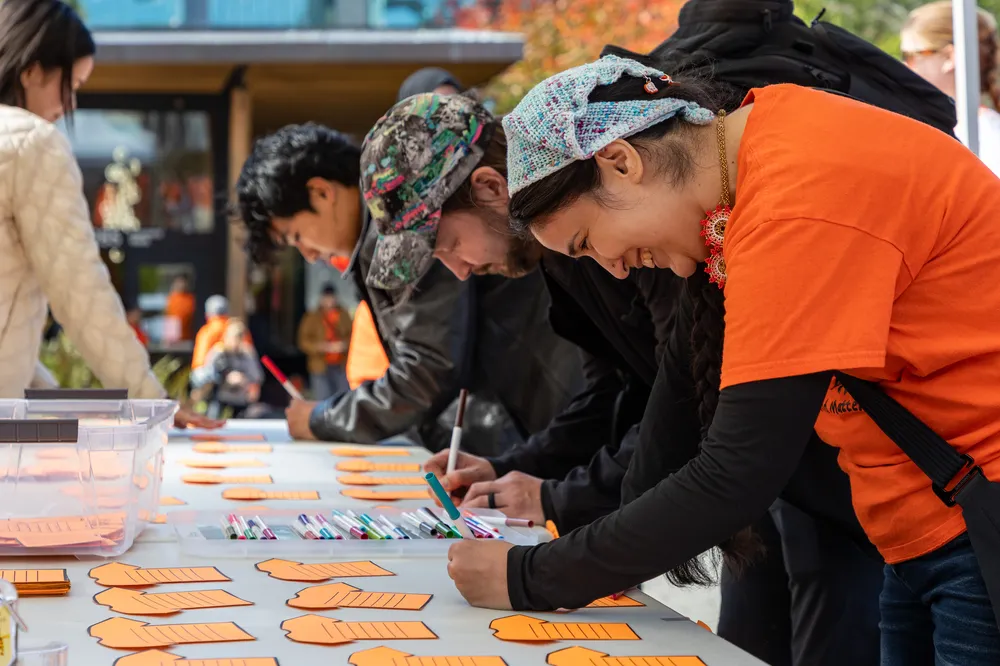
Throughout the event, volunteers encouraged people to write what reconciliation means to them and how they work towards it on orange shirt printouts.
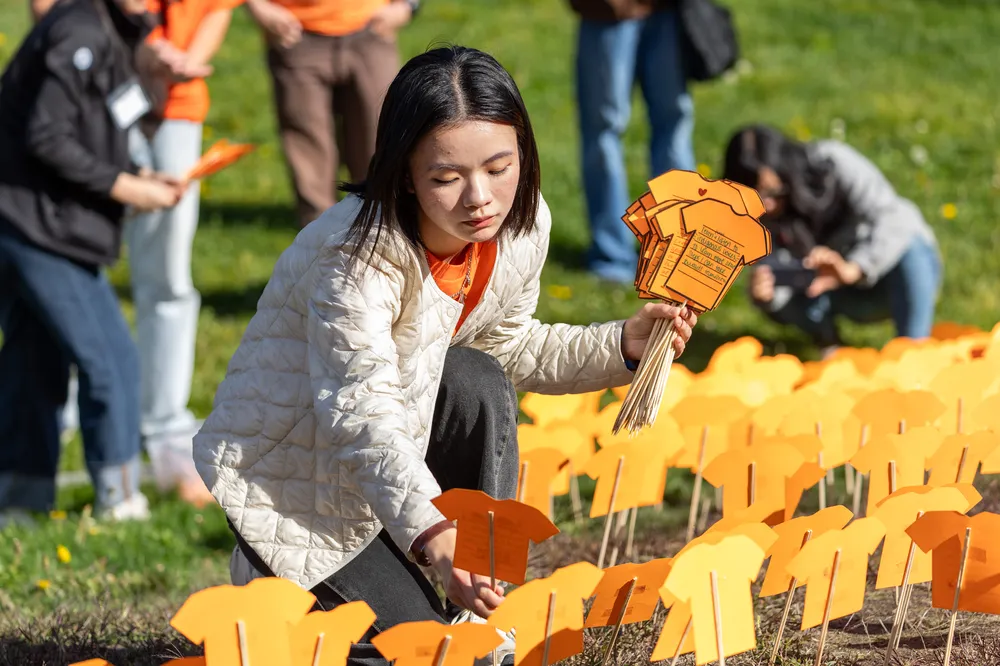
After the march, the printouts were planted across the Thunderbird Commons Field.
Ari Wilson, a granddaughter of residential school survivors, said that the event was a step towards better understanding their experiences alongside those of other survivors.
Residential schools are part of Indigenous history, but "they do not define our future," Lacey Bull of the Indian Residential School Survivors Society added.
"They tried to take away our culture, our identity, and our connection to who we are. Our future generations will not have to carry the same shame we were taught to carry. They will carry our strength, our culture, and our resilience ... We are still here and we are not going anywhere," she said.
"I always seem to forget what a privilege it is to be here today, to speak my native language, to be close to my family, and to participate in cultural practices," Wilson said.
However, Wilson thinks that more should have been done to raise awareness for Truth and Reconciliation. "Most of my friends [saw] it as 'Oh! No school today,' and never gave it a second thought," she told The Ubyssey. "Even one of my professors didn’t know why lectures were cancelled for today."
The march also attracted attendees from beyond campus. Christopher Coutrie, the Indigenous initiatives coordinator at a nearby hostel, referenced residential school denialists' visit to UBC earlier this year. Coutrie told The Ubyssey he was frustrated with the denialist "agenda" and hoped no agitators would attend the march.
In his view, that would take away from "the true intent of the event," which was solidarity with survivors. He believes in "maintaining healing ... and not feeding into their attempts to get a reaction." Coutrie added that amid his frustrations, the Elders have kept him grounded.
Like Coutrie, a number of speakers addressed a recent incident in the Tk'emlúps te Secwépemc Nation's territory in the B.C. Interior. On Sept. 27, a white nationalist group stood on the Pacific Way overpass and hung a banner featuring denialist rhetoric, while one pretended to dig with a shovel by the side of the road. Photos of the group sparked fear and outrage.
Five years ago, the Tkʼemlúps te Secwépemc said it had identified over 200 potential unmarked gravesites outside the former Kamloops Indian Residential School. Ever since, it's been the subject of far-right conspiracies that deny that children died there and demand evidence from the site to prove them wrong. In a statement addressing the rise of denialism late last year, IRSHDC Academic Director Johnny Mack said, "The record already stands, coherent and overwhelming."
Wade Grant, Liberal MP for Vancouver-Quadra — and the first MP of Musqueam descent — condemned the incident during his address before the march.
"Those thugs stood there ... thinking they were strong by ... attempting to intimidate the Kamloops people, standing with their masks on," Grant said. "That's not strong. What we saw today from Elder Bill is true strength. He has more strength in his pinky finger than they do in their entire bodies."
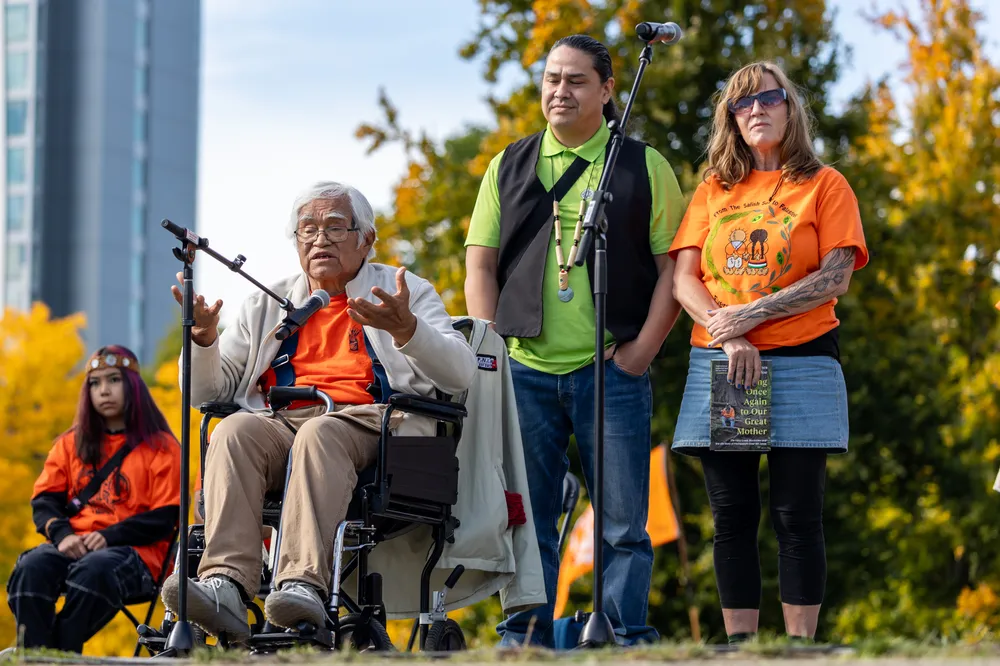
Elder Bill in front of the Reconciliation Pole addressing the crowd for a second time, accompanied by Richard Wolff and his co-author Karen Moe.
Elder Bill also addressed the incident in his remarks, calling on attendees to stand against hatred. "Your mission is to combat the right wing and to give your hand out in peace ... you are the flowers, the orange shirt flowers ... you are the health and the prayers and the hope of our people."
In his final speech, Elder Bill called members to action. "This is the world of our Great Mother, and we are the care persons of our Great Mother, and that is what we have to do now."
He spoke about his recent book with writer Karen Moe, Listening Once Again to Our Great Mother — an autobiography that focuses on his efforts during the Fairy Creek Blockade —as he related it to the theme of this year's march and his message of hope for future generations.
"The last thing [in] Pandora's box ... was hope. That is what you're going to thrive on. You're going to build this world in a way of hope and providence."