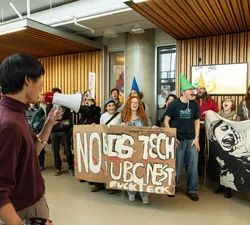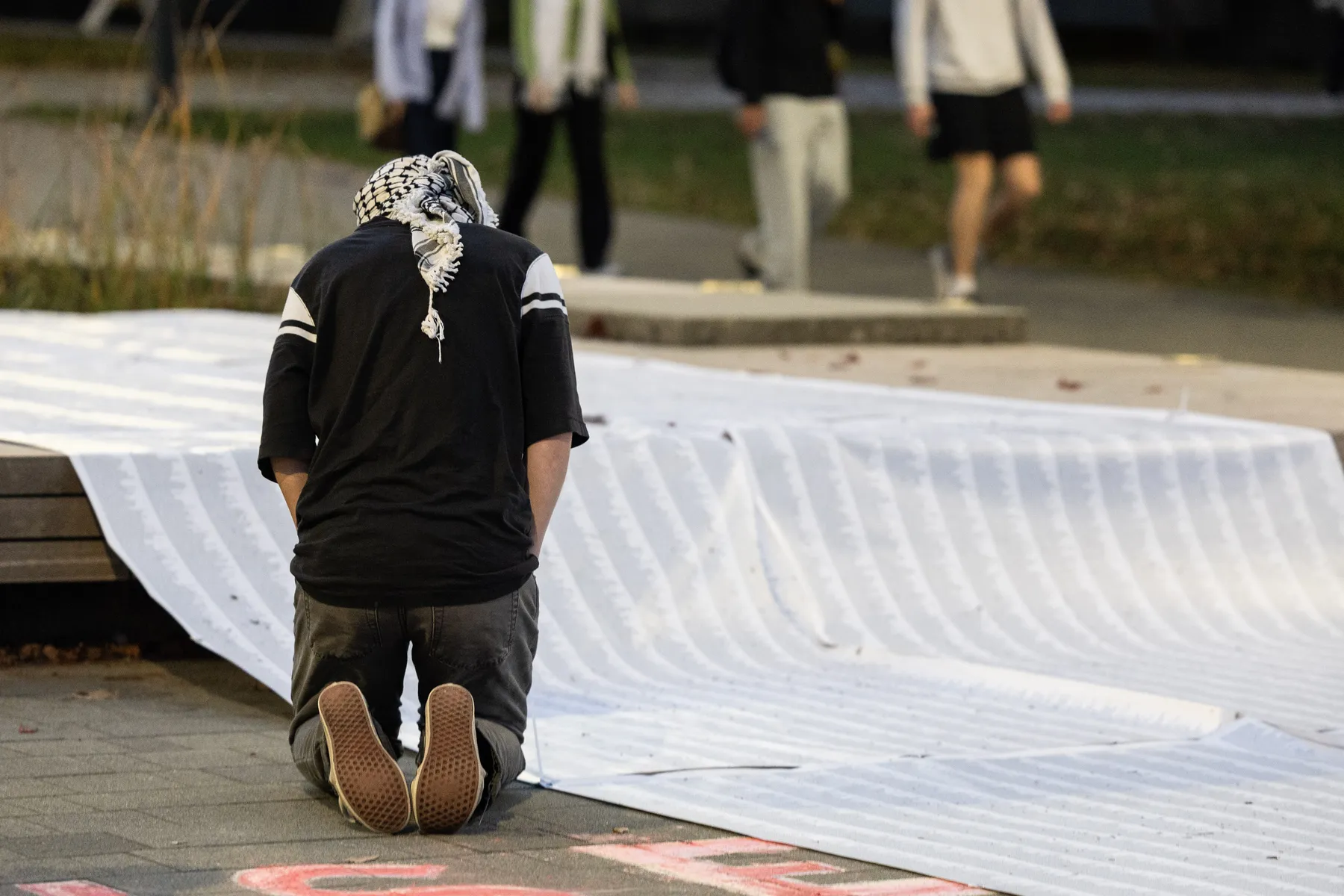


Nearly a hundred people gathered at the xʷməθkʷəy̓əm (Musqueam) Post on Wednesday evening at a vigil to mourn Palestinians killed in Gaza, exactly three years after Hamas’s attacks on Israel. Speakers tied the Palestinian struggle to Indigenous resistance on Turtle Island and to fights in the Philippines and Latin America.
On Oct. 7, 2023, Hamas — an armed group from the Gaza Strip — launched an attack on Israel, killing an estimated 1,200 people and taking 251 hostage. Following the attack, Israel launched an aggressive military campaign in Gaza and the occupied West Bank that has killed more than 76,900 Palestinians— more than three per cent of the territory’s pre-war population, according to the Gaza Health Ministry. This figure includes at least 21,000 children.
Last September, a UN commission found that Israel is committing genocide in Gaza within the meaning of the 1951 international convention. Genocide studies experts have also called Israel's actions genocide. The International Criminal Court has issued arrest warrants for Israeli Prime Minister Benjamin Netanyahu and his former Defence Minister Yoav Gallant for crimes against humanity and war crimes.
Though a ceasefire took effect at noon on Oct. 10, 2025, the ministry says Israeli fire has continued to kill more than 1,460 people since.
Last month, The Atlantic's Vivian Salama reported there is a "growing body of evidence" that Netanyahu had intelligence about an imminent attack by Hamas in the weeks before Oct. 7, 2023. Israeli officials have denied this.
Israelis vote Oct. 27 in their first election since the attack, with Prime Minister Benjamin Netanyahu’s handling of it emerging as a core issue. Netanyahu, Israel’s longest-serving prime minister, is seeking another term after about 19 years in the job across three stints. His main challenger is Gadi Eisenkot, a former military chief of staff under Netanyahu who lost a son in Gaza. Gal Eisenkot was an Israeli soldier killed during a hostage extraction mission, months into Israel's military campaign.
The vigil, organized by UBC Solidarity for Palestinian Human Rights (SPHR), was one of several Oct. 7 events at UBC. Hillel House, in partnership with Israel on Campus, Chabad, and a number of other clubs on campus, held their own programming, including a “Run to Remember” that invoked the slogan #NeverAgain. This event was not open to the public. The Ubyssey saw two RCMP vehicles parked outside Hillel House from at least 8:30 a.m.
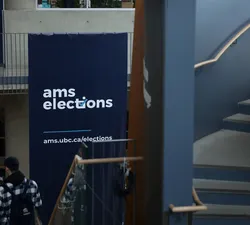
Starting at approximately 10 a.m., organizers set up a memorial outside of the AMS Nest, with a metres-long banner listing over 70,000 names of Palestinians killed since Oct. 7, 2023. At 6 p.m. SPHR members moved to the xʷməθkʷəy̓əm (Musqueam) Post and began the vigil. Dozens of attendees — fewer than the turnout last year — arrived while RCMP officers and UBC campus security watched from afar.
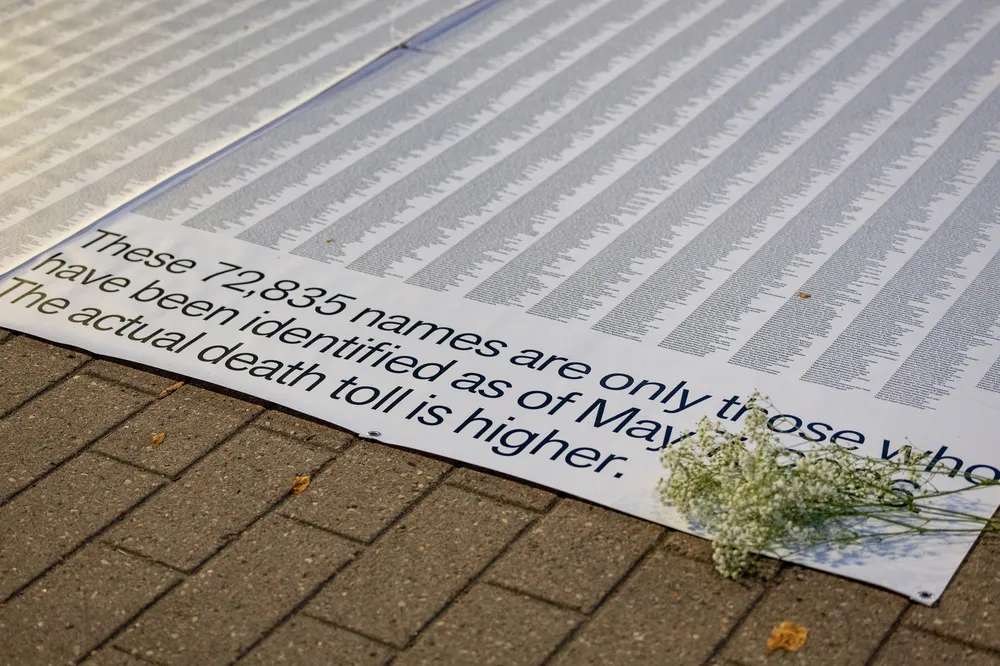
A long banner lays on the ground outside of the xʷməθkʷəy̓əm (Musqueam) Post, containing the names of Palestinians who have been killed since October 7, 2023.
The vigil began with a land acknowledgement. A speaker urged attendees to resist the Prince Rupert Gas Transmission pipeline, the dredging of the Burrard Inlet, and the occupation of Palestine.
A dua, an Islamic prayer, followed, recited first in Arabic, and then in English. It asked Allah to be the "supporter and helper" of Palestinians. "Be there for the protectors of Masjid al-Aqsa ... return Masjid al-Aqsa to the Muslims, [and] grant us prayer in the Masjid Al-Aqsa before we die," the English translation of the dua concluded.
This was a reference to the Al-Aqsa Mosque in Jerusalem's Old City, which has been under Israeli occupation since at least 1967. In April 2023, six months before the Oct. 7 attacks, Israeli police raided the mosque, and just over the previous month, Israeli occupiers have stormed the site 26 times, including on September 30 when hundreds besieged the mosque during the fifth day of Sukkot, a Jewish holiday.
At the recent vigil, one speaker told the crowd, "This night is not a night for rage. Tonight, we hold space for the ache."
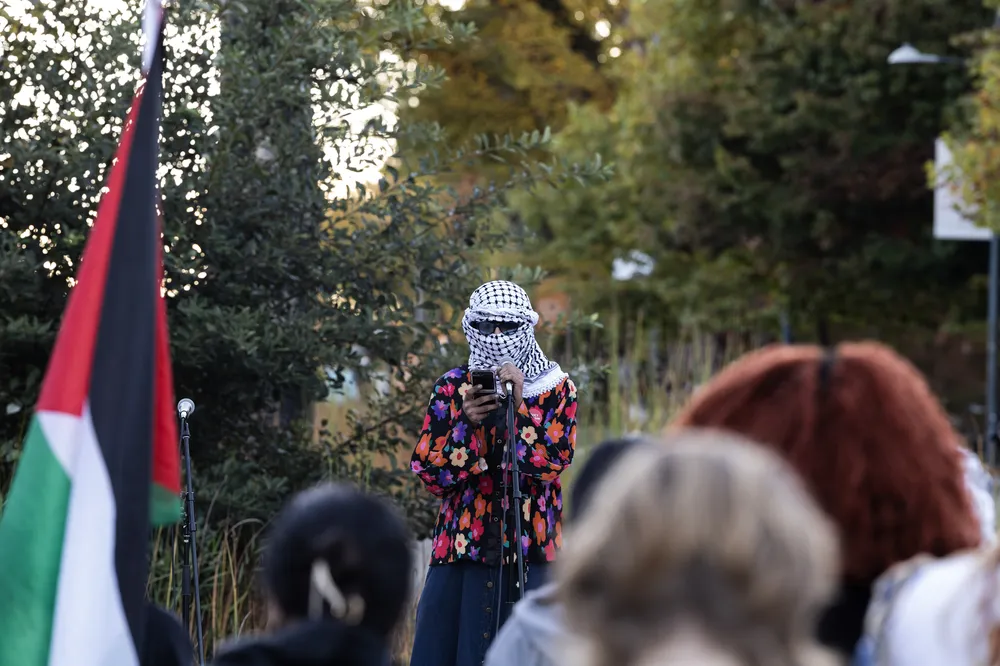
A speaker addresses a crowd of students in front of the xʷməθkʷəy̓əm (Musqueam) Post.
The crowd heard speeches from Sulong UBC (a self-described "national democratic Filipinx" organization),Climate Justice UBC, and Colectivo Mariposa (described onstage as an "anti-imperialist Latin American youth organization").
In an interview after the vigil, fourth-year student Erdani Cerca, a member of Colectivo Mariposa, told The Ubyssey their group was born two months ago at UBC and is now looking to expand beyond campus.
"We really want to connect with all Latin American migrants ... we're here today because we understand that the Palestinian struggle is a shared struggle."
GSS councillor and student senator Bryan Buraga also took the stage. In an interview after the event, they told The Ubyssey their attendance stems from both their personal values and their work as a student leader.
Buraga is part of a campus movement effort that aims to push UBC to cut academic ties with three Israeli universities — Hebrew University of Jerusalem, Tel Aviv University and the Technion – Israel Institute of Technology. A pamphlet distributed by organizers at the vigil claims these institutions uphold apartheid in Gaza and the occupied West Bank.
According to the pamphlet, "cutting ties" would mean ending memorandums of understanding and partnerships, ceasing student mobility between the universities, stopping joint research and exchanges, and refraining from forming new ties “with institutions complicit in apartheid.”
During the last UBC Vancouver Senate meeting, a motion that would have seen faculty and librarians express their views on the "cutting ties" in a non-binding referenda was initially going to be put to a vote, but was removed from the agenda. Buraga was the motion's proponent.
They told The Ubyssey that "after community consultation," they found that bringing the motion to the Senate floor "wasn't the best way to move forward." Nonetheless, they said they remain committed to the issue, which they campaigned on during Senate elections last academic year.
Senators are anticipating a report from Provost Gage Averill's group on global partnerships, which is currently working to finalize a framework for such collaborations. Buraga, however, said they "honestly don't know" what to expect from it.
"I would like to think the university has listened to the will of students and has crafted something that deals with the current situation and the need to cut ties with Israeli institutions, but also is broad enough to cover other human rights abuses in the future and safety considerations for students," they said. "[I'm] optimistic, but if that's not the case, the student body will make sure its voice is heard for sure."
Much of the evening was poetry. Near the end of the vigil, a reader performed "The Palestinian Chalk Circle" by Mahmoud Darwish, often regarded as Palestine's national poet, partly for writing the Palestinian Declaration of Independence in 1988.
The poem follows a Palestinian citizen of the Israeli state through his arrest, a denied travel permit, and a court that has been moved into a prison. It was during the reading of this piece that a man walked into the quiet crowd and disrupted the proceedings.
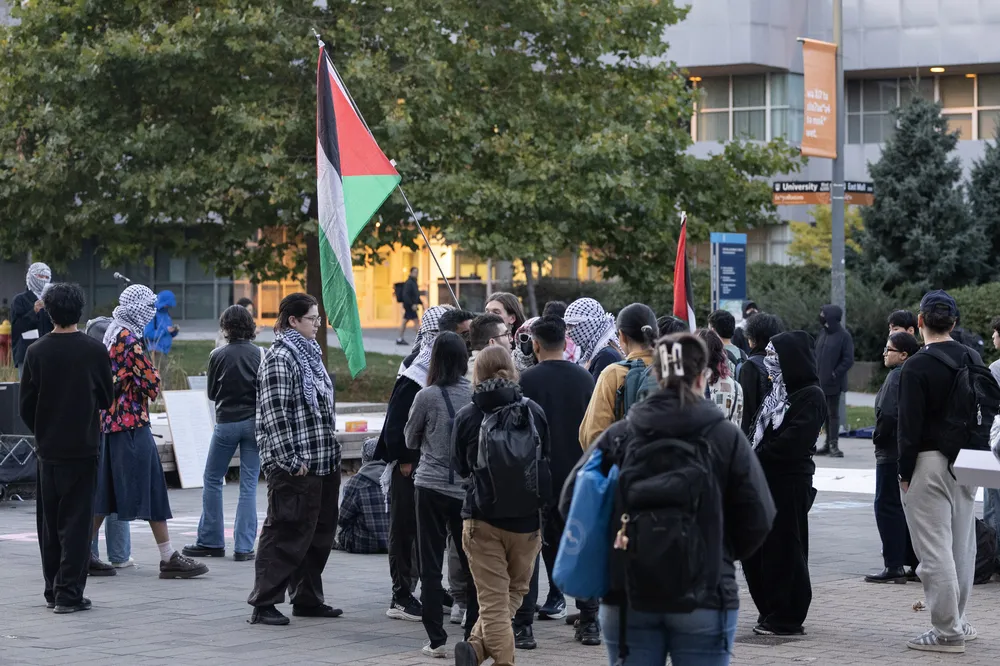
Community members gather around a list of names as speakers share statements of solidarity and read Palestinian poetry
The Ubyssey has identified the man as Arya Noeerazlighi, a master's student in the faculty of science who ran unsuccessfully for VP Students of the GSS in 2025.
"I'm here to question you — what's your feedback?" Noeerazlighi loudly asked the attendees who began surrounding him.
He stated that he was a "patriot ... born and raised in Iran." Pointing to Palestinian flags and keffiyehs worn by some attendees, he claimed, "I'm yelling ... because you have the terrorism signs here ... "
Several attendees kept Noeerazlighi separate from the rest of the crowd as the poem continued through the interruption. Naheed Gilani was in close proximity to the agitator at the time. In an interview after the vigil, Gilani told The Ubyssey that he was there to mourn and someone "walking in and being distinctively loud" did not sit right with him.
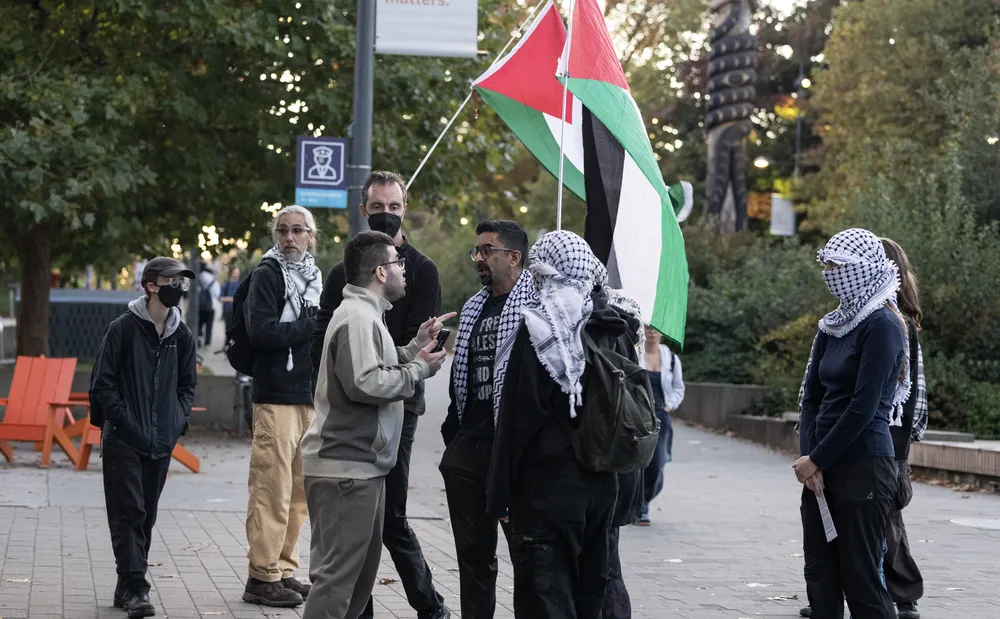
Noeerazlighi interrupts a poetry reading as several vigil attendees keep him separate from the rest of the crowd
"I really feel bad for you, this is shameful," Noeerazlighi said as he pointed to the keffiyehs worn by attendees.
On this, Gilani said, “To a lot of people, this is a cultural symbol. It resembles so much. It has so much history ... And for somebody to come here and try to strip that away, regardless of the pain or suffering they felt where they’re from, is dishonourable."
The keffiyeh is a traditional headdress worn by Palestinian farmers and Bedouin (nomads). It was a political symbol during the Arab Revolt, when rebels covered their faces with it and British Mandate authorities banned it. In the '60s, it became increasingly associated with Palestinian nationalism and solidarity against the Israeli occupation. The keffiyeh holds no religious meaning and is worn by people of all backgrounds.
"Nobody should tell me ... what symbols of cultural solidarity I can hold, and no matter what [another] person’s suffering is, it doesn’t take away my right to show my solidarity with the Palestinian people,” Gilani said.
A previous version of this story stated that 73,000 Palestinians have been killed by Israel since Oct. 7, 2023. The article was updated on Oct. 9, 2026 at 4:35 p.m. to correct this error. The most recent numbers from the World Health Organization on Oct. 6, 2026 show that 75,717 people from Gaza have been killed since Oct. 7, 2023. An additional 1,215 have been killed in the West Bank. The total number of Palestinians killed thus exceeds 76,900. The Ubyssey sincerely regrets this error.
This story has been updated to remove specific, immaterial details about an attendee we determined may be at risk of transnational repression.