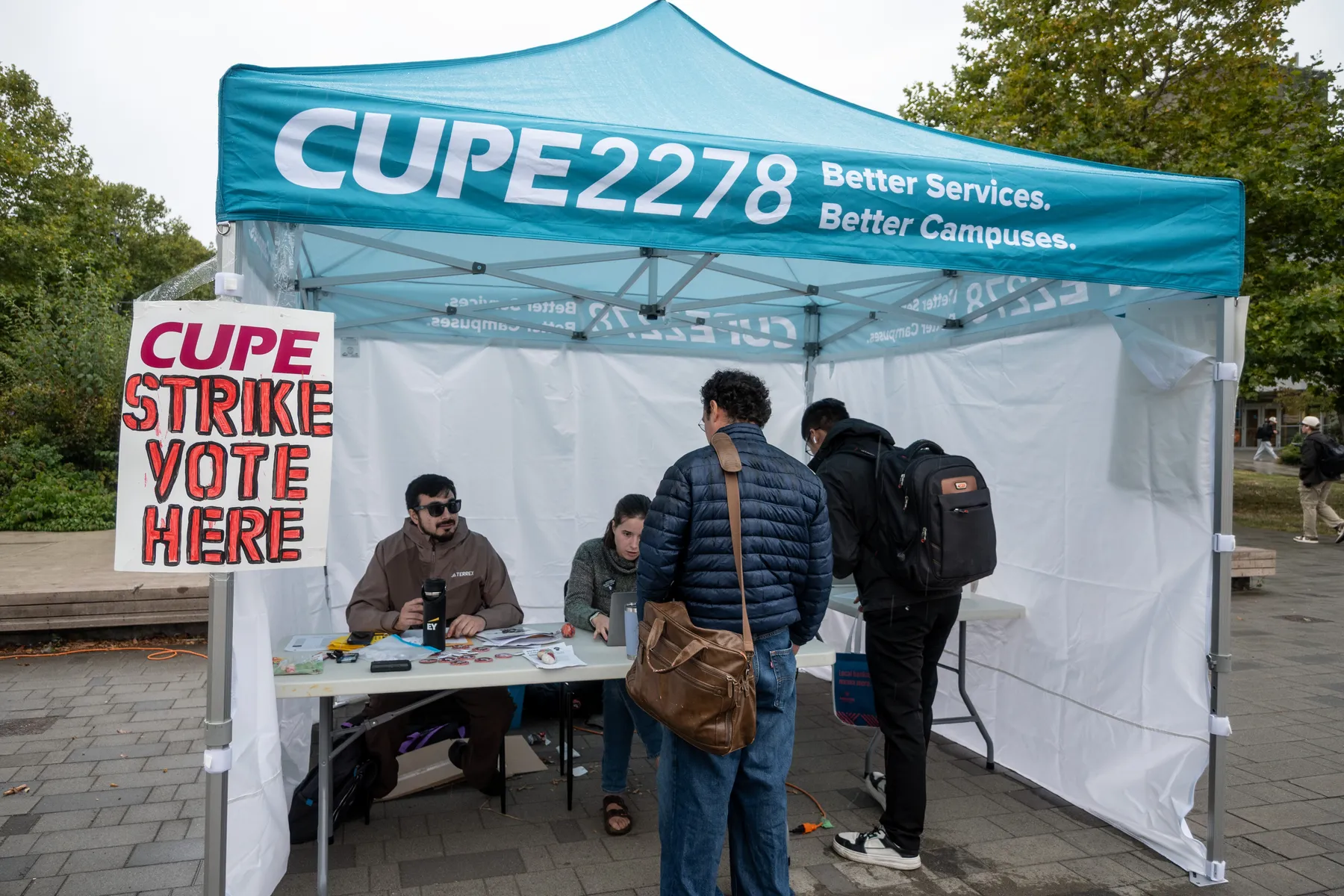

CUPE 2278 members have voted with 95.4 per cent in favour of going on strike. This result gives the union power to call a strike any time within three months and with 72 hours notice.
"It's a very strong strike mandate from our members that shows [them] and the university that we are prepared to do what is needed to get the fair deal that our members deserve," CUPE 2278 President Jessica Wolf said.
Wolf claimed the union had "record turnout in terms of member engagement," though she did not share specific numbers for turnout.
"We are prepared to return to bargaining. I would say the ball is now in the employer's court, and if UBC doesn't get serious about bargaining, then they will be forcing us onto a picket line," Wolf said.
In a statement to The Ubyssey, UBC spokesperson Erik Rolfsen wrote: "The university is preparing resources for our community to provide information and to support teaching, learning and essential operations if a strike occurs."
He added that in such a case the university will "remain open and classes will continue, although some Vancouver campus operations may be affected by job action."
The strike vote came following a series of escalations by CUPE 2278 in a now year-long collective bargaining process. In late July, the union filed for third-party mediation, claiming UBC was not "engaging seriously" with their proposals. A month later, CUPE 2278 leadership decided to call a strike vote claiming mediation was turning unproductive.
The university claims their assistance to meetings throughout the bargaining process is evidence of a willingness to negotiate in good faith. They have also pointed to having signed and ratified agreements with seven other unions this cycle.
"UBC remains as always committed to reaching an agreement," Rolfsen wrote.
CUPE 2278 has been asking for employer-paid health care — a benefit other staff at the university have access to — as well as limits on class sizes and "balanced" workloads for TAs, protections for academic freedom, higher wages for GAAs, and for the university to end minimum research funding clawbacks.
Clawbacks are an industry practice wherein the university discounts TA salaries from the minimum research funding graduate students who work as TAs have access to. They can also take other forms, like discounting external funding a graduate student has been awarded.
As of September 2026, UBC Vancouver must guarantee full-time PhD students a minimum of $40,000 annually for the first four years of their program. The union claims that clawbacks effectively make wage increases that were gained in bargaining disappear. According to CUPE 2278, UBC has said clawbacks do not belong at the bargaining table.
In a press release shared with The Ubyssey, Wolf wrote: "A job action that would disrupt classes would be a last resort."
An earlier version of this story stated that UBC had been reached for comment. The Ubyssey has since received a statement from the university. This story was updated to include the statement on Sept. 28 at 11:06 a.m.
An earlier version of this story incorrectly said "minimum research funding at UBC was raised to $40,000." The $40,000 minimum applies only to eligible full-time UBC Vancouver PhD students for their first four years, effective September 2026. This story was updated on Sept. 30 at 6:44 a.m. to reflect this change.