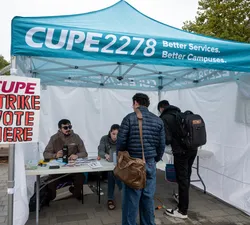


CUPE 2278, the union representing TAs and other academic assistants on UBC's Vancouver campus, has voted to ratify their collective agreement with the university, ending the possibility of a TA strike.
Union members voted 96.1 per cent in favour of the agreement. Its full terms, formed earlier this month, were shared with members last week but have not yet been made public.
Contingent upon the university's ratification, CUPE 2278 President Jessica Wolf told The Ubyssey that a strike is no longer a possibility and that union members are "happy with this agreement."
Wolf said the university is “making plans to vote ... soon,” but did not have a specific date.
In an email to The Ubyssey, university spokesperson Thandi Fletcher said the university is making progress on its ratification process and expects to "complete this process in the next few days."
"We are pleased that CUPE 2278 members have voted to ratify the four-year agreement," Fletcher said, "and we thank both bargaining teams for their hard work."
She further stated that "students can expect courses and teaching assistant support to continue as usual."
The union won a “supplemental” health plan that will work alongside the AMS/GSS Health & Dental Plan, Wolf said, which she called a “huge win.” Health care has “consistently been the biggest priority for our members,” she added.
Until now, members have not had employer-provided extended health or dental coverage through their CUPE 2278 jobs, and she said the plan adds thousands of dollars in coverage.
Also among the terms of the agreement, exam invigilators at the Centre for Accessibility won paid 15-minute breaks per shift, Wolf said, along with changes to hiring, training, scheduling, and leave. Graduate academic assistants, who signed to join the union in July 2023, now also have a first contract.
The union also asked for limits on class sizes and "balanced" workloads for TAs. Wolf said the union did not win hard limits on the issue of workloads, but got commitments from UBC to keep discussing the issues, to identify relevant information, and to set up a better process for addressing staffing. She called it “a good step to build on moving forward.”
She said the union prioritized pay equity, with targeted increases for the lowest-paid members, including exam invigilators and undergraduate TAs. The agreement also eliminates the UTA II classification, which moves all undergraduate TAs into the higher-paid classification.
General wage increases are flat rather than percentage-based, which Wolf said is more equitable and keeps the lowest-paid workers from falling behind.
She said CUPE has achieved "some really big wins in this agreement," and she attributed the success to the support of the union's members and a strike vote that saw over 95 per cent of members vote in favour of job action in late September.
The agreement also includes “language limiting the minimum funding clawback,” which Wolf said “UBC was previously unwilling to discuss.” Clawbacks refer to the practice of discounting a graduate student’s TA salary from their minimum funding package. They can also take other forms, such as discounting external funding awarded to students.
Wolf said the university had previously framed the issue "as a student issue rather than a worker issue." The agreement now sets a "fixed dollar amount limit" on how much can be discounted from their research funding.
Wolf said that throughout this bargaining process, the union has "learned that if we want better learning and working conditions at UBC, we have to fight for them." She added that "having collective support and building collective power is what works."
UBC's Vancouver Senate, which is meeting tonight, was expected to hear a report on the formation of an ad hoc Labour Disruption Preparedness Committee. Presumably, the committee will no longer be needed.
You can follow our live coverage of Senate here.
A statement from UBC's acting director of news and university affairs, Thandi Fletcher, was added at 3:23 p.m. on Oct. 23, 2026.