

On MacInnes Field, a few dozen students are sprawled in a circle. They're writing messages on poster boards with colourful Sharpies. One sign reads "[Seven hours] is a flight from B.C. to Peru." Passing markers back and forth, people chat in twos and threes.
Over the course of the hour-long "Art Jam," many students arrive straight from midterms, drop their bags, and grab crafting materials. Others who had arrived earlier, get up, dashing off to go write their own tests.
This was the start of Thursday's "We are Jane Doe" solidarity march at UBC, just one of many protests that have erupted across university campuses in the past week, following a former Cornell student's lawsuit — filed on Sept. 16 — against Cornell University and seven members of the Chi Phi fraternity.
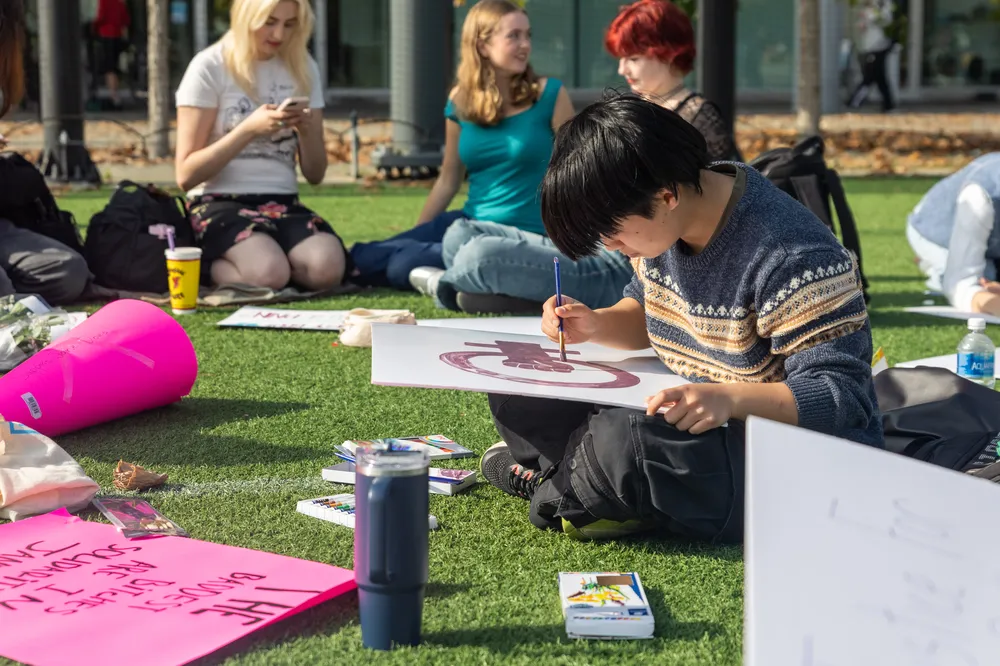
A student on McInnes Field paints a poster during the "Art Jam" before the march begins.
The student, known only as Jane Doe, alleges that seven members of the fraternity drugged and sexually assaulted her at the fraternity house in October 2024 over the course of several hours. The lawsuit further claims that Cornell did not do enough to punish the offenders after conducting an internal investigation.
When Doe went to the university's police department, Tompkins County District Attorney Matthew Van Houten initially declined to pursue criminal charges, saying her first statement to police didn’t allege criminality. Her lawyer, Thomas Giuffra, told the Associated Press she was “misled” about the status of the investigation, and told that it was still ongoing.
The DA has since reopened the case. New York Gov. Kathy Hochul appointed Attorney General Letitia James as special prosecutor, and Cornell has announced an independent review of how it handled the case. The lawsuit has attracted widespread attention and ignited outrage against Cornell and the involved fraternity.
Many on MacInnes Field saw the alleged assault as a reflection of a larger issue. “What happened at Cornell was obviously an egregious act of violence, but it also isn’t isolated to just that college campus,” Cecilia Lee, a UBC graduate student, said. “It happens everywhere.”
For student Serena Cooper, attending wasn’t even a question. “When a group of people, or somebody, anybody ... has gone through something that really hurts them or impacts their life, they deserve to see that kind of support,” Cooper said. “It’s just kind of automatic ... [they] should know that people are on their side.”
Mackenzie Packwood, another student, agreed. “I can’t even imagine how terrified Jane Doe must have been, and how terrified she still is ... [and] how terrified the rest of the victims are.”
Timon Mao, a third-year UBC student, said he came to show that “there’s people on campus who are pushing back against frat culture.” Sexual violence on campus, he said, is “an issue that [UBC fraternities] are actively a part of.” Many UBC fraternities have posted statements on Instagram supporting Jane Doe. However, Mao said that “a half-hearted acknowledgment ... is not even nearly enough.”
The UBC march was organized among students online, led by Adam Schmitt, Isabella Korkor, and Paula Jiang. "It all started on Reddit, surprisingly," Schmitt said. "I just kind of put out feelers ... like, is anyone interested in joining [or] organizing a march?"
Jiang said many of her close friends have experienced harassment and stalking on campus. “Every time it’s been reported ... it’s been so frequently invalidated, and it’s just heartbreaking for me to watch,” she said. “[It’s] probably happening to other people on campus as well, and we don’t have the resources or the community to do anything about it. And this gave us a platform to do that, so it was really meaningful.”
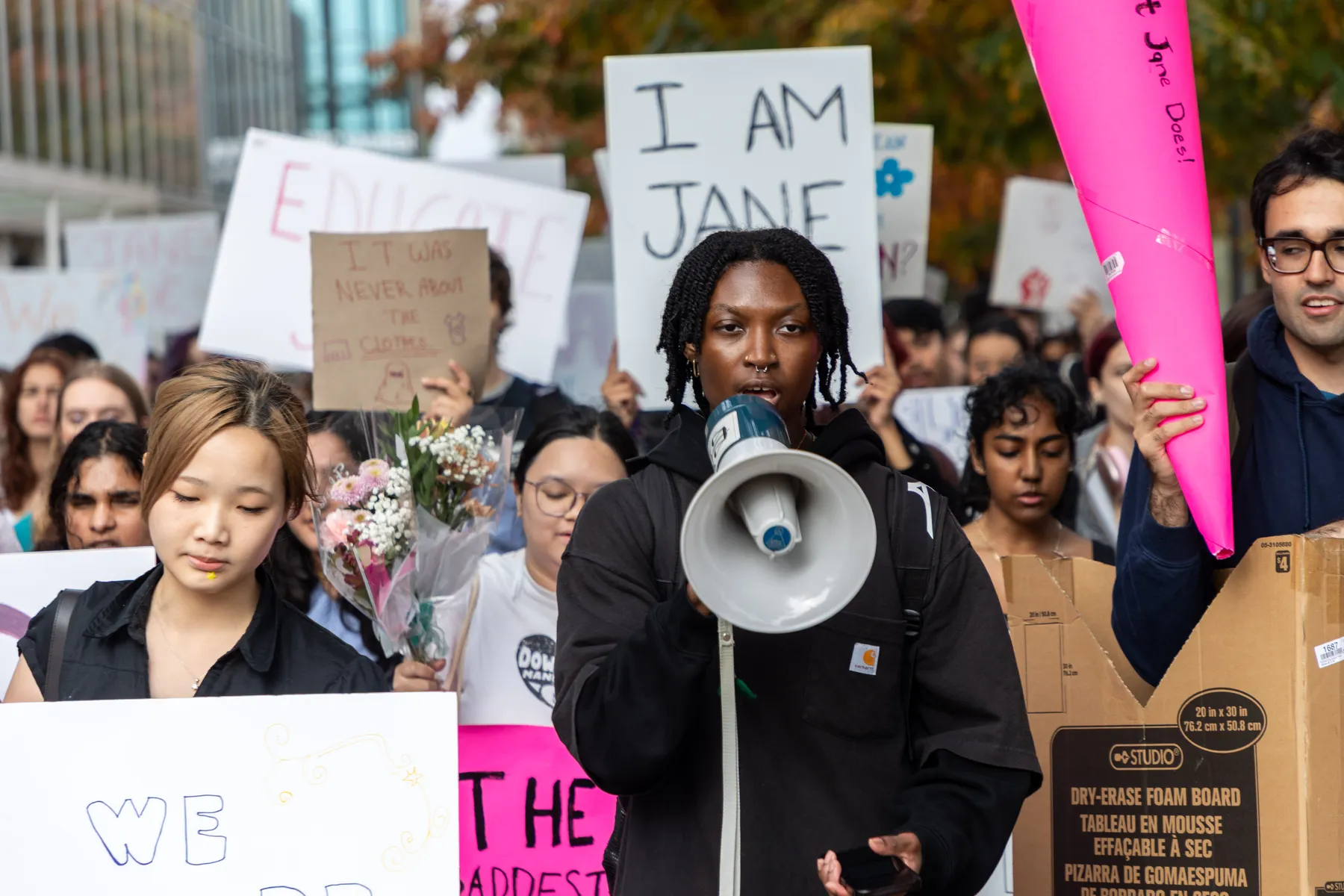
After finishing their signs, protesters marched down Main Mall, shouting “we want justice, we want change.” They stop at the Sauder School of Business. Turning to face the crowd, Schmitt reminded them why: in 2013, a recording surfaced of Sauder students chanting in celebration of non-consensual sex with underage girls during orientation week. The chant had reportedly been used at Sauder orientations for twenty years. “We’re here to show them that no, that’s not okay,” Schmitt declared into a megaphone. “And we stand with Jane Doe.”
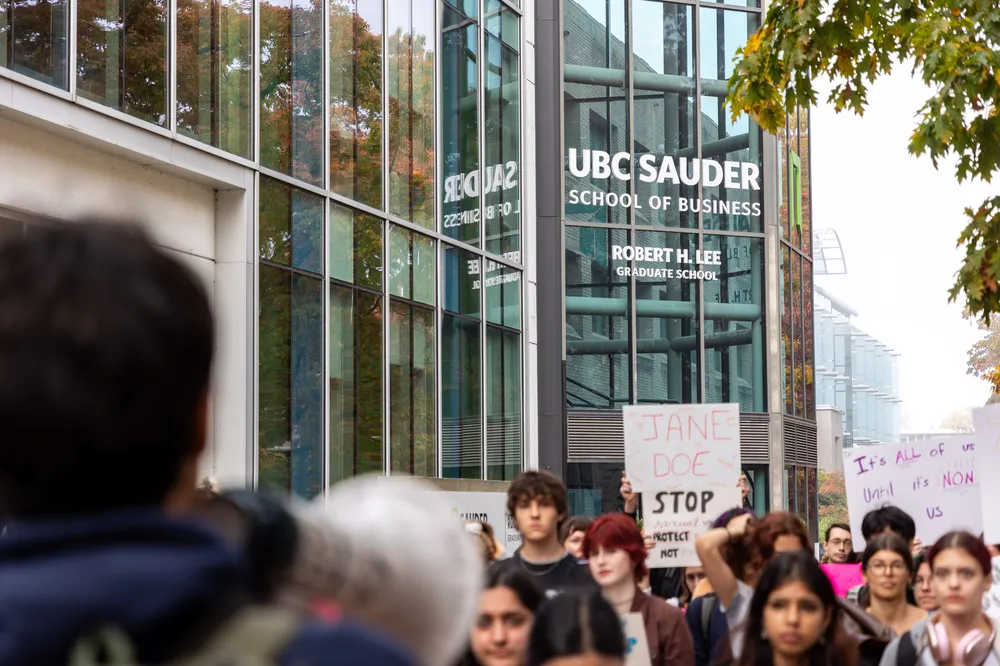
Protesters stop in front of the Sauder School of Business. In 2013, Sauder was at the centre of a national story about "rape chants" at the start of the school year.
However, the Sauder rape chants aren't UBC's only public controversy when it comes to sexual violence. The university didn’t have a stand-alone sexual assault policy until 2017. It got one only after a CBC investigation, student lobbying, and a provincial law pushed it to act.
In 2015, 28-year-old Dmitry Mordnivov, a PhD student in UBC's history department, was quietly expelled. Since spring of 2014, Mordnivov had received at least six complaints of harassment and sexual assault. A CBC investigation later that year reported that UBC had been slow to act and had allegedly suggested some complainants stay quiet. The university also reportedly urged the complainants to engage in mediation with Mordnivov, which they refused.
After the story, UBC apologized and commissioned an independent review, which identified unnecessary delays and unclear reporting policies. But it ultimately found UBC hadn’t broken its own rules.
Following widespread debate around university standards for responding to reports of sexual violence, the B.C. legislature passed the Sexual Violence and Misconduct Policy Act in 2016. It requires every public post-secondary institution to have a publicly available policy covering prevention and procedures for complaints and reports.
The act further requires institutions to review their policies at least every three years and consult students when they do. University administration must report to the Board of Governors each year.
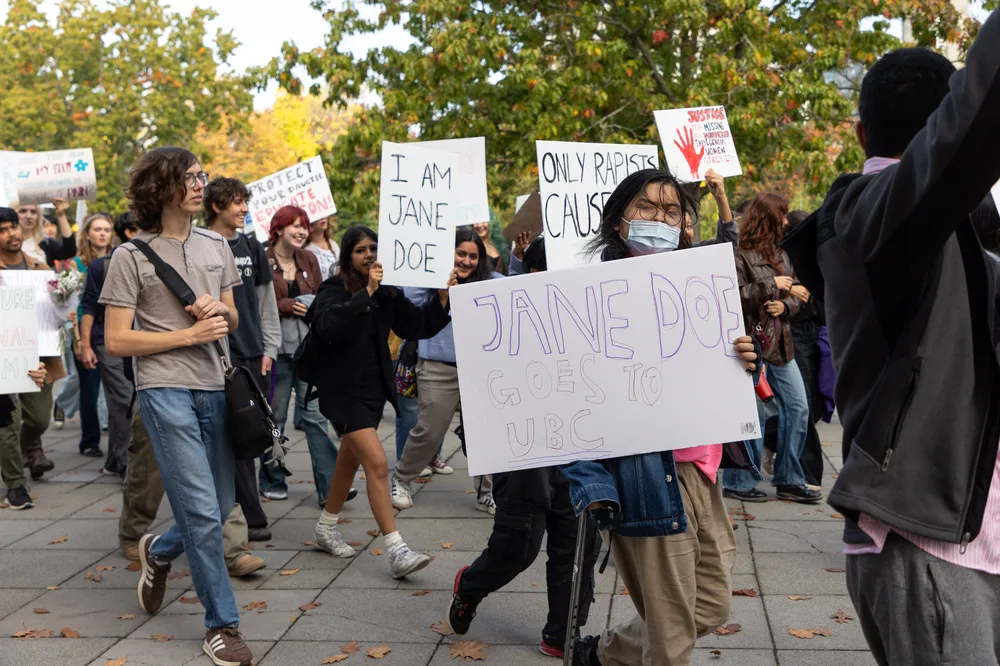
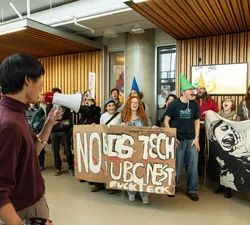
Protesters march down Main Mall with their finished posters, chanting "we want justice, we want change."
UBC’s Policy 131, now SC17, took effect in May 2017, a day before the provincial deadline before the statute came into effect. It created the Sexual Violence Prevention and Response Office, which offers confidential support, and the Investigations Office, which investigates reports at arm’s length.
In 2018, the AMS wrote to the board with “significant concerns” about the rollout, and UBC conceded it had underestimated the resources needed. The 2020 policy revision added a trauma-informed approach and protection from discipline for drug or alcohol violations when reporting. The AMS and the Sexual Assault Support Centre (SASC) said gaps remained.
The current version took effect on October 1, 2024. It clarified that UBC keeps jurisdiction to investigate even if the respondent leaves the university. Mandatory training for all faculty and staff followed in January 2025.
A decade later, the province has rewritten the law. Bill 18, the Sexual Violence Policy Act, passed third reading in October 2025. Among other changes, the new law adds objectives for universities to foster cultures of consent on campuses, implement prevention and education measures, and respond to the needs of those disproportionately affected by sexualized violence.
Despite being passed, the statute has not come into effect yet, as it awaits final approval from Cabinet — presumably to give post-secondary institutions time to implement it.
The questions around how institutions handle allegations are also in court this week. Steven Galloway, the former chair of UBC’s creative writing program, was fired after a student accused him of sexual assault in 2015. He was never charged, and a report produced for UBC by former judge Mary Ellen Boyd concluded the allegations were unsubstantiated. He sued several people in 2018 for defamation, and the trial began in B.C.'s Supreme Court on October 5 of this year. The case's circumstances predate UBC’s current policy.
Last week, SASC released a statement standing with Jane Doe and survivors of sexual violence. A group of constituencies — including engineering, economics, science, forestry, music, arts, commerce and the Graduate Students Society — also recently released a statement on sexual violence. In it they said "sexual violence has no place in our campus communities," and committed to develop "sustainable measures that strengthen safety" at their events.
As Thursday's march proceeded down Main Mall, some pedestrians filmed on their phones, while others crossed the grass to make space. Many joined the protesters’ ranks. By the time they arrived at the field by the Forestry Building where the vigil would be held, more than fifty were marching behind the organizers. “Universities, hear our call,” they chanted. “Listen to your students, listen to them all.”
The organizers stood on the grass, while others filled the stone steps around the field. Korkor and Jiang invited participants to speak. There was hesitation, but a few stood and made their way to the microphone. At least a dozen spoke by the end of the event.
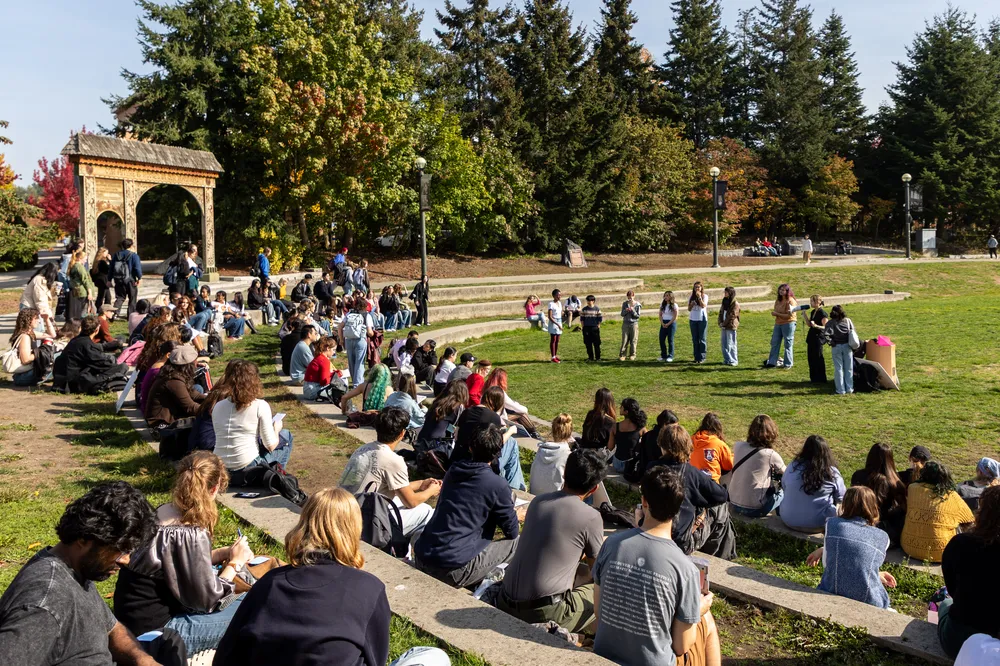
Protesters filled the steps at the field by the Forestry Building, where participants lined up to speak.
"We were not expecting that many people to come up," Korkor said.
Jiang looked out at the sea of expectant faces that surrounded her. "What kind of environment allows sexual violence to be so prevalent, and what kind of role are we playing in creating that environment?"
Some speakers railed against the injustice they saw around them, both on campus and globally. Others shared their own experiences as survivors. As they spoke, more rose from the steps, forming a growing line behind the microphone. “I’ve only told two people this,” one speaker said, “but I am also Jane Doe.”