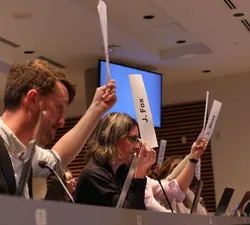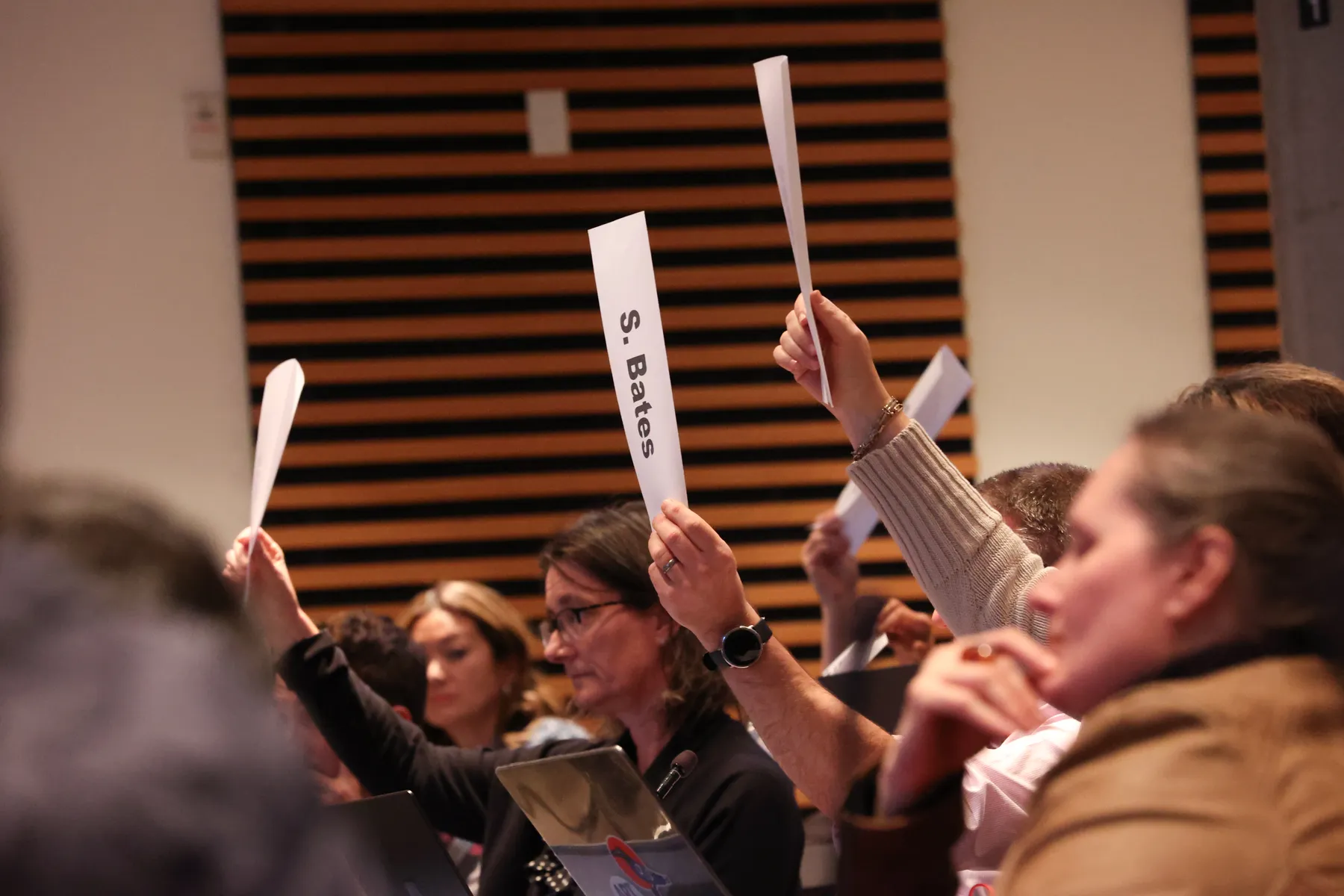

Senate met for the last time this year to discuss the student experience of instruction survey data, look at UBC’s research accomplishments and hear the annual library report.
Here’s what you might have missed.
UBC’s research funding totals over $900 million
Vice-President Research and Innovation Gail Murphy presented UBC’s overall research and impact review for 2024-25. She said $841 million of UBC’s research funding came from Canadian sources, with total funding reaching $936 million for 10,120 projects.
“One new service we're really proud of is working on an alternative Indigenous ethics application,” said Murphy, adding that this was done in collaboration with Indigenous communities. This pilot application is meant to aid in supporting research initiatives that are reciprocal, are community-led, legitimize Indigenous ways of knowing and promote Indigenous peoples’ self-determination, according to the UBC website.
She said that they have also instituted new equity, diversity and inclusion (EDI) education, now available to researchers.
Research funding has come from across the globe, with UBC being the top recipient of European research funds in the country, according to Murphy.
Some of the projects and studies highlighted in her presentation include development of AI tools to predict sepsis in newborns, findings that show renewable energy is more popular than realized, the launch of an Indigenous parenting app to provide culturally grounded parenting advice and discoveries on how food shapes our identity.
Senator Santokh Singh asked what focus UBC will take with undergraduate research opportunities in the future, as he raised concerns about students in the science faculty not being able to find lab work.
Murphy said this is the first year the Undergraduate Research Expansion Pilot Program — an initiative aiming to create more undergraduate research opportunities — was conducted with the help of AMS leadership, and they are looking to refine this program in future years.
“It's really important for us to move towards a long term and sustainable plan for increasing these opportunities and as an institution making this a priority,” said student Senator Zarifa Nawar, who is also the AMS VP academic and university affairs and helped secure $2 million in undergraduate research funding from UBC.
Academic units face financial challenges
Afterwards, Provost Gage Averill presented the external review of UBC’s academic units. This report looked at 14 academic units including the department of orthopaedics, language and literacy education, school of kinesiology and the BC Children’s Hospital Research Institute to name a few. Every unit that was reviewed received key recommendations ranging from reducing the number of programs offered, better supporting graduate students and expanding external engagement or communication.
“[We] make sure that the university and the and all of our units, all of our departments, our institutes, our centers, many of our administrative units and our faculties are performing at the peak of their possibility, and that we are leading,” said Averill.
Student Senator Drédyn Fontana raised concern that many units brought up financial hardships, like the faculty of medicine, which noted frustrations on a lack of faculty renewals and consequent loss of some faculty.
Averill said the faculty of science gave the “most refreshing presentation of the budget” this year and the dean of medicine will look into how revenue for faculty positions can be generated in the coming years.
Senator Ben Britton asked whether there was any consideration to how units are focusing on EDI, reconciliation, Indigenous engagement and decolonization. Averill said EDI and Indigenization were in fact a strength of some of the units and reflect progress.
“The faculty of medicine … for example … have made considerable efforts over the years to focus on Indigenous medicine and the issues surrounding it,” he said.
Student Senator Kareem Hassib noted that some departments, like zoology and physics, were worried about a lack of funding for graduate students. Hassib said the University of Toronto’s base stipend for PhD students is $40,000, while UBC’s base is $24,000 — he asked whether any thought had been given into raising this minimum stipend.
Averill confirmed he had been committed to changing this and said to “watch this space over the next couple months,” as he does not believe this same conversation will be happening in the future with next year's budget.
Senator Sathish Gopalakrishnan said he noticed that the workload on faculty and staff has increased across units and asked whether any solutions to this were being discussed.
“Some of this seems to have arisen and intensified in the years following COVID,” explained Averill. He added this has been tricky with the decrease in funding, but there are plans underway to address some of these issues.
“I am committed to seeing a university where we do not all feel … like hamsters on a treadmill running faster to stay in place,” said Averill.
Many courses do not meet the recommended minimum response rate for SEIs
VP Teaching and Learning Simon Bates presented the data from the Student Experience of Instruction (SEI) surveys. He noted in his report that only about 10 per cent of students completed all the surveys, 60 per cent completed some and 30 per cent did not do any. At the individual course level, only about 37 per cent of surveys had met the UBC’s recommended minimum response rate.
Senator Charles Menzies noted that when he used to hand these evaluations out in class to be done on paper, he would have a 100 per cent response rate. Bates noted that they do urge faculty to set aside class time to have students fill out these surveys.
Senator Britton raised concern that these surveys are often used to weigh faculty’s merit, despite students often not being aware of this when filling out the survey.
“There are certainly a number of instances where this is used adversarially by individual students [and] in certain cases, I could imagine malice,” said Britton. He added that with the financial stress facing the university and how this has affected the teaching assistance budget, he is unsure how these statistics can be decoupled from the financial strain occurring.
Senator CW Marshall echoed this, saying, “I continue to feel that the university is authorizing the use of this feedback in inappropriate ways, as we have heard SEIs are used in determining whether faculty members maintain their employment.”
Bates said they are working with faculty developing procedures for the survey and how to ensure harmful and disrespectful comments are removed before faculty read them.
“Removing them from access, hiding them from the people affected, is not a solution,” said Marshall.
UBC Libraries looking to stop reliance on student employees
Finally, University Librarian Susan Parker gave the annual librarian report and highlighted some of the work the branches have done like hosting community events, opening the Chung | Lind Gallery and offering unique experiences through the EDI Scholars-in-Residence Program.
“With 4.2 million ebooks and 5.7 million physical items, we continue to expand and enhance UBC Library's print, digital and special collections to support the needs of students, faculty and researchers,” said Parker. According to the report, the library also fundraised $1.5 million.
Parker said the libraries rely heavily on student employees to keep the spaces open and many of these positions are supported by Work Learn funding. She explained that the funding is quite competitive and the less Work Learn funding the library receives, the more it impacts their ability to hire student staff.
She said that depending on funding, libraries may need to trim down their hours here and there, but she added that they are also looking at realigning staff hours to ease the reliance on students.
“It is a fact that we might sometimes have to look at [cutting down hours], but we wouldn't do it necessarily across the board. We have many different libraries, and we try to keep the bigger spaces open,” said Parker.
Student Senator Jasper Lorien noted the AMS and Graduate Student Society recently asked the Board of Governors to increase Work Learn funding.
“This is a really great opportunity for targeted funds for [UBC libraries], because we should be protecting our library hours. It really is one of the most vital services that we provide to students,” said Lorien.