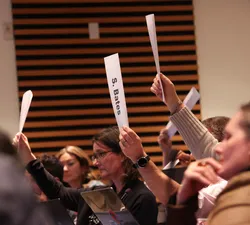
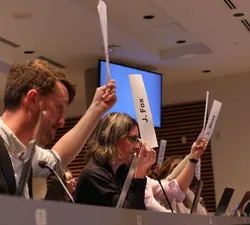
Last week’s Senate meeting saw the university’s highest academic governance body amend the name of the Faculty of Forestry — after reportedly two decades of deliberation — and endorse the UBC’s Strategic Directions 2025-2030 report.
The Sept. 17 meeting, the Senate’s first this year, was opened by remarks from President Benoit-Antoine Bacon and included an acknowledgement of “challenging times” in “a complex year for higher education.” Bacon said UBC is continuing to address the “fallout” from the federal government’s January 2024 move to limit the number of international student permits, which triggered unequal financial consequences for postsecondary institutions across Canada, and has been particularly devastating for some schools. In its 2024-25 enrollment report, UBC announced a 4 per cent decrease in the number of international students enrolled in programs at the Vancouver campus from the previous year, from 17,019 to 16,357.
In this year’s budget report, passed in March, administrators told the Board of Governors that “various” Vancouver campus faculties “are managing either one-time or recurring budget pressures.”
However, Bacon told the Senate it’s not “the cap that's hurting us,” but the provincial attestation letters now required by the federal immigration department, which he said are a “deterrent from coming to Canada.”
“All universities across the country are feeling it,” Bacon said. Despite this, the president said UBC remains able to “fully support” its academic and research missions, expressing confidence in enrolment and budget targets and saying the university continues to “fare relatively well” in a position stronger than “most, if not all, other universities in the country."
Bacon also celebrated the university’s record-breaking $936 million in research funding across 10,000 projects over the last year. The figures certify “people want to invest in what we do,” and fund UBC’s ideas and innovation, he said.
After Bacon’s speech, senators heard an update from the committee for student appeals on academic discipline chair George Tsiakos, who reported the committee heard and dismissed two appeals in the past year, arising from academic misconduct incidents in two computer engineering classes, CPEN 212 and CPEN 211.
Student Senator Kareem Hassib intervened to express disappointment that the committee had not met outside those two cases between May 2024 and August 2025. Associate Registrar & Clerk to the Senate Christopher Eaton replied saying there are few active files at the moment, with zero at the inquiry stage and six “somewhere in the process.” Senator Tsiakos responded that he takes the committee’s obligations very seriously in spite of quorum challenges in recent history.
The UBC Strategic Directions 2025-2030 report received a unanimous endorsement from the Senate, renovating the 2018 Shaping UBC’s Next Century report four years ahead of its original timeframe in light of what the new document calls a “shared recognition that the world had changed significantly.” When Bacon announced the refresh initiative in July 2024, he identified the “global pandemic, increased geo-political tensions, and the rise of AI” as key challenges that encouraged a revisit to the university’s short-term, long-term and institutional plan-related goals.
Student Senator Zarifa Nawar prompted the university to explain the absence of explicit affordability and housing-related measures for students in the report, citing data from the AMS’s Academic Experience Survey Report that found nearly one in two students are worried about their ability to afford groceries, and one in five are worried about their ability to afford continued studies at UBC. Bacon said that those matters are addressed “by definition” under the heading of “nurturing a strong and vibrant university community.” He also committed to a “refresh the student wellness plan” with those issues “first and foremost on that agenda.”
Come 2026, the Faculty of Forestry will be named the Faculty of Forestry and Environmental Stewardship, following the passage of a largely unopposed motion to enact the change.
Forestry Dean Robert Kozak told senators the requested change was the precipitate of an “ongoing discussion” within the faculty “going on two decades.” Kozak said the school began in 1950 as a “professional forestry school” but has since evolved to offer programs in natural resources, conservation, bioeconomy and bioproducts that no longer reflect a focus on the “industrial practice of logging and resource extraction” that is “too often equated” with what the entire faculty is about. In a memo to Senators, Kozak wrote the faculty’s target market often finds the name “off-putting.”
Senator Steven Pelech said he thought the new name was too broad and “a little bit misleading” in light of other faculties who also pursue work in environmental stewardship. Kozak agreed the name is broad but “reflective of the breadth of scholarship” in the faculty, pointing out the letters of support received from several deans of other faculties submitted to the Senate.
Senator Sean Graham voiced that marine environments cover three-quarters of the Earth’s surface, and “only a fraction” of the remaining terrestrial environments are “forest-based.”
“I just see this as a step too far to claim environmental stewardship globally, which is how this could be interpreted,” Graham said. Kozak said the Faculty of Forestry has “at least eight scholars” working in marine ecosystems.
Other matters addressed that night included the appointment of two student senators to the Senate Nominating Committee, which nominates elected members of the Senate to all other Senate committees. Senators Jasper Lorien, Drédyn Fontana and Zarifa Nawar were considered and gave brief statements; Fontana and Nawar were elected, according to Senate clerk Chris Eaton.
The Senate also created the “Dr. Connie Eaves Chair in Cancer Stem Cell Research,” whose namesake was a “pioneer” in leukemia and breast cancer research and a “devoted champion” of female scientists, and expanded enrollment in the master of occupational therapy and master of physical therapy programs by six and three seats respectively, following a request from the Ministry of Post-Secondary Education and Future Skills.