

Editors' Note
People across the province are heading to the polls on Oct. 24 to elect the next Legislative Assembly. The Ubyssey is writing profiles on candidates and parties running in the Vancouver-Point Grey riding — where UBC's Vancouver campus sits — and explainers on the election's main issues, including affordability and housing. Click here to find our entire coverage.
Alex McMillan is running to be Vancouver-Point Grey's next MLA for the B.C. Conservatives. He's vying to beat incumbent NDP Premier David Eby on a platform of enforcing public safety and cutting taxes.
McMillan's career spans across business and public service. Beginning as a political staffer, he has collected 11 years of experience as a civil servant working for the provincial government in Victoria. On the business side, he recently served as an interim CEO for the B.C. Chamber of Commerce and, as of February, has returned to working in his own consulting practice. His career has focused on advising for public and government relations. McMillan did not respond to The Ubyssey's interview requests.
The Conservatives' platform emphasizes safety across many areas, from public spaces to inside classrooms.
Concerning public safety, the platform focuses on crime, mental health crises, and addiction. The party promises to expand the Justice Institute of British Columbia's Police Academy, while deploying officers to the "hardest-hit neighbourhoods" to end street disorder.
They also plan to strengthen the justice system by hiring 50 more Crown prosecutors and 20 more trial judges. To combat crime in rural communities, they plan to add 500 more officers to the RCMP.
Regarding mental health and addiction, the platform takes an interventionist approach. Besides expanding mental health care access, the Conservatives propose expanding involuntary, "compassionate intervention" by amending the Mental Health Act. These amendments would appear to grant police officers greater legal powers, making it easier for police to take "visibly distressed" people who are publicly consuming drugs into mandatory treatment.
"Intervention is not just necessary; it is the most humane thing a society can do," said Conservative Party Leader Lorne Doerkson in a recent speech about public safety.
Involuntary care has existed in B.C. for a long time but was put in the public spotlight during the 2024 provincial election, when Premier Eby announced plans to expand involuntary care for people facing addiction. This election, both major parties have committed to expand this form of intervention.
The Canadian Mental Health Association has acknowledged involuntary care "may be a needed last resort for those at extreme risk of harm to themselves or others," but has warned that the province is relying heavily on involuntary care "without really examining whether it is effective."
McMillan's Conservatives platform also involves ending safer supply programs: harm reduction services that provide safe, prescribed medications otherwise only accessible to users through toxic and unregulated illegal drug supplies. The prescribed alternatives includes opioids like heroin or stimulants like cocaine.
Earlier studies have shown safer supply can lower short-term death risks for individual recipients, but also that it did not reduce overall overdose deaths on a systemic scale in B.C. since its introduction in July 2021. As of February 2025, however, the safer supply program has been transitioning to now require consumption of these prescribed alternatives to be witnessed by health professionals.
According to their official plan, the party also promises to remove Sexual Orientation and Gender Identity 123 from education in the name of providing "safe schools." SOGI 123 inclusive programs, as defined by the B.C. Ministry of Education and Child Care, refers to a set of resources that helps teachers to integrate more inclusive language and representation in their classes. Its aim is to "stop discrimination and bullying" through anti-bullying policies, as well as education around "the experiences and challenges faced by 2SLGBTQ+ people."
The Conservatives' platform does not specify what specifically about repealing SOGI 123 will make schools "safer" or how SOGI 123 currently impedes safety in schools.
Within the riding of Vancouver-Point Grey, there are several parks, numerous beaches, and residential areas. An issue experienced across this riding, like much of the province, is the cost of living and inflation. As such, Alex McMillan and the BC Conservatives have tried to frame themselves as the party that won't take more money from British Columbians in taxes.
A baseline for the conservative campaign has been the simple policy of "no new taxes." For British Columbians, if elected, the Conservatives say there will be no new taxes throughout the entirety of the next government, as well as no increases in current taxes. The Conservatives have framed this tax freeze as a much needed relief for British Columbians who have been "squeezed" by nine years of NDP governance.
The second major taxation proposal introduced by McMillan's party was announced on Oct. 8. By raising B.C.'s personal exemption — the base amount of tax credits a taxpayer gets — from $13,216 to $32,000, the Conservatives say they will help families save $167 a month to cover rising costs.
The Conservatives have also stated they will replace ICBC's current no-fault model — an insurance model that prevents individuals involved in crashes from suing others involved for compensation — with a hybrid system that would allow individuals seriously or permanently injured in crashes to seek compensation in court.
The NDP government introduced the no-fault insurance system in 2021, stating that the system would save British Columbians an average of 20 per cent on their auto insurance. An ICBC report to the B.C. legislature in May showed that insurance rate increases levelled off in 2021, and have not increased since.
The Conservatives also told the CBC that if elected, it would allow private insurers to compete with ICBC.
Plenty of the Conservatives' time has been spent discrediting David Eby's economic record. For instance, in last week's debate, Conservatives leader Lorne Doerkson said, in response to the Premier defending his economic plans: "Nobody believes you anymore, Mr. Eby."
Adding to the 58 per cent dissatisfaction rate with Premier Eby across British Columbia— according to a recent survey — Alex McMillan is banking that his party's rhetoric is correct when British Columbians take to the polls.
On Sept. 29, the Conservatives promised in a press release to remove PST from Canadian alcohol in the face of U.S. President Donald Trump's tariffs on the industry.Also included in this release was a commitment from Conservatives leader Lorne Doerkson to keep U.S. booze off the shelves of British Columbian liquor stores.
Despite this, Doerkson has received criticism from Eby for not being able to stand up to “extremists” in his own party, let alone Donald Trump. This followed controversial remarks from Conservative candidate Heather Maahs regarding SOGI 123 materials in schools — a resurfaced video shows Maahs calling education about 2SLGBTQ+ people "grooming." Doerkson has refused to drop Maahs as a candidate.
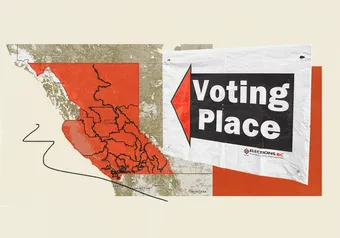
B.C. voters will elect the next Legislative Assembly of British Columbia on Oct. 24.