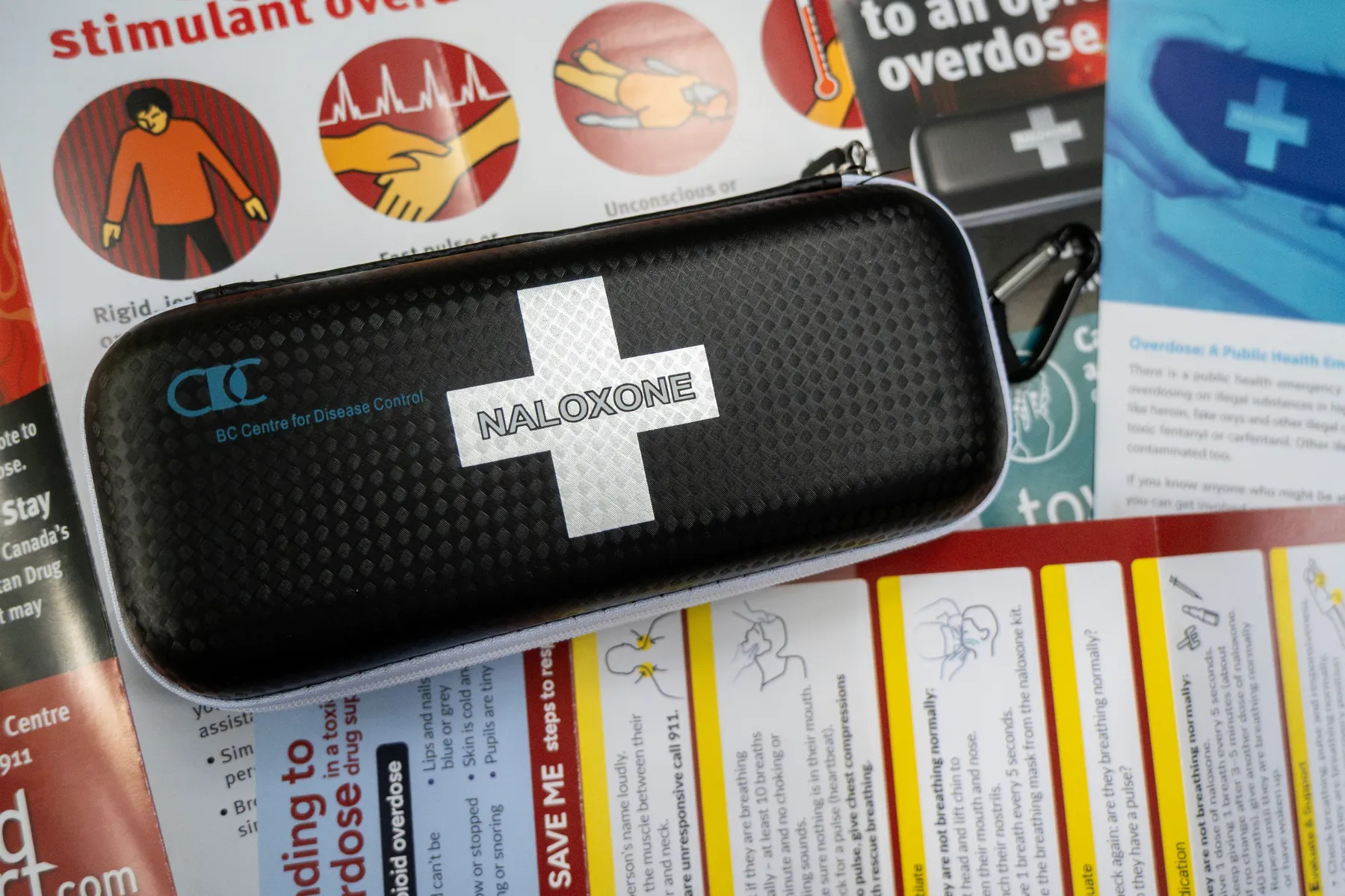

As students head back to class for the winter semester, the provincial government's guidance on post-secondaries' responses to a suspected overdose looks different from last fall.
B.C. has revised its overdose prevention and response guidelines for the post-secondary sector, and institutions are encouraged to have the updated measures in place this fall.
The original guidelines were developed in 2024 by the Overdose Prevention and Response Steering Committee — organized by Lisa Beare, then-minister of post-secondary education and future skills. Membership to the steering committee included representatives from the B.C. Centre for Disease Control, post-secondary institutions and the First Nations Health Authority, among other ministries. UBC's VP Students pro tem Andrew Parr sat on the committee.
The guide applies to all 25 of B.C.'s public post-secondary institutions, though each institution is still expected to build its own overdose prevention and response plan (OPRP). The revisions are centred on raising overdose awareness, structuring an effective response, training employees, aligning related institutional policies and building emergency contact notification protocols. The province has said it hopes institutions will use the guidelines to build consistency across the sector and, if a student splits their education across more than one B.C. institution, they want the messaging to remain consistent.
The toxic drug crisis has shaped provincial politics for nearly a decade. Fentanyl began supplanting heroin as B.C.’s dominant illicit opioid starting roughly around 2012, when it was detected in roughly five per cent of overdose deaths in the province. By 2015, that figure had climbed to 31 per cent. Fentanyl can be synthesized in the lab — rather than having to be grown and harvested first, like heroin does, as morphine — which makes it cheaper to produce and easier to smuggle.
The drug is also many times more potent than heroin, which means small inconsistencies in how it’s mixed in with a batch can be the difference between life and death. Chiefly because of fentanyl, unregulated drug deaths became — and have remained — the leading cause of unnatural death in the province, according to the B.C. Coroners Service.
British Columbia declared a public health emergency in response to drug-related deaths in 2016, and the following May, the federal Good Samaritan Drug Overdose Act came into effect with the intention of reducing fear of police at overdose scenes and to complement Canada's broader drug strategy. The act shields anyone at the scene of an overdose — the one experiencing it, those who seek help and bystanders — from simple possession charges and from related breaches of probation, parole or conditional release, though it does not protect against more serious charges like trafficking.
At UBC, harm reduction efforts have not always met student expectations. In March 2022, then-chief student health officer — now associate vice-president, student health & well-being — Noorjean Hassam told UBC's Board of Governors that UBC Health Services had provided naloxone kits, but that student groups preferred to distribute testing materials themselves.
“We have heard … that they don't want to access drug testing strips from the Student Health Centre. They do not want to come to our Wellness Centre,” she said. Hassam added she would be open to shifting UBC's approach if that was what students wanted. Then-AMS President Eshana Bhangu followed with a letter to the Board criticizing what she called a lack of urgency. At the time, Bhangu told The Ubyssey that such lack of urgency meant students “had to … take this on [themselves].”
By September of that year, UBC and the AMS had laid out a plan spanning four areas — education, supplies, support and services — according to Levonne Abshire, UBC's director of health, equity, promotion and education. That included fentanyl test strips at the Wellness Centre; nasal naloxone in residence lobbies and common blocks; and naloxone training through AMS Peer Support.
The next year, in 2023, B.C. also launched a three-year pilot decriminalizing small personal-use amounts of drugs, which expired on Jan. 31 of this year — the province opted not to renew it. (At a news conference in Victoria at the time, Health Minister Josie Osborne said, “the pilot [hadn’t] delivered the results [the government] hoped for.”)
The first version of the provincial post-secondary guidelines followed in 2024, after the Ministry of Post-Secondary Education and Future Skills convened the committee that May, setting awareness, response and naloxone access as its three founding objectives. UBC published its own OPRP that December, backed by 250 naloxone cabinets and 1,000 doses the province had allocated to the university’s two campuses that August.
According to the province, the 2026 revision specifically adds new support for institutions developing emergency notification systems — both campus notification protocols, which would alert students and staff of “toxic drug risks in their local community,” and emergency contact protocols, which would “[ensure] those involved in serious incidents are … supported.” The latter would cover overdoses, but also accidents, mental health crises, and suicide attempts, which the guidelines warn would “intersect with various legislation, regulations, and policies [and] may involve multiple departments and external agencies” each time one is triggered.
Asked how UBC specifically plans to develop its emergency contact notification protocols, university spokesperson Erik Rolfsen told The Ubyssey in a written statement that new students will now receive a “Review My Friends and Family” task in Workday as soon as they are set up in the system, and enrolment advisers are including reminders in beginning-of-term emails for students to keep their emergency contact information current. Beyond that, UBC said only that it is “reviewing” its current program alongside the updated guidelines “to identify further enhancements.”
The guide also asks for cultural safety in how notifications are handled, including in situations involving Indigenous community members, and instructs institutions to document their decision-making and retain records. It further recommends institutions tailor training to who is receiving it, weighing what risks and protections apply to that person, building in trauma-informed practices and working within the constraints of union agreements and job descriptions.
On expanding overdose response training for staff and Community Safety (formerly known as Campus Security), Rolfsen said UBC’s “robust program of training and education … requires no expansion under the updated guidelines” — despite B.C.'s guidelines' emphasis on leading practices for training campus security, staff, and faculty.
The update also pushes institutions past naloxone alone, pointing students toward supervised consumption sites, drug-checking services and phone-based options like the National Overdose Response Service, which lets someone stay on the line with a person who is using drugs alone. Nonetheless, the province says it has distributed 1,600 nasal naloxone kits to all public post-secondary institutions and First Nations-mandated institutes in time for the fall semester.
Spread across the 25 public post-secondary institutions, the guidelines apply to well under 100 per school on average — a fraction of the 1,000 doses UBC alone received in 2024. It is worth noting that the same 1,600 figure also appears in a provincial announcement from August of last year, and that there's no public funding schedule or regulation specifying an annual naloxone allocation to post-secondary institutions.
Data from the B.C. Coroners Service — published on Aug. 25 — suggests that the number of unregulated drug deaths has fallen for three consecutive years, from a peak of 2,591 in 2023 to 2,319 in 2024 and 1,828 in 2025. The 2026 data totals 776 deaths so far — down from 926 over the same period in 2025. Despite the fall, fentanyl remains by far the leading factor, detected in roughly 79 per cent of unregulated drug deaths in 2025. It is, however, down from a peak of nearly 87 per cent in 2021.
Methamphetamine and benzodiazepines (like Xanax and Valium) have both become far more common in this same timeline; meth was involved in just under a third of unregulated drug deaths a decade ago and now shows up in more than half, while benzodiazepines went from under five per cent of deaths in 2015 to nearly 45 per cent in 2025. It is unclear if a response centred on naloxone — which reverses opioid overdoses but has no discernible effect on sedatives like benzodiazepines — will continue to be effective with an increasingly heterogeneous illicit substance market.
UBC's current response structure as laid out in its December 2024 program, involves an advisory committee drawing on the VP Students office, Student Housing and Community Services (SHCS), Student Health & Wellbeing, Human Resources, Facilities, Safety and Risk Services, and Communications. The committee oversees implementation and reviews the program.
The university’s judgment on the program’s efficacy appears to be largely an internal process. The advisory committee meets annually to evaluate the OPRP and “look for efficiencies,” drawing on feedback from students, staff and faculty. Findings from these reviews are reported to university leadership and shared with what the program document calls “relevant stakeholders,” though it is unclear whether those findings are made public or shared directly with students — and who these stakeholders are.
In July, the UBC Wellness Centre shared a survey on their Instagram that asked students for feedback on the B.C. government’s 2024 overdose prevention campaign, stating that responses would “help inform future overdose prevention messaging and campaigns.” Rolfsen did not address questions specifically about how students themselves would be able to provide feedback on the program. He reiterated that “feedback from students, faculty and staff may also be used” without specifying any mechanism. This approach had already been made clear in UBC’s 2024 OPRP.
Rolfsen sent The Ubyssey a paragraph stitched together from direct passages of UBC’s 2024 OPRP document when asked how UBC will evaluate whether the updated guidelines are working, and how that information will be shared with the campus community.
UBC's program has so far relied almost entirely on stationary cabinets rather than kits carried directly by staff. The new guidelines direct institutions to weigh both approaches — static options like wall-mounted cabinets and dynamic options like naloxone carried by personnel — when deciding how to distribute the drug.
The provincial guidelines encourage institutions to implement toxic drug alerts into their existing campus notification systems, including alerts about incidents where a toxic supply was discovered nearby — a tool that doesn't appear to be part of UBC's current, publicly available messaging. Rolfsen did not acknowledge, or refer to, such a system beyond what he mentioned about Workday.
The guidelines also say students in orientation and welcome programming are a priority audience, and encourage particular attention to groups they describe as being at “higher risk.” They note that institutions should adjust their messaging for factors like international student populations and non-standard academic schedules. However, when asked which students or community members UBC considers most affected by the crisis, and how UBC’s updated plan will address their specific needs, Rolfsen said that “the toxic drug crisis can affect anyone” and that the program is “designed to support students, faculty, staff and visitors across our campuses.”
The 2022 friction between UBC and student groups over who should be distributing testing materials have shown a broader lack of student trust in the university's channels. In 2022, then-AMS VP AUA Dana Turdy told The Ubyssey the AMS was working with Student Housing and Community Services on revising residence contracts that, at the time, “[threatened] disciplinary action against those found to be in possession of illicit substances.” Under section 3.10 of the 2021–22 residence contracts, students found possessing, using, trafficking or even being around others using illegal drugs could face eviction or police involvement, with cannabis being the only substance exempted.
UBC's 2026–27 residence contracts still prohibit the possession, use, and trafficking of illegal drugs, but they also state that “should students seek assistance in the context of a medical emergency, neither they nor other students at the scene will be subject to discipline” under that section. The contract also excludes the “possession and use of naloxone” from its list of prohibited items, along with paraphernalia used for safe storage, cleaning, or disposal of drugs, and negligible amounts of substances carried for the purpose of drug-checking, including transport to testing sites.
Parr, who as SHCS vice president defended the 2022 residence policy, is the same UBC official who later sat on the provincial steering committee whose guidelines now direct institutions to review internal drug policies specifically to reduce students' fear of disciplinary consequences.
The Ubyssey requested an interview with Parr, given his role on the steering committee and his position as VP Students, or with the current AVP, Student Health & Wellbeing, Hassam. UBC responded with a written statement.
UBC’s answers repeated the same sentences verbatim across separate, unrelated questions — that UBC is “reinforcing the importance of a community of care” and that “the health and safety of our university community is our highest priority.”
Rolfsen did not address a question regarding consultation with student groups like the UBC Harm Reduction Coalition. Instead, he listed the same university departments named in the internal 2024 program.
Rolfsen said an updated version of UBC's Overdose Prevention and Response Program will be published on the Community Safety website “this fall,” but he did not further specify a timeline.