
Six UBC employee bargaining units have ratified new four-year collective agreements since May. They all share a three per cent annual wage increase, though benefits beyond that vary between units.
CUPE 116, the Association of Administrative and Professional Staff (AAPS), the Faculty Association, BCGEU (with UBC Okanagan), BCGEU (with UBC Vancouver) and CUPE 2950 have all ratified new collective agreements with the university in the past five months. Three more bargaining units — CUPE 116 Aquatic, CUPE 2278 and IUOE 115 — remain in negotiations.
Combined, the six ratified agreements represent thousands of university faculty, staff and student employees across the Vancouver and Okanagan campuses, spanning child care support staff, administrative and professional staff, professors and library assistants.
Each of the six agreements includes a three per cent annual wage increase, retroactive to 2025 — meaning workers receive back pay for the time already elapsed — consistent with the provincial government’s 2025 Balanced Measures Mandate, which sets out bargaining parameters for B.C.’s public sector. All collective agreements run until 2029.
“[We] are pleased to have concluded bargaining in a way that supports our employees … within the negotiating mandate provided by government, [applying] to the entire B.C. public sector and [reflecting] the university's ongoing commitment to collaborative and constructive labour relations,” UBC spokesperson Erik Rolfsen wrote in a statement to The Ubyssey, referencing the agreement with CUPE 2950.
“[Not] every concept discussed ultimately formed part of the final agreement, but there were meaningful discussions on items of importance to both parties.”
Beyond the shared wage increase of three per cent, each of the locals secured different combinations of benefits increases and new entitlements.
Effective Jan. 1, 2027, all six units will have access to health and personal spending account entitlements, though amounts will differ across locals.
Health Spending Accounts (HSA) can be used to pay for certain medical expenses that are not covered by provincial or extended health plans, such as prescription drugs and dental services. HSA benefits are non-taxable. By contrast, Personal Spending Accounts (PSA) can be used to pay for health and wellness costs, such as gym memberships, public transit passes, personal care products like sunscreen, smartphones, computers and more. PSA benefits are taxable.
The AAPS’s HSA and PSA will see the highest raise among all six, with the HSA increasing from $400 to $800 annually and the PSA increasing from $200 to $650 annually.
CUPE 116’s HSA will rise to $650, paired with the lowest PSA amount of $100, which is a new addition to their agreement. CUPE 2950’s HSA will increase to $650 from $375, alongside a PSA increase to $400 from $125.
The Faculty Association and BCGEU Vancouver both clinched HSA amounts of $600 — previously $400 — with PSA amounts of $200 apiece — previously non-existent. BCGEU Okanagan’s HSA rises to $500 — previously $200 — the lowest among the six, paired with a $100 PSA.
All initial increases or implementations are effective Jan. 1, 2027.
Supplemental maternal and parental leave benefits (additional to standard employment insurance benefits) have changed as well. Only BCGEU Okanagan, the Faculty Association and AAPS had these benefits prior to the new agreements. CUPE 2950 and 116 had maternal leave but not parental leave. All six locals now have both.
Additionally, all locals are now offered 95 per cent of their regular earnings while on leave — with the exception of BCGEU Okanagan members, who are entitled to income top-ups of up to 75 per cent. The number of weeks offered for this benefit vary from local to local.
CUPE 2950 members entering their 25th year of service will receive a new long service recognition benefit, which grants employees a one-time benefit of five additional paid days off. They join AAPS, which already had this benefit.
The university has also committed to sustainable transportation funding for its employees. All units at the Vancouver campus that have signed agreements, except for the Faculty Association, will receive funding for subsidized monthly transit passes for some employees.
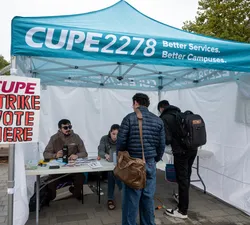
Notable among the three units that remain in negotiations with the university is CUPE 2278, which represents teaching assistants, graduate academic assistants and CfA exam invigilators at the Vancouver campus.
After nearly a year of negotiations, the local applied for non-binding mediation with the BC Labour Relations Board in July, only for talks to fail. The unit is scheduled to hold a strike vote between Sept. 21–25.
CUPE 2278 claims the university has been unresponsive to their demands. The university argues their successful agreements with other unions serve as evidence of willingness to engage in bargaining.
The two remaining units are smaller and further from conflict. IUOE 115, which represents about 65 employees who operate UBC’s District Energy System and maintain the university’s heating, cooling and ventilation systems, reached a tentative agreement in April which has not yet been ratified. CUPE 116 Aquatic, representing lifeguards, instructors and shift supervisors at the UBC Aquatic Centre, is listed as pending on UBC's collective bargaining page.