

Vancouver Mayor Ken Sim wasn't on stage for a housing-focused mayoral debate earlier this month. He didn't need to in order to stay at the centre of the candidates' conversation.
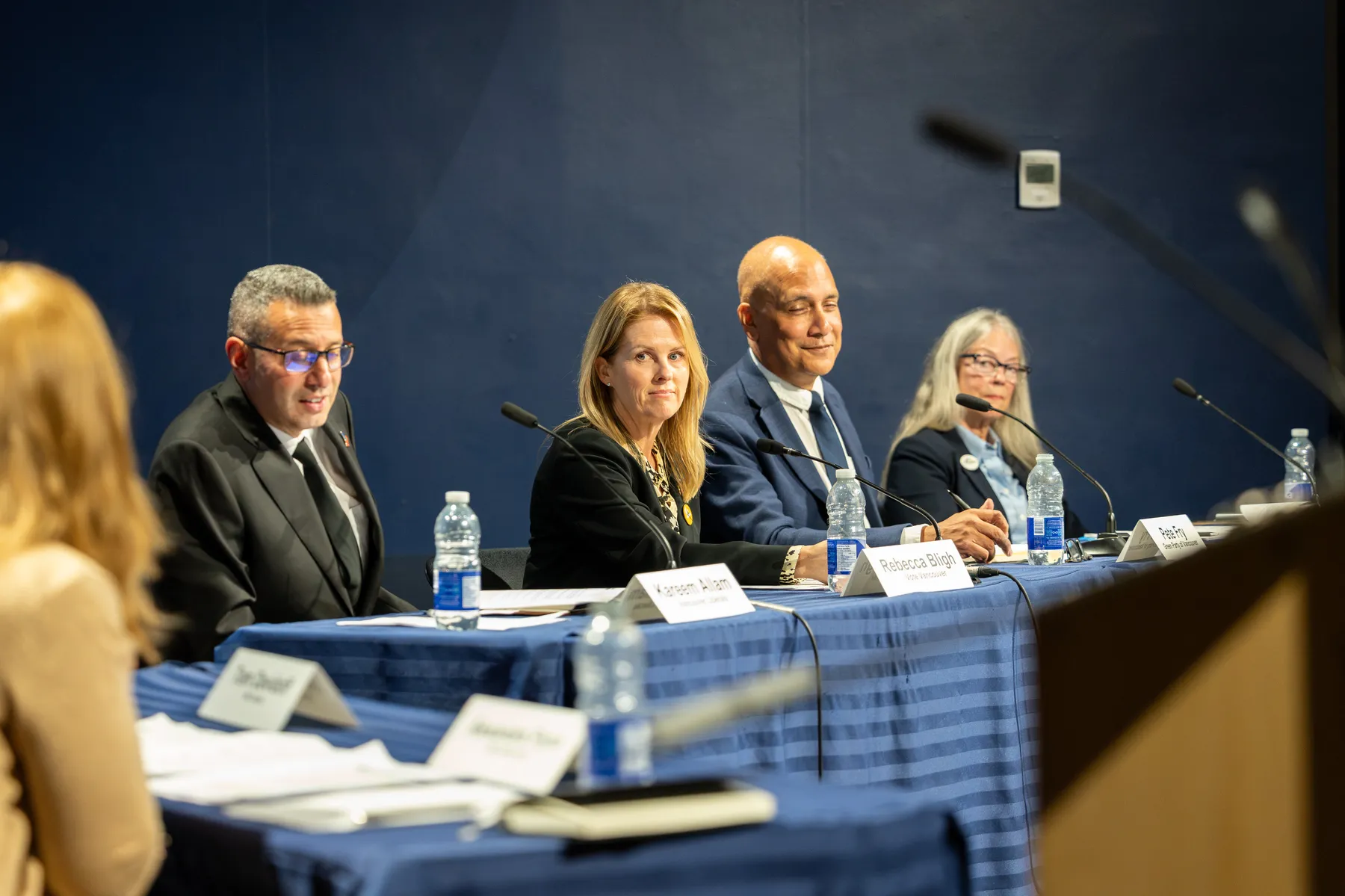
Kareem Allam of the Vancouver Liberals, Rebecca Bligh of Vote Vancouver, Pete Fry of the Vancouver Green Party, and Colleen Hardwick of TEAM for a Livable Vancouver participated in the third-annual debate held at UBC's Robson Square location on Sept. 8.
William Azaroff of OneCity was originally expected to attend, but did not, after dropping out of the mayoral race earlier that morning. Also in attendance was the former mayoral candidate for COPE, Stephanie Allen, who dropped out of the race a week before.
Hosted by the Sauder School of Business and Allard School of Law, the debate comes at a time when students are feeling the pressure of housing costs. According to the AMS’s 2026 Academic Experience Survey, published in June, 49 per cent of UBC students reported experiencing financial hardship related to housing costs over the past year. That figure is down from 52 per cent in AES’s August 2025 report.
In a repeated trend throughout the debate, Hardwick was the only candidate to disagree with the others when it came to the controversial villages plan that City Council rejected in July.
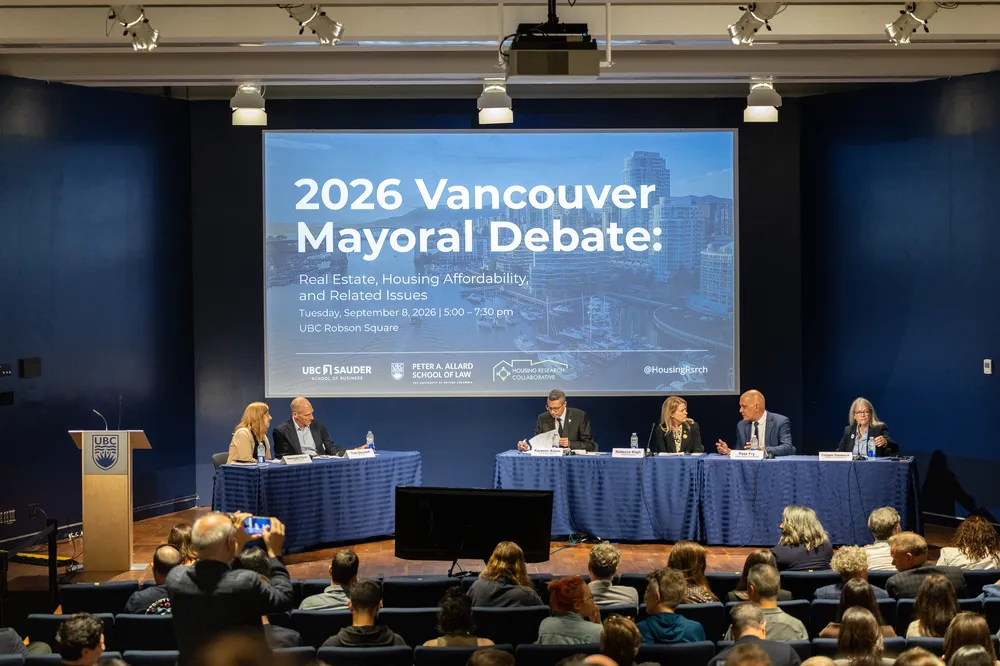
The debate stage on Sept. 8, 2026.
The plan, which would have seen increased zoning density in 17 “villages” across Vancouver, was voted down 10–1 after public hearings indicated opposition. As councillors, Fry and Bligh both voted against the plan at the time. Opponents to the proposal raised concerns over how the plan would affect neighbourhood character.
But at the debate, Bligh said the plan missed the mark by not starting with a pilot. "It was a failure, I think, to not move ahead with the three to five suggested pilot locations that staff had identified," she said. Moving forward right away with 17 locations would be "destabilizing," and would risk losing the character of a pre-existing neighbourhood.
Fry said that Sim "threw staff under the bus" when he imposed on staff "a very unrealistic timeline that they had to deliver before an election."
Allam, Fry, and Bligh said that, if elected, they would reverse the pause on using city land or funding toward supportive housing for unhoused people — a halt passed by Sim's ABC-led council in February of last year.
The pause, which Fry and Bligh voted against, came despite fierce opposition from advocates, many of whom told city council that it would worsen the homelessness crisis in the Downtown Eastside.
Ken Sim told CBC News at the time that single-room occupancy housing in the city is crumbling and rodent-infested, and that several levels of government need to "step up" to address the problem of homelessness. Bligh said it was “astounding” that council had decided to freeze supportive housing funding amid a homelessness crisis. She called the initiative the “straw that broke the camel’s back,” a move which led to her being kicked out of the party earlier that month.
Fry told the crowd that Ken Sim was disrespectful of the province when he froze supportive housing funding, and has caused "worse outcomes" for people on the street and those who are incredibly vulnerable.
On climate, Hardwick said the market should decide whether natural gas should be allowed in apartment buildings, and that the city "cannot sacrifice our tree canopy for building density." Allam disagreed. "There is a way to densify by building canopies," he said (although he didn't elaborate) and added that he also wants to further electrify transit. Bligh said reporting on emissions was key, as was reporting on canopy cover that distinguishes between old growth and new trees. She also said she thinks the city has "struck the right balance" with large buildings by energizing heating and hot water with electricity and cooking and fireplaces with gas. Fry said Vancouver has "opportunity to decarbonize new construction ... It's the right thing to do for our health, for the health of the planet."
Moderators also asked each of the candidates whether they would commit to a specific Floor Space Ratio (FSR) that would incentivize multiplexes, but without eroding neighbourhood aesthetics.
FSR measures the size of a building relative to the parcel of land it's built on. It's calculated by dividing the area of all a building's floors by the area of the parcel. The Vancouver neighbourhoods near campus are generally zoned for o.6 FSR.
Bligh said she'd support 1.25 FSR, with the caveat that she thinks the discussion is really about tolerating different kinds of housing rather than FSR figures. Fry didn't give a number. After Bligh spoke, he said he would support a "higher" FSR if it preserved canopy cover and ease of movement at the site level. Hardwick said she'd rather start with evidence about housing needs over making "slick slogans and quick statements." Allam said he'd be willing to go higher than 1.25, depending on proximity to transit — the further away, the lower that number should be, he said.
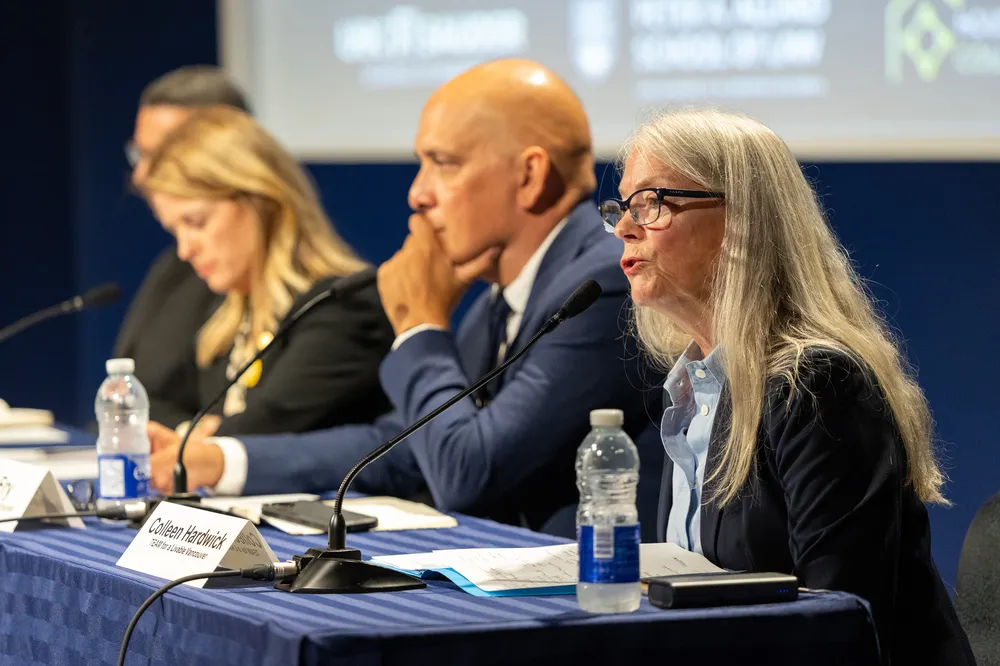
Hardwick, Fry, Bligh and Allam at the debate.
On strengthening Vancouver's economy, Bligh said her mayorship would capitalize on the Carney government's investment ambitions. "We could be the head office location for those investments," she said. Fry opted to criticize Sim's latest budget and the increased user costs it distributed to residents. Hardwick said Vancouver needs to preserve industrial land, adding that her experience as an entrepreneur since the '80s has left her thinking Vancouver hasn't been willing "to stand behind our own industries." Allam aligned with Hardwick on preserving industrial land. He said he wants to establish an "artist land reserve" and assailed Sim's move to wind down the Vancouver Economic Commission.
Allam's main point on the economy, though, was that the "next generation of jobs ... starts by getting the SkyTrain line from Arbutus all the way to the University of British Columbia."Early on in the debate, Allam repeated his pledge that if elected, he'd make the long-promised UBCx project his first priority.
The UBCx project is a proposal to have the Millennium Line run from Coquitlam to campus. The line is currently being extended from VCC-Clark Station in East Vancouver to a new terminus at Broadway and Arbutus Street, stopping a few kilometres short of the university.
The province originally promised a SkyTrain in 2008. Since then, UBC, the AMS, and Vancouver City Council have all pushed for its completion — commitments to lobby for the line are an annual ornamental inclusion in AMS VP external campaign platforms. Support for the project from mayoral candidates like Allam is typically uncontroversial — but it is also outside their direct authority. Usually, conversations get tied up around who will fund the project between the federal, provincial and municipal governments.
Allam said the City could fund the project through density bonusing, a zoning mechanism that offers developers increased FSR in exchange for benefits like parks, and affordable housing paid for by a project's proponents.
Allam said bringing a SkyTrain to UBC would mean connecting intellectual property created on campus with capital in downtown Vancouver. He said it's also part of his larger plan to ask the province to amalgamate UBC into the City of Vancouver in order to acquire domain over zoning.
Currently, UBC's Board of Governors makes and plays by its own zoning rules on the university’s land. It has been criticized in the past for presiding over higher rates of investor ownership than the City of Vancouver. In 2024, nearly a hundred faculty members signed an open letter accusing the university of being a "net contributor to housing price inflation." Data published this August from the Canadian Housing Statistics Program reports that 46.5 per cent of residential properties in the Metro Vancouver A regional district were investor-owned that year, compared to 31.7 per cent in Vancouver.
In the post-debate press conference, Allam didn't answer directly when The Ubyssey asked if he knew whether student leaders, the university, or the provincial government were in favour of amalgamating the campus.