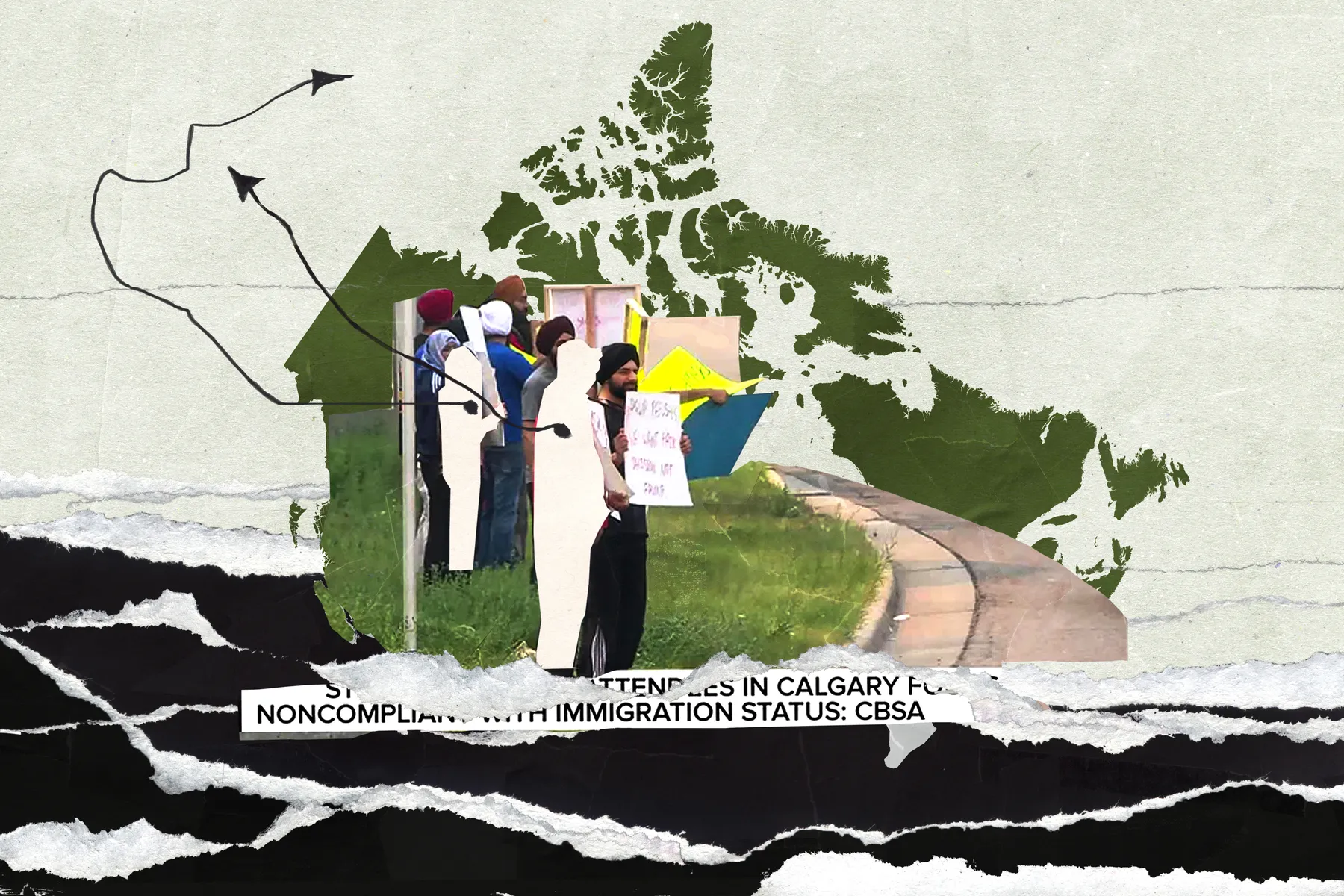

Two months ago, Calgary police called the Canada Border Services Agency (CBSA) to check the immigration statuses of four people at a protest of Portage College graduates. CBSA officers then came to the site and checked 20 people, identifying 12 as possibly inadmissible under the Immigration and Refugee Protection Act. Ten received exclusion orders soon after, requiring them to leave Canada and barring them from returning for at least a year.
The incident has left migrant rights advocates concerned that civil liberties aren't being respected universally.
The Aug. 12 protest in northeast Calgary was part of repeated demonstrations that began in mid-July after Immigration, Refugees and Citizenship Canada (IRCC) refused post-graduation work permit applications from graduates of non-credit programs offered through Portage College partnerships in Calgary and Edmonton. A Sept. 2 open letter from over 250 civil society groups — including Amnesty International Canada and the Canadian Civil Liberties Association — says at least 1,500 graduates are affected by the decision.
The civil society group's letter is addressed to Prime Minister Mark Carney, Alberta Premier Danielle Smith and the federal public safety and immigration ministers. It calls for an independent investigation into the incident and an immediate suspension of the exclusion orders. It also asks governments for clear public policies so that peaceful protest never leads to immigration enforcement, and for the graduates' work permits to be processed under the rules in place when they enrolled.
No UBC-affiliated organizations are among the signatories, despite the letter being signed by multiple B.C.-based groups such as Migrant Students United Vancouver, Migrant Workers Centre BC, and the BC Civil Liberties Association. Two Simon Fraser University groups did sign: the executive of its graduate student society and its labour studies program.
"Freedom of expression and peaceful assembly are fundamental Charter-protected rights. They do not belong only to Canadian citizens or permanent residents. Migrants must be able to speak out, organize and protest without those activities becoming a pathway to immigration enforcement," the letter reads.
In a statement to The Ubyssey, CBSA said it "fully agree[s] that the freedom of peaceful assembly is a Charter-protected right and is "aware of and reviewing" the Sept. 2 letter. The agency said it receives referrals from law enforcement when "a person's legal status in Canada is unclear," and that officers "investigate and take appropriate action" when they learn of foreign nationals who may be inadmissible. It said officers attended the site after confirming that two of the four people Calgary police had requested a status check on were not in compliance with immigration law.
Eric Lowe, the senior manager of marketing and communications for AMS's department of management and staff, wrote in a statement to The Ubyssey that the AMS was unaware of the Aug. 12 incident and they were not invited to sign the open letter. AMS executives declined an interview request.
"The AMS firmly believes that everyone in Canada, including migrants, have the right to speak out freely and peacefully protest without the fear of CBSA action and possible deportation," he said.
Azraf Ahmad is a member of Migrants Students United Vancouver, a grassroots advocacy group that organizes on behalf of international and migrant students across Metro Vancouver. He told The Ubyssey that several UBC-based unions, some of which represent students, have also not signed the letter, which he said is notable given how many international students attend the university.
Ahmad said the incident sets two troubling precedents. First, Immigration, Refugees, and Citizenship Canada (IRCC) can apply new eligibility rules without exempting students who enrolled under different assumptions. Second, he said, CBSA can issue exclusion orders to people whose applications for judicial review are still pending before the Federal Court.
"If they can do this to migrant students, where does it stop?" he asked.
CBSA did not say whether any exclusion orders were issued to people with pending reviews, saying it cannot discuss specific cases because personal information is protected under the Privacy Act. The open letter says the students have Federal Court challenges underway. The agency said people ordered removed from Canada "are afforded due process," including access to appeals and judicial reviews, and "can only be removed after all legal avenues of recourse that constitute a stay of removal are exhausted."
For Irene Bloemraad — co-director of UBC's Centre for Migration Studies — the involvement of immigration enforcement at a protest is concerning because freedom of expression and peaceful assembly are Charter-protected rights — they are constitutionally guaranteed to everyone in Canada, regardless of citizenship status.
"I certainly think the fact that the Calgary police called [CBSA] is problematic. It undermines who [and] what we stand for in Canada," she said.
However, Bloemraad added that circumstances in Calgary were different from what most UBC students would face. The protesters in Calgary were largely graduates of Portage College programs, whose eligibility for post-graduation work permits had been affected by recent changes to federal immigration policy.
IRCC has characterized the June update to its work permit webpage as a clarification of existing eligibility rules rather than a new policy. The department says the refusals stem from a longstanding requirement that eligible programs lead to a degree, diploma or certificate.
Some advocates, however, disagree. They say IRCC added the "non-credit" exclusion on June 24, after the graduates had enrolled. Ahmad claims that applying a new criterion to students who had already enrolled or applied for a post-graduation work permit under the previous standard functions as a retroactive rule change, regardless of how the department describes it.
International students typically move through several distinct immigration statuses after arriving in Canada, most of which grant them temporary resident status.
They will first hold a study permit tied to their enrolment at a specific institution. After graduation, they may become eligible for a post-graduation work permit, which allows them to work in Canada for up to three years depending on their program.
From there, some pursue permanent residence, often through pathways like the Provincial Nominee Program, which can require a qualifying job offer, language test scores, and competing against other applicants for limited spots. A disruption or policy change at any one of these stages, like the one that happened to the Portage College graduates, can affect a student's ability to move to the next.
Bloemraad said that a key difference between the Calgary incident and UBC's reality is that most international students at UBC are enrolled in degree programs, rather than the kind of non-credit programs at the core of the Calgary dispute.
According to the university's annual enrolment report, in the 2025–26 academic year, UBC had approximately 18,000 international students across both its campuses.
Nonetheless, being in a degree program does not mean UBC students are completely exempt from the broader issue.
"There is certainly the possibility that there are students at UBC who will be facing similar challenges if they want to stay in Canada permanently," Bloemraad said. "The [immigration] process has become much more complicated and is open to fewer people than it was in the past."
While no specific protections currently exist at UBC specifically, some B.C. municipalities have adopted policies meant to shield residents from exactly the kind of enforcement seen in Calgary.
Vancouver's Access to City Services Without Fear policy (ACSWF) was first adopted under Mayor Gregor Robertson in 2016, and has been in place ever since. The ACSWF prevents city staff from asking about or disclosing a resident's immigration status when providing municipal services like housing support, emergency shelters, and utilities — unless legally required via court order or subpoena.
New Westminster adopted a similar "sanctuary city" policy in 2021. City staff will not report immigration status to police or CBSA except where the law requires it.