

On Monday evening, free speech advocates Kate Marland and the Hon. Stockwell Day spoke at UBC about the state of free expression at Canadian universities.
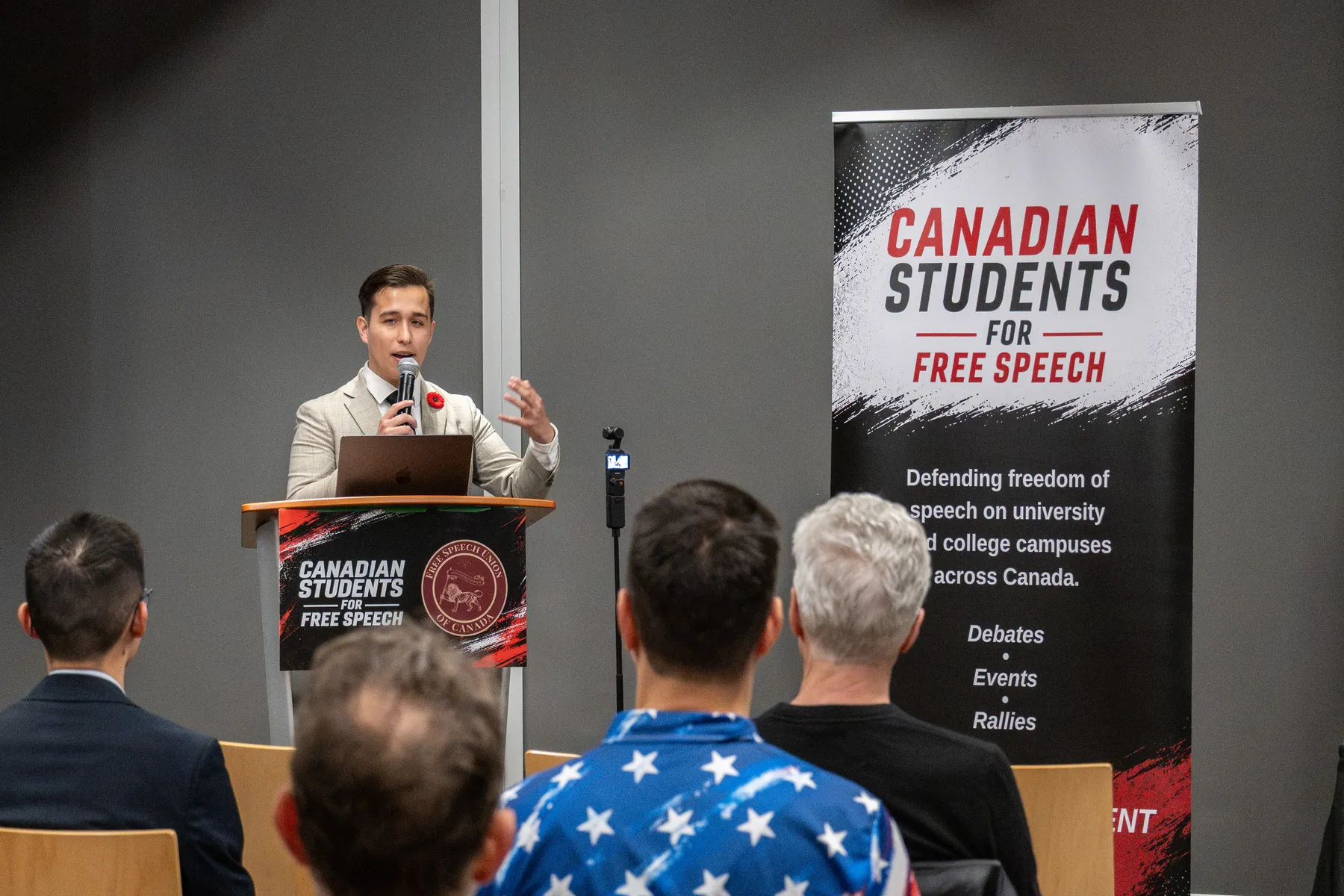
“No Safe Spaces: A Discussion on Free Expression at Canadian Universities” was co-organized by the Free Speech Union of Canada (FSU) and Canadian Students for Free Speech (CSFS), garnering around 30 attendees.
Marland, a University of Ottawa law graduate, has been the FSU’s executive director for three months. Day is a former Alberta MLA and was a cabinet minister under Prime Minister Stephen Harper. He said he spent Saturday night at the BC Conservatives’ election celebration and was “speaking in a partisan way.”
According to Marland, the FSU launched in January 2025 as “a nonpartisan mass membership organization” with a mission to “defend a culture of free speech.” It is an affiliate of FSU UK, founded in 2020 by Member of the House of Lords Toby Young. Marland said Young created it in response to a “growing environment of censorship emerging in the United Kingdom,” which was “particularly galvanized” by government overreach during the pandemic.
The panel was moderated by William Diaz, CSFS’s national coordinator. CSFS launched in August 2026 “to promote and defend freedom of expression on university and college campuses across the country.” Diaz told The Ubyssey the group wants to host speakers from across the spectrum. “I believe personally that when people stop talking, that’s when violence happens,” he said.
Organizers kept the location private until the event started, which Diaz said was “purely” for security reasons. Campus security was present throughout the programming.
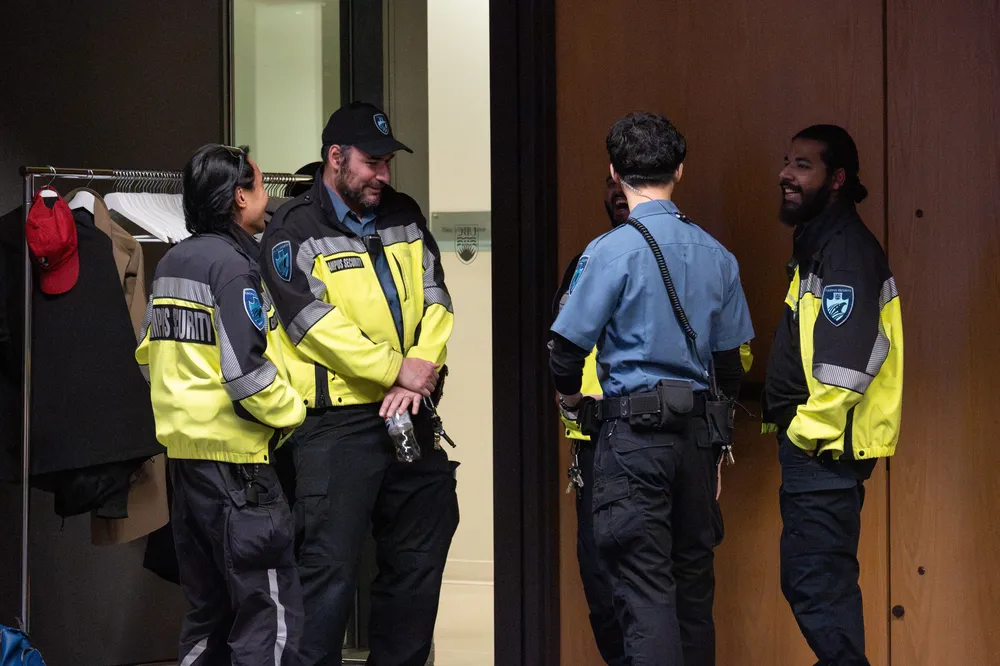
Multiple members of campus security were present at the event on Monday night.
Day argued that free expression is under threat on campus. Day spent most of his opening remarks on what he called “cultural Marxism,” which he said is endemic in universities and government. He said “a very high percentage” of professors hold Marxist views, based on conversations he’s had with professors. He did not cite data. “Institutionally, we do not have freedom of expression at our universities,” Day said. “You can say things, but in true culturally Marxist form, you will be cancelled. I know what it’s like to be cancelled.”
In June 2020, Day resigned from the Telus board and as a strategic advisor to law firm McMillan LLP, and stepped down as a CBC commentator, after remarks on a CBC panel in which he denied systemic racism and compared racism to being mocked as a child for wearing glasses. He later apologized, saying he asked forgiveness for “wrongly equating my experiences to theirs.” During Monday's event, Day again described being bullied as a teenager for his glasses and braces.
Marland said her turn toward the issue began at the University of Ottawa, where she was barred from campus for choosing not to get a COVID-19 vaccine and attended law classes over Zoom. She said professors who had praised civil liberties suddenly saw some views as “beyond the pale.” Free speech, she said, is “a fundamental part of what it means to be a Canadian” and “the bedrock of our Western civilization,” and it goes beyond the Charter.
Section 2(b) of the Charter guarantees “freedom of thought, belief, opinion and expression,” subject to reasonable limits under section 1. The Supreme Court has found that Criminal Code hate propaganda laws infringe that right but are justifiable limits. Diaz said during the discussion that Canada has no equivalent of the U.S. First Amendment. Canadian courts read section 2(b) broadly, covering any activity that conveys or tries to convey a meaning, but the Charter constrains government action, and the extent of its reach within universities is unsettled.
In 2020, the Alberta Court of Appeal held that the Charter applies to how the University of Alberta regulates students’ expression on campus. Legal commentators noted at the time that courts in B.C. and Ontario had found it does not.
Marland has spoken against the BC Human Rights Tribunal in her online publication and in an article in the National Post. On Monday she said it should be abolished or have its mandate “very strongly” revised. She called the province’s human rights regime a “regime of terror” that “has been allowed to run roughshod over the rights of free expression.” She pointed to former Chilliwack school trustee Barry Neufeld, who she said was “fined” $750,000, calling that “simply unacceptable.”
The BC Human Rights Tribunal found that Neufeld violated the Human Rights Code by "publishing hate speech and discriminatory content against 2SLGBTQ+ people."
In a Feb. 18 decision, the Tribunal found that 24 of Neufeld’s publications were discriminatory and that six constituted hate speech. It ordered him to pay $750,000 to LGBTQ teachers in the district, with individual awards of about $4,600 to $16,667, plus $10,000 for improper conduct in the proceedings. The $750,000 is an award to those teachers, not a payment to the government. Neufeld’s lawyer has said he will apply for judicial review in BC Supreme Court.
Marland also called for changes to a provincial curriculum she said teaches students that “they must decolonize Canada.” She said many students have no Grade 12 English option other than English First Peoples. B.C. graduates must complete four credits of Indigenous-focused coursework, and the ministry says both English First Peoples 12 and English Studies 12 meet the Grade 12 English requirement.
During a Q&A after the panel, Day said the federal Liberal government was trying to “override” the Constitution “in certain areas.” He called Prime Minister Mark Carney “a globalist” and “culturally Marxist.” Day did not say what he meant by either term. Carney spent 13 years at Goldman Sachs and later led the Bank of Canada and the Bank of England.
Both Day and UBC Conservatives treasurer George Morris criticized Bill C-9, the Combatting Hate Act. The bill passed the House of Commons in March, and it removes a Criminal Code defence for hate speech expressed as a good-faith opinion based on a religious text. Morris, an Orthodox Christian, said a priest told him reading scripture aloud could land someone in jail. The federal Justice Department says the law does not criminalize religious teaching or restrict reading scripture.
Both speakers also criticized the response to an incident at the University of Calgary. On Sept. 29, a student poured water on professor emeritus Tom Flanagan during a debate on whether residential schools were a genocide, held at an event organized by the Calgary branch of CSFS. Police detained the person responsible but laid no charges. Day said the media and the university downplayed the water incident. UCalgary’s vice-provost told CTV News the event was “deeply harmful and hurtful” and declined to comment on the water incident specifically.
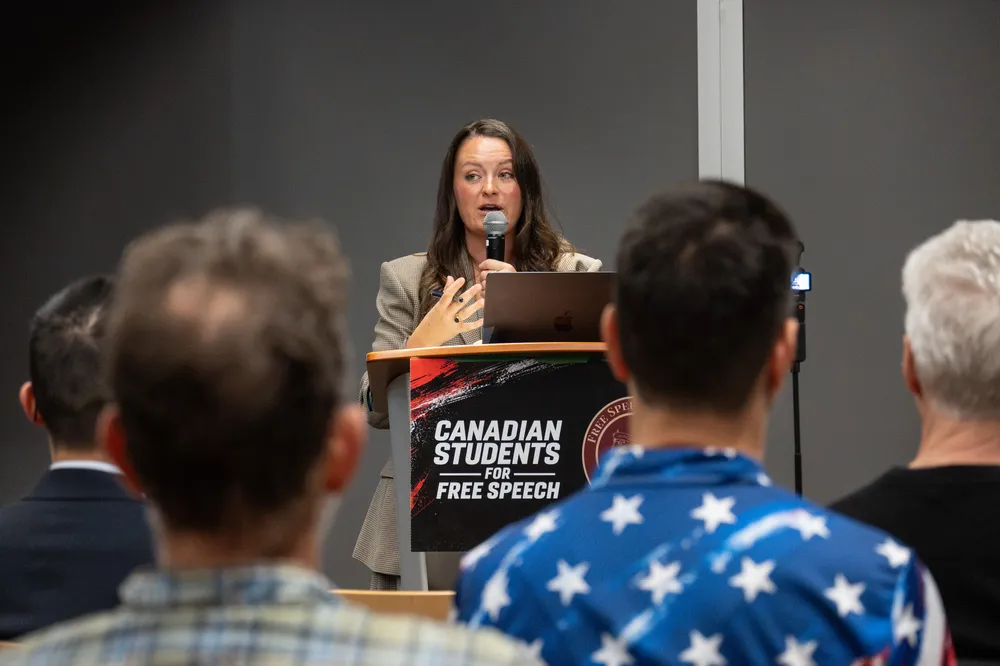
Kate Marland, executive director of the Free Speech Union of Canada, speaks at Monday’s event.
Flanagan has said there is “a legitimate academic debate” over whether residential schools constitute a genocide. The Truth and Reconciliation Commission found in 2015 that the system amounted to “cultural genocide,” a term the United Nations genocide convention does not address. The convention defines genocide as acts committed with intent to destroy a national, ethnic, racial or religious group in whole or in part, including “forcibly transferring children of the group to another group.”
TRC chair Murray Sinclair said the removal of children “appears to fall within the definition of genocide.” An estimated 150,000 Indigenous children attended residential schools, the last of which closed in 1996. The National Centre for Truth and Reconciliation has documented more than 4,100 deaths. The House of Commons unanimously passed a motion in 2022 recognizing this as genocide. The motion, introduced by NDP MP Leah Gazan, cited the convention’s definition and Pope Francis’s description of the schools as genocide.
Diaz cited the Calgary incident as motivation behind the security precautions at that day's event. He said he saw online comments calling for the event to be cancelled, and added that critics would have been welcome inside. “Freedom of expression is for everyone. It’s not a partisan issue,” he said.
Executives from the UBC and SFU Conservative clubs attended. UBC Conservatives president Sabastian Marion called Day “an incredible speaker” on the topic. Marion said free speech is under attack on campus. “Universities have become institutions that prefer conformity over inquiry,” he said.
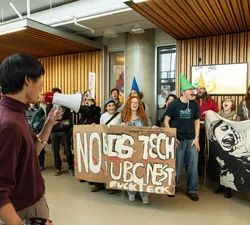
He pointed to the club’s “Restore the North” event in March with Conservative MPs Jamil Jivani and Aaron Gunn and BC Conservative MLA Harman Bhangu. About a dozen protesters gathered outside the room in the Nest. Marion said the protest “wasn’t peaceful protesting either,” with demonstrators “banging on the doors, on the windows, using megaphones.” Morris said protesters held a sign reading “Discount Charlie Kirk.”
In March, then-AMS president Riley Huntley said the student union learned of concerns the day before the event. After confirming it was a private, ticketed event, he said the AMS worked with the club to make sure safety and risk plans were in place. Marion said the AMS questioned the club about security and why they were holding the event.
Since then, the AMS requires clubs to disclose external speakers ahead of booking a room at The Nest in order to identify "controversial speakers." The measure was introduced by AMS VP Administration William Sparks, who was criticized last week by student organizers for sending warning emails ahead of events commemorating Oct. 7.
SFU Conservatives treasurer Bryce Reimer said the club believes free speech is “vital” to a healthy democracy. He said the SFU student union has moved in the past two or three years to deny funding to club events featuring political figures, and that his club was refused a grant for that reason. He said he might be off on the timeline.
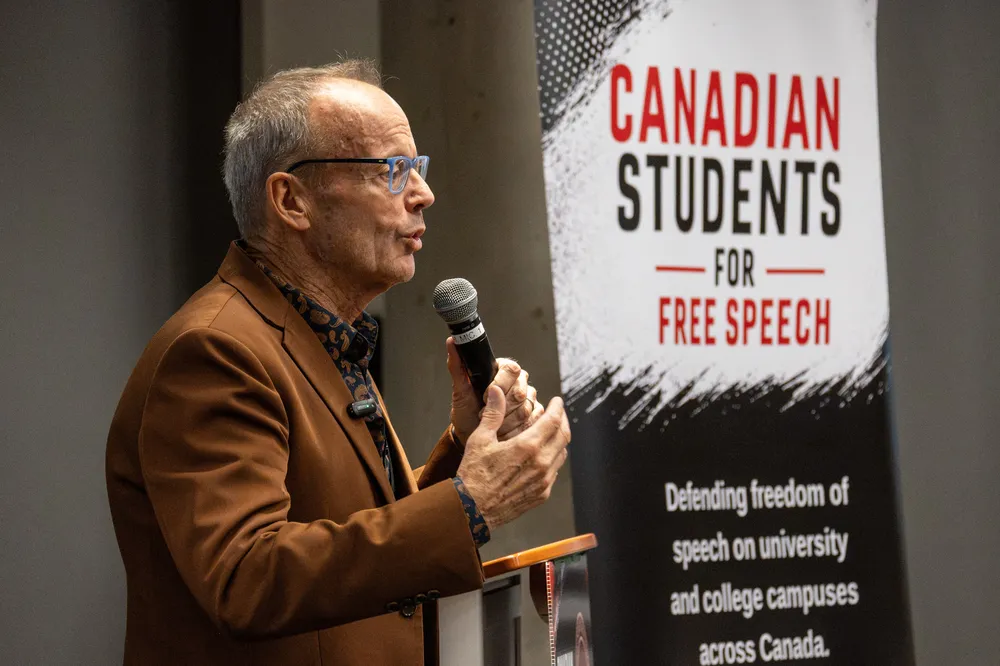
Stockwell Day, a former cabinet minister under Stephen Harper, said he knows “what it’s like to be cancelled.”
Monday’s event followed Saturday’s provincial election, in which the BC Conservatives won a majority. Asked how that might affect free expression, Reimer said, “I think we can look to or hope for great changes positively towards freedom of speech.” However, he said that was his personal view, not club policy. “I’m hoping for more information on that. They’re just establishing themselves.”
The party’s 2026 platform doesn’t mention campus free speech, the Human Rights Tribunal, or protections for regulated professionals’ speech, the measures Marland called for. It does promise to repeal SOGI 123, the school resources on sexual orientation and gender identity, and to “address bullying directly” instead, and to repeal the Declaration on the Rights of Indigenous Peoples Act (DRIPA), B.C.’s law adopting the UN declaration.
The Conservatives’ campus commitment, laid out in an Oct. 4 letter from premier-designate Lorne Doerkson to the Jewish Federation of B.C. and the Centre for Israel and Jewish Affairs, is to make provincial funding conditional on colleges and universities enforcing codes of conduct and cracking down on the targeting of Jewish students. It also pledges to adopt the International Holocaust Remembrance Alliance definition of antisemitism across campuses and other public institutions.
The Canadian Association of University Teachers has called that definition a threat to academic freedom.
Diaz said CSFS did not work with the UBC NDP or Greens on Monday’s event, citing limited resources. He said he hopes to organize a UBC debate between a supporter of Marxist economics and a supporter of capitalism. “I want to have debates with people who disagree,” he said. “That’s how we move forward in society.”
When asked about Doerkson's promises, Diaz said any legislation that “promotes free expression” and discourages political violence “is a step forward.”