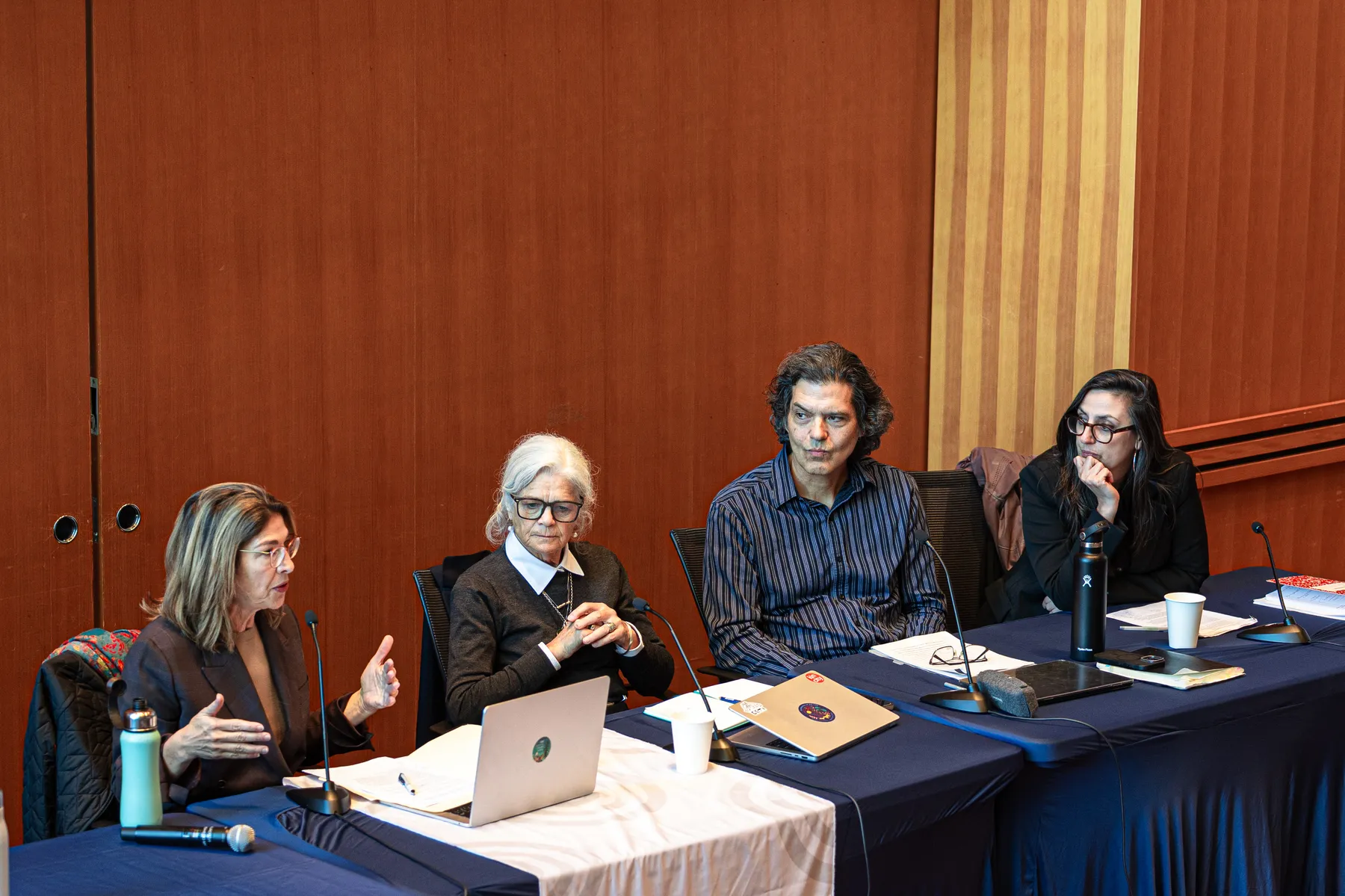


Four days after the B.C. Conservatives won a majority government, researchers from Canada, Argentina, and New Zealand gathered at UBC to argue that climate rollbacks in all three countries are following the same playbook.
The UBC Centre for Climate Justice hosted the Oct. 28 talk, "Challenging International Far-Right Agendas on Climate Policy," which drew on "Mapping Far-Right Discourse," a five-year research project now in its second year. The project is building a database of climate policy decisions to analyze how far-right narratives influence them, alongside media analysis of how those decisions were received.
Canada is not known as a far-right country, but its inclusion in the study raises questions at both the federal and provincial level. The Conservatives won the Oct. 24 election with a promise to expand natural gas production and repeal the province's climate plan, while Ottawa continues to designate major infrastructure and natural resource projects as being in the national interest.
Carol Liao, co-director of the CCJ, opened the event by laying out its guiding principle — analyzing far-right approaches to climate change can inform how we understand climate disinformation and its impact on policy. The discussion that followed covered how these networks operate, how their influence shows up in domestic politics and what can be done to counter them. Amy Harris, the centre's senior research manager, moderated the panel.
Véronica Gago, a professor at the University of Buenos Aires and the National University of San Martín, described the rise of what she calls the "politics of cruelty" in Argentina; a combination of austerity and blame-game politics that deepens polarization and pulls attention away from climate.
Gastón Gordillo, an Argentine researcher and Guggenheim Fellow, built on Gago's concept by tying climate change to other social issues. Street protests and physical demonstrations, he said, play a role in countering this style of politics.
Gordillo and Gago described climate change as part of a wider struggle against rollbacks on environmental, social, and economic causes.
Christine Winter, a senior lecturer in environmental, climate change and Indigenous politics at the University of Otago, applied the same concept to recent policies in New Zealand. The government says its 2024 Fast-Track Approvals Act makes it "easier and quicker to gain approvals for development and infrastructure projects that would deliver regional and national benefit." Winter said the law's centralization of decision-making is a way to avoid Indigenous consultation and environmental assessment, and to sideline public input.
CCJ co-director Naomi Klein shared Winter's skepticism of this concentration of power. She compared the New Zealand law to Canada's new Major Projects Office, which was created to speed up approvals for projects the federal government deems to be in the national interest. The discourse around the politics of cruelty may differ in Canada, Klein said, but she does not believe it is any less sinister.
Klein argued that federal and provincial governments alike have found a scapegoat in the U.S. president, using him to justify the "necessary" bypassing of environmental commitments. In reality, she said, it reflects a clear choice by Prime Minister Mark Carney's government.
The federal government has framed its fast-track laws as a response to the U.S. trade war. Bill C-5, passed last year, came in the wake of Trump's tariffs and threats to annex Canada. At the time, Carney called the trade war one "we must win." The Assembly of First Nations has since said that C-39 uses the guise of national interest and foreign threats to override Indigenous rights.
Bill C-39, a 243-page omnibus bill tabled Sept. 21, would cap federal reviews of major projects at one year, create "regions of national interest" with faster approvals, and centralize Indigenous consultation in a single hub. The government says it keeps environmental safeguards and Indigenous rights in place. Environmental groups and more than 50 scientists and scholars say it weakens both.
At an Oct. 8 event at the Chan Centre for her new book with Astra Taylor, End Times Fascism and the Fight for the Living World, Klein called the omnibus bill "a real centralization of power" meant to narrow space for debate, environmental review, and independent assessment. She described it as a classic case of the shock doctrine: using "the Trump shock" to push through what looks like "a corporate wish list," along with more fossil fuel infrastructure, from a prime minister who she said has spent a lot of time talking about climate and isn't talking about it now.
Taylor, her co-author, compared the Carney-Trump relationship to a wrestling match, with Trump as the villain and Carney as the hero — in a battle that is "not what it appears."
The Oct. 28 panel's warnings came as B.C.'s incoming government set out an energy agenda built on gas and fast approvals. On election night, Premier-designate Lorne Doerkson promised to double natural gas production by 2032, open B.C. to global investment and, in his words, "cut red tape like it's never been cut before." He said the expansion would create tens of thousands of jobs and generate at least $6 billion a year for hospitals and schools.
Doerkson's party platform promised to triple gas production by 2035 and repeal CleanBC, the previous NDP government's plan to cut emissions 40 per cent by 2030. It would also end the zero-emission vehicle sales quota, stop municipal bans on gas hookups, remove the emissions limits that apply to new LNG projects, and replace the carbon pricing framework for LNG with rules the party says won't penalize exports against U.S. and Qatari competitors. The platform says it would keep a carbon price on large industrial emitters.
On approvals, the Conservatives promised a 120-day permitting law for major projects worth more than $250 million. The party has also said it would harmonize provincial permitting with Bill C-39 so that B.C.-led projects are approved within a year.
What repealing CleanBC will mean in practice has yet to be spelled out. Doerkson met Carney virtually on Oct. 27, the day before the panel. In a post on X, he said the two are "aligned on the need to supercharge our economy, attract investment, and create good-paying jobs." The readout he shared said the two set out "a plan for cooperation in support of B.C. and Canadian growth." On LNG and natural gas, it described a "joint desire to ensure the right investable and competitive conditions are created to maximize private sector investment." It also cited "alignment on the need for progressing improved infrastructure and services in [B.C.]"
Winter was asked about what to expect from the new B.C. government. She warned that they would "break things fast." She also cautioned against a broader extractivist outlook and the damage it could do to Indigenous peoples and Crown-Indigenous relations in B.C., again linking environmental and social issues.
One of the final questions in the panel was about how people can fight rollbacks on climate action and other forms of the politics of cruelty. The panel's answer was organization: groups seeking to repeal climate action are already organized, the panelists agreed, because climate policy threatens not only their profits but their structural political influence. The speakers also urged those fighting climate inaction to develop a common language of protest. Gago, in particular, pointed to student activism as one way universities can play a central role in the fight against the far right.
The panel’s argument will be tested soon. In Ottawa, a special House of Commons committee is set to begin its clause-by-clause review of Bill C-39 the week of Nov. 16.