
Editor's Note
People across the province are heading to the polls on Oct. 17 to elect their local governments. The Ubyssey is covering Vancouver's mayoral race, the city council and park board races, and mayoral races around the Metro Vancouver area. This piece is part of that coverage. Click here to find the rest of our coverage, and look out for our live coverage of results on election night.
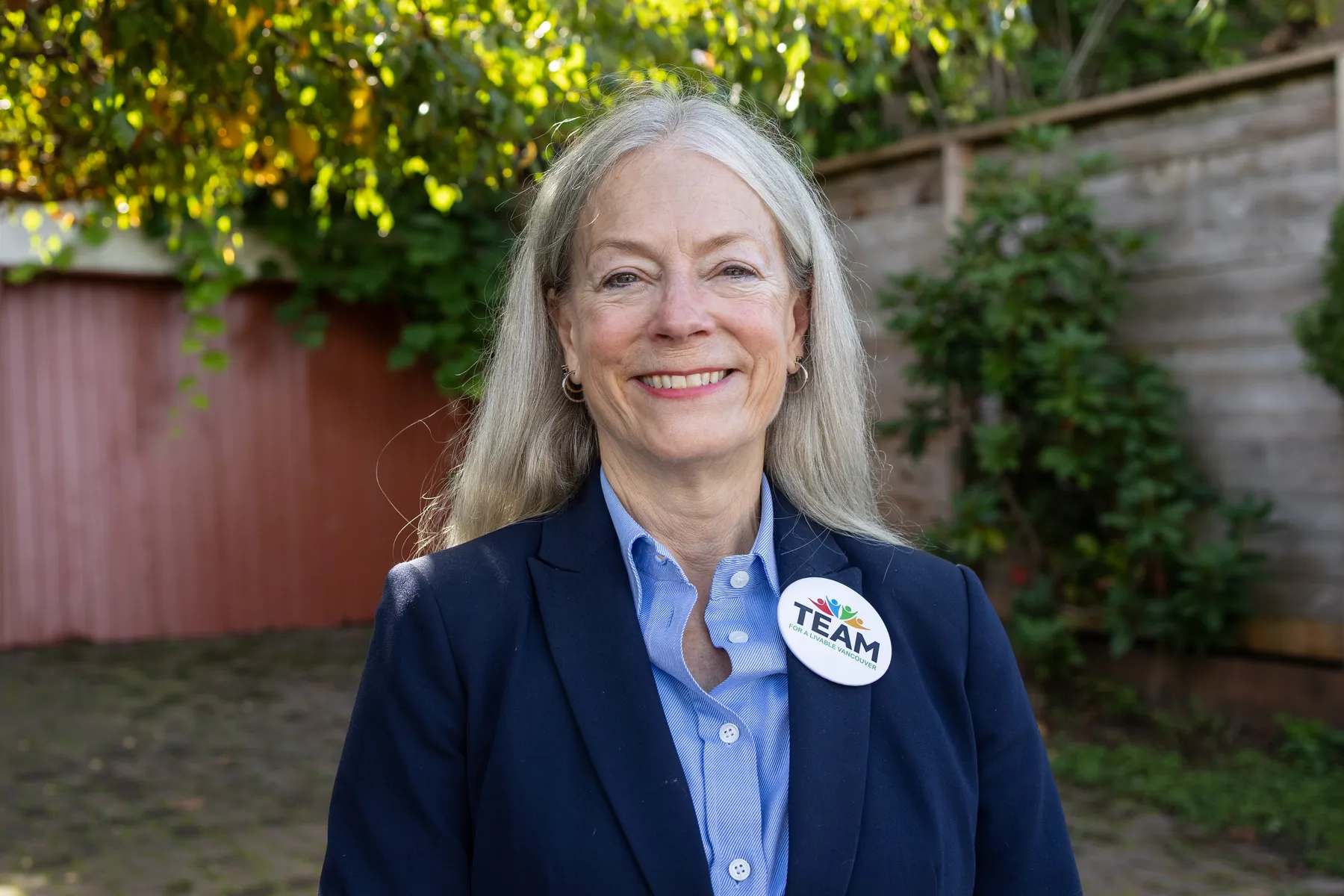
Colleen Hardwick, a former city councillor with a background in urban planning policy, is running for mayor of Vancouver with TEAM for a Livable Vancouver. She was elected to council in 2018 with the Non-Partisan Association, after a career spanning the film industry and housing policy.
In 2021, she left the party over internal concerns with how it was operating, and sat with TEAM Vancouver until the end of her term in 2022. She ran for mayor that year and placed third with nearly 17,000 votes. This year, she is trying again. Hardwick sat down for an interview with The Ubyssey.
Hardwick described her connections to UBC as “existential.” Her father, Walter Hardwick attended UBC, was a UBC geography professor in the 1960s and 1970s and was elected to Vancouver City Council between 1968 and 1974. Hardwick said she started at UBC at 16 and, influenced by her father, committed to studying political science and geography.
She said she approached municipal issues from a technical, data-driven standpoint. She expressed frustration that “people respond to things on a superficial level and don’t do their homework,” and repeatedly cited data as the measure for assessing population and housing needs in Vancouver.
Hardwick has long opposed the SkyTrain extension to UBC (UBCx). In 2019, she likened it to a freeway that would physically destroy neighbourhoods. In March 2022, she formally opposed council’s endorsement of an alignment recommending specific station locations for the extension.
In her interview, Hardwick maintained her opposition. She said UBCx would accelerate unsustainable population growth and that private housing developers would benefit disproportionately. She added that the extension lacked funding.
“The money doesn’t exist to do it, and it probably won’t for decades if it does at all,” she said. She said the original business case was not supportable and that the project was really about letting UBC develop more land. She said it would “shave five minutes off the trip” and that light surface rail (LRT) would have been far cheaper.
The provincial government considered LRT in 2018 and rejected it in favour of rail rapid transit along the Broadway corridor. Hardwick urged UBC students not to accept “sold” narratives and to use “critical thought” in considering how everyday issues connect to wider planning policy.
Housing affordability has been a pressing issue for voters. Hardwick said housing delivery needed “balance” and that critical infrastructure had to be in place before new housing was built. TEAM’s “respect for neighbourhoods” platform states that no new housing development is needed between now and 2050, given current population growth trends and approved developments.
As a councillor from 2018 to 2022, Hardwick opposed major city planning policies, including the Broadway Plan. The plan is forecast to contribute more than 30,000 new housing units over three decades. Hardwick said she still opposed it. She called it a harmful example of “growth promotion for profit as opposed to planning for livability and balance.” She also argued that the business models the plan relied on risked stepping outside municipal jurisdiction.
Hardwick proposed more neighbourhood representation through neighbourhood councils, which she said would improve democratic consultation. She said she wanted a “proper audit” of city-owned land. She added she was concerned that much of it had been “back-doored” over the past 18 years and should have been preserved for future generations. She said she favoured using city land for affordable housing, and named co-op housing as her preferred model.
Hardwick said that during her time on council she was “trying to shine a light” on dysfunctional mechanisms in municipal governance. That approach led to abstentions on council votes and opposition to citywide policies. She said her record was not a sign of indecisiveness. Rather, Hardwick said, an abstention counts as a vote in favour under the Vancouver Charter but signals that a councillor has insufficient information to decide.
She said her need to make informed decisions on reports and policies before council was frustrated by private housing developer interests and by a lack of expertise among fellow councillors on municipal issues.
Hardwick said that as an undergraduate she lived in basement suites, mostly in Kitsilano, and took the bus to UBC. She said affordability required stopping the inflation of land values and building the affordable housing the city needed. She said a roof over students’ heads was “the most important thing.”
The final day to vote in Vancouver's municipal election is Oct. 17.