
Editor's Note
Contrary to what AMS Elections said earlier today, Hu says he has not withdrawn from the race as of 7:26 p.m. tonight. We're reporting the story here.
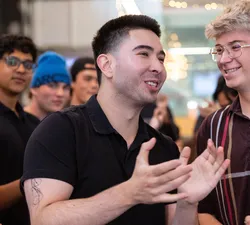
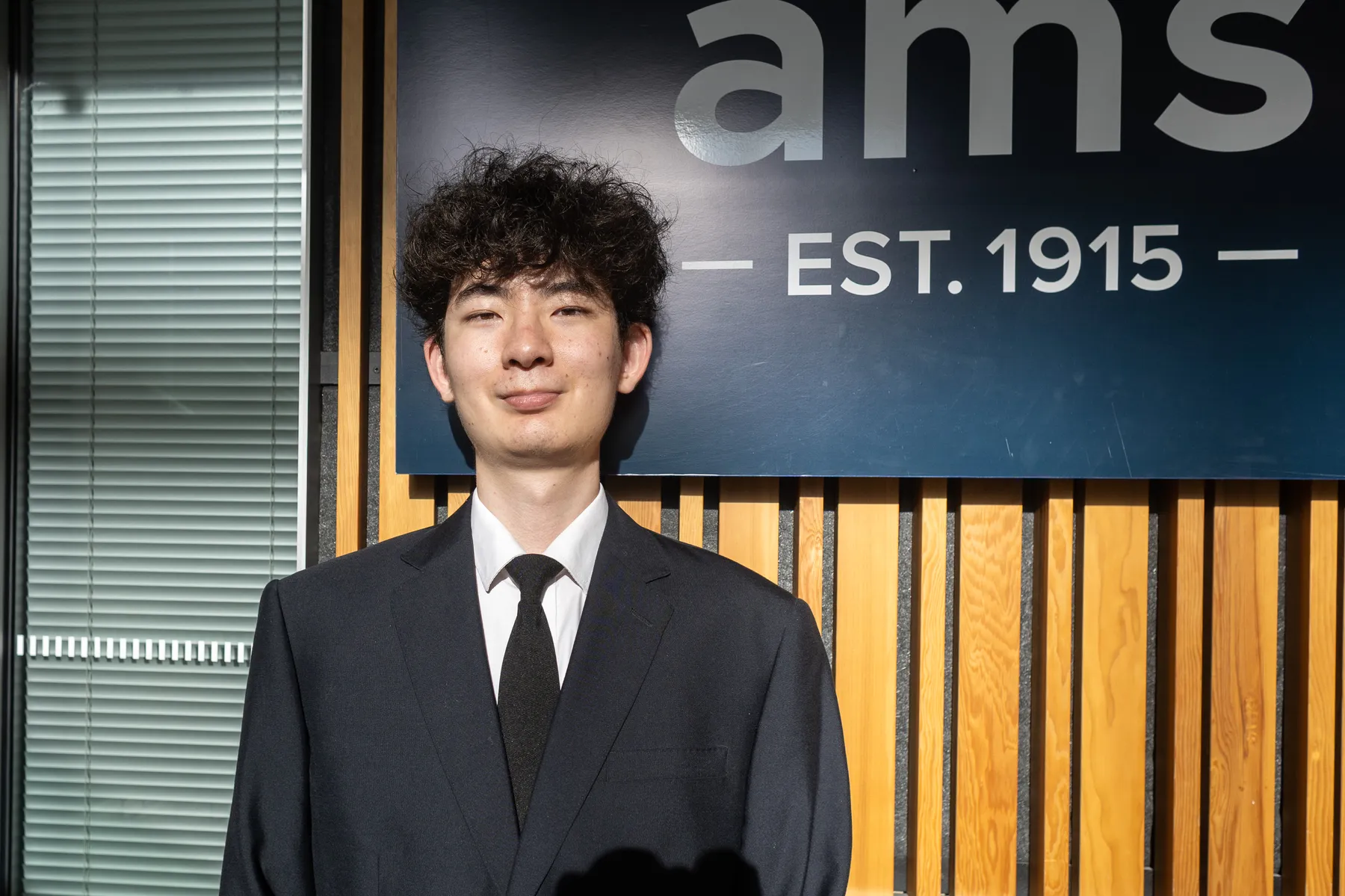
"Inclusion" and "transparency" are at the core of Chengwei Hu's bid for AMS Vice-President Student Life.
"I think being transparent isn't just about holding myself accountable. It's also about letting people see what's going on in my head, so people can suggest what they want to change or what they don't like," he told The Ubyssey in an interview.
Hu, a first-year student, was born in China and immigrated to Canada at a very young age. He grew up in Saskatoon.
Coming from Saskatchewan, he didn't know anybody on campus. As he "started to talk with more and more people, [he realized] that the social scene at UBC is actually really strong. People are really open."
The ability "to talk with a wide variety of different people," he said, "has allowed [him] to see that we seem really different on the surface, but really within, you can see that everyone has really similar struggles."
"Everyone wants a sense of belonging," he added. "So I thought, hey, if everyone's facing really similar problems, maybe I should step up and do something about it."
Hu is currently in the faculty of arts and aiming to major in economics. On LinkedIn, his profile claims he holds a leadership certificate from Harvard University. It also says he worked as a supervisor for a youth basketball team.
Hu accepts that when it comes to knowledge about the AMS, he is not the "most experienced," but he added that he "wouldn't worry too much about that."
"I think the more important thing is for a person to be fully committed in what they do, rather than understanding everything ... I think the more important thing would be about growth rather than perfection right at the gate."
Hu said that he has leadership experience and community involvement, pointing to his work as a corporal in the federal government's Cadet Program.
The program offers training to over 60,000 youth aged 12 to 18. Corporals are the program's third-lowest rank.
Hu said he believes his relative youth compared to fellow candidate Matthew Renzitti shouldn't weigh against him in the eyes of voters.
"The question we have to ask now is: what do the students want? Are they happy with what they have right now, or would they like to see a new, fresh perspective?"
"My experience, I would say, is authentic," he said. "I've lived the first-year experience through my own lens, right? ... I've been through all of it ... I want to be able to give people a conversation starter."
Hu started at UBC less than three weeks ago.
He said he has spent the last few weeks researching the VPSL role, which has led him to conclude that he "wanted to look at things from a different perspective."
Hu believes event planning too often focuses on the positive experiences of attendees, while neglecting those who are unable to attend. "We don't tend to see who gets gated out ... What about the commuters who have to get on the bus at five? They can't attend the party. There's people who don't drink. There's people who just don't like partying," he said. "So I'm a big person on being inclusive and transparent."
Hu proposes two concrete actions that he says he will implement if elected: moving from "big, one-time single events" to ongoing programming, and establishing a virtual suggestion box.
Event programming
Hu says one of the biggest issues facing students is a lack of ongoing programming. He proposes what he calls the "Nest Cup," which would see people from residence buildings create teams to compete in sports and arts brackets that last throughout the school year.
"It's really positive, because the people who you have the most close proximity with, those are the people you're going to build friendships with ... just being able to interact with the people alongside you, I think that's creating really healthy relationships."
He said the "Nest Cup" — or similar initiatives — would also be available to commuter and upper-year students, but did not specify how this would work, logistically.
It is unclear how Hu's proposal differs from sports intramurals run by UBC Athletics & Recreation.
Hu said that prior to before his interview with The Ubyssey, he was unfamiliar with the AMS's biggest event, Block Party.
Virtual suggestion box
Hu said he plans to build a website where students will be able to leave suggestions and express the issues they care about. Those suggestions would be processed by him and put to the student body via referendum; if approved, he would lead their implementation.
"I feel like it's only fair that the people suggest what needs to be focused on more importantly, because this allows me to be constantly adapting to what the people want," he said.
When asked if this proposal overlaps with already existing routes for AMS executives to communicate with students, Hu said: "There's already those suggestion things, right? But here's kind of the problem ... visibility is still a sometimes yes or no thing. You have to come in, you have to reach out. The thing I'm doing is stopping a feedback loop, right? A problem arises, and then I'll handle it."
Hu said he had no knowledge of the existence of the Blue & Gold Society, a meeting of student leaders that happens at the discretion of the VPSL since former VPSL Kevin Heieis brought it back last year. Nonetheless, Hu said "if people love it, I don't see a reason why it should disappear."
Hu's ability to finance a referendum while the AMS faces a deficit of just under $60,000 leaves questions.
When asked if his reliance on student proposals could be interpreted as a lack of planning, Hu said, "by having a plan, you're always gating someone out, and as VP student life, the point is to bring people in."
However, in the same interview, he also said he believes having a plan is "really important, because if you're just running without a plan, you're just going with the flow and hoping for the day to dictate how it's going to go ... my main plan is to implement those two things."
To strive for his second campaign priority — transparency — Hu promises to report to the student body through a monthly "transparency document."
He said the document would include information about what he achieved and what progress he has yet to make toward his goals. "Here's the feedback and suggestions I got from all of the UBC students who submitted feedback on the website, here's what I achieved, here's what I wish I could have done but I didn't, here's my short-term focus, here's my long-term focus, and I think this is able to create trust," he said.
Like all AMS executives, the VPSL reports progress on their goals on a biweekly basis during Council's open sessions.
Hu said he has plans to collaborate with UBC Athletics & Recreation to see "what we can work out," but did not specify any further.
He said his message to students is "we are greater when we are together."