

Building community on campus is not an easy task, AMS VP Student Life (VPSL) Kevin Heieis would tell you.
Since 2018, around 60 per cent of students have felt a sense of belonging on campus, according to the AMS’s annual Academic Experience Survey (AES) Report. This year was not an exception. To many, this represents an issue still not addressed by university leaders.
In a 2024 op-ed titled “The death of blue and gold,” Heieis, then AMS projects lead, said that the shift in UBC’s institutional colours — from blue and gold to white and navy — is representative of a decline in campus spirit. “The key here is that wearing campus colours connects you with an in-group despite not knowing each other. Visual identification breaks down the toughest barriers to forming social connections by showing commonality,” Heieis said.
In his op-ed, Heieis goes on to argue that “culture cannot be maintained by students alone” — echoing the concerns of former AMS President and at the time, UBC Athletics employee Aaron Bailey. In a 2016 Ubyssey article, Bailey was highly critical of the university’s efforts, or lack thereof, to encourage students to attend varsity games.
To say that campus spirit under Heieis’s leadership has been a priority of the VPSL portfolio would be an understatement. In his executive goals over the past year, Heieis stated his intention to enhance campus life, which he said requires “effective branding and collaboration between organizations.” To build the student experience, he outlined his intention to “investigate [the] re-creation” of the Blue and Gold Society, with a targeted completion date of July 2025.
The Blue and Gold Society, in its most recent iteration, consists of an open forum chaired by the VPSL, focused on building connections between student constituencies who are concerned with student life and improving communication with university administrators. This vision has been refined by Heieis throughout his term, who initially planned for the society with the intention of coordinating an events schedule. This pivoted in July 2025 towards bringing in campus groups as stakeholders into planning events and widening community reach.
After 86 per cent of students voted in March last year to create the VPSL portfolio, the AMS appointed Heieis as interim VPSL, a position he would retain after winning an unopposed byelection that September.
Almost a year after taking office, and amidst tension surrounding the future of the VPSL portfolio, Heieis held this year’s inaugural Blue and Gold Society meeting on March 18, just over a month away from the end of Heieis’s term. It was originally scheduled for August 2025, but got postponed due to a lack of common goals, and a desire from UBC Athletics & Recreation for the VPSL office to provide a “long-term vision” for the society.
Heieis said that it took “decisive independent action” to make the Blue and Gold Society a reality — in an interview with The Ubyssey — especially since “supporting this new executive position was not a goal of the president nor other AMS bodies.”
AMS President Riley Huntley told The Ubyssey that the AMS supported the portfolio “through staff resourcing, budgetary funding and integration into existing governance and operational structures,” which came with a “clear expectation” Heieis would take initiative and deliver on his mandate.
Although the “delayed execution of the Blue and Gold Society project is disappointing,” Huntley said, he was still confident that the VPSL portfolio will continue to “deliver meaningful outcomes for students over the long term.”
This year’s Blue and Gold meeting was the first since 2016, when then AMS President Ava Nasiri re-established the Blue and Gold Society, which was previously dormant on campus. That year was not the first time UBC students have tried to bolster campus spirit. As early as the 1920s, “pep clubs” have existed on campus, providing a dose of cheer at varsity sporting events. In 1957, the Pep Club rebranded to the Blue and Gold Society — which at the time provided half-time entertainment for campus sports games.
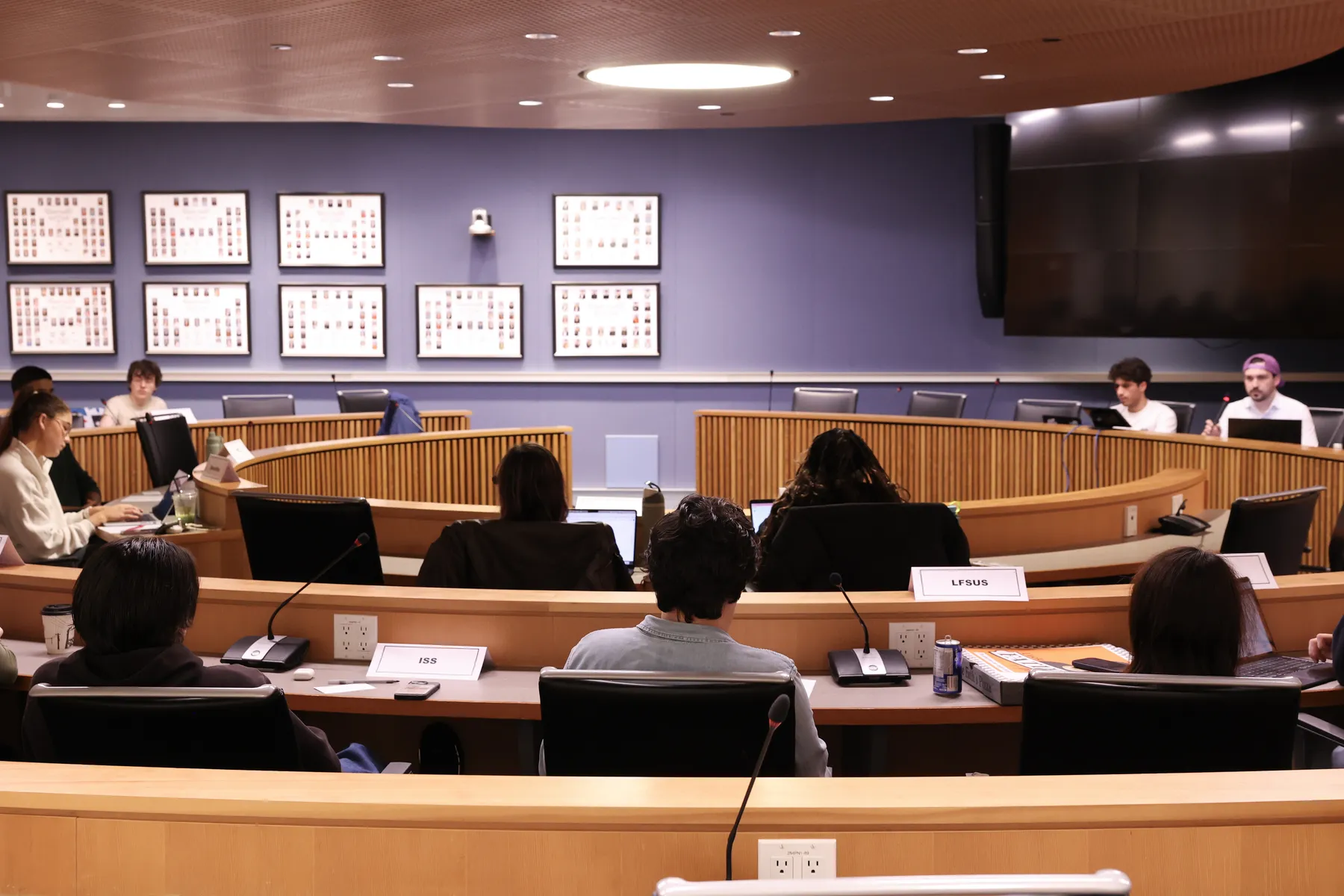
At the meeting, representatives from various AMS constituencies and subsidiaries, as well as leaders from campus groups, discussed events logistics and university identity. Halfway through, they were joined by UBC interim VP Students Andrew Parr and his deputy, AVP Samantha Reid to answer questions from the society.
Heieis explained to The Ubyssey that the VPSL office determined the Blue and Gold membership at its discretion, with a focus on AMS subsidiaries and groups the office has built relationships with. Subsidiary attendees included but were not limited to representatives from the Thunderbird Athlete Council (TAC), Thunderbird Marching Band (TMB), Interfraternity Council (IFC), The Calendar, CiTR, and the Indigenous Student Society (ISS). The AMS did not invite its clubs due to their quantity and narrow scope. “It can become difficult to pick and choose a few that could represent all of campus,” said Heieis.
Members targeted issues with space bookings throughout campus and a lack of “unified” university branding as focal points throughout the meeting.
Panhellenic Council President Brigitte Montgrand, TAC VP External Bryce White, and TMB President Nadia Scurfield agreed that room bookings outside the Nest was an issue. They all said a lack of standardized UBC Facilities room booking system organization has been a driving factor to this.
Scurfield said the TMB has “a lot of booking requests that hang in the air” and that the lack of confirmation or denial “pushes plans” and has led them to cancel events. Arts Undergraduate Society VP Student Life Akuol Riak echoed the concerns and added that the high cost of sport field booking prices can discourage student groups. Similarly, White said payment processes and timelines are unclear. He discussed a case where, according to him, the TAC was not charged for the use of a field. “It was just so inconsistent,” he said.
Parr said that UBC administration was considering introducing broader cost-recovery policies for rental fees, describing it as “ideal.” Citing his involvement with UBC Recreation, Parr said UBC uses the rentals of athletic fields to off-campus groups to generate revenue, which can subsidize student rental fees for athletic fields or provide general support services.
Extending this model to bookable spaces outside of recreation would alleviate the financial burden facing student organizations, Parr said, and would provide consistency while maintaining a cost-recovery rate for administrative, audio-visual and maintenance needs as required under the UBC space rental policy.
Heieis told the society that UBC’s lack of unified branding negatively contributes to UBC’s social environment — he said there are “pockets of culture” as opposed to a “global” identity on campus. He said he saw potential in a more cohesive brand where students “could associate with the broader community.”
Several Blue and Gold members illustrated their own problems with university identity. White said that there is a feeling of "separation between the Thunderbirds community and the UBC community,” and they need greater integration. He added that the TAC wants “everyone at UBC to be a Thunderbird,” implying that the brand should extend beyond varsity students.
Parr said UBC operates with three brands: The crest, the ‘UBC’ letters, and the Thunderbird. He said he’s “not sure that UBC itself” has a concrete idea of which one dominates. Nonetheless, he claimed the “T-Bird” brand is strong and that “everyone's a T-Bird, not just varsity athletes.”
Throughout the meeting, Heieis emphasized that the first material outcome of the discussion would be a memo sent on behalf of the society to the university. He added that, following what he considers to be a "successful" meeting, his office is “excited to collaborate with the VP Students Office to move forward” with this project. The society currently operates at the discretion of the AMS’s VPSL office, and its capacity to enact change is dependent on the student life portfolio.
After nearly two hours discussing student life in Michael Kingsmill Forum, members of the Blue and Gold Society met elsewhere for a social gathering. “Drinks and snacks on me at The Gallery,” said Heieis. “I have some budget to use up, so happy to spend it on you guys.” He later explained that he considers student leaders at the Blue and Gold Society key stakeholders for the AMS, and that building relationships with them “constitutes official business.”
“I was happy to spend about $100 on snacks for the attendees,” he added.
Heieis later said there are no plans to make the Blue and Gold Society a permanent AMS committee — which could potentially expand its jurisdiction. “The way the society is running right now is effective and impactful. The power of the society comes from the dedication that student leaders at UBC and myself have to improving student life on campus,” he said. “I don't think at this point there is a need to add in additional layers of bureaucracy to this collaboration.”
“So much potential was lost from the death of blue and gold,” wrote Heieis in his 2024 op-ed. Wednesday’s meeting represented his latest, and perhaps last attempt at “reviving” the colours that, he claims, fuel campus spirit. The success of the Blue and Gold Society’s efforts to improve UBC’s “dying” culture remains to be seen. Its legacy will be determined by a student population where, for almost a decade, four in ten have not felt a strong sense of belonging to UBC.
Heieis said the next step for Blue and Gold is to ensure a good transition with the next VPSL. When asked what advice he would give to whoever fills his office next, he said: “Listen to the students more than anything.”