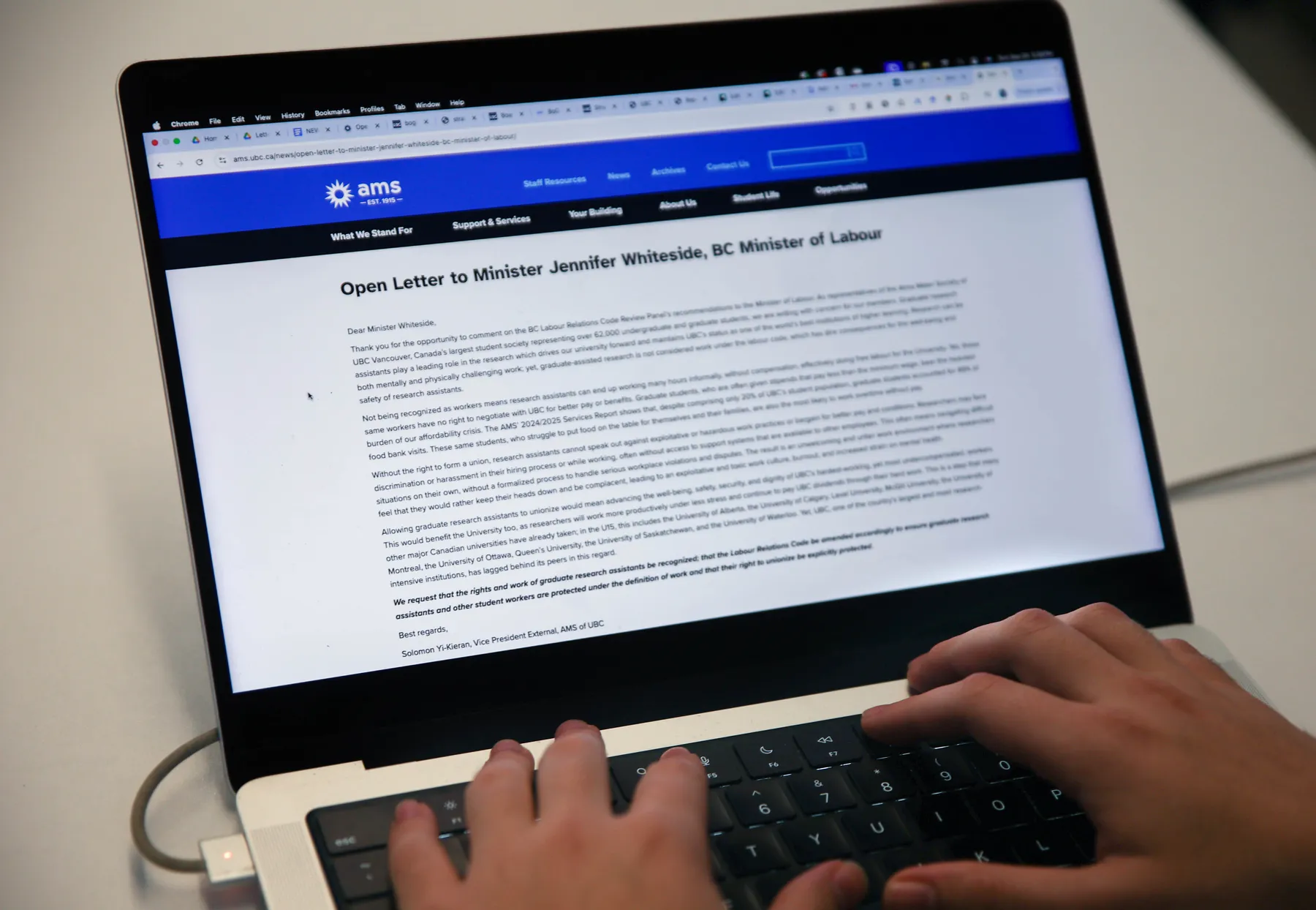

The AMS sent an open letter to B.C. Labour Minister Jennifer Whiteside on Sept. 17 urging the government to recognize graduate research assistants (GRAs) as workers under B.C.'s labour laws, giving them the right to unionize.
The letter comes months after British Columbia’s Labour Relations Board, dismissed CUPE Local 2278’s — the Canadian Union of Public Employees local chapter representing groups of academic workers at UBC — bid to expand its bargaining unit and unionize roughly 3,200 GRAs at UBC — on the basis that GRAs do not meet the definition of employees in the Labour Relations Code.
Graduate research assistants launched their unionization drive with CUPE 2278 in 2022 after reporting unfair working conditions, low pay and long hours, all without rights to negotiate better pay or benefits with the university.
“The fact that thousands of students at UBC are unable to be counted as workers or unable to unionize is a huge issue,” AMS VP External Solomon Yi-Kieran said in an interview with The Ubyssey. “It's a huge injustice, and it does make it harder for a lot of students to afford their education, to afford living in the city and to continue doing the research they love.”
The AMS’s open letter was sent just days before the public consultation on proposed changes to the Code closed on Sept. 19.
“Research can be both mentally and physically challenging work; yet, graduate-assisted research is not considered work under the labour code, which has dire consequences for the well-being and safety of research assistants,” Yi-Kieran and AMS President Riley Huntley wrote in the letter.
The three-month consultation period allowed stakeholders, the public and other interested parties to provide feedback to the Labour Relations Code Review Panel, whose recommendations will be reviewed by the Ministry of Labour.
“Our hope is to see the panel include ensuring that student workers are able to be afforded the rights and protections that other workers get,” Yi-Kieran said.
In addition to the AMS, CUPE 2278 has submitted feedback to the Labour Relations Code Review Panel, calling for the code to recognize GRAs as employees.
“If the language of the labour code is going to be so that GRAs cannot qualify as workers under the code, then our next best option is to change the labour code,” the president of CUPE 2278, Drew Hall said in an interview with The Ubyssey.
Prior coverage
Brad Spencer, communications director of the Labour Communications Office, told The Ubyssey in an email that the Ministry of Labour confirmed it had received the AMS’s open letter. However, the government could not comment on the matter while the Labour Relations Code (LRC) remains under review by the Labour Relations Code Review Panel.
“All feedback from workers, student organizations, and stakeholders on the LRC will be considered in the current LRC review process,” he stated.
CUPE 2278’s GRA fall 2022 unionization drive was built on years of student interest. The local union already represented various academic workers, including teaching assistants, but sought to expand its bargaining unit.
The campaign came just months after the provincial government passed Bill 10 — the Labour Relations Code Amendment Act 2022, which lowered the threshold for automatic union certification. If 55 per cent or more of employees in a proposed bargaining unit sign union cards — a legal document indicating their support for union representation — the union can be certified without a vote.
After eight months of organizing, the union applied to add GRAs to its unit, with more than 55 per cent of GRAs signing union cards — enough to qualify for automatic certification under the revised labour code. But in May 2023, UBC challenged the application. The university argued that GRAs do not meet the definition of an “employee” under the Code; instead, they are students who receive financial support to pursue their academic studies. UBC maintained that GRAs were ineligible for inclusion in CUPE 2278’s bargaining unit.
“When we learned that UBC was objecting to this application, I think a lot of us were a bit appalled,” said Hall.
“This was a historic organizing drive … thousands of people signed union cards. For UBC to come and object to that decision and say that research assistants are not workers felt like a slap in the face.”
UBC’s objections led to a months-long hearing before the Labour Relations Board, where both the university and CUPE presented their cases. On March 31 this year — nearly a year after the Board’s original target decision date of April 2024 — the Board dismissed CUPE’s application. CUPE 2278 has since appealed the Labour Relations Board’s decision.
“The delays, no matter the cause — are only further hurting these precarious workers and making it harder to organize.” Vice-President of CUPE 2278 Jessica Wolf told The Ubyssey.
Emily Tang, president of the Graduate Student Society, said that the society remains committed to working alongside CUPE 2278 to advocate for the fair treatment, protection and recognition for all student workers.
“We have always known that the fight for student worker rights does not begin or end with a single decision. This is part of a broader and ongoing movement,” she said in an email to The Ubyssey.
Hall, Tang and Yi-Kieran all said that GRAs not being counted as workers and not being able to unionize leads to a more exploitative workplace. Yi-Kieran pointed out that the situation can be even more dire for international students, whose ability to stay in the country is conditional on being in school.
“In many cases, a GRA may be hesitant to raise concerns out of fear of jeopardizing their academic progress or relationship with their supervisor,” Tang stated.
“It's not just about the wages … but also having a mechanism where you can be protected in the cases where there is abuse of power or harassment or discrimination,” Hall said.
CUPE 2278 has since begun bargaining its expired collective agreement with UBC.
“We will be fighting for more protections for teaching assistantships in the face of [reduced hours and budget cuts], while GRAs continue to go without any sort of protection,” Wolf said.