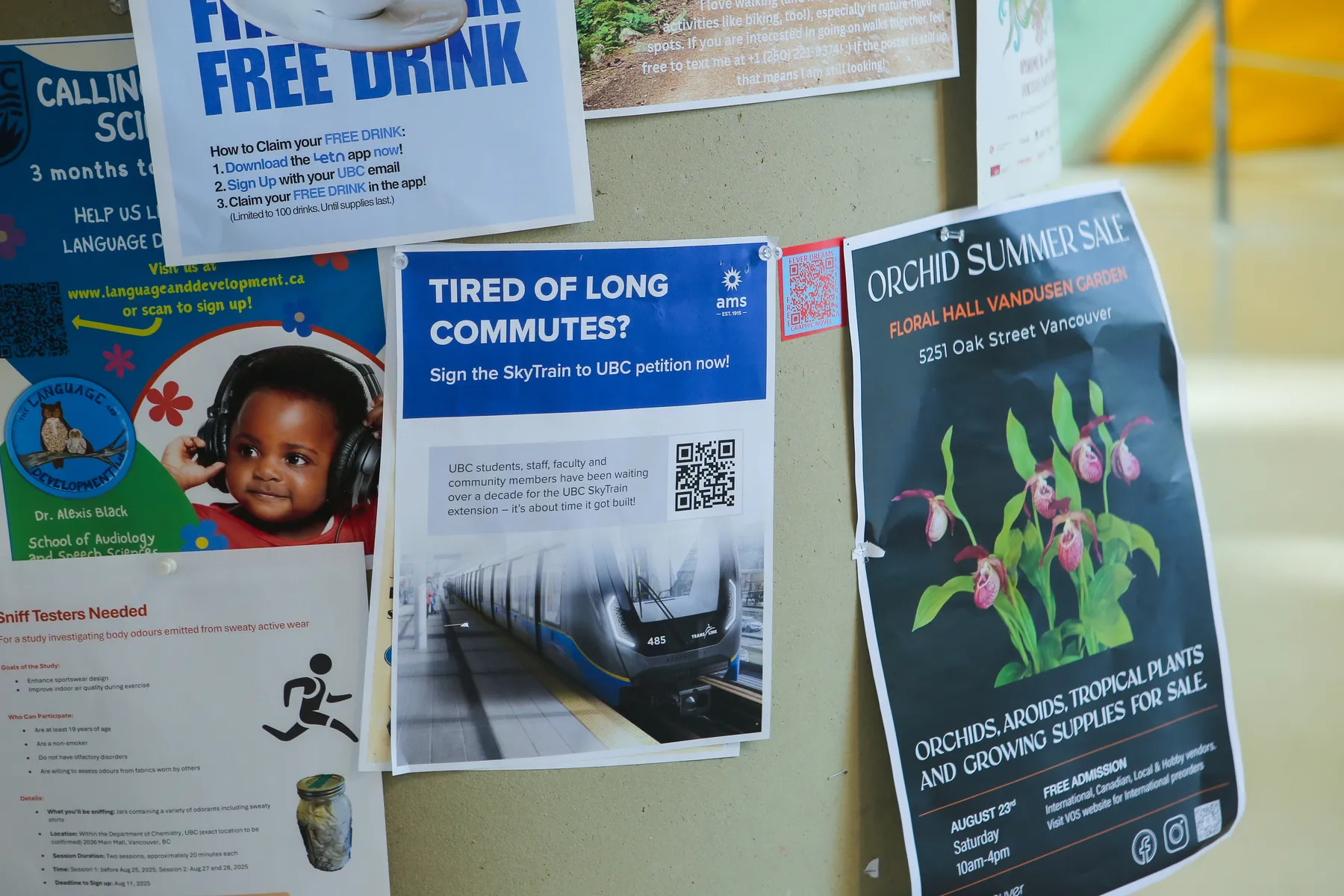
The AMS — UBC's student union — SkyTrain petition has surpassed its sign up goal with 10,000 signatures, after a months-long campaign spearheaded by VP External Affairs Solomon Yi-Kieran.
The petition is one aspect of an advocacy plan by the AMS to push for provincial and federal support for a SkyTrain extension to UBC’s Point Grey campus, announced at a June 11 Council meeting. The action plan has been split into three components — the petition, the “Trek for Transit” and coordinated lobbying.
This plan comes after years of advocacy by the AMS. Previous VP External Ayesha Irfan emphasized the importance of the Skytrain to UBC within her initial election platform and continued to advocate for the extension throughout her term. Before her, Tina Tong said she wanted to get “shovels in the ground as soon as possible” on the SkyTrain extension during her successful campaign to become VP external.
In an interview with The Ubyssey, Yi-Kieran emphasized the importance and purpose of the petition.
“Politics is a numbers game, numbers talk and politicians care about that data. There hasn’t really been that show of mass student turnout, showing that this is something that the community cares about, and is something that students need,” he said.
As well, Yi-Kieran believes that the petition is integral in engaging student voices in AMS advocacy. “The advocacy that the AMS can do is stronger when students know what's going on, when students feel that they have a voice, that they can participate … student life becomes better when students know how they can get involved to champion the causes they believe in. And we've had a really strong reception,” he said.
With nearly 80,000 daily trips to and from UBC utilizing transit, students and Metro Vancouver residents have indicated support for the extension.
TransLink surveyed over 15,000 people from across Metro Vancouver in 2021 and found that 92 per cent of public survey respondents supported the UBC SkyTrain extension. More recently, 84 per cent of students surveyed as a part of the AMS’s 2025 Academic Experience Report agreed that the extension would benefit their commute.
However, in order to move forward, the provincial government must release the business case. It indicates fundamental aspects to the project, such as the justification for the project, funding and the timeline.
“What I really want to see from the government is releasing the business case, which talks about how the funding and how the community impacts of this project, what they would be, as well as what the next steps are,” Yi-Kieran said.
Yi-Kieran stated how the AMS will “be working with the Vancouver City Council to make sure that these asks go to the provincial government, and make sure that these asks are supported by the Vancouver community through a motion to city council.”
Following the petition, the next step within the advocacy plan takes place on October 1, with a march in an attempt to mobilize the student body. The “Trek for Transit” aims to generate substantial media attention and pressure on the provincial and federal government to make statements.
After the Trek, “the third step is taking everything, the letters of solidarity, the petition, the media attention from the rally, and taking that to meetings with government, taking that to city hall, taking that to the legislature, taking that to Premier [David] Eby, and taking that to the federal government,” Yi-Kieran said.
The VP external believes the extension would make it easier for students to commute to the university. “UBC Skytrain makes sure that 80 per cent of all UBC commuters live within one hour each way to campus. It makes sure that students are actually able to access [campus], especially from cities like Surrey, New Westminster, Burnaby and Coquitlam.”
As well, Yi-Kieran emphasized the importance of a seeing a clear financial plan from different levels of governments, stating that “the really big thing is a funding agreement between the provincial government, the federal government and other important partners. I think it's really crucial that we actually know where the money's gonna come from, and that we have commitments from all levels, that students are finally gonna get this SkyTrain.”