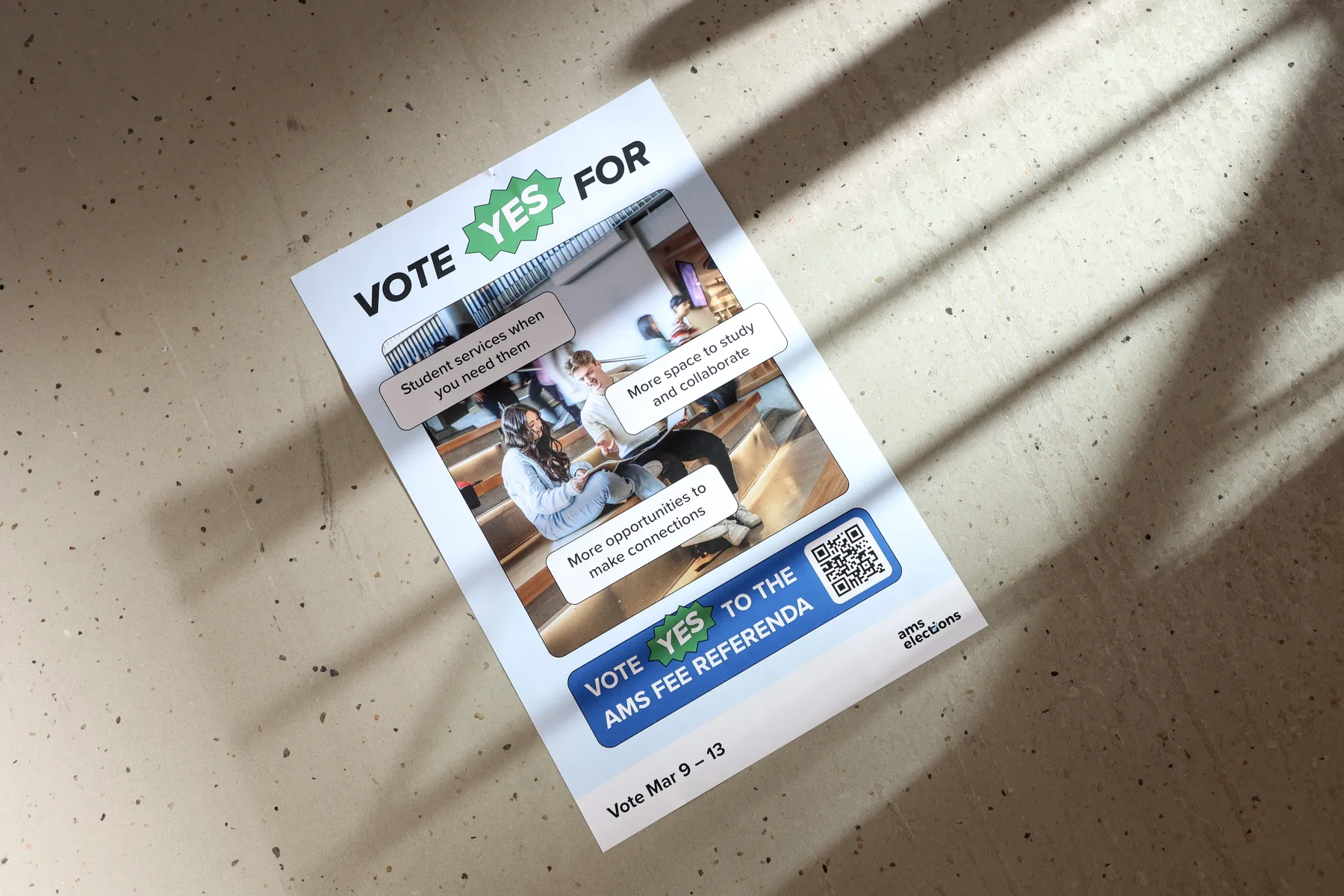

Following last year's failed referendum for a $4.95 student fee increase, the AMS is once again asking students to vote for increased fees.
This year’s proposal would raise two of the AMS’s 23 student fees and reintroduce another in September. For most students, the new fees would represent a 1.4 per cent — or $12 — increase in overall student fees from 2025-26 rates. To pass the referendum items, each must get a majority of ‘yes’ votes, and the number of ‘yes’ votes needs to equal to at least eight per cent of the student body.
When the referendums were first brought to council, AMS VP Finance Gagan Parmar said the AMS was at a “crossroads” — and that students will have to decide on the future of their union. “With the fee referendum, we're hoping to do two things, not only meet the demand right now that is growing, but meet the demand tomorrow,” Parmar said in an interview with The Ubyssey.
The AMS has officially endorsed the referendums and, following Council approval, AMS services staff can campaign in favour of it.
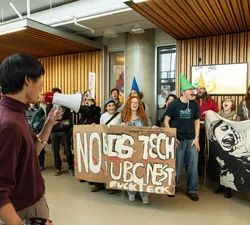
However, not everyone agrees with the $12 ask. Lucas Sun, chair of the Student Affordability Coalition (SAC), said that student leadership should not “look at a bunch of poor students” and think solutions come from raising fees.
The SAC also made an aggressive comparison to the AMS: “You can quote me on this. They're worse than Epstein. At least Epstein doesn’t violate my wallet,” Sun said.
When asked to respond, AMS President Riley Huntley wrote that the comment was "completely unacceptable and has no place in a student campaign. Making comparisons that trivialize the experiences of victims of serious abuse in order to score a political point is deeply inappropriate."
Clubs Benefit Fee
The Clubs Benefit Fee currently stands at $0.85 per year. If the referendum passes, it would increase by $4, landing at $4.85 annually. But despite the rise, students would be able to opt out of the fee — another change the referendum would introduce.
Parmar said money from the increase would fill the $80,000 deficit in club funding. According to him, the increase would also allow the AMS to hire a second permanent staff member to speed up room booking requests and slowly provide more grants to clubs for events, which have been cut in half over the years.
“We need to be doing more,” Parmar said. “That's what we're hoping to do with this fee referendum, is [to] not only stabilize right now, but to be able to continue providing those services at a greater scale and … level.”
If the referendum fails, Parmar warned that it could reduce the number of AMS grants and amount given, an extension on the clubs cap and fewer storage spaces.
Parmar said the amount was decided as a result of calculations that focused on addressing the $80,000 deficit. Necessary revenue for other projects — like expanding club grants — future growth, and putting the AMS “back on the path” to providing clubs with the resources they need were all considered, according to Parmar.
Data from the 2025 AMS Academic Experience Survey indicates that only 58 per cent of students indicate a sense of belonging on campus, and Parmar said this was also taken into account, given that clubs address this problem.
Sun argued that making the fee opt-outable “plunges” clubs into “uncertainty every September.” He said that room booking processing is a “baseline administrative duty” of the AMS, and that students should not “be forced to pay a premium tax” for the AMS to “do its basic job efficiently.”
Capital Projects Fund Fee
With a successful referendum, the Capital Projects Fund Fee would see an increase of $3, from $9.95 to $12.95 per year.
Parmar said the fee was proposed after a 2024 Nest experience survey and social media interactions led the AMS to realize spaces within the building for studying and social life were over capacity; an even more acute issue during peak academic periods. “This fee specifically is us hoping to address some of the pressure that the Nest is feeling to be able to service the volume and the high traffic as a central spot on campus,” he said.
The Capital Projects Fund Fee would predominantly fund the creation of a new student study lounge in the lower level of the Nest where the old hair salon used to be — also referred to as the clubs commons project. The fee would also fund replacing and getting more tables, chairs and AV equipment as well as expanding operations of the food bank by adding storage space for food pallets, according to Parmar.
Were the referendum to fail, “it would mean status quo,” Parmar said. He claimed the AMS would be unable to replace deteriorating equipment or purchase additional ones, overcrowding at the Nest would continue and big investment projects like the student study lounge would be scrapped.
According to Parmar, the AMS decided to increase the fee based on quotes for the student study lounge and average estimated prices of replacing equipment.
SAC is not opposing the Capital Projects Fund Fee.
“We take [this] as an example of a good fee increase that is needed, that is small and that doesn't have those structural issues that we were talking about before,” said Mohkam Singh Malik, a member of SAC.
Student Services Fee
The student services fee was last collected during the 2014 academic year at $7.25, after which it was consolidated with an extinct $4.14 fee for external and university lobbying and advocacy into the present AMS membership fee.
If reintroduced, the fee would be $5 per year, indexed to the B.C. Consumer Price Index (CPI).
SAC believes indexing the fee to the B.C. CPI represents a “forever-tax,” and Malik said this takes away prospective students' “fundamental right to vote” on future increases. CPI indexation guarantees that the fee maintains its purchasing power despite inflation.
Parmar cited a 700 per cent increase in student interactions with AMS services such as Safewalk, peer support, the AMS Food Bank, advocacy and tutoring over the past five years. Growth has “outpaced [AMS] resourcing [and] overextended capacity,” Parmar said.
Parmar placed the AMS food bank at the centre of this. The fee would fund improvements to food bank wait times through new software and the hiring of full-time permanent staff.
Parmar mentioned the AMS has found that students are often coming to the union with intersecting issues. The services fee would allow the AMS to hire permanent management staff that can connect students to the multiple services they might need at once.
“It would be wrong for me to say that, should the fee not pass, that we would not continue providing the services,” Parmar said. “We absolutely would, because it's something students expect of us.” He stressed that if there continues to be exponential growth, there may be limited access to these services.
The AMS originally calculated the fee amount above $5, but Parmar said the fee was brought down as “students are going through a difficult time and this is a lot to ask [of the] student body, and during a time when … finances are tight.”
Malik said SAC supports the “values” and “needs” of students, but thinks the AMS should have “reallocated funds” first before asking for the fee increase.
Sun criticized the AMS for not “prioritizing essential services over internal perks.” Some of the expenses they consider “luxury items” include $65,000 for AMS Awards Night Gala, $40,000 for catering and retreats, $61,802 in legal fees and the entirety of the VP Student Life portfolio.
The Ubyssey confirmed with Parmar that $40,000 is expected to come from sponsorship revenue for Awards Night Gala, and the rest will come from the AMS budget. He noted the gala is meant to “recognize the hard and volunteer work” of over 400 student leaders and constituencies. Additionally, Parmar said the $13,440 for AMS Council reflects that AMS councillors are volunteers and meetings can span upwards of five hours.
Sun claimed the “luxury items” could have been reallocated “directly to the food bank and student clubs,” instead of proposing a referendum. These adjustments would amount to around $160,000 altogether, according to Malik.
(For reference, the fee increase could raise over $600,000 for the AMS. )
Parmar said the AMS will lead its campaign in favour of the referendum with positive messaging, but maintained the student union has a responsibility to transparently communicate any potential consequences if it fails.
“[This referendum] has always been student-led and student-driven, and all of the tangible benefits that we're hoping to come out of this and come to fruition will again be student-led and student-driven,” he said.