

On Monday morning, going up the stairs of the AMS Student Nest was more challenging than usual.
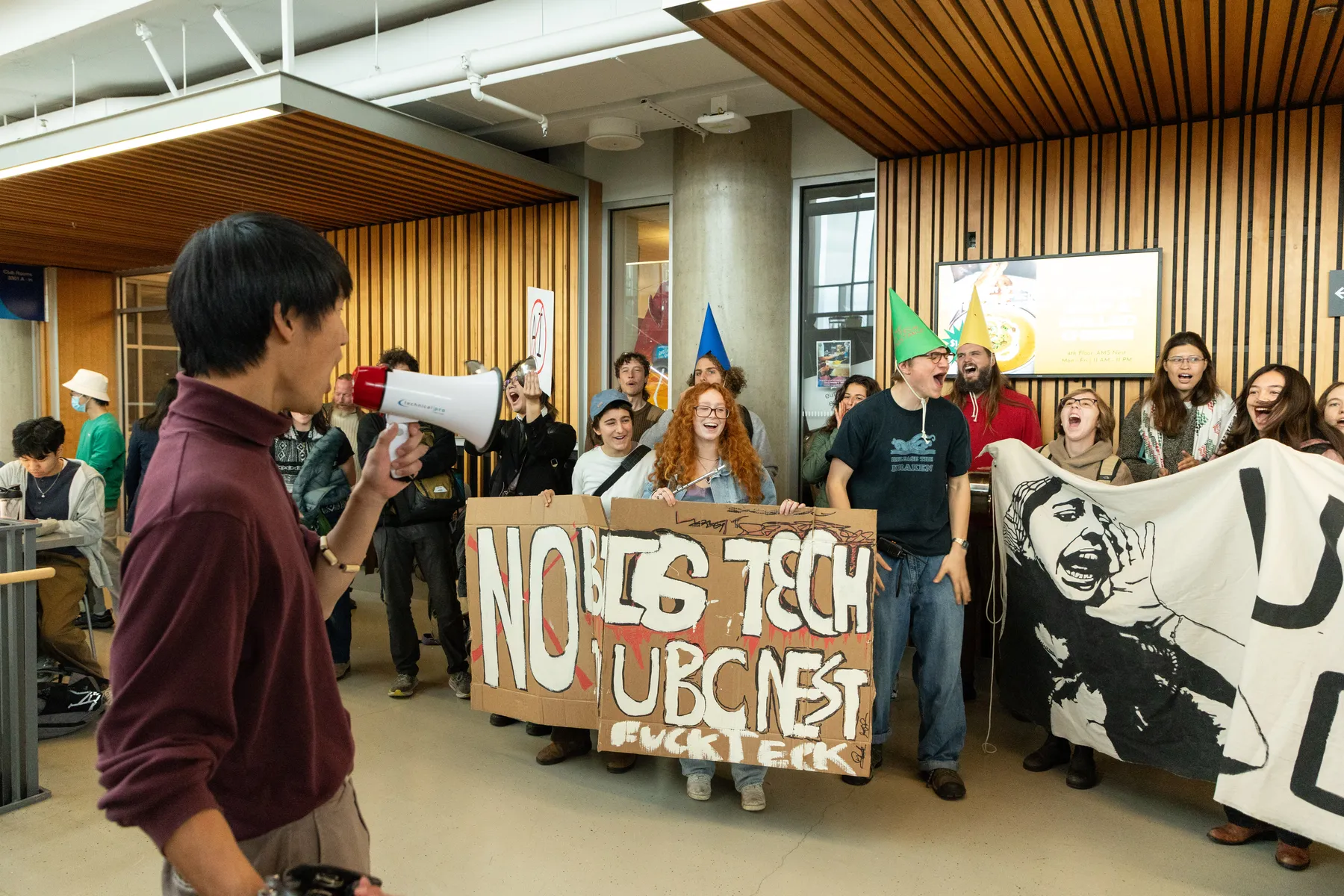
Dozens of protesters huddled on the landing. Some wore pointy green hats while others rattled pots and pans. "Big tech, hell no," they chanted. Private security guards stood between them and the Great Hall, where tech professionals and aficionados sporting conference lanyards chatted casually.
The demonstrators had gathered in the Nest in opposition to the Global Summit AI Vancouver 2026 — a two-day event self-advertised as a place for "bold ideas, practical insights, and meaningful connections," offering a range of activities from startup pitch showcases and workshops expert panels to "fireside chats."
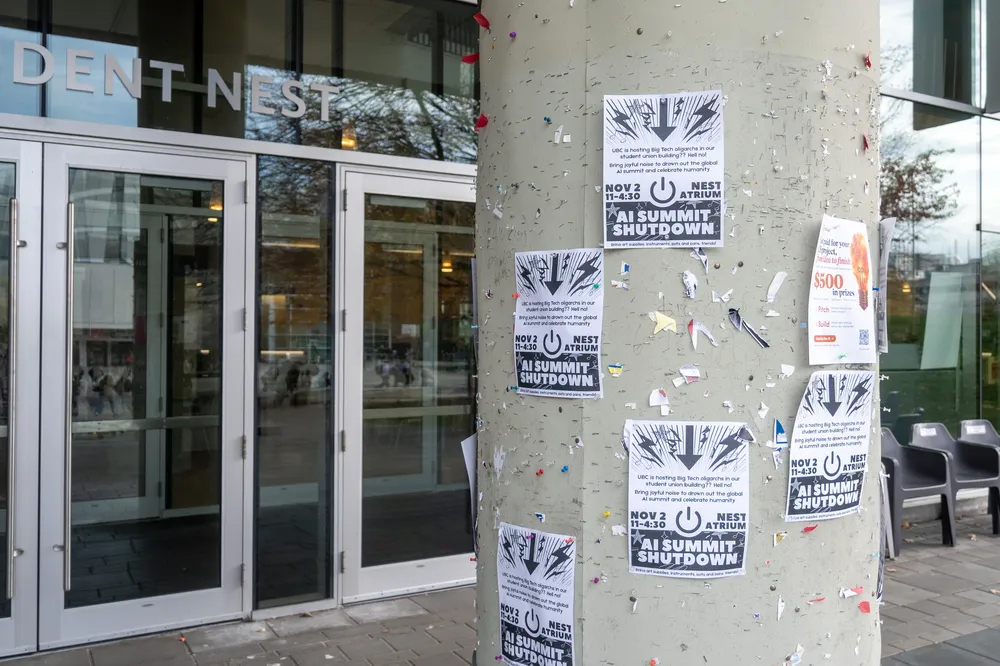
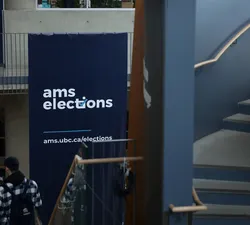
The bulletin board outside the AMS Student Nest, containing multiple posters advertising the AI Summit Shutdown in the morning of November 2.
In the lead up to the summit, posters advertising an "AI Summit Shutdown" protest began appearing throughout campus and in social media. They invited students to "Bring joyful noise to drown out the AI summit and celebrate humanity carnival-style." Multiple student groups collaborated on the protest, including Climate Justice UBC, Palestine Solidarity Action, the UBC Social Justice Centre, the No AI UBC Committee, and the UBC Greens.
Alex Dabbs was one of the most vocal participants on Monday, leading the crowd's march throughout the Nest and delivering speeches.
"The AMS is supposed to be our student union, and yet they seem to just follow the interests of big tech corporations," Dabbs said through a megaphone during the protest. "Here today is the wife of the prime minister, Diana Carney, UBC officials, [and] representatives from major U.S. tech companies. This is not a space for that ... That is not acceptable. That is despicable."
Diana Fox Carney, an economist and wife of Prime Minister Carney, delivered the summit's opening remarks. The conference also brought speakers from companies such as Google DeepMind, Microsoft, Anthropic, Meta, and Cohere, as well as UBC staff and faculty. Nonetheless, the summit mostly featured researchers, software engineers, data scientists and small entrepreneurs, the most notable exception being Andrej Zdravkovic, AMD's Senior Vice President & Chief Software Officer.
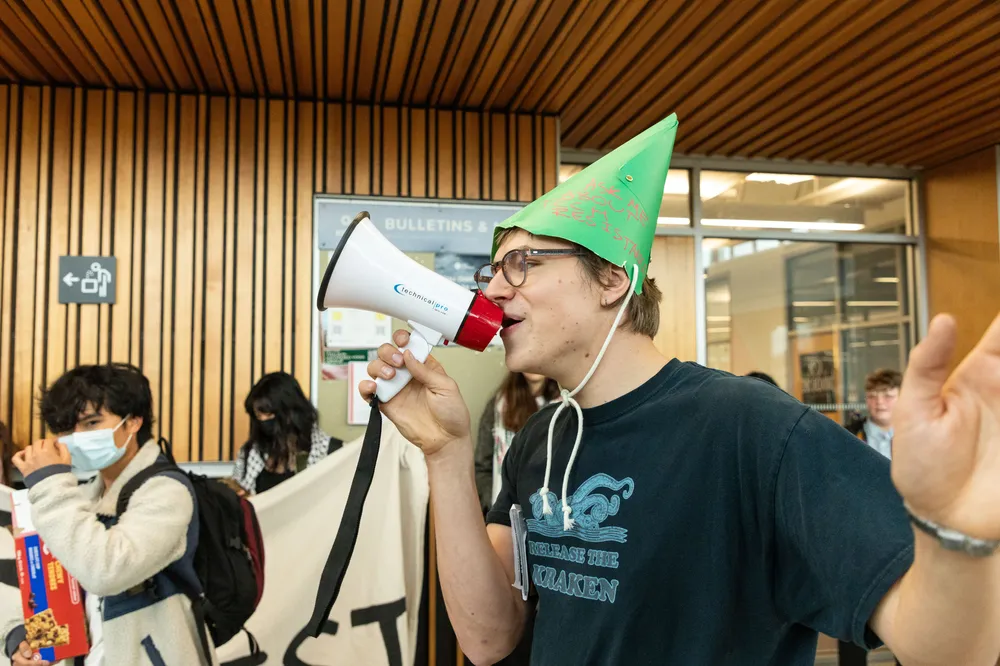
Alex Dabbs, one of the participants at Monday's event, speaks into a megaphone.
Rabab Ward, professor emeritus of electrical engineering at UBC, had a unique perspective on the protest. Her lanyard marked her as a summit attendee, but she walked with the protestors as they chanted, observing. "We have to learn about AI," she told The Ubyssey. "The most important [thing] is how to control it, and ... the government and the CEOs of the big tech [companies] don't want to be controlled. But it doesn't mean the technology itself is bad."
Ward thought many would agree with what the protestors were saying. "The big tech [companies] are really in bed with Trump and these governments. And that's of course wrong, because there have to be checks and balances."
Last week, The Guardian reported the world's first trillionaire, Elon Musk, spent US$446 million to help elect Republican candidates in the United States midterm elections. Most of Musk's money went to Texas, home to his car manufacturer Tesla and rocket-maker-to-AI company SpaceX.
The historic investment will pay little dividends, as Democratic nominees James Talarico and Gina Hinojosa are projected to become the next United States senator from Texas and the state's governor, respectively. Talarico and Hinojosa's are the first state-wide victories for the Democrats since 1990.Hijonosa has pledged to put in place a moratorium on data centres in Texas.
On Monday, students inside the Nest moved up the stairs and began to march around the third floor. "No big tech in our Student Nest," they shouted, later switching to "We need water, not data centres." They sang Bella Ciao, accompanied by fiddles and harmonicas.
The summit and the protest weren't the only events happening in the Nest that day: two floors below, the Mexican Student Association (MEXSA) — an AMS Club — was hosting their Day of the Dead celebration. This year, it involved collaboration with the Consul General of Mexico in Vancouver and a performance from Cirque du Soleil. MEXSA President Tayde Asbun said she had been working on the celebration for months and was worried the protest would cause problems for their event.
"I found out about the protest two days ago ... I started taking [down] all the posters," Asbun told The Ubyssey. "Of course, we are also against AI, but this is a huge event for us. This is the biggest celebration of the Mexican culture ... we don't want this to get out of hand. We don't want security."
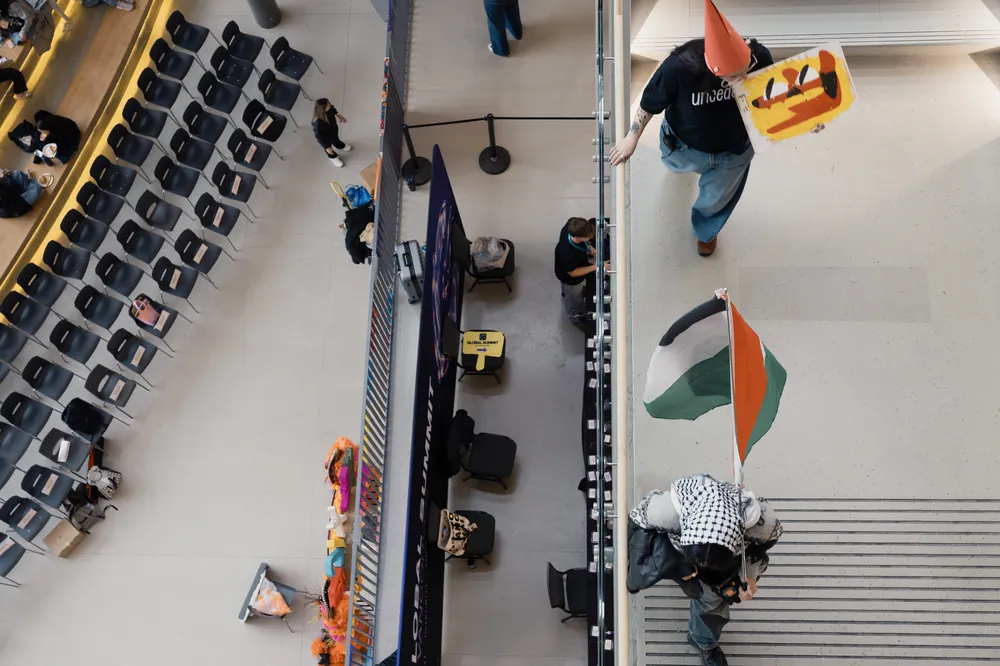
The Summit, protest, and MEXSA's Day of the Dead event all took place in the Nest on the same day.
She said both protesters and summit organizers had been cooperative when it came to sharing the space, with protestors moving their banner away from the student association's flags and summit workers providing MEXSA executives passes to access all areas freely.
Around noon, the protestors moved outside to congregate on the hill in front of the Nest. Some sat in a circle, singing anti-war songs and making signs with paint and cardboard. Others stood further up the hill talking.
Josephine Trigg and Sadie Musselman, both first-year forestry students,took part in the art circle.
"I like the idea that this is a celebration of humanity because AI can be very dehumanizing," Trigg said. "It's unregulated ... there are so many things happening, and these big tech companies aren't being stopped by anything."
When asked about the gnome hats protestors wore, Musselman described them as a "celebration of how silly" humans can be. "If we use our creativity ... it can create a lot of joy and whimsy."
Marcus MacGregor, the writer of the daily UBC Bus Loop pamphlets, briefly observed the protest. He told The Ubyssey he is "glad to see people out, doing a good thing."
Luka Santiago, president of the UBC Greens, was also in attendance at the protest. In a written statement to The Ubyssey after the event, Santiago criticized the event's pricing, describing it as a "searing indication" that it was "simply not designed for UBC students." Two-day access to the summit started at $349 for a general pass. VIP access was priced at $1699. Santiago said that while the UBC Greens were not involved in initial protest organization, they joined after being "disappointed with the AMS Council’s decision to let this event happen within the AMS Nest."
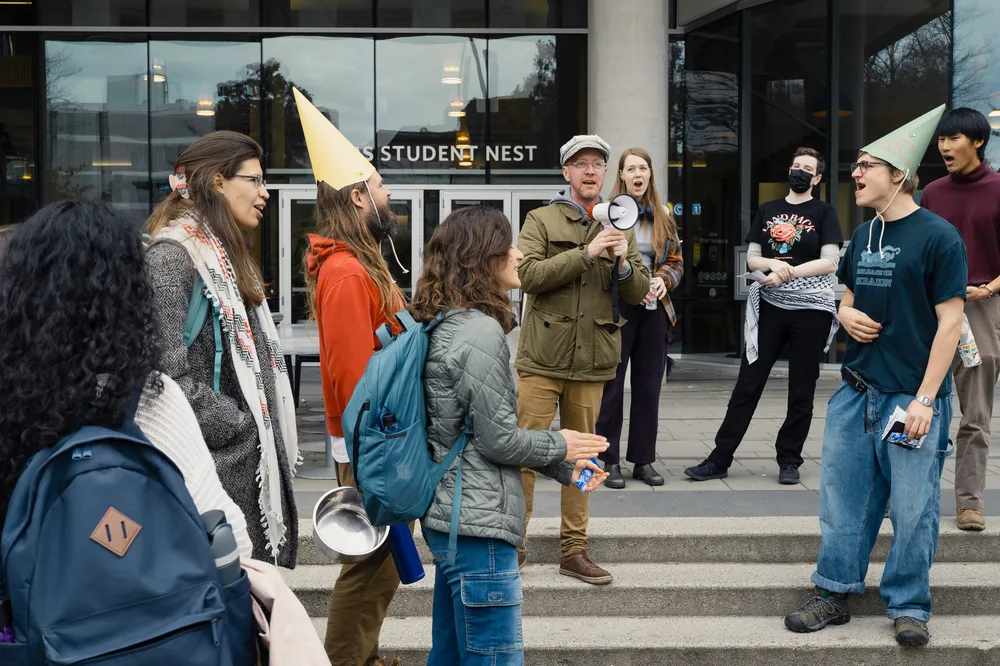
Protesters gather outside the Nest. UBC Greens president Luka Santiago said the club joined the organization of the protest after their disappointment in the AMS Council's decision to let the event take place in the Nest.
"[The Nest] was not designed to be an avenue for American tech corporations to advance their own interests, whose operations involve participating in genocide and environmental destruction."
One of the protestors' main talking points was the presence of representatives from multinational technology corporations like Cisco and Nvidia at the summit. Protestor Dayla Hart criticized Cisco's presence at the Summit. Abhishek Kumar, a senior engineering leader at Cisco, delivered a speech titled Agents Work in Demos. What Breaks in Production? earlier that morning.
"Cisco is absolutely integral to the genocide of Palestinians, and big tech companies in general have been really profiting off the death of Palestinians and the stealing of their lands ... This is techno-colonization," Hart said.
The American Friends Service Committee, which tracks United States companies that have provided Israel with military equipment, has listed Cisco as having sold Israel US$2 million in servers and "professional services" between November 2023 and January 2024 alone. This summer, the US Equal Employment Opportunity Commission found that Cisco had likely violated the civil rights of Southwest Asian, North African, and Muslim employees by failing to address hateful rhetoric on company forums online.
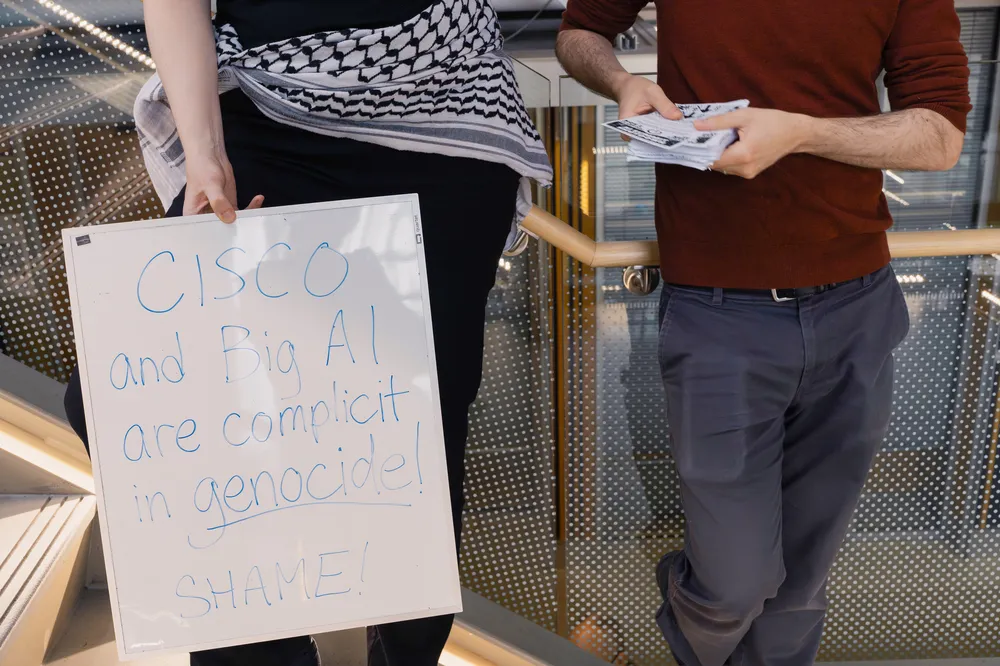
While standing on the stairs listening to another protestor speak, Hart held a sign that read "Cisco and big AI are complicit in genocide." A person walked up to Hart and smeared it until it was illegible. "[The individual] said 'there is no genocide' and called me a jihadist ... I was not physically harmed, but she did destroy my sign."
Inside the Great Hall, UBC students and Global Summit volunteers Jeffery Qi, Carter Chung, and Jared Shum lingered by the water cooler. For the three first-year students, volunteering was a way to network with tech professionals and get to know the AI landscape. Shum said he was eager to speak with AMD's Zdravkovic but was unable to.
When asked about the protestors outside, Qi expressed support. "We are in Canada ... This is a place where freedom of speech is absolutely encouraged, and they were doing it in a very peaceful way ... I think that should be encouraged at a place like UBC," he said.
Shum was more critical of the protestors than Qi. "I completely understand their point and where they're coming from ... But when I asked [them] specific questions about content, they wouldn't really respond." Shum claimed he was "verbally attacked" in response to his questions.
He said "these types of protests" tend to focus on the negative aspects of AI over its benefits. "I'm sure that every single person that's ever used the hospital or any other type of infrastructure that is provided by the government has always [benefitted from] using AI to actually help them,"he said.
The Government of Canada currently uses AI-based models to accelerate applications for temporary and permanent residence.
In a blog post by the Canadian Medical Association, they outline how AI is being used to diagnose patients early, analyze DNA samples, and monitor vitals across the country. However, they say "some AI programs have been known to 'hallucinate,', providing information that's inaccurate and, at times, just plain weird," and recommend human medical professionals are always trusted first.
"The reason [protesters] are able to live right now is because of these systems that use AI," Shum claimed.
When asked whether he believed general attitudes on campus towards AI were better aligned with protestors or summit attendees, Chung said he thought neither group accurately represented UBC students as a whole.
"They're both extremes on either side ... I don't know if either of us are a good representation of how people feel about it."
The Ubyssey reached out to AMS VP Administration William Sparks for comment on the event. When asked what the UBC community stood to gain from the summit, he said events held in the Nest raise revenue for the AMS and its businesses.
Sparks said the AMS "does not make or cancel any bookings based on ideology ... given that the event does not have the effect of promoting discrimination, hate speech, or violence according to AMS policies or relevant legislation."
In response to the UBC Greens' criticism, Sparks said they currently have no policies against hosting commercial events. "As this event did not breach any of our internal policies or legislation, we did not see sufficient cause to cancel the event. However, we appreciate that different students might have their own opinions on companies with a presence on campus and absolutely have a right to express those beliefs."
This piece was updated on November 5, 2026 at 1:36 p.m. to correct the pronoun used to refer to Dayla Hart.
A previous version of this piece said protestor Dayla Hart criticized the presence of Cisco employee Abhishek Kumar at the summit — this was inaccurate. Hart criticized the presence of Cisco representatives overall with no focus on particular individuals. This piece was updated on November 11, 2026 at 10:19 p.m. to reflect this change.
A previous version of this piece said the American Friends Service Committee has listed Cisco as having sold Israel US$2 million in servers and "professional services" — this is factually correct, but incomplete. That contribution was in a period of three months between November 2023 and January 2024. This piece was updated on November 15, 2026 at 11:55 p.m. to reflect this.