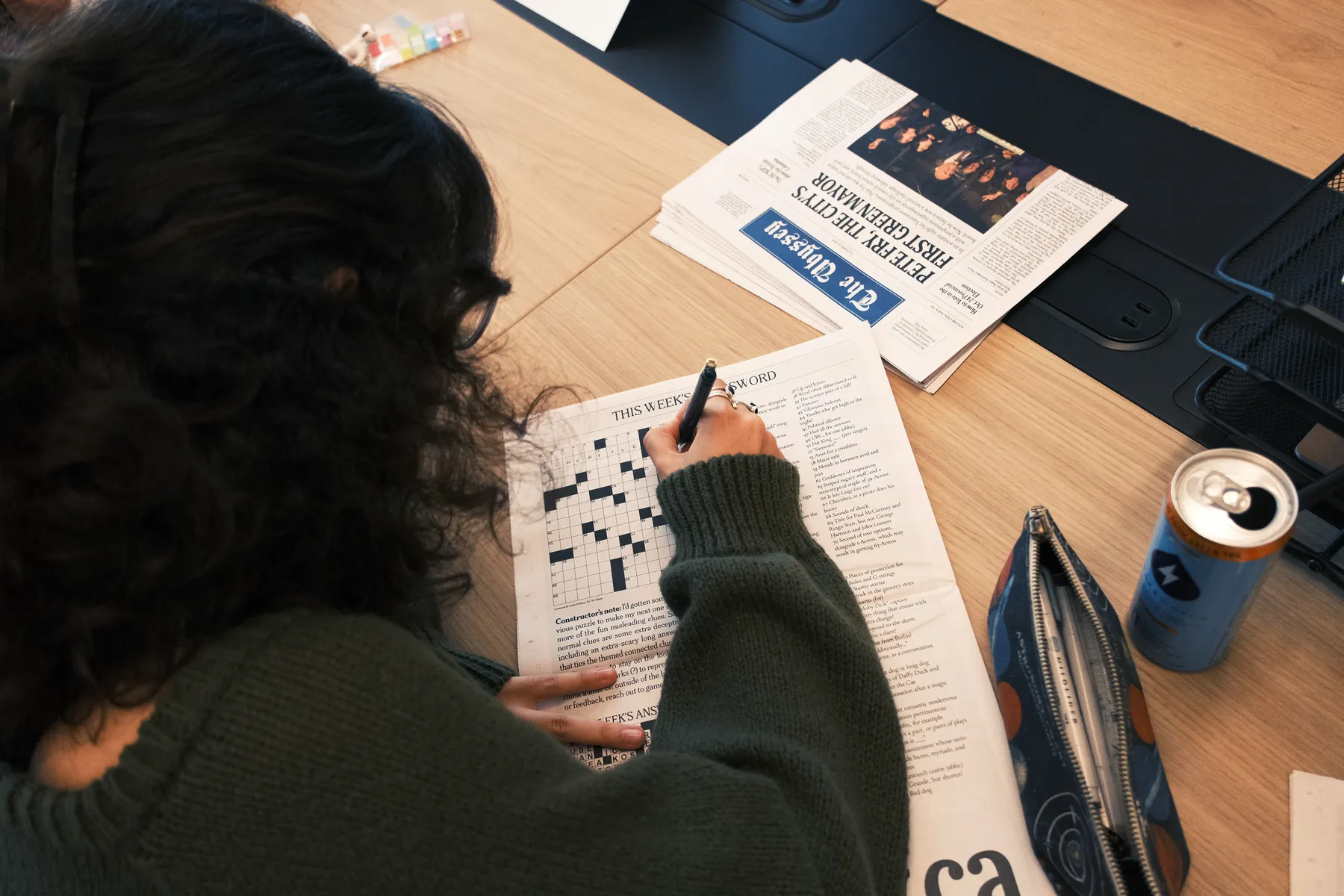

Every time I see a newspaper in the wild, my first instinct is to pick it up and flip through until I find the crossword. There’s something so satisfying about those grids of black and white squares, practically begging to be solved. Once you start to fill it out and all the pieces fall into place — there’s really no feeling quite like it. Maybe it’s just a personal thing, but I do think there’s a basic human instinct that causes us to see an empty grid and desperately want to fill it in.
A few years ago, when I had an abundance of free time on my hands (something to do with a global pandemic), I began trying to construct my own crossword puzzles. As someone who’s passionate about solving them, it was a process I’d been curious about for a while. At first, it was one of the most challenging things I’d ever tried. It was infuriating trying to make a grid of words fit together; at the last moment, I’d come to a corner where there was simply no possible word left to make it work. I’d find myself having to practically start over just to find a new sequence of words that might align.
But after years of honing the artform, it’s become a therapeutic hobby. It turns out, like so many other things in life, there are strategies and patterns you start to recognize with enough practice, and it makes the construction process so much easier and fun.
And now, with The Ubyssey, there’s an outlet for the puzzles I make, and an audience to solve them. I’d done some work with The Ubyssey in the past, as the composer of the theme music for The Vilest Rag, but now I have the chance to put my other artform on full display: crossword puzzles!
As the Senior Games Designer, I’ll be constructing crosswords for every print edition of The Ubyssey, and soon, I’ll also be building weekly puzzles online at ubyssey.ca. As of writing this, my first puzzle has already been printed, and the reception has been incredible. It turns out that my hunch was correct — people inherently love solving crossword puzzles. It’s a fun way to increase audience engagement with the paper, and having a local games designer keeps things fresh.
In fact, one of the biggest upsides of designing crosswords for a paper like The Ubyssey is that I can include references to things local to UBC and Vancouver, whereas bigger outlets — like The New York Times — need to remain generally accessible to wide audiences. So, keep an eye out in the puzzles for references like which Thunderbirds teams are really killing it, what hot new TV drama is being filmed on campus, and where the best local ice cream spot is.
Also, to ensure that The Ubyssey’s games are as unique and fun as possible, we are hiring a team of volunteer game designers.
Our long-term goal is to get daily puzzles on the website. As much as I love designing and solving the big 15x15 crosswords, I understand that it can be time-consuming, and maybe not for everyone. So, we’re planning to include mini-crosswords and short trivia games into the mix on a daily basis.
If you are someone who’s passionate about crosswords and trivia and would like to be a part of the Games team as we inevitably take over The Ubyssey, then consider applying at ubyssey.ca/join. We ask for two mini-crosswords (between 5x5 and 10x10) as an example for the application, but training will be provided to successful applicants. If you’re someone who’s just here to solve the puzzles, then don’t worry – you’ll be seeing a lot from me.
For those of you who are new to the crossword-solving lifestyle, I thought it might be worth including some insight from the constructor’s perspective to help you better conquer the clues.
As a crossword constructor (or a cruciverbalist, if you’re fancy), building the grid is only half the battle. Every word on the grid needs its own clue, of course! This is the part where I get to be clever. Ideally, every word on the grid is a commonly known word, phrase, or name. The puzzling part comes from the clues. The most simple type of clue is a basic definition, synonym, fill-in-the-blank, or example of the answer, such as:
Clue: Tightly packed | Answer: DENSE
Clue: Ubes, for example | Answer: YAMS
Clue: Director Sam of the Tobey Maguire Spiderman films | Answer: RAIMI
Pretty straightforward. Sometimes, you might also see a word at the end of the clue, which might indicate an altered form of the answer. If a clue ends in “abbr.” or “briefly,” then you can assume that the answer will either be an abbreviation or acronym. Similarly, if the clue itself contains seemingly unnecessary abbreviations or acronyms, then the answer will too. Such as:
Clue: UBC grad. deg. for an aspiring author | Answer: MFA
The most fun type of clue is one that involves misdirection. I’m not always trying to stump the solver, but sometimes I want them to think a little harder. So, if you ever see a clue ending in a question mark (?), that means that the clue is using wordplay to be misleading. For example:
Clue: Convertible for a crash? | Answer: SOFA BED
Clue: Spherical opening? | Answer: HEMI
In the first example, it seems like the clue is morbidly referring to a car crash. The question mark should lead you to think outside the box about other types of “convertibles” and other meanings of “crash,” then deduce that a SOFA BED is a convertible bed that you crash on. The second example seems like it’s referring to a sphere-shaped hole in something, but the question mark should lead you to think about another interpretation of “opening” and deduce that the prefix HEMI is an opening to the word “spherical” to form the word “hemispherical.”
There are some other types of clever clue-ing that might come up, especially once I start making more themed puzzles. But I’ll trust your puzzle-solving instincts and leave it there for now.
Make sure to keep an eye out for the print edition crosswords, and very soon, for online crosswords, as well. If you have any questions or feedback about The Ubyssey’s puzzles, you can reach me at games@ubyssey.ca. Good luck, and happy solving!