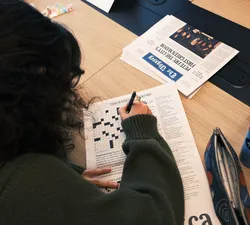


Since 2022, The Ubyssey has printed a 16-page issue every other week, and before that, we did weekly print for many years. We have covered UBC since 1918, and for most of that period, print was our primary — or even only — medium. At our peak, we published a four-page paper multiple times a week.
The frequency of print publication establishes a paper’s character. Early in The Ubyssey’s history, issues were short and came out often, so their content had to be hyper-current. A story that was a day or two old was most likely stale by the next print date.
When we moved to a weekly — and subsequently, biweekly — print, we reduced the number of production nights but increased the space that was available per issue.
The content in a biweekly publication needs to be able to withstand that two-week gap. This means writing longer features, explanatory pieces, and stories that stay relevant for days, if not weeks. We were telling you what information from the last two weeks might still matter for two more weeks. This is closer to a magazine’s logic than a newspaper’s. A magazine, however, isn’t meant for news. It’s meant for things that will still make sense whenever the paper is picked up.
There’s nothing wrong with that kind of journalism, and we’re not letting go of that side of our report. But it’s not all we want to do. This year, our newsroom — especially our news and sports sections — have shifted toward more timely reporting, including coverage of meetings, games, campus events, and elections. A biweekly schedule is not the optimal fit for that — a story about Pete Fry winning the Vancouver mayoral race, for example, may not reach readers in print until nearly a week later.
Because our print schedule couldn’t keep up with our reporting, timely stories went online first, and print became a delayed, condensed version of ubyssey.ca. That made the paper dependent on the web. It also made it less enticing: its contents could have already been seen elsewhere, earlier.
Since last January, our print has been somewhere between a newspaper and a magazine. We've been redesigning, trying to find a compromise between the new style of reporting and old way of publishing. Breaking stories were finally making it onto the cover, but they weren't serving anyone 10 days after they hit the stands.
Putting it together felt impossible. There were too many competing logics for the design to fully make sense. Good design has a purpose. People associate the practice with art and aesthetic, but function comes first. Changing the form without changing the function meant we were printing a magazine while pretending to be a newspaper.
We want our print to stand on its own. A reader who picks up the paper on a Tuesday should find the week’s reporting there relevant and timely. Weekly publication makes that possible. The interval between reporting and printing is both short enough that the paper is actually carrying news rather than simply summarizing it, and long enough that our reporters, editors, and designers get the time they need.
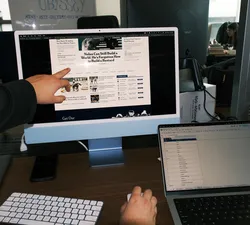
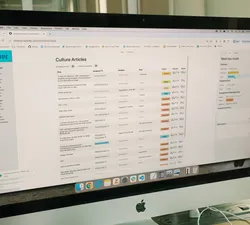
Of course, none of this means moving away from digital. Breaking stories will still be published online as they develop, and the website — which we also recently redesigned — will remain our primary channel. Every day, our newsletter — The Ubyssey, in Brief— will also reach readers’ inboxes with a rundown of our new stories, editors’ picks, and announcements, including open positions, podcast episodes, or videos.
New print issues will now appear on stands across campus every single Tuesday.
A predictable schedule is important for us, because reading a newspaper is a habit, and habits depend on regularity. A paper that appears on an irregular — or worse, infrequent — basis has to be remembered or noticed, and sought out each time. But a paper that appears on the same day each week, in the same stand, can become part of a reliable routine.
A large share of news use is more routine and force of habit than it is deliberate. Habit helps people cope with a crowded media environment by saving them from making a fresh decision every time. In other words, readers don’t decide to pick up the paper each week so much as they get into the practice of picking it up. For that to happen, the paper has to be in the same place, on the same day.
There’s also a community side to this habit. When writing on the early daily press, Benedict Anderson called newspaper reading a “mass ceremony” — an act performed alone, though with the awareness that thousands of others are doing the same thing at the same time. Anderson was writing about nations — but the idea easily transfers over to our campus too.
A fixed schedule gives the UBC community a shared point at which the paper is new for everyone at once.
You can find print stands around the AMS Nest, the Buchanan Building, IKB, and many other spots, each and every Tuesday.
If you have thoughts on the new schedule — or can’t find a copy — contact print@ubyssey.ca.