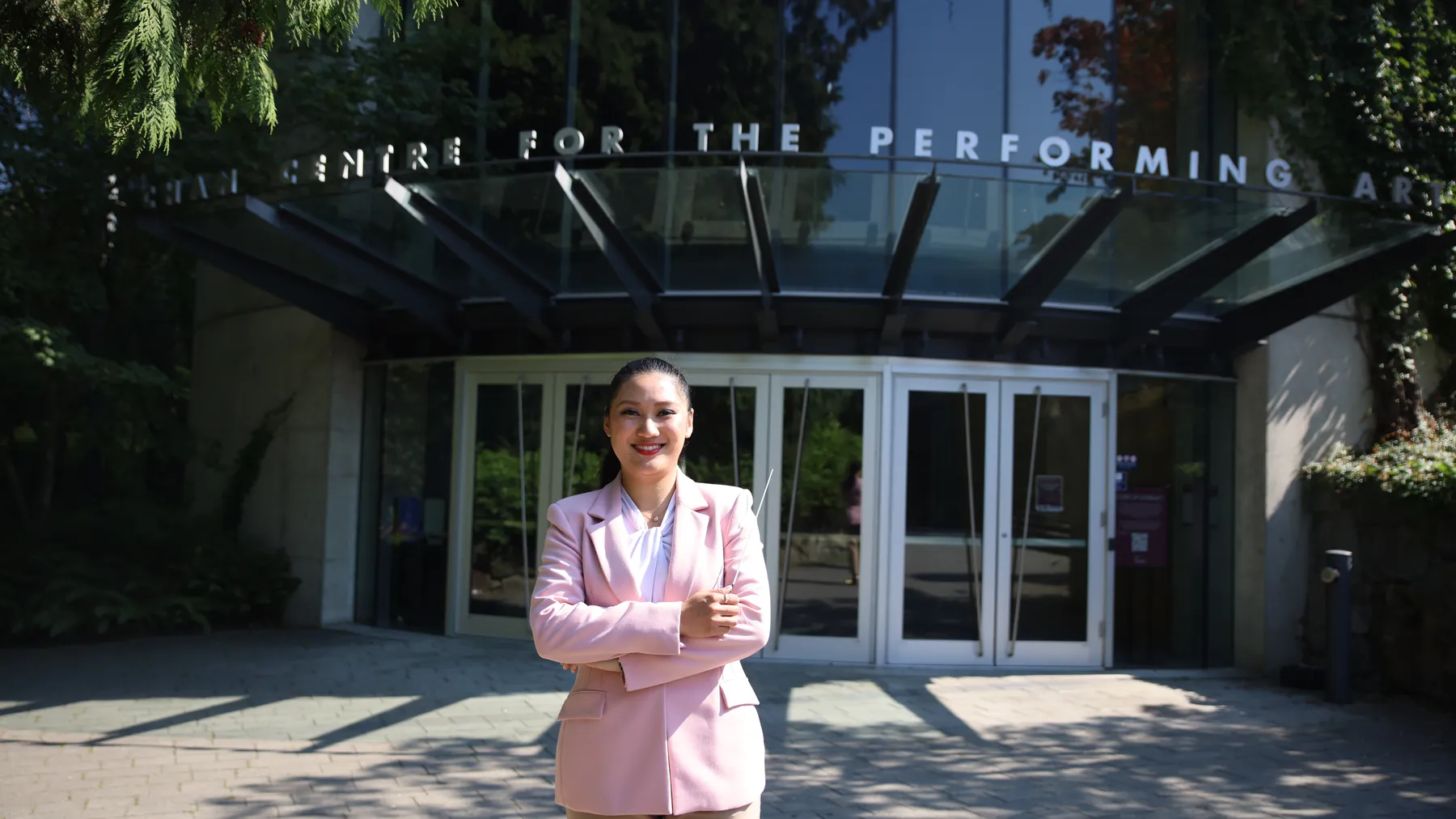

The podium looks deceptively simple: a wooden block, a music stand, a conductor standing at the centre of it all. But conducting a wind ensemble is anything but simple. Arms rise and fall for hours on end, muscles burn under the stage lights. Every flick of the wrist must be precise, every gesture must be commanding and supportive.
Dr. Meijun Chen, UBC’s director of concert winds, does just that. “It’s indeed like an athletic move,” she said, “because you need to really practice everything to make sure your muscles are in shape.”
Conducting requires not only physical stamina but also intense mental focus and talent: preparing scores in meticulous detail, anticipating questions before they’re asked, listening in multiple directions at once. At any moment in rehearsal, Chen is thinking in several directions at once, turning dozens of individuals into a harmonious whole.
For Chen, the path to the podium was not straightforward. Born in China and educated in Alberta, she began piano lessons at four and picked up the clarinet in elementary school. Like many young children, her parents wanted her to have musical hobbies. While music may have started as a hobby, she kept on playing. When she joined her elementary school band, she realized that she loved the group environment where she could “hang out with friends and make new friendships” in a band setting.
But going into her post-secondary education, she didn’t think music would become her career. When Chen entered the University of Alberta for her undergraduate degree, she did so as an economics major. But she couldn’t resist auditioning for the bands, eager to find the same sense of belonging she’d found in the past. After her auditions, her professor — and eventual doctoral supervisor — Dr. Angela Schroeder pulled her aside.
“She literally persuaded me to switch to music because she thought I played the clarinet pretty well,” Chen said. “If she didn’t do that, if she didn’t say, ‘you should consider switching to music,’ I would never think about being a music major.” That moment altered the course of her life.
Despite never expecting to pursue music professionally, Chen switched her degree, eventually completing a master’s degree and just this summer, finished her doctorate of music under Schroeder at the University of Alberta — being the first woman to complete a doctorate in wind band conducting at the university.
Although she has reached the pinnacle of a formal academic education, Chen sees herself as a lifelong learner. “The more I can learn, the more I can share with my students,” she said. To do so, she has carried her baton across 13 different countries — training, performing, competing. In 2023, she won the Johann Strauss Foundation Music Award to study under Professor Toby Purser in Vienna. That same year, she was a conducting fellow at the United States “Pershing’s Own” Army Band Conductors Workshop, which is “one of the best wind bands in the world,” Chen said.
Her international prominence has won her praise at home and abroad. In July, Chen was named to CBC’s 30 hot Canadian classical musicians under 30 list. “I'm definitely very, very happy,” to be included on the list,” she said. “I've been looking at that list since when I was much younger as an undergrad student,” always hoping to be a part of it. “I definitely work very hard for all my goals, no matter how small or big and sometimes … you just need to keep your passions and don't give up. And then when the opportunities come, just be ready for it.”
The recognition matters, she said, less for herself than for what it signals to others. By being on the list, younger students get to see a female role model reaching her dreams, inspiring them to "achieve much more” than they would otherwise.
At UBC, Chen leads the university’s concert winds ensemble. Most of her players are first- and second-year students, many still adjusting to the pressures of university life. Her approach to programming reflects her belief that the ensemble should be both a platform and a classroom. “I make sure every concert we include one female composer's work, one underrepresented composer's work,” alongside a Canadian composer’s work, Chen said.
Rehearsals under Chen can be demanding. Students must not only master notes and rhythms but learn the historical and theoretical context of the music. A fast, rhythmically precise piece develops tonguing and agility; a slow, lyrical one demands breath control and patience. Every piece in each concert is thoroughly thought out, to make sure students are learning something new from every performance, Chen said.
The difficulty for Chen lies in balancing a room full of musicians at different levels. Some arrive with years of private instruction; others with only high school band. She has just two rehearsals a week, each two hours long, to make sure everyone is learning and no one is left behind.
The question is, “how can I accommodate, try to make sure everyone learns something throughout the rehearsals,” Chen asked. “It’s challenging, but at the same time it’s rewarding.”
Still, Chen sees her role as extending beyond music. Teaching for her is about impact and community. “It’s not a one-time thing, that once I’m done teaching it’s done,” but more so that those she taught can pass on her teachings and impact the people around them.
“It's not that I only teach the student sitting in front of me, but I'm also teaching through the music — we are educating the audience that is sitting behind me.”