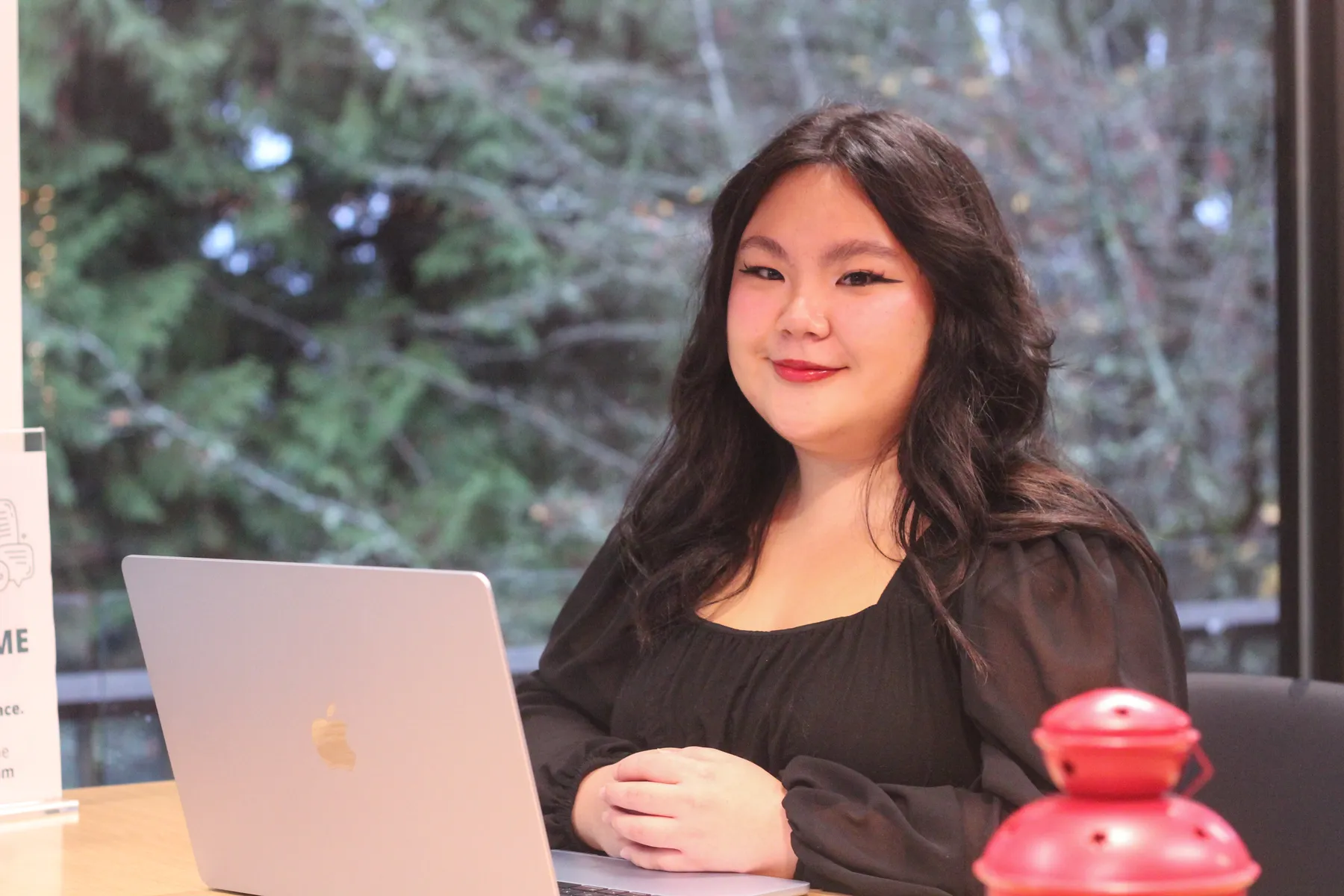

Emily Tang has loved governance since long before she got involved with UBC’s Graduate Student Society. She thinks her passion started in elementary school, when she was involved in student council. But politics aren't everything to the master’s student.
Tang’s in-progress thesis focuses on sexual health, specifically social media’s potential impacts on sexual education for first-generation immigrant Chinese women — not what typically comes to mind when people think of kinesiology.
When entering her master’s, Tang thought she might look into body image and femininity, but her experiences with sexual health advocacy were pushing her in another direction. Tang has served on the National Youth Advisory Board of Action Canada for Sexual Health and Rights — a non-profit focused on upholding sexual health and reproductive rights — since 2022. She has been working on initiatives centred on making information about sexual health accessible to youth, including a national campaign that flooded social media platforms with advertisements encouraging young people to get tested for sexually transmitted and blood-borne infections.
Though her master’s thesis is still in very early stages, in some ways, she’s been thinking about questions surrounding the immigrant experience and its intersection with health for her entire life.
Stories from Tang’s upbringing are threaded through all of her work. She moved to Canada when she was eight years old and noticed that her mother’s understanding of how to deal with her daughter’s changing body was very different from what the girls around her were doing. She wasn’t allowed to wear a bra and tampons or shave her body hair, and because of that, she missed out on dance classes and swimming lessons, and found herself put into a lot of uncomfortable situations around other girls her age. Puberty and sexual health were topics her family simply refused to touch.
“[Immigrant women’s] perspectives and our encounters with sexual health [are] a little bit more unique, in a way,” Tang said, referencing a recent UBC study that found migrant youth less likely to use contraceptives than their peers born in Canada, likely due to barriers they face in getting adequate sexual health education and care. Tang’s focus on social media comes from her observations of how underserved communities — like queer people — who receive a sexual education that’s lacklustre or inapplicable to their experiences tend to turn to online platforms to find information or support. Sometimes this works in their favour, but other times, it can leave people with a misguided understanding of how to approach sexuality and health.
Although it’s not entirely clear yet what information will surface from Tang’s research, she hopes it will spark change both in the classroom and online. She believes social media could be a valuable teaching tool, if used in the right ways, to dispel some of the myths and taboos that surround topics relating to sexuality.
“I'm really hoping that some girl [will] look at my research paper and be like, ‘I totally understand this, and I resonate with it,’ and that hope inspires them to be more open about their own sexual health,” Tang said. “I really want it to be more of an inclusive conversation.”
Although Tang’s interest in sexual health stems from challenging and uncomfortable experiences, she’s able to recognize the comedy in them now — and she’s not afraid to share that with the world. One day, after she had finished a meeting, Tang decided to try doing a stand-up set at the UBC Comedy Club. She didn’t have any jokes written out, just a bunch of funny premises for stories she could tell. It was a hit with the audience, enough so that she came back for the club’s year-end show. In the two years since then, she’s taken her jokes beyond campus and into the city. “Stand-up is one of my loves,” she said. “If I start dating someone, I'm gonna be like, ‘You're going to come after my stand-up priority.’”
Tang’s passion for stand-up comedy draws from a lot of the same questions and feelings that inspire her research — it’s all a bit “unhinged,” as she puts it. When she steps on stage, she can tell that people wouldn’t have expected a small, “cutesy” woman to approach stories about bodies and sex with such candour. For her, talking about sexual health isn’t shameful, but normal and integral to being human.
In between research and jokes, she’s somehow found time to lead UBC’s Graduate Student Society (GSS).
The GSS advocates for the needs of UBC’s graduate student population, led by a team of five executives. Tang served as the VP external relations from 2023-25 and stepped into the role of president in the spring of this year.
A priority of the GSS is making sure that graduate students are supported in all aspects of life, even outside of their classes. They provide subsidies to help students access Vancouver attractions, like skiing or soccer games, and put together hampers of childcare products for students with families. The GSS also works alongside the AMS on larger-scale goals that impact both graduate and undergraduate students. Last month, this meant speaking up about the new provincial post-secondary funding review.
“I'm so privileged to be here and to have gained the trust of the grad students,” Tang said. One of the driving factors in her decision to lead the GSS was her own upbringing; she’s the first in her family to work toward a master’s degree and grew up with a single mother, which forced her family to work through financial hardships.
She’s held a few different leadership and advocacy roles throughout her life. In addition to her advocacy work with Action Canada, Tang also served on Library and Archives Canada’s Youth Advisory Council, which allows young people a chance to provide input into how we handle the documents that shape Canada’s cultural histories.
Her studies at UBC, however, are completely different from her work at the GSS. Even though she doesn’t necessarily come from the conventional law or political science background that’s perhaps expected of student politicians, Tang thinks her approach to the work has a lot to offer. “I think that it's really cool to not have a law degree or a poli sci degree, because I think that there's value in all disciplines,” she said. “Those are the voices that we need in a governing structure.”
Whether by supporting graduate students’ well-being or advancing understanding of sexual health through her research, Tang is always striving to aid the communities around her. “They're all interconnected,” she said. “You can't have sexual health if you don't have food security, [and] you can't have sexual health if you don't have affordable housing … No matter what I do, I'm just hoping that I can make a positive impact.”