
Zadie Smith is terrified of the passage of time.
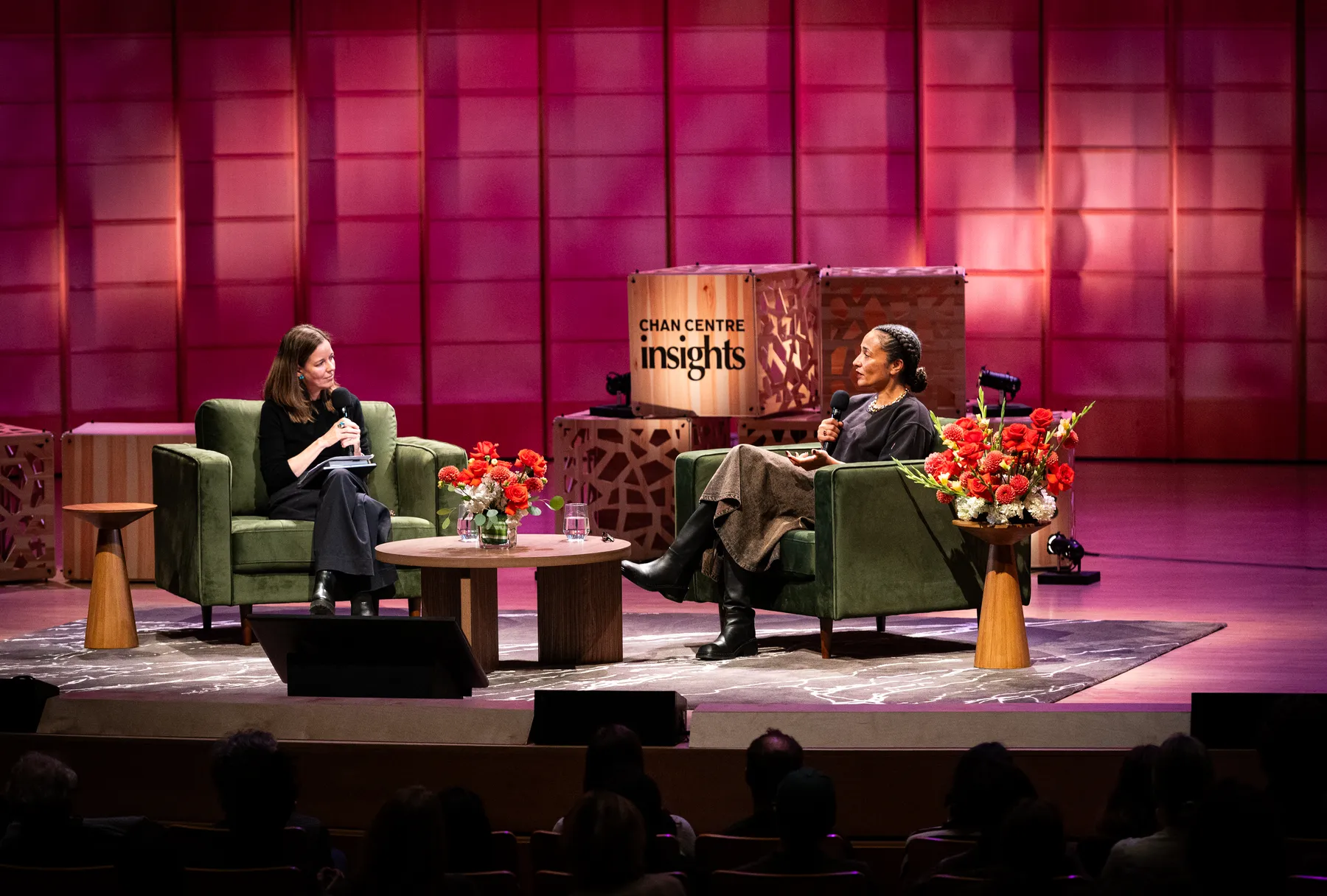
The world-renowned author — with a body of work often compared to that of Charles Dickens — graced the Chan Centre stage last week. She was joined by the director of UBC's School of Creative Writing, Alix Ohlin, who moderated the event. (Ohlin's novel Dual Citizens, a 2019 Scotiabank Giller Prize Finalist, drew inspiration for its complex female relationships from Smith's Swing Time.)
The set-up was comfortable, conversational: two leather armchairs, a coffee table, roses the same vibrant red as Smith's signature lipstick. The only things missing were a couple glasses of wine, which the crowd, on the other hand, had no shortage of.
I took in the eclectic mix of audience members: seniors in funky glasses, toting colourful, woven bags; middle-aged people of all walks of life; a few fresh-faced youths. Spreading my gaze across this shifting, expectant sea of Vancouver's diverse residents, this makeup seemed fitting — we were reminiscent of the mixing-pot cast of her books.
Smith entered the literary scene with her debut novel White Teeth at the age of 24. She's earned the exceptional merit of being famous for more than half of her career. For a writer to have garnered such renown at an early age is rare in the literary world. Even Toni Morrison — whose books Smith called an "existential" experience when she read them as a child — published her first novel The Bluest Eye at 39.
The Guardian dubbed Smith "the first publishing sensation of the millennium" following the release of White Teeth, and the novel has evoked an inescapable discussion ever since. Last night was no exception. When Ohlin asked about the 25th anniversary of White Teeth — which was last year — Smith said her "main response was horror."
Despite the acclaim her first novels receive, the fact is that Smith does not like her early writing.
In a 2010 interview, Smith reflected on how other authors treasure their work, while she remained unable to find that confidence in herself — to the point where writing became "a very painful experience." That's why Smith doesn't surround herself with her own work at home; she confesses that she keeps most of her novels at her mother's flat.
During last week's talk, Smith described the abrupt anniversary of her book as a "moment of forced reflection" on her career. In the light of the occasion, she's thought about the emotional fragility she carried as a young writer. She recalled crying for a day after reading a negative review of her novel NW in The New York Times, which had stamped her narrative style with descriptors like "clunky" and "jerry-built."
Having been immersed in university life at King's College during the creation of her 2000 work White Teeth, Smith compared her relationship with critique of her work to receiving a bad mark from a professor.
But now, as a teacher herself, Smith reverses this deprecation; she's realized she does not have to be submissive to the reviewer. She shared a phrase she tells her students: "A voice is something you can't help but have, perhaps. That is not the problem. The problem is everything else." After 26 years of living in the shadow of her first novel, Smith has finally begun to feel comfortable in her own skin.
It wouldn't be a Smith talk without mention of the moments that mortar England's past. In her 2023 novel The Fraud, Smith finally tackled the colossus that is historical fiction. For her, the genre seeks to answer a question that nagged her growing up: why am I here?
In simple terms, The Fraud recounts a scandal where an English butcher claims to be the long-lost heir to an inheritance and title. Despite being an impostor, he amasses a swarm of passionate working-class supporters who stand with him against the elite who dare to challenge his claim.
Amid this throng of political chaos, Smith injects an examination of how Caribbean slavery built the economic foundations of England. She does this through the character of Andrew Bogle, a formerly enslaved Jamaican who supports the claimant. To explain the disparity between the civilized normalcy on the surface and the British colonialism that made it possible, she referred to a scene from Jordan Peele's Get Out, where the main character falls through the floor during hypnosis.
"That's how I think about Victorian England," she said. "Everybody's living their lives, and underneath it, there's this monstrosity."
She also spoke about the comic impulse in her writing and how it's ingrained in English culture. An avid fan of British comedic icons like The Goon Show and Monty Python, Smith insists that England has an obsession with humour.
In approaching history, however, she admits to using humour as a weapon to get past people's defences. "I'm aware that if I scream in somebody's face about slavery, reparations, or the history, they're really in this state where they don't want to hear it," she said. And she's far from the first to take this approach — English-born Charlie Chaplin's The Great Dictator is a satirical film that presents a wartime mockery of fascism.
More often than not, the Victorian and early 20th-century fiction genres Smith frequents were punctuated with the racist perspectives of those eras. She recounted a childhood memory of "wincing at epithets." But despite the prejudices that come with works like Virginia Woolf's — "I'd come across bits in her diaries and be like, okay. So I'm not coming to tea," Smith said, rousing a hearty chuckle from the audience — literature of that time has shaped Smith's essay writing.
As a young reader, Smith had to learn to weave around the language of books that discriminated against her, because they were all that was available. Now, with the rise of racial, cultural, and queer representation in 21st-century literature, she's glad young people don't have to do this.
Generations tend to carry symbolic weight on their back — a token from their time period. The Greatest Generation upheld the civic duty and endurance born from the Great Depression; baby boomers embodied the revolutionary spirit of 1960s counterculture. Smith wants the product of her generation — Generation X — to be institutional memory.
She invokes a concept called selective retrieval — "it's the opposite of nostalgia," Smith said.
I took this to mean that after living across the economic and social changes of different time periods, you become the memory of the status quo. You are capable of drawing connections across the conditions that existed, comparing them to the present, and deciding which aspects of history are worth bringing back. In lieu of "retrieve," the word "reclaim" comes to mind.
So, what are we going back through history to retrieve?
"Not all of it," Smith said. "Not all of it's worth it. But some of it is."
Smith draws on Philip Roth and John Milton to demonstrate the value of reading as a way of revisiting the living facts of history. She sketches her observations of young people in New York reading Roth on the subway, and noted how they weren't necessarily reading for his dated views on women, just as one wouldn't read Paradise Lost to embrace Milton's portrayal of the Devil. Instead, we still read these books because "the language is extraordinary," Smith said. "That energy, you can use it. Anyone can use it and take it for their own project."
Leading up to her appearance at the Chan, Smith spoke to The Vancouver Sun about the importance of human volition in our current political and cultural scene. She pinpoints the complications within these arguments as a loss of belief in divided feelings and incomplete knowledge.
But during the talk, she handed us a vital tool to combat this absence: the power of looking back. She urges youth to turn toward the past in order to move forward. Ultimately, the grit and energy we reclaim — the things we choose to remember — are up to us.