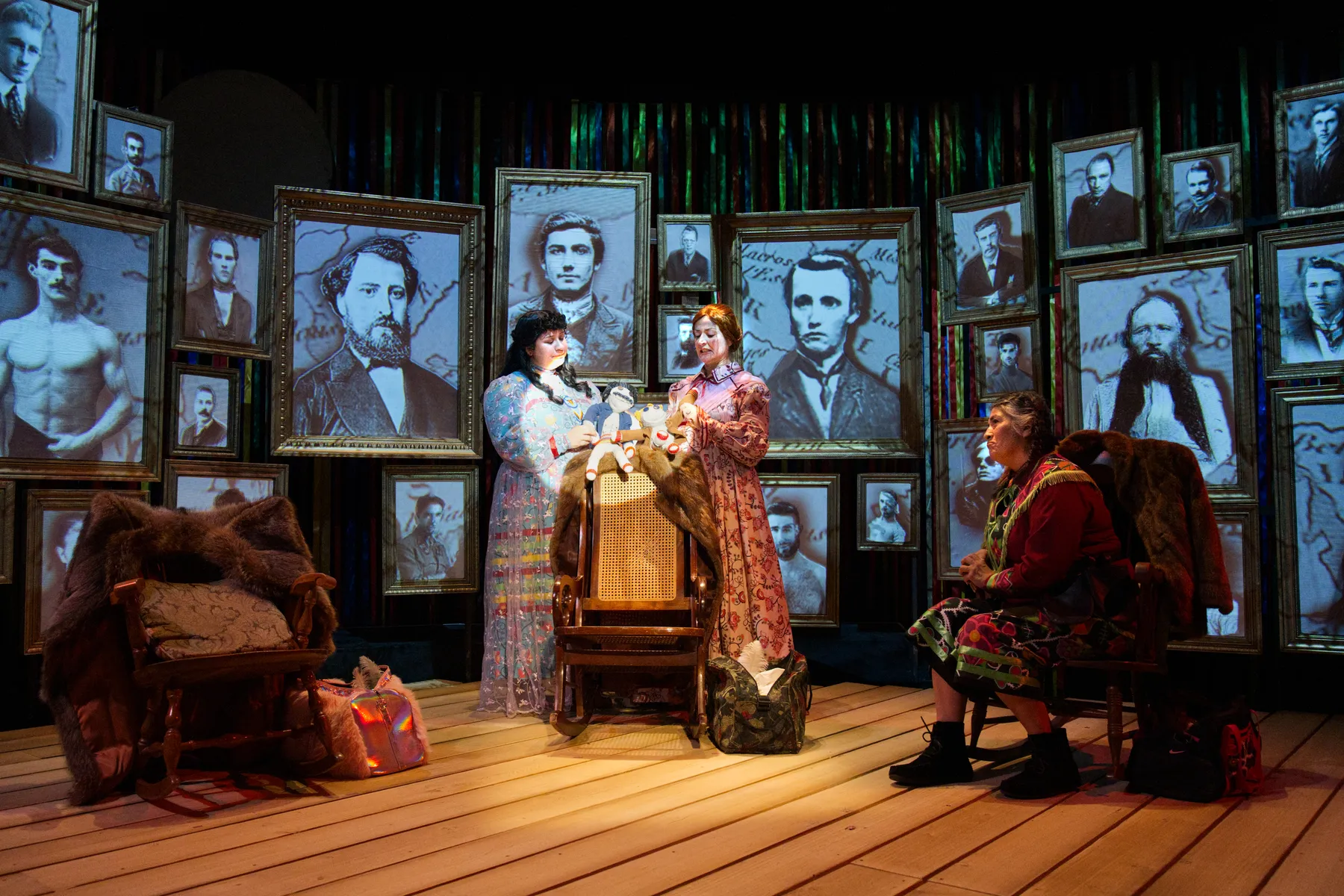

The set of Touchstone Theatre’s 2025 production of Women of the Fur Trade is a highlight. A diamond-shaped platform dominates midstage; a scaffold structure above its two back sides supports dozens of black-and-white portraits of men. From Frances Koncan’s script: “famous men, infamous men, nobody men, somebody men … Men of the Fur Trade, men of all kinds.”
They are nearly all white men, except for Métis leaders Gabriel Dumont and Louis Riel. Their portraits, along with that of anti-Assiniboine insurgent Thomas Scott, are the largest. As the lights come up, identical copies of each portrait are projected onto them as overlays, lending each face a spectral gravitas as they loomed above the three women trapped beneath them.
This platform — a stand-in for “a fort much like Lower Fort Garry or Upper Fort Garry” in the “Reddish River” Métis territory — is where the majority of the play’s action takes place. Marie-Angelique (Kelsey Kanatan Wavey), Cecilia (Cheri Maracle) and Eugenia (Columpa Bobb) sit in fur-lined chairs, sleeping, playing with dolls — doing anything they can to stave off boredom. Though Eugenia, an Ojibwe fur trader, is able to leave the fort through a hidden door in the wall of portraits, Marie-Angelique and Cecilia are both physically and socially trapped, unable to leave the gaze of the men.
This treatment of mobility is the most interesting thing Koncan’s script does. Marie-Angelique, a young Métis woman infatuated with tales of the freedom-fighting Louis Riel, paces around the room nervously, pent-up energy visible in every excited gesture. Cecilia, on the other hand, is a settler with an absent husband and a crush on Thomas Scott. She rarely leaves her chair, and does so less and less as frontlines are drawn across the Reddish River and her unwillingness to actively resist the colonial project becomes more apparent.
When Riel (Jonathan Fisher) and Scott (Victor Hunter) enter halfway through the first act, they are immediately mobile, marching downstage, carrying suitcases and gazing off into the distance. No walls of portraits hem them in.
Koncan, an Anishinaabe and Slovene playwright and assistant professor in UBC’s school of creative writing, said Women of the Fur Trade started out as a serious historical drama when she first drafted it in 2017.
“I wanted it to be a history play — super serious — and I was trying to write in a really authentic late 1800s vocabulary and style,” she said. “I found that really difficult.” After a few rounds of edits, though, Koncan decided to write in a contemporary voice inspired by the time-bending style of Lin-Manuel Miranda’s Hamilton.
“A lot of the feedback was just that people really liked that the dialogue was contemporary. I started leaning into that more and making some intentional choices about when we would be really anchored [in the late 2010s] era, and when we would have these more formal 1800s serious moments. Playing with the difference and the contrast between those became part of the fun.”
That contrast reached highs and lows throughout Women of the Fur Trade. The comedy of Victorian-era characters name-dropping Tyra Banks and telling each other to “touch grass” gave the play an energetic spice, even if some references were, by now, a few years out of date. Hunter’s buffoonish Thomas Scott and Bobb’s cool, snarky Eugenia were high points of the performance, opposing energies bouncing between them though they rarely shared the stage.
At times, this light tone bumped up awkwardly against the often complex and brutal realities of the plot. In these cases, the quippy dialogue sometimes confused the messaging or else disappeared altogether. The last 15 minutes of the play ramped up the pacing dramatically, jokes falling by the wayside as the Reddish River Rebellion, the death of Thomas Scott and the execution of Louis Riel resolved themselves over the course of two or three scenes.
Despite a rushed third act, Women of the Fur Trade manages to contribute to discussions around the insidious creeping of colonialism into the lives and rights of Indigenous people in a unique and resonant way. The play’s best scene sees Eugenia leaving the room while Marie-Angelique complains that she can’t do the same. She wasn’t born in this room, she says, but she can’t seem to find the door. Cecilia doesn’t mind — she was born here, and it suits her just fine.
As their conversation continues, walking through a door becomes a skillful metaphor for stepping outside the bounds of settler society. Eugenia does it with ease; Marie-Angelique thinks she has before, but can’t quite remember; Cecilia never has and never will. Eugenia soon re-enters, her laid-back smile now an uneasy frown. “I can’t find the door,” she says. “It’s gone.” Against the backdrop of John A. MacDonald’s encroachment on Manitoba and the threat of confederation looming large above the safety of Indigenous people, this line is chilling — one of the reasons, no doubt, for the play’s enduring popularity.
Women of the Fur Trade is one of Koncan’s earliest plays, and her first to be widely produced.
“I had done some smaller shows for Fringe festivals and that sort of thing, and some of them did pretty well,” she said. “They'd win awards, but they didn't really have a life after the Fringe festival. And Women of the Fur Trade was a Fringe show … In 2023, it got picked up by the Stratford Festival and the National Arts Centre, and it's been getting produced pretty regularly ever since.”
Koncan said the play represents her work as a younger, up-and-coming writer, and that its repeated production by different theatre companies taught her a lot about writing for the stage. These days, she passes on that knowledge to creative writing students at UBC while working on new scripts of her own. Her new play, Murder on the Pacific Spirit Express, was commissioned by the Arts Club Theatre Company in 2024 as part of its Silver Commissions initiative. Inspired by Agatha Christie’s Murder on the Orient Express, the play sets up a satirical murder mystery on a luxury passenger train journeying from Montréal to Vancouver.