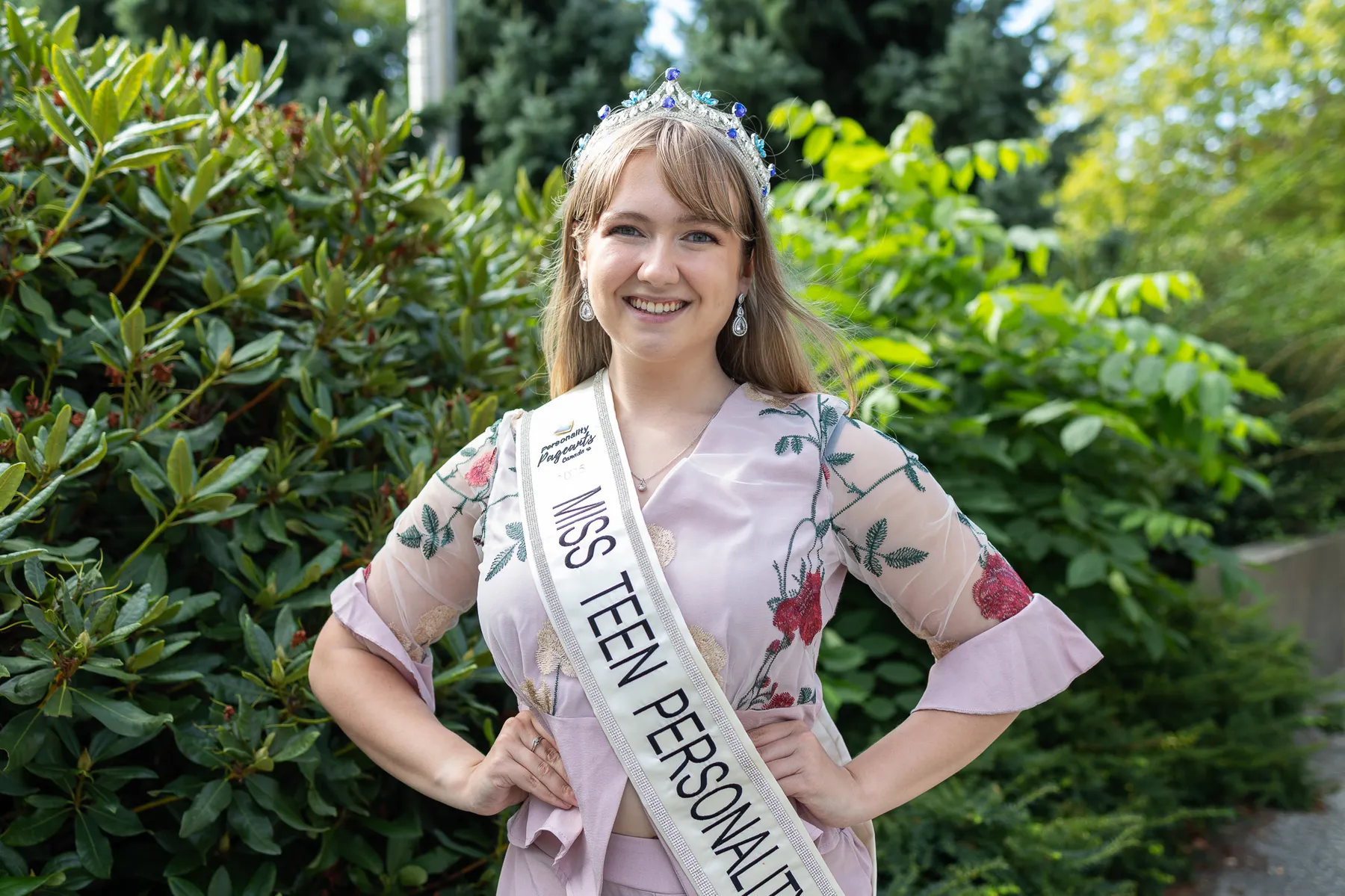

Shaelyn Hunter is well aware of the reputation pageantry holds in the popular imagination — the beauty-centric competitions of Toddlers & Tiaras or Miss Universe pageants. Still, Hunter proudly sports the title of Miss Teen Personality Southern Canada 2026, a pageant that turns the focus away from evaluations of feminine beauty and toward the advocacy and accomplishments of Canadian women. It is from this platform, on the pageant stage, that Hunter practices her activism.
Hunter, a third-year psychology student at UBC, puts her education to practice through her queer mental health advocacy organization, The Belonging Initiative.
“I’m eventually going for a PhD in clinical childhood psychology,” she said, “so I decided to link the two and do a bunch of research on the queer community and youth, especially what their opinions are about the mental health system and how it can be improved moving forward.”
To this end, Hunter’s program has issued an anonymous survey polling queer youth about their experiences with Canadian mental health services. The response opened her eyes to the differences in queer experience across intersections of race and gender. “It has been super astounding to me because I am obviously white, straight-passing, and cisgendered, so I don't have a lot of the experiences that someone in a more minority situation would have,” Hunter said. “Those people really are struggling, and I didn't necessarily understand the gravity of it until I put numbers on it.”
According to federal government statistics on 2SLGBTQIA+ communities, 77 per cent of queer youth report being the target of bullying, as compared to 69 per cent of “cisgender youth who are attracted exclusively to a different gender.” Moreover, queer youth subjected to bullying are twice as likely to consider suicide than cisgendered and heterosexual victims of bullying. Notably, the survey does not take into consideration how racial identities intersect with queer identities — but the Belonging Initiative survey does, Hunter said.
The ultimate goal of this data collection is to create a government-mandated training program to teach mental health professionals how to better handle the unique circumstances of 2SLGBTQIA+ youth. The more people who adequately understand the experiences of queer youth, the less young people slip through the cracks. Hunter aims to finish an early draft of this program by June 2027.
In the meantime, she is developing workshops for local public schools. Drawing on her experience working with children as a figure skating coach, Hunter said she has “seen how [children] are just so accepting off the bat [and] that prejudice is really taught.”
Elementary schools in particular are a breeding ground for prejudice, she explained, whether they intend to or not. Hunter hopes that by implementing workshops that expand the ideas of support, family structure, and expression beyond their usual heteronormative frameworks, elementary schools may shape into more tolerant and inclusive environments.
Having struggled as a queer youth who “slipped through the cracks,” Hunter wanted to make a difference from a young age. She started working the pageant scene at around age 13. Backing from an organization like the Miss Teen Personality Pageant made the kinds of activism Hunter pursues possible. With the pageant title under her belt, she found that non-profits took her — and her commitment to the cause — more seriously.
Since winning Miss Teen Personality BC in 2025 and Miss Teen Personality Southern Canada in 2026, Hunter and her Belonging Initiative connected with multiple non-profit organizations to fundraise for their causes, rotating which non-profit the funds go to every three months.
Hunter’s primary form of fundraising is a yearlong virtual bottle drive. Those who wish to contribute to the Belonging Initiative's collaborator — currently QMUNITY— can forward the refund on bottles and containers recycled at Return it Express & GOs to Hunter’s organization. “A lot of people don't know about these resources.”
The pageant stage is not only a practical platform for Hunter’s advocacy, but a symbolically-rich one as well. She finds that the way pageantry is represented is often very heteronormative, but in doing some research on the origins of pageants, she found their queer roots. “Pageants were actually started by drag queens,” she said. “This was their thing that we took, and I think that allowing a platform to queer people is like bringing the conversation back to where it actually started.”
Next year, Hunter will move out of the teen division and into the adult Miss Personality Canada. This leap will demand more of her as a contestant and an activist, but she is optimistic about the doors that will open in turn. For her cause, the community, and, of course, the fun, Hunter expects to be a part of the pageantry world for a good while longer.