Three hundred students and community members gathered in the Nest’ Great Hall to celebrate Día de Muertos with the UBC Mexican Students’ Association (MEXSA) on Nov. 3. The event was organized in collaboration with the Consulate of Mexico in Vancouver.
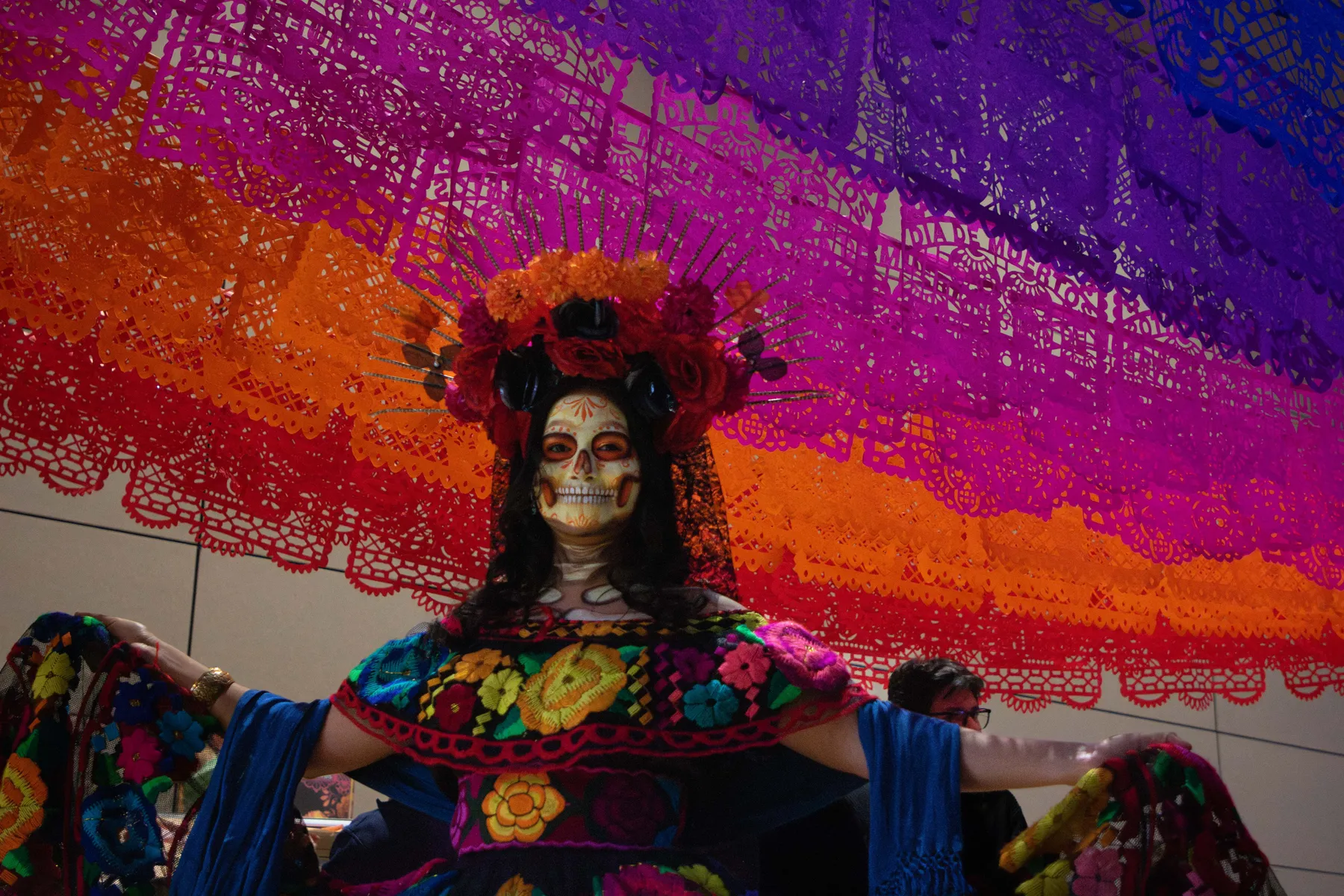
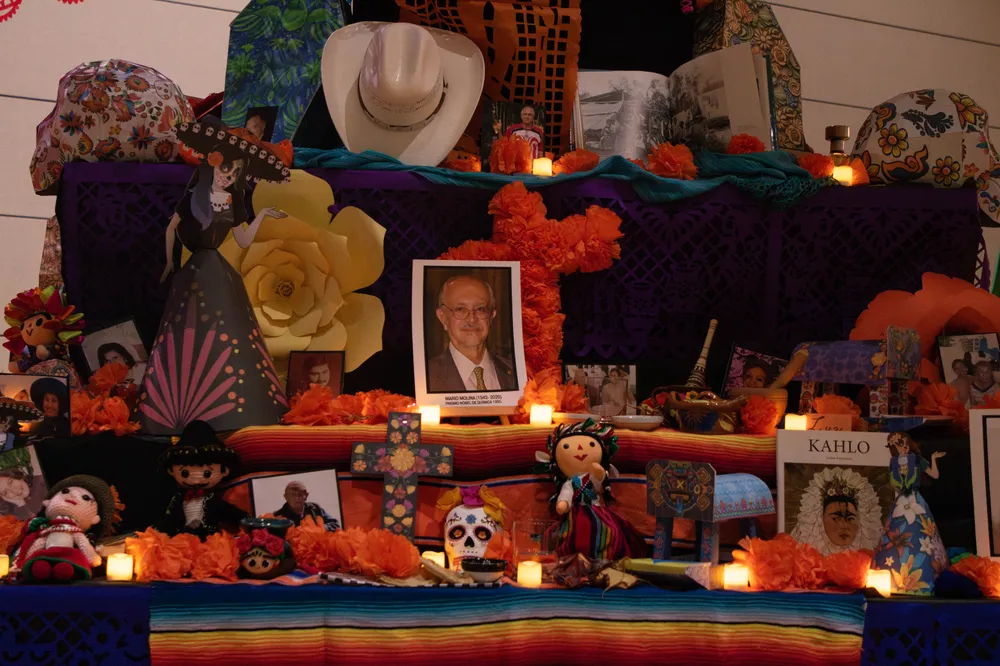
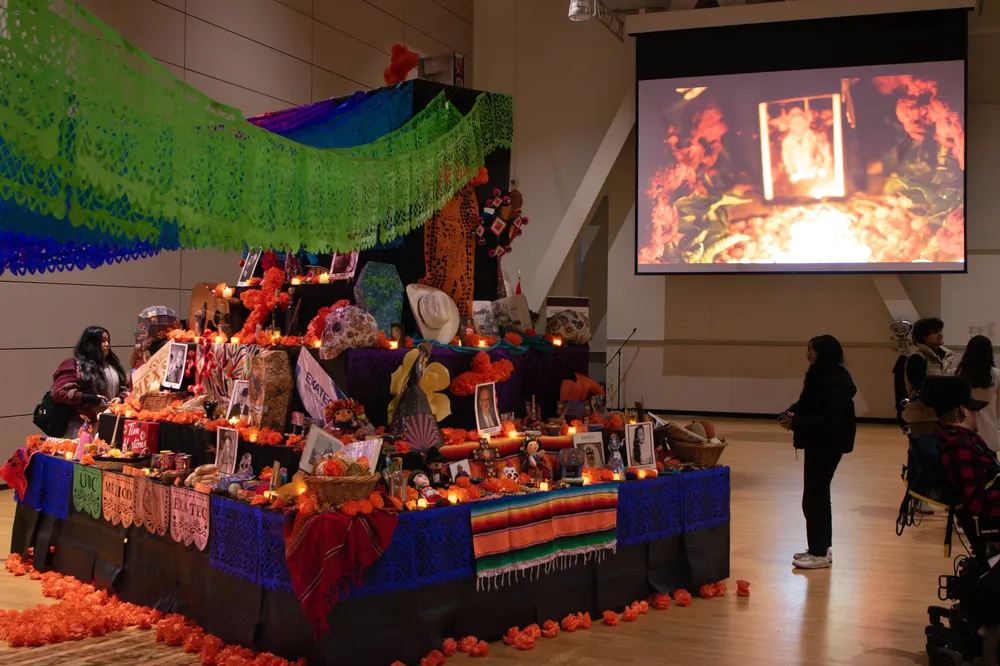
Upon entering, each guest was greeted by a performer depicting a mesmerizing, flower-covered Catrina, the emblematic female skeleton figure of Día de Muertos originally attributed to Mexican artist José Guadalupe Posada’s satirical lithograph. Arm in arm with an elegant Catrín dressed in a charro suit and top hat, the pair circled the entrance of the room, welcoming attendees and showcasing their skull — or calavera — makeup. Behind them stretched the towering altar to the dead — the ofrenda — which, per Día de Muertos tradition, was covered in fabrics, candles, pictures and keepsakes.
For Tayde Asbun, vice president of MEXSA and key organizer of the event, the intention was to showcase the beauty of Mexican culture, bringing it beyond perception from media to a more vivid and student-focused method of engagement, while connecting with UBC’s Mexican community. In her words, the student association wanted to say, “I know you miss home. We miss it too. Come join us for this celebration.”
After inviting participants to wander the room and contemplate the altar and build anticipation for the pan dulce supplied by local Mexican bakeries, the event came to an official start with a welcome speech that greeted attendees, which notably included a panel of university representatives and diplomatic authorities.
Dr. Maxwell Cameron, representing UBC’s department of political science, opened the panel’s speeches by reflecting on the emotion brought on by the ofrenda, which synthesized elements of Mexican and Canadian culture, including tributes to deceased figures from both nations. Cameron used this as a direct parallel to remind the assembly of the common causes, values and revolutionary pasts present across the Americas.
Julián Adem Díaz de León, Consul General of Mexico in Vancouver, shared the consulate’s pride in being able to show Día de Muertos — one of Mexico’s “most cherished traditions” — to the world and the holiday’s particular emphasis on honouring the bonds of those that came before us through celebration over mourning. De León also stressed that this tradition transcends Mexico’s colonization, dating back to Indigenous practices.
Dr. Tamara Mitchell, professor at UBC’s department of French, Hispanic and Italian studies (FHIS) and specialist in Mexican literary studies, gave context to the literary, linguistic and cultural representations around the tradition, including the history of the calavera Catrina, which emerged as a symbol of social critique during the Mexican revolution and originated the “calavera literaria” style, which are playful poems on the subject of death that parody living or deceased figures. UBC student Camila Sanchez then read a poem — in Spanish and English — by UBC FHIS PhD student Tesi Aguire entitled “La Catrina in Vancouver.”
Artist Daniela Mercedes Ocaña Macías proceeded to go deeper into the history behind Día de Muertos, including its origin in Nahuatl cosmology, where death and passage in the underworld (Mitlán) formed a part of the cycle of life. Though Indigenous beliefs were repressed over time by colonial Christian traditions, the holiday as it stands today represents a mix and synthesis of these world views. Ocaña Macías, donning calavera makeup herself, went on to describe the individual elements of the altar and their symbolism, with each colour, food and flower representing part of the dead’s journey.
Co-created by MEXSA and EXATEC Vancouver, an alumni network of the Technological Institute of Monterrey, the event’s altar reflected the specific exchange of Mexican and Canadian culture, as explained by EXATEC President Diego Arroyo and EXATEC member Laura Davila. Named “De chile, mole y poutine” — a play on the Mexican culinary idiom “de chile, mole y pozole” — the altar specifically featured symbolisms and historical figures that reflected the two cultures, adding maple leaves to the marigold and bringing together Frida Kahlo with Emily Carr, Chavela Vargas with Leonard Cohen.
After the speeches, it was time for the performance portion of the event. Folklore singer and songwriter Naty Cerecedo, in vibrant green and calavera makeup, opened the show on the guitar, playing “La Llorona.” As she started strumming and singing the verse, dancers from the Mexican Dance Ensemble appeared one by one from the doorway, carrying candles and entering in procession. Once they had made it to the centre of the room, each performer placed the candle on her head and proceeded with the dance, elegantly holding the white skirts of their dresses as they swayed to the rhythm of Cerecedo’s melody.
The Mexican Dance Ensemble and Cerecedo then took turns showcasing iconic Mexican songs. Performing in a variety of formations, the dancers explored energetic and upbeat styles, skilfully clacking their heels and whirling their large skirts, every movement amplified by their energy and the costumes themselves. Sometimes joined by mariachis in paired dances, the transitions and costume changes were a delight.
Performing on vocals and guitar, Cerecedo beautifully contrasted this by bringing in beloved and emotional Mexican folk songs.. Her renditions of “Que la Vida Vale” (Because Life is Worth Living) or “Amor Eterno” (Eternal Love) elicited sighs and cheers from the audience and felt like a perfect encapsulation of the earlier speeches on valuing the bonds of love and life beyond death, but it was her version of “Recuerdame” (Remember me) from the movie Coco which truly left the audience in wonderment and emotional shambles.
The event closed out with a distribution of certificates from the Consulate and a rallying speech by MEXSA President Ursula Lojero. The event’s final moments were punctuated by the rush of participants queuing to get a chance to devour the pan de muerto provided by the local Mexican bakeries.
For Asbun, the event’s scale was one of its major successes — an unexpected but welcome surprise. In an interview with The Ubyssey, she recalled that the collaboration with the consulate “started really small.” Initially, the consulate had said, “let's do a small ofrenda [and] we will help you with material and with promotion. Every week the event was escalating and escalating, and at some point they were giving us a lot of responsibility ... I'm really grateful that they trusted us.”
As plans for the event developed, the consulate’s support allowed more and more performers to get involved in the celebration, while MEXSA’s concern was focused on delivering sufficient attendance. Collaborating with several local bakeries, they managed to be sponsored for 100 panes dulces for their expected attendance. “We were only expecting 100 people — at the end it was between 280 and 300 people,” said Asbun.
Regarding MEXSA’s future plans, Asbun cited more collaboration with other Latin clubs and the consulate for academic and diplomatic conversations, a second iteration of this term’s ‘Pedaween’party — a Halloween party organized by the association — and a cultural celebration of the Día de la Candelaria. Asbun explained that MEXSA “[tries] to take the official holidays of Mexico, the official traditions that most Mexicans celebrate, and replicate it in the way [they] can. [The celebrations are] for those here in Vancouver, for all the students that are missing home, that are [thinking], today I [would] be eating tamales with my family, but now I'm here alone.”
Asbun added MEXSA also welcomes non-Mexican students. “If you're not Mexican, you can come to all of our events. We know you might feel intimidated because we're all speaking Spanish … [we are] trying to go back and speak a little bit of Spanish when speaking English all the time. But we're really welcoming — that's part of our culture, that's part of how we are.”