
Fraser Street is not close to the university. Fifty minutes away from UBC on the R4 during rush hour, the Nest is only for the bird, and President Bacon is a formal name for cured pig butt. But the moment you open Hyderabad Biryani House's door, the smell inside brings homely comfort far from campus. The aroma is thick, spiced, fried, herbal, and draws the hunger out of you like juice from a squeezed tomato. It's the perfect vamp for food that lives up to this introduction.
Since 2022, Hyderabad Biryani House has aimed to bring authentic Hyderabadi food to the Sunset neighborhood. They obviously derive joy in carrying this tradition. Someone has to — the Lion City's cuisine is a complicated condensation of flavour profiles from other regions in India, Turkey, Iran, and more. Here, herbal basmati rice houses delicately slow-cooked meat. Masalas are made with chemically-precise spice combinations. It's warm, filling, and — with ramen and pho — completes the canon of food perfectly suited to keep students full during nutrient-starved epochs of midterms.
The restaurant environment itself is mathematically optimized for the clientele it could hold. The kitchen is close to the guests who sit in a floor space designed for dozens. TVs are mounted to the wall like a proud taxidermical display in a big game shop— silently playing Wheel of Fortune, one of the Got Talents, or a nightmarish show actually called Hardcore Pawn — while songs like "Bol Do Na Zara" play from the stereo. The music is loud, but not loud enough that one couldn't make good conversation.
The Gongura Chicken ($18.95) came as a dark brown and orange curry in a metal basket with a tealight underneath — an aesthetic treat for anyone paying attention, and a smart way of keeping the food reasonably warm without overcooking it. The steam gently danced into the air as its aroma tugged at every bone in my body.
The chicken was an example of why thighs are the best part of the bird: just enough fat to compliment the tender meat that broke apart with barely a tooth movement. The curry itself was tangy, steeped in umami, and hearty. I was nearly (notice: nearly) full after just half of this dish.
The naan ($3.50) was warm, buttery, and acted as a well-constructed glutenous vehicle to passage curry to mouth. In every compliment I could give, it tasted homemade. The bread itself pulled apart with a lightly gummy texture, complimented the taste of the dish, and helped me get my money's worth as I sopped up every last drop of deep, orange stew.
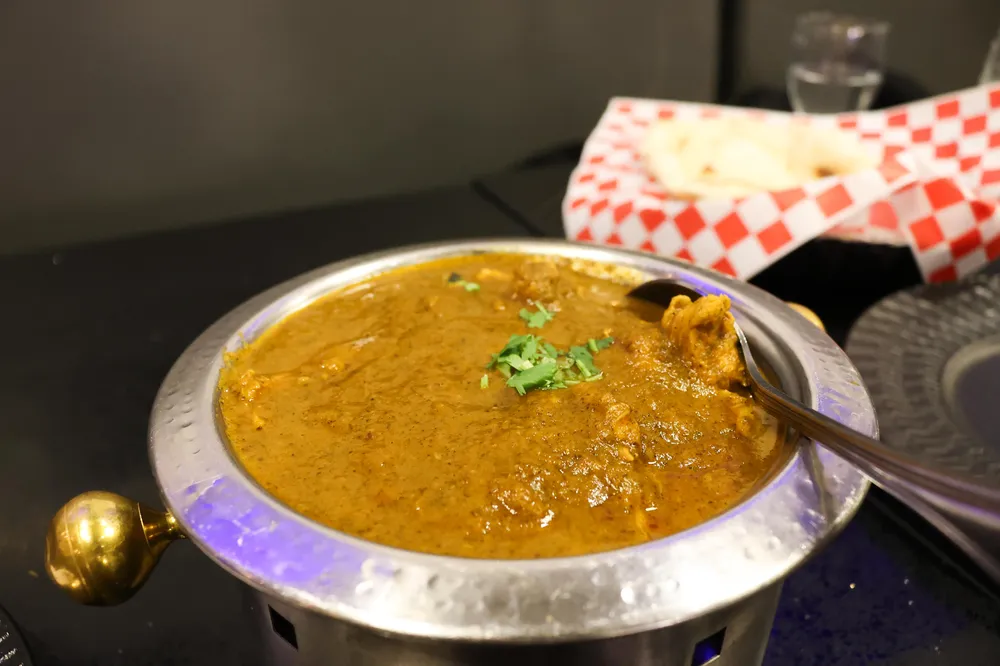
Gongura Chicken.
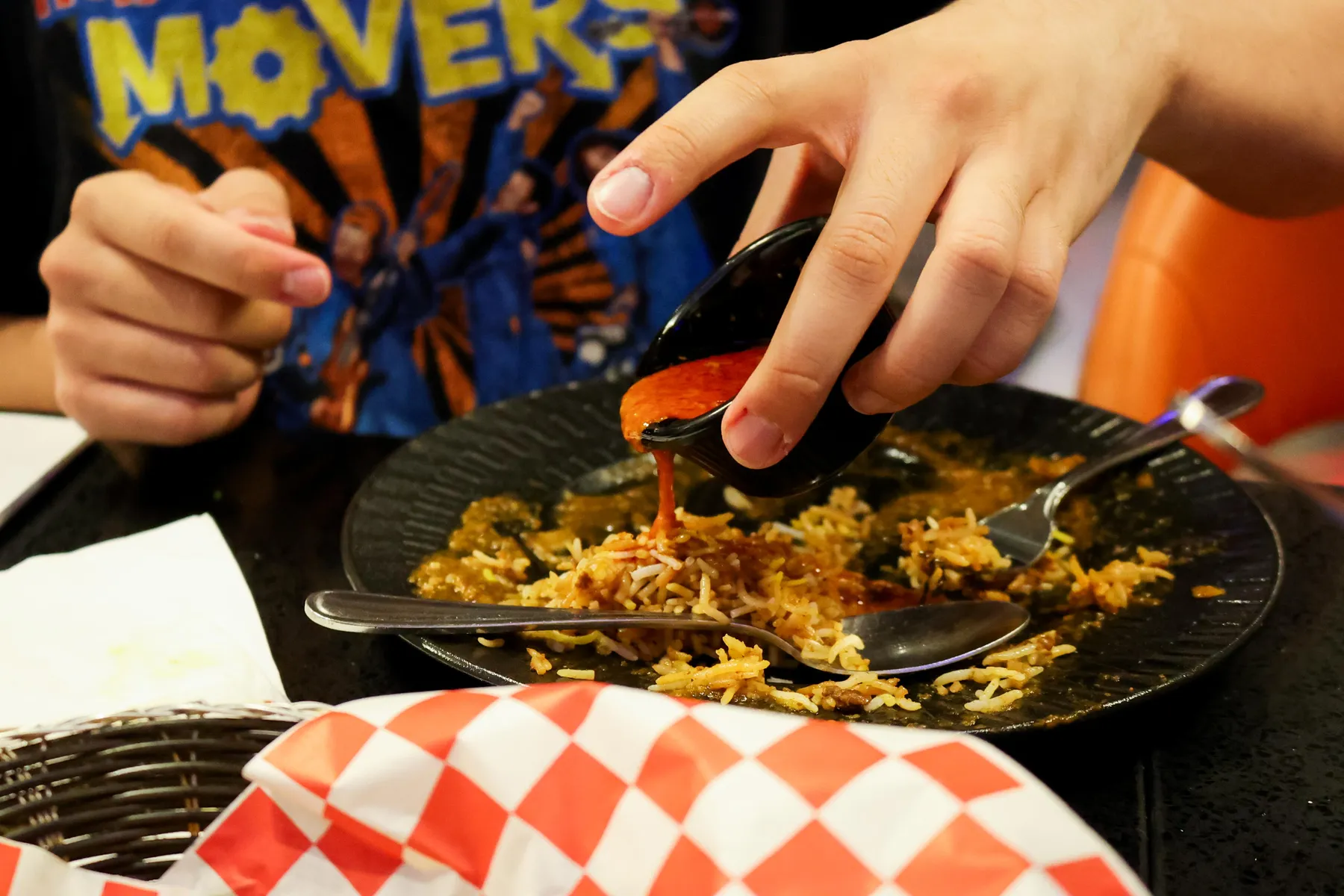
Only a fool would go to a place called Biryani House and not have biryani. Goat Dum Biryani ($20.95) is a mountain of yellow and white basmati rice hiding deposits of slow-cooked goat meat and bone. The portion had to be excavated, working around a small bone standing like a flag on a conquered peak.
Dum Biryani is the distillation of what makes good food: layers of meat and rice are sealed in a container to simmer with turmeric or saffron and cook in their own juices for hours at a time. It traditionally comes with a deep red mirchi ka salan (a peanut curry) and pale white raita (yogurt sauce).
Extra sauce poured upon or cooked with slow-cooked meat is homologous around the globe — each culture has some variation of this: Montréal poutine, Texan brisket, Brazilian feijoada. It's the culinary equivalent of the simple and loud group song.
You could see the effort and time spilling out of the the goat biryani in every grain and herb. The rice was lighter, almost a fruity sweet. My stomach was thankful for this brightness, considering its capacity was quickly running out.
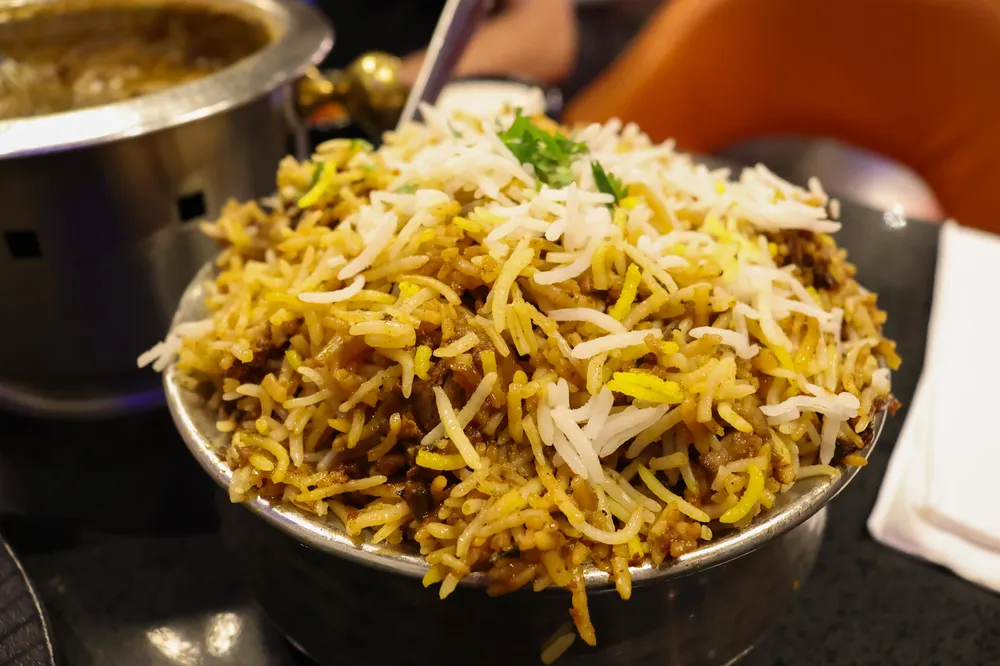
Goat Dum Biryani.
The slow cooking process earned how tender and flavourful the goat was. I can attest — from my father's grand experiments and few failures — this is not an easy thing to do. It was gamey and hearty in the way only a well-cooked goat could be.
The side sauces changed the profile of the dish. The raita let tartness flow into it, cutting past the natural sweetness of the rice. My personal favourite was the mirchi ka salan — the peanut sauce filled each crevice of the goat and bolstered its gamey flavour.
The spices need their own conversation. I ordered medium heat for each and the waitress looked slightly disappointed. Maybe it was a rational judgment of spice tolerance based on my Eastern European complexion, maybe it was a silent mercy from the knowing chefs, but the meal wasn't devastatingly hot. I got to sit in the spice and feel how each of the dishes employed it.
The Gongura Chicken didn't decrease in piquancy over time or rest, but kindled alive in the centre of the mouth, the flame rising like a blacksmith's bellows. The Dum Biryani surrounded the mouth with heat, closing in for a devastating final blow as soon as you put down your fork.
The greatest compliment I could give is that the food made me so full I started to fall asleep at the table. This was a monstrously large portion of food, and two starving college students could barely take down the beast. We did it with a smile, left the restaurant, and deliriously made our way back to the R4. So rarely do I become inebriated from sheer volume of food, but Hyderabad Biryani House made me deliriously tired — the happiest feeling after a meal.
Total cost: $21.70 per-person (pre-tax and tip)
Atmosphere: Bright indoor lighting. Slightly loud music, but good for conversation.
Location: 6231 Fraser St., Vancouver, BC