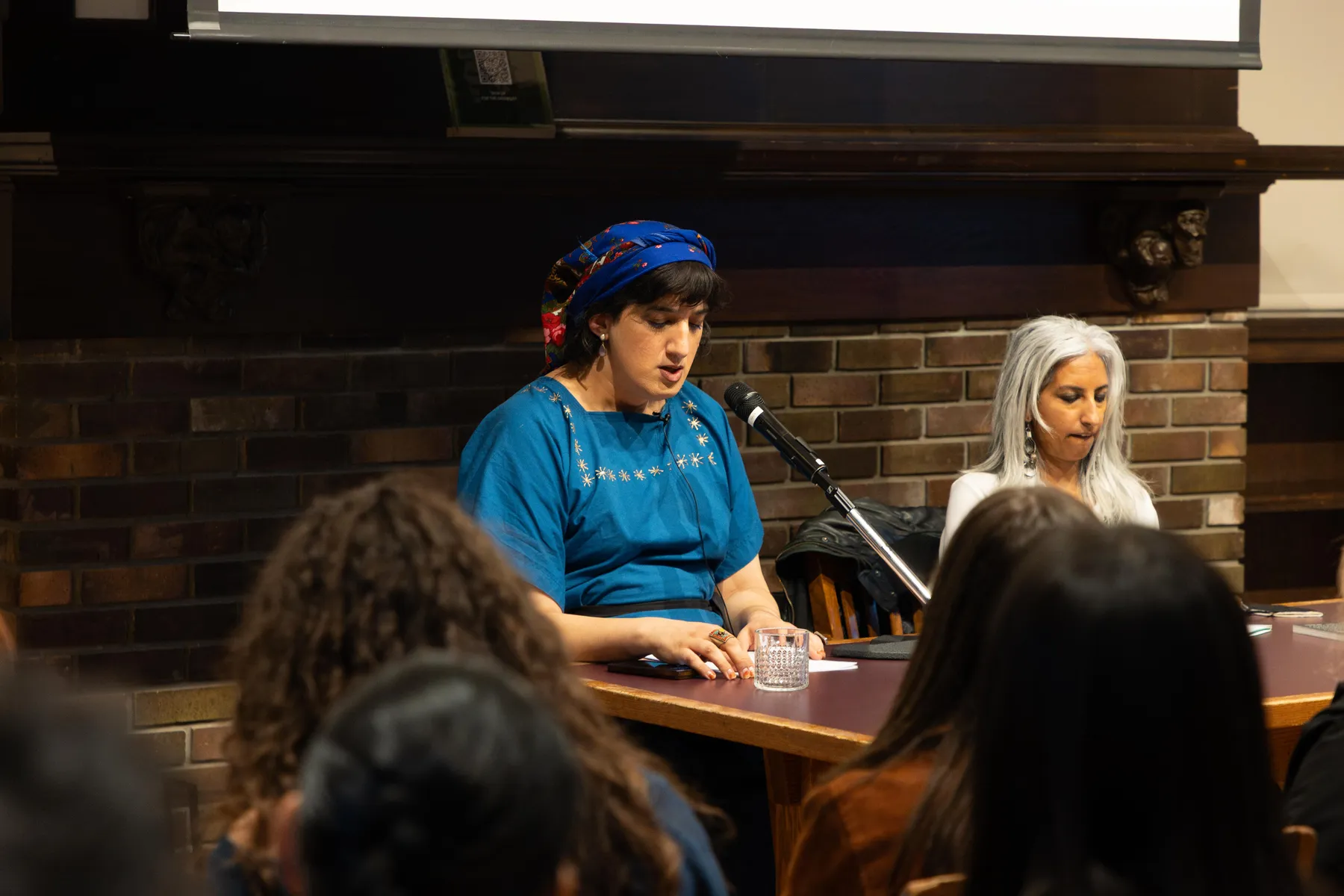
“The art market wants you to be vague and divorced,” artist Xaytun Ennasr said at Green College last week. “Reject that."
Ennasr was first approached about This Death is Not One on the night that the NYPD raided the Columbia University encampment. At that point, she said, "live-streamed genocide" made it impossible to make art or even talk about Palestine.
Ennasr believes her work — and all cultural production on Palestine — should be grounded in theory and political analysis. "Be didactic," she told the audience.
The conversation between Ennasr and academic Jasbir K. Puar, "Graphic Theory: On the Production of Knowledge and Culture for Palestine Today," was the first event in Green College's Living Conversations series, co-presented with UBC's Public Humanities Hub. Ennasr was in Vancouver for three weeks as the inaugural artist-in-residence for UBC's Queer Trans Centre for Radical Praxis, which launched earlier this fall.
She spoke alongside Puar about This Death is Not One, a collection of writings in English and Arabic providing reflections on genocide and settler-colonialism in Gaza.
This Death is Not One's creation began the day before Hamas' October 7 attacks. On Oct. 6, 2023, Puar and prominent Palestinian artists Basel Abbas and Ruanne Abou-Rahme started to discuss translating Puar’s book on disability and biopolitics, The Right to Maim, into Arabic. In it, Puar argues that states in warfare — the last chapter of the work focuses on Israel's actions in Palestine — supplement "the right to kill" with "the right to maim.” During the talk, she described maiming as a strategy of "violent decimation," in which populations are targeted for non-lethal yet permanent bodily harm.
Originally, the proposed translation of The Right to Maim sparked from Abbas and Abou-Rahme talking about how the work should be circulating in more Arabic-speaking contexts, Puar said.
But after October 7, the project developed into something different. She wasn't sure if it was still worth talking about maiming at all; given that it no longer seemed to be an operative logic in terms of genocide. "What we were witnessing was the drive to just wholly exterminate and annihilate in full force," she said.
It took her two-and-a-half years to come to terms with recontextualizing the right to maim as a "changing saying." Puar read an excerpt from This Death is Not One, titled "Living in Genocide."
Genocide is a way of life, she said, not just an event. That's why she opted for the excerpt's current title over an alternative such as "Living Through Genocide." In the text, Puar elaborates on maiming as a "more ideologically defensible mode of domination" that extends the timeline of genocide far past when the outright killing stops. Maiming is no longer "supplementing" or "replacing" the act of killing; rather, they exist alongside each other, and both leave an irreparable mark.
The final version of This Death is Not One is an Arabic translation of The Right to Maim's final chapter, appearing alongside a new preface from Puar elaborating on how maiming should be understood in our present, as well as an introduction from author Nasser Abourahme. One of the most notable differences from the 2017 text, however, is the way Puar's words are represented on the page.
Artistry and academic theory are not typically seen as going hand-in-hand. To Puar, however, theoretical production is a creative endeavour that transcends the "threshold of knowing." She wasn't just questioning the merit of what she had to say in an ever-evolving political climate — she also had doubts about the ways she'd been communicating it.
This is where graphic theory — This Death is Not One’s defining feature — comes into play.
Ennasr's illustrations cultivate a visual balance between violence and beauty. In Palestinian poetry, martyrs are often referred to as moons, so Ennasr used celestial motifs as a symbol of Palestinian lands, bodies, and their intertwined relationship. The compositions blur the line between "an injured land and an injured body," she said.
Even when Ennasr wasn’t speaking, Puar made us feel the need to look at her as if she was. Without inspiration from the graphics, Puar would've found it hard to carry on with the project. "I was not having any movement through the writing," she said. The illustrations finally allowed her to "sharpen the analysis of the violence."
As they talked, a slideshow of the book's graphics moved in a carousel, introducing a sort of hypnotizing fluidity to the discussion. The star-like etchings in the artwork represent barbed wire's constant presence in a war-torn environment. The works in the book were mainly orange and black. While these works had a more limited colour palette compared to Ennasr's past work, they held myriad geometric shapes, lines, and the talismanic stars commonly seen in her illustrations.
The Death is Not One is anything but vague or divorced. Ennasr sees her illustrations and Puar’s words as “transforming each other” to create something new; the abstract etchings narrate suffering without capitalizing on the emotions associated with it. Ennasr described how these images gained "theoretical weight," and in return, Puar's words were "charged with emotion," when placed in tandem. Puar hummed in agreement. The resulting book is grounded in their own methods of seeing and creating; it melds politics and art, theory and emotion, image and text.
If the market demands that art be divorced from politics, then Puar and Ennasr's work is not what consumers are being told to want. Maybe it's what they need.