
A woman told the documentarians filming c̓əsnaʔəm, the city before the city about seeing a plane fly over her while sitting in a longhouse. She couldn't believe she was living in the space age, still sitting in a longhouse listening to her ancestors' teachings with dirt on her feet while humanity could reach the clouds. Another woman, Louise 'Weeze' Point said, "We are here and we're never gonna leave. We are strong Musqueam people."
The festival that showed this film demonstrated its strength through art, music, storytelling, and time.
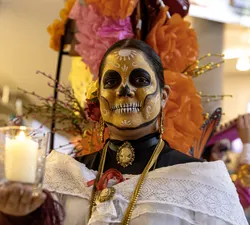
ʔəm̓i ce:p xʷiwəl, or Come Toward the Fire, is an annual Indigenous festival co-presented by xʷməθkʷəy̓əm and the Chan Centre. Founded in 2022, the festival takes its mission from the hən̓q̓əmin̓əm̓ translation of its name: bringing Indigenous voices to the forefront of what is performed and seen on their land.
This year, the festival stretched across three days. Sept. 18 was a day of knowledge-sharing, with workshops and tours to give attendees a richer understanding of cultural practices and histories. Sept. 20 was a giant evening concert hosted by activist — and personal favourite cast member of mine from Reservation Dogs — Dallas Goldtooth.
But I attended on Sept. 19, a day of concurrent programming with live music, storytelling, games, workshops, films, and skateboarding. Aleah Kippan, our visuals editor, photography, and I ran around the Chan trying to see and hear as much as we could.
I remember walking back to the Ubyssey office exhausted by the day's end. I passed the final stragglers eating alone on benches and smiling vendors packing up their trucks and boxes. I felt my heartbeat in my feet, the few hours of sleep catching up to me like an approaching linebacker ready to run me to the ground. Even given my exhaustion, I wished I could backtrack and start the day over again.
Come Toward the Fire made me see the past concurrently with the present; it made it nearly too easy to slide back and forth in time when remembering the event.
The unyielding drums set the tempo for my heart pounding in my ears. I look across the aisle at two people who cunningly smile and hold their hands to me. Their fists clench over white bone pieces. I swallow to remedy the dryness in my throat. It doesn't take. The drums keep going. I stare into their eyes like a poor beatnik detective trying to find motive for a crime. I find none. The drums keep going.
With bated breath and no belief in my own choices, I stick both thumbs to my right. The drums halt. The two holding the bones flip open their hands with a smile. I guessed both wrong. We give up two sticks and I sheepishly beg someone else to call bluffs.
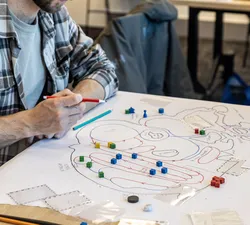
This is Slahal, a game of guessing and bluffing and treacherous wins and losses you have to claw back even as your (metaphorical) fingernails break. Two teams face each other and try to win the other's tally sticks. One team has two sets of "bones" — now white game pieces — one with a coloured stripe in the middle and one without. The team with the bones mixes them up behind their back, and the other team must guess which hand has the non-marked bone.
If you're right, you get the set of bones. Each wrong guess loses you a stick. The role of guessing trades to the other team once they lose both sets of bones. You play until you have all of yours and your opponents' sticks.
I have not yet played a game with such a tide of victory — until Slahal. In the second round, my team was losing hard. We had a handful of sticks and we couldn't pick the right bone to save our lives. A man with small, round glasses was ushered to sit down. Someone gave him our set of bones, a last hope to not be destroyed in this game.
He robbed the other team blind.
He stared at them with an honest smile and both hands lightly placed on his lap. I don't know what smokescreen he put up, what grand distraction he employed, but he was impenetrable. I think I saw the guesser start to sweat after their third wrong guess. By the seventh, the entire other team had their heads in their hands.
The man with the glasses was my hero — a protégé yet unseen at this little novice collective in front of the Chan Centre. He got caught after his all-star game and handed over the bones. We sat in nervous anticipation for his talent to win them back. The other team held the bones back out to him and he got both wrong immediately.
The bones giveth and the bones taketh away.
Freda Grant played the drum next to me. She was an older woman, with thick, square sunglasses and a bright-pink shirt. Her granddaughter, Jocelyn Grant, was teaching our group how to play Slahal.
Freda was an old-school competitor. She began playing in the '70s when official Slahal tournaments had just started. She taught her kids and they taught their kids — a bone-guessing dynasty. Jocelyn, Freda told me with pride, had one year where she ran the gambit: she and her team won each tournament they entered. I looked up again and saw Jocelyn eyeing each movement we made with a conductor's precision. Each of our movements was accounted for in a space she knew better than I know my own room.
Slahal games aren't small affairs either. Some tournaments can have cash prizes up to $50,000. In a tournament with her grandfather, Jocelyn got sixth place and came out with a personal prize of US$1,600. The games started at noon on Saturday and went until four or five in the morning of the following day. You play until the games are done and you lose the bones.
I sat there in awe next to people I considered world champions. What I had originally imagined to be guesswork could actually be studied, improved upon, and made a craft to be built into an art.
I asked Freda if we seemed terrible. She laughed in a short burst. She said that we were doing great; she was just teaching.
It's two hours later. I'm standing beside the Chan Centre, moments before a time I'll return to often so long as I can cling onto my memory. Kung Jaadee, a Haida storyteller and author, is telling a story in Cedar Grove. I'm slightly out of breath after running from a food truck up two flights of stairs to make it back in time. I take a bite of what I had bought, and the sound of the bite reverberates through my spine. I swear I lift a couple inches from the ground.
I've always struggled with overly-fried foods. Funnel cake at the fair was great until I hit the second half and felt myself melt in with my cholesterol. I only ate fried Oreos because the tradition of the Texan rodeo beckoned me to the oil while I floated on cartoon steam lines. I felt like a sinner shortly after.
The bannock from Tradish — one of the handful of food trucks brought into the event — cleansed any mortal grime that stained my soul. I don't know if I like fried food, but that first bite will be a moment I see when my life flashes before my eyes.
Bannock is a frybread with a long history for Indigenous Peoples, one mixed and fried alongside the contention it invokes. Some say the British and Scottish fur traders brought it as bannach, but some historians say communities were making it long before their arrival. Some say it's Indigenous food, while others say its a byproduct of colonization. What I do know is that there were at least three food trucks that had bannock as a main menu item.
Tradish's bannock was one of the best bread-based products I've ever had. The outside was expertly and lightly fried, so there was a sonorous crunch without an oil residue. The inside was perfectly light, almost undercooked but just on the other edge of the knife, and it had a deep sweetness that radiated outwards. This was the first baked good I've had that made me feel lighter after consuming.
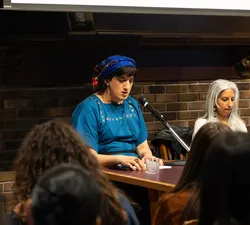
Suddenly, I'm in the Telus Studio Theatre with Aleah an hour before my bannock bite. It's a small venue with dozens of round tables scattered across the ground floor and two rows of balcony seats fit for a Civil War president to die in. The two musicians sitting on the stage set up their instruments. The man puts a stringed instrument horizontally on his lap — I've always been a sucker for a slide guitar. He nods to his wife, who holds a guitar in her lap. She takes a breath in. In a moment, they construct a layered tapestry of notes and chords. I can't tell where one instrument begins and the other ends — it's a perfect and infinite maze of strings.
Burnstick is the JUNO-nominated folk duo of Jason and Nadia Burnstick. Francophone-Métis singer-songwriter Nadia powerfully commands her voice into complex configurations and picks the guitar with bluegrass precision (genuinely my highest compliment). Plains-Cree guitarist Jason added a gravelly undertone that complemented Nadia's alto as he played a Weissenborn — a rare lap slide guitar manufactured in the '20s and '30s.
They are one of the most impressive musical acts I've seen. Everything they did complimented each other in ways I could hardly imagine. Their voices just fit together. Their instruments seemed to only play in congress.
On stage, their rapport was infectious. Jason made Nadia laugh after a long story that ended with him in tears, only to reveal he had made it up. Nadia gazed wistfully into the middle distance of the audience; Jason looked at her with affection and admiration, then looked on with her.
One of the last songs they played was "Made of Sin," about the 215 unmarked graves of Indigenous children discovered at the site of a former Indian Residential School in Kamloops. The song starts with the refrain, "I must be made of sin," then turns into "We must be made of sin," and ends with "They must be made of sin." It's an expert turn that points the finger back at the people who perpetrated that act.
Their style of singing and harmony construction reminded me of the Fugitives. But while the Fugitives made me feel like I was flying, Burnstick compelled me to sit down. You have to let their music wash over you to see the horizon they construct with two instruments.
I take a step and it's two hours later, and I'm sitting in the Royal Bank Cinema. Kippan went back to the office to charge her camera battery. I'm watching c̓əsnaʔəm, the city before the city. The filmmaker plays an interview about how historically significant the area called c̓əsnaʔəm is to xʷməθkʷəy̓əm. Over the interview audio, they show a contemporary sight of unfortunate mundanity — a garbage-filled shopping cart lying beside a minimally-used highway.
Elle-Máijá Tailfeathers— a Kainai Nation and Sámi filmmaker, and a UBC alum — directed c̓əsnaʔəm, the city before the city in 2017. The project's namesake was originally an exhibit at the Musqueam Cultural Centre featuring Indigenous artifacts found at c̓əsnaʔəm, known by some as the Marpole Midden.
The film is a series of interviews with Coast Salish people about the 2012 protests against the development of an 108-unit condominium on the land of their ancestral village and burial ground.
The film expertly introduces its subject and importance to an audience that may not know the history of this event. The interviewees talk about their reactions to the news of the development, their despair when they saw the site being excavated, and the joy they had bringing together their community in protest to this act.
But the film is also about the price of progress and what we do with the land we're on. Vancouver was modified for the industrial working man, and the environment paid the cost. One interviewee talks about a stream so dense with salmon that it would keep you awake at night. Now, a farm has been built and the stream is sterile.
Elder Larry sʔəyəɬəq Grant, UBC's Elder-in-Residence and the reason why signs at UBC have hən̓q̓əmin̓əm̓ translations, said that he once respected advancement like this, but now recognizes that "progress is terrible."
Everywhere in Vancouver had a name before the city tried to erase it. Jericho Beach is ʔəy̓alməxʷ. Spanish Banks is šxʷsyiΦəm. The film centres these names because without them, the areas' histories are lost. They go from sites to places.
The filmmaker made me consider what the hell we're doing with the land anyway. Tailfeathers juxtaposes what her subjects are saying about the land's importance with banal images of the present. Car dealerships sit idly. Garbage apathetically lounges in shopping carts left on the side of the road. I hazard to think what that condo would have looked like.
Thankfully, it was never built. After the protests, xʷməθkʷəy̓əm bought the parcel of land owned by the developer. Six years later, the city decided to "donate" (return) the parcel to the Musqueam Indian Band as "part of its ongoing commitments as a City of Reconciliation."
Through her extensive and comprehensive interviews, as well as the structure and editing of the film, Tailfeathers advocates for the recognition of each and every site. Progress should not be some feral beast satiated by the tendons of nature and the flesh of others' history. If it is that beast, we cannot value it any longer.
I walk out the cinema door and I'm back in the Telus. It's an hour prior and Aleah is sitting next to me. I furiously blink as I gain my bearings. A woman skips to the next song on her laptop. She's wearing a cape of grey leaves and pink, fuzzy leg warmers. Her hair's gradient of red, orange, and green makes it look like it's ablaze. She flips her hair around and it looks like an alchemical inferno. My brain fills in the missing components. I see backup dancers, crowds, and her name in bright lights — even if it was in my imagination.
There is a version of this article, one that I write content, that focuses only on Semiah. She's a Mohawk pop musician from Six Nations who has been releasing music since 2021. But she's been on the rise for the past year, winning a DORA Award for Outstanding Composer and being invited as support act for Aysanabee and Jully Black.
Semiah mentioned several times that certain songs were written in the style of PinkPantheress, and I could tell. In all honesty, I am much more of a folk fan than a pop proponent. I do know, however, that Semiah's music easily fits into the canon of Billie Eilish and Doja Cat.
Even though she was armed with only a laptop and a guitar, she performed like she was at Coachella. With choreographed dances, jumping and flipping her hair like a trained superstar, she filled the room with what had been absent from the Telus: hype.
I should not have attended a Semiah concert in the middle of a Saturday, sitting down with older folks and their families. It should have been at 3 a.m. on a Sunday, in a sea of brightly-dressed university students whose collective jumping could level buildings.
It felt like walking around campus in the small hours of the morning: uncanny, wrong. No campus should be a ghost town, and no stadium tour should be confined to the Telus.
Her voice deserves a review of its own. Each note lands where she wants it to hit with a sniper's precision. Unlike some contemporary, heavily-produced pop idols, Semiah's pitch and tone is sturdy and powerful. She performed a song called "White Lightning," based on the tales she grew up with and written as a love song to the west wind, sang by the Sky Woman — her voice was so strong and precise that it pressed against each column and wall in the theatre.
Forty-five minutes later, I am still full on bannock and gliding to catch up with Semiah. I'd never felt more like a ragged reporter, running after my dream interviewee who was walking slowly in the other direction.
She told me about her influences. You have your obvious choices when it comes to modern pop: Adéla, Slayyyter, and big K-pop acts. But she's trying to bridge the gap between her love for pop and her personal cultural influences. She grew up singing traditional Ë:sgä:nye:’ — shuffle dances performed exclusively by women.
Originally, she was hesitant to add this directly into her music. "I felt tokenized a little bit by conferences, and it just didn't feel good to me. So I did move away from publicly singing traditional songs for a while," she said. "I want to be like a pop artist first ... I don't want people to think I only do traditional music."
But she is working to overcome this reluctance. She just submitted a grant that, if accepted, will let her do in-depth cultural work: speak to elders, go through museum archives like the Smithsonian, and interview people who know about Haudenosaunee history. "I want to be a pop star, as if colonization has never happened," she said.
Semiah made me see the future. Her performance and her music were so fresh and polished that I felt like I had found a comet bound for the cosmos as it left the garage.
She told me that when she performed at Rogers Centre in Toronto, one of the organizers had said, "We'll see you back here again." I'm glad others saw the same future I did, and I'll be shocked if it doesn't come to pass.
I walk away from Semiah and it's the end of the day again. I have another piece of bannock in my hand somehow, this one filled with blueberry jam. The streets that were once full run quiet.
ʔəm̓i ce:p xʷiwəl held past and present in one hand. We must walk with those who came before and deal with the choices made by monsters of the past. It made me feel like Billy Pilgrim — unstuck in time. I was in both the past and present, and saw into a beautiful future. But unlike Pilgrim, I'm happy to be temporarily free. We can understand more about the place we are if we aren't tethered to time.