
When was the first time you saw yourself represented in media? The question may pull you back to a time of storybooks, dino nuggets, and late-afternoon cartoons. My early childhood revolved around characters like Kim Possible, Scooby Doo’s Daphne, and Sam from Totally Spies! But while these may have been my first glimpses of some version of myself on screen, the first significant moment came much later (and wasn’t just tied to hair colour).
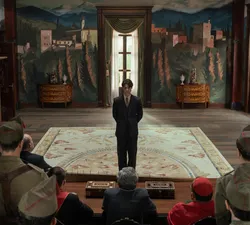
At 13, I saw But I’m a Cheerleader, directed by lesbian filmmaker and queer icon Jamie Babbit. It’s not ideal, or even good, queer representation, but it was the first time I saw femininity and queerness linked. I was hooked. I recently saw Teenage Sex and Death at Camp Miasma, and left the theatre speechless. It was a recognition of my experiences to a depth I hadn’t experienced in a while, if ever. Filmmakers hold the power to shape the ways an entire community is perceived — by themselves, and by others.
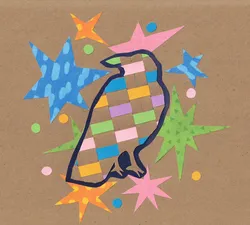
This work happens on a local scale too. The 38th annual Vancouver Queer Film Festival ran in late September, with programming ranging from experimental short films to more traditional, narrative features.
One of the recurring themes of this year’s festival was the natural world, and our strained but deeply significant relationship to land. The opening presentation, Ecosystems Not Empires, included the documentary Understanding Myself as an Amphibian, by trans, Toronto-based filmmaker May Caroline Matchim. In the film, she researches various species and interviews professors, questioning the assumed heteronormativity of the natural world.
Matchim took a reflexive approach to the documentary. Early in her research process, she mentions the impulse to validate her queerness by observing it in other species. She realizes, however, that this is not a viable path to self-acceptance. As explained by researchers in the film, the desire to validate one’s identity by proving it as “natural” can undermine the complexity of human identity.
While we may be able to see parts of ourselves within the amphibians that can fully change their sex, this alone should not be propped up as evidence that trans identity is valid. Instead, Matchim asks us to see the meaning behind the science. With every convention or standard explored in the film came an exception — it is within these margins that queerness thrives.
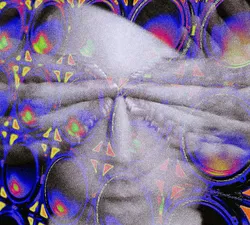
The Coast is Queer, another collection of short films, featured local actors, filmmakers, and creatives in provocative and visually-inventive works. Egg Yolk Custard was a joyful exploration of queer bodies, sex, and the everyday moments that provoke less than everyday thoughts. Mixing fever dream with wet dream, director Soya Wu built a wild sexual fantasy around eating dim sum. It’s fun, sexy, and it’s a tight two minutes — the shortest film of the program.
Dreams and fantasies (or, perhaps more accurately, nightmares) carried into Marilyne Lamontagne and Shane Savage’s Mascott. The film follows a transmasculine actor who is finally given a chance to be in the limelight — the only caveat is that they must wear a bear costume the whole time. Set against the absurdist backdrop of a children’s television set, the events of the film are comically horrible.
Dingy subway trains and producer’s offices are exaggerated through high-contrast light and colour, provoking memories of late-night cartoon horror from my childhood in the vein of Jimmy Neutron and Rocko’s Modern Life. Only valued within the hideous, terrifying bear costume, our protagonist's humanity is literally stripped from them as cameras and microphones are immediately shoved in their face — an apt commentary on the commodification of trans bodies.
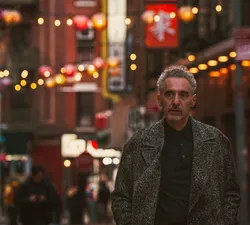
In a dramatic tonal shift, we moved from absurdity to sincere sentimentality with the final film of the presentation, Kimberly Ho and UBC alum Cynthia Zhou’s I Do (願憶). We follow Jacob, a queer Taiwanese man, on the day of his wedding. He has a beautiful ceremony and a close group of friends there to celebrate him. However, with only his sister present from his immediate family, Jacob is confronted with the sorrow of knowing who’s missing his special day.
The film cares deeply about each of its characters — the complexity of family ties is honoured rather than shunned. The final shot of Jacob’s face quivering with emotion — equal parts joy and grief — is a brilliant depiction of the sacrifices that come from balancing queerness and familial expectations.
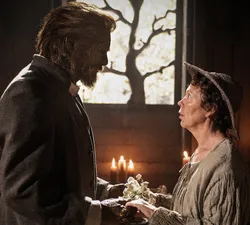
Also on family, when I sat down to see Gail Maurice’s Blood Lines, I thought I knew what kind of story I was sinking into. As a devout lover of sapphic cinema, I believed I’d seen it all. I was wrong.
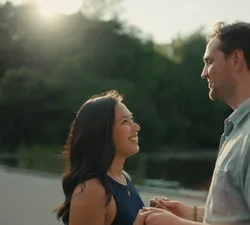
Blood Lines starts out feeling like a warm hug. We follow Beatrice (Dana Solomon), a Métis woman living in a small, tight-knit town. Gas station attendant by day and local reporter by night, Beatrice lives a simple but full life. She dates women without receiving even a glance of judgment, and she’s supported by a community of locals who chomp at the bit for her contributions to the town newspaper. Her life is stable, until it isn’t.
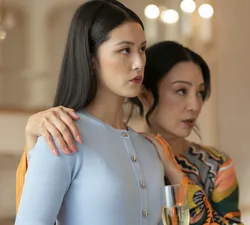
After leaving for the good part of her childhood, Beatrice’s mother Leonora (Maurice) returns home, causing buried memories to resurface. But Leonora isn’t the only new face in town. The beautiful Chani (Derica Lafrance) also captures Beatrice’s attention, for entirely different reasons. Chani is trying to connect with her birth family, so she takes a job on a ranch next to the town she’s told she comes from, which, coincidentally, is next to Beatrice.
Complicated family ties bring the women together as Beatrice offers to write a story about Chani, and their connection eventually blossoms into an intimate relationship.
The film takes quite a twist during the latter half. It’s complicated, messy, and sometimes uncomfortable; I desperately wanted a resolution I could understand, but instead, the film pushed me to consider an alternative conclusion. The only place I was left wanting more from this film was in Chani’s character. Other than knowing she was looking for her birth family, we don’t learn a whole lot about where she comes from. She’s selfless, kind, principled — but why does she want to find her birth family now? A bit more insight into her background would’ve enhanced the film, but it was still more than worth the watch.
In an interview with The Ubyssey, VQFF program manager Audder (Jasmine) Monton said that programming a festival like this means talking to artists themselves. It means constantly asking, “What kind of stories do our communities tell us?”
Queer artists, Monton said, will always be ready to build themselves a seat at the table, regardless of how often they’re told they don’t have a future. “We need a different table,” they said. “We need to imagine a new room.”
Monton and VQFF want to see a world that doesn’t just allow queer people to survive, but gives them the opportunity to exist on the same level as everyone else — and films, they said, are the best way to imagine potential futures.
A previous version of this article used the wrong pronouns for the protagonist of Mascott. The Ubyssey regrets this error.