
An enormous prairie sky flickers onto the screen, projecting a wash of cool blue light onto the audience nestled around the Lindsay Family Stage at Granville Island. The winter prairie scene cuts to a family decorating their home for Christmas, the warm glow of the lights illuminating their faces. But the dim blue returns, this time reflected off a giant metal cylinder. An eerie hum rises as we flip back and forth between the two settings — a sterile hospital room, a picturesque family. Each frame juxtaposes the last: orange to blue, warmth to cold, life to death.
In David Ehrenreich’s documentary, Relax, Open Your Eyes — screening at this year’s Vancouver International Film Festival on Oct. 2 and 6 — UBC alum Carrie Radomski and her husband Witek attempt to build the first cryonics facility in Canada. Radomski travels around the world, learning the intricacies of cryonic preservation — freezing human remains in hopes of reviving them when we have the technology to do so.
VIFF was the second stop on the documentary’s festival circuit after its premiere at the Calgary International Film Festival. Both Ehrenreich and Radomski have roots in Vancouver, but the Radomskis have relocated to Calgary since B.C. law prohibits the sale of cryonic services.
Cryonic preservation had been a completely fringe concept to me. My previous encounters with the topic were limited to the playground rumours swirling about Walt Disney when I was a child (said rumours were smothered within the first 10 minutes of the film). Having never been the most scientifically inclined, I saw cryonics as a distant, otherworldly approach to death. What Relax, Open Your Eyes does so brilliantly is gently wipe away that haze of misunderstanding, engaging with both its subject and audience with the utmost care and respect.
Ehrenreich originally learned about the cryonics movement through a news article outlining the legal conflict between the Lifespan Society, a B.C.-based life extension advocacy group, and the provincial government. The foundation was Ehrenreich’s gateway into cryonics, as well as where he first met Radomski.
“I remember the first time I chatted with her on the phone,” Ehrenreich said. “[She] said a lot of really powerful things. Afterwards I was just thinking, well, she's incredible. She would be an amazing person in a film.”
While Ehrenreich’s cryonics journey began with the Lifespan Society, Radomski’s started long before. Having been drawn to science fiction media in her youth, she was familiar with the concept of radical life extension — though it was only speculative imagination, at first.
“I didn't have the happiest childhood, so I was trying to escape something,” she said. “I lived in this far, future, fantasy world.” She recalls reading Engines of Creation by K. Eric Drexler, which features a preservation and revival scenario. “I didn’t think about it very much at the time. It was just another science fiction book,” she said.
After attending UBC, Radomski started seriously engaging with the concept. Her innate curiosity with far futurism, philosophy, and science drew her into spaces where experimental technology was celebrated, rather than dismissed. After graduation, Radomski was invited by a friend in grad school to attend a talk about cryonics at UBC. The speaker broke down a landmark experiment that involved vitrifying a rabbit kidney, freezing it at negative 130 degrees, rewarming it, removing the cryoprotectants, then filling it with blood. They then managed to successfully reimplant the kidney in the rabbit. “My mind was completely blown,” Radomski said. “I realized in that moment that there would never be any other option for me.”
Soon after the talk, Radomski began paying for a monthly cryonics membership at the Alcor Foundation, one of the longest running cryonics organizations in the world. Alcor is the first main location explored in the film, and establishes some basic context about the science behind cryonics.
But with every conversation about science came debate, as seen in the car ride to the Alcor facility. As Radomski and Witek prepare to go inside the facility, they delicately discuss grief, and what mourning might look like for the family of someone who has been preserved. Here, we’re encouraged to look at grief with a new perspective. How might someone relate to a loved one in suspension, the resting state of an individual cryonically preserved? How does this technology confuse our understanding of time, humanity and progress? Not even 15 minutes into the film, I had endless questions.
On the film’s dance between science and philosophy, Ehrenreich spoke candidly, explaining that “if anything, it was [about] reducing the science to its bare minimum, so that we understand how interesting it is.” It was the debates raised by the science that captured my curiosity. Another example came later in the film, when Radomski visits Jordan Sparks, a computer programmer and dentist by trade, at his facility, Oregon Cryonics. Sparks, who primarily works in chemically preserving brains, has a different perspective on cryonics.
In his conversation with Radomski, Sparks outlines his concerns with mainstream cryonic preservation methods, pointing to the lack of scientific consensus on the ability to revive those in suspension. In return, Radomski argues that the scientific consensus changes over time, and that cryonics is still worth investing in. Even within communities working towards the same goal, there is still much disagreement about what the best methods are and what ethical responsibilities are held by those pioneering the technology.
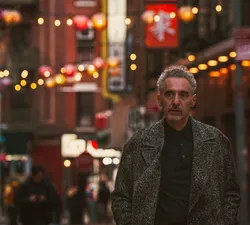
These thought-provoking scenes are enhanced by Ehrenreich’s visual storytelling. Infused with intention and care, every frame of Relax, Open Your Eyes reveals a new layer of intrigue. The camera closely lingers on the facial expressions of its subject — you can’t help but feel lucky to get uninhibited access to a community of people who have long been mocked by mainstream media. “The audience is placed inside this conversation in which you're almost close enough to be a participant,” Ehrenreich said. “It places you at the table, and I think that that's really important because subconsciously, it offers a bridge to what's being talked about, and it also asks you to care.”
Ehrenreich was well-aware of how important trust and relationship-building would be in order to successfully tell the story he wanted. He self-funded the first two years of production by picking up commercial work, and those early years were pivotal in setting the foundation for what would become a breathtaking documentary. When asked at the Q&A following the Oct. 2 screening what convinced Radomski, Witek and another cast member, Lauren Fosco, to join the production, the answer was synonymous: it was because of Ehrenreich.
“When I was first approached by Radomski, I was very skeptical,” Fosco answered at the post-screening Q&A. “But like the others, after I met Dave and got a chance to converse with him, I found he was just radiating authenticity. I could tell he was willing to put in the work and the effort that it would take to build trust.”
Trust and respect guided Ehrenreich’s visual approach to the film, too. “It was really important that the camera wasn't used as a voyeuristic tool and with a long focal length that's far away,” he said, opting instead for a large cinema camera that allowed the crew to position themselves as participants within the film alongside Radomski and her family. You’d think this approach would feel invasive, like the filmmakers were asserting themselves onto this community of people. Rather, it drew attention to their involvement in the community, allowing a tighter relationship between the filmmakers and their subject.
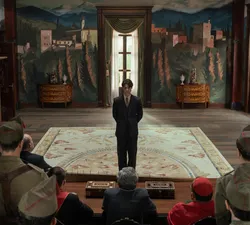
Extending this sentiment into the aesthetic choices for the film, Ehrenreich leaned into a square aspect ratio, giving the film an indie, experimental feel. The colours were vivid and the compositions were gorgeous. “I wanted to create an environment in which it looks like the world me and you live in, that we all live in, but there's something a little bit different. There's something a bit special,” Ehrenreich said. “We held ourselves to a standard in which everything has to be beautiful. Every frame has to progress the story. Every frame has to grow the world.”
The result of this meticulous approach is not only a stunning film, but one where each moment furthers the subjects’ emotions behind their ideologies. Ranging from techno-futurism to secular humanism, the ideas the film proposed allowed me to confront much of my existential dread about the world, our future and the current progress of technology head-on. It didn’t feel like a movie about technology, it felt like a movie about humanity.
I’ll be completely honest: while I was excited to see the film and curious about its subject matter, I didn’t anticipate reflecting on everything I thought I knew. It made me think about my friends who struggle with nihilism, who have a hard time imagining themselves even 10 years in the future, let alone two centuries. It made me think about belief and faith. As someone raised in Christianity, the thought of freezing my body and putting my personhood in the hands of a future generation pulled a lot of complex fears to the surface. It made me think about the self, and what my own essence consists of.
Early in the film, Radomski mentions that there are two main ways to be cryonically preserved: full body or neuro. The two methods are weighed throughout the film, and Radomski eventually decides to switch her position from neuro to full body due, in part, to the neurons found in the rest of the body, like the spine or stomach. “Maybe they aren't central to who I am, but maybe they're part of who I am,” she said.
These discussions are the heart of the film. While I’m still not convinced to cryonically preserve myself after death — although that is far from the film’s goal in the first place — I can recognize why the cryonics community feels hope towards humanity’s future.
“I think this film, at its heart, is about family. It's about love, right?” Ehrenreich said. “It's about dreams and hope, and it's about striving for something, and that's what good storytelling is.”