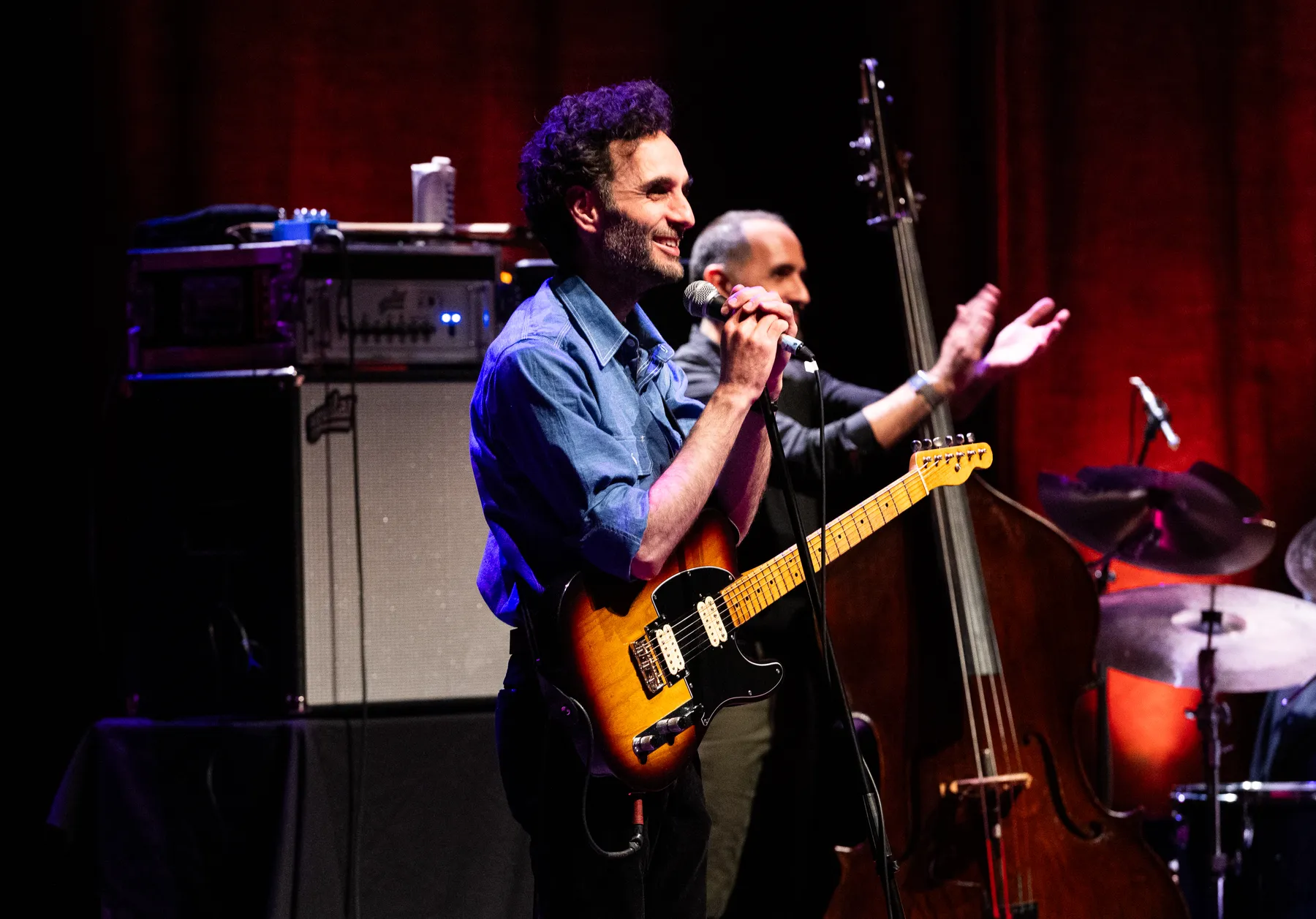
One of the gifts of good live jazz is witnessing a song be reinvented in real time by a performer whose understanding of the tune — and their instrument — enables them to build it into something new. Last week, the Julian Lage Quartet gave the crowd at the Chan Centre this joy in spades.
Wednesday was the first night of VanJazz '26, a brand-new jazz festival running until Oct. 25. Tim Reinert, founder of Infidels Jazz and one of the festival's directors, came onstage before the show to thank the crowd for being there on the festival's inaugural night, telling us we were about to see "one of the greatest bands in contemporary jazz."
As well as kicking off the festival, the performance at the Chan Centre was the quartet's first stop on their international tour. Lage, bassist Jorge Roeder, drummer Kenny Wollesen, and keyboardist John Medeski debuted as an ensemble in 2025.
Their first album together, Scenes From Above, came out in January of this year — Wednesday's set consisted mostly of songs from its tracklist, but they did play a few songs from Lage's earlier projects and some unreleased work. Roeder and Wollesen are longtime collaborators of Lage's, but Scenes From Above marked his first time recording with Medeski, who's best known for his work as part of the jazz fusion trio Medeski Martin & Wood.
It's difficult to talk about Julian Lage without the words "former child prodigy" cropping up at some point. A guitar virtuoso, Lage was playing onstage with Carlos Santana as an eight-year-old, and famously performed at the 2000 Grammy Awards at the age of 12. Now, at just 38, he's led or co-led over a dozen albums and played as a sideman on countless more. But Lage didn't conceive of himself as helming the quartet. He wrote the songs on Scenes From Above with the players' qualities in mind, more interested in being a band member than a band leader. That focus on balance showed in the performance — intimacy, restraint, and conversation between musicians superseded show-off-y playing throughout the night. It was obvious these musicians had great respect for each other and no desire to dominate the sound. Lage went so far as to literally step into the shadows when he wasn't playing.
That's not to say Lage's mastery wasn't on full display. He achieves astounding richness and complexity of sound with a guitar alone. Once or twice, I had to do a quick double-take during an unaccompanied solo from Lage, just to make sure there really wasn't an organ or bass adding texture.
Lage has a reputation for being one of the world's greatest improvisers, and he lived up to it here. He has a knack for taking a song to a totally unexpected place, and making it seem inevitable once he gets there. A few wistful minor-key licks in "Ocala" injected surprising melancholy into an otherwise calm, light-hearted tune. He brought rock sensibility into the soul jazz of "Talking Drum" with a solo that, if I'd had my eyes closed, you could've told me was Jimmy Page and I'd believe you. Someone in the row in front of me wolf-whistled in the middle of Lage's "Red Elm" solo, which sums up better than words how it feels to hear a master at work.
The interplay between Lage's guitar and Medeski's organ was the centrepiece of Scenes From Above, and their chemistry was only heightened onstage — witnessing the pair exchange ideas was a true meeting of the minds. The quartet's performance of "Speak to Me," the title track of Lage's 2024 album and the opening number of the setlist, culminated with Medeski and Lage in a fevered back-and-forth; they passed phrases back and forth, completing ideas and doubling melodies, almost as if they were daring each other to go further — the energy never dipped from there.
In a project where balance is the name of the game, Medeski's organ grew a bit overbearing at times. But it was stunning to hear him squeeze out all the possibilities of the instrument, using it as a substitute for a steel drum for calypso-inflected tunes "Opal" and "Ocala," and adding distinct gospel flair that had been absent from the recorded version of the dreamy "Solid Air." Medeski performed an extended solo during "Borrowed Light," an unreleased track that I can only describe as wonderfully manic, and he brought an incredible dynamism to the performance, pumping all four limbs and barely staying in his seat.
The rhythm section was less up-front, but their brilliance shone in subtler ways. Wollesen's propulsive drumming kept the momentum at full blast without once overpowering his fellow musicians. Roeder was solid throughout, and achieved a wonderful expressivity on the double bass during his moments in the spotlight. It was obvious that all four musicians are playing at the highest level and having fun doing it.
Of course, not all improvisations landed, and not all the threads were the best to follow — that's the nature of experimentation. But missteps were few and far between, and the rapport between these four musicians shaped the performance at every turn. At those moments when Lage's improv magic kicked in, the songs were his sandbox, and it was a privilege to watch this quartet build their castles.