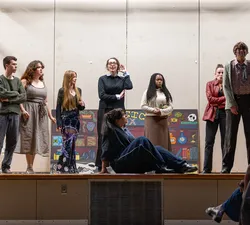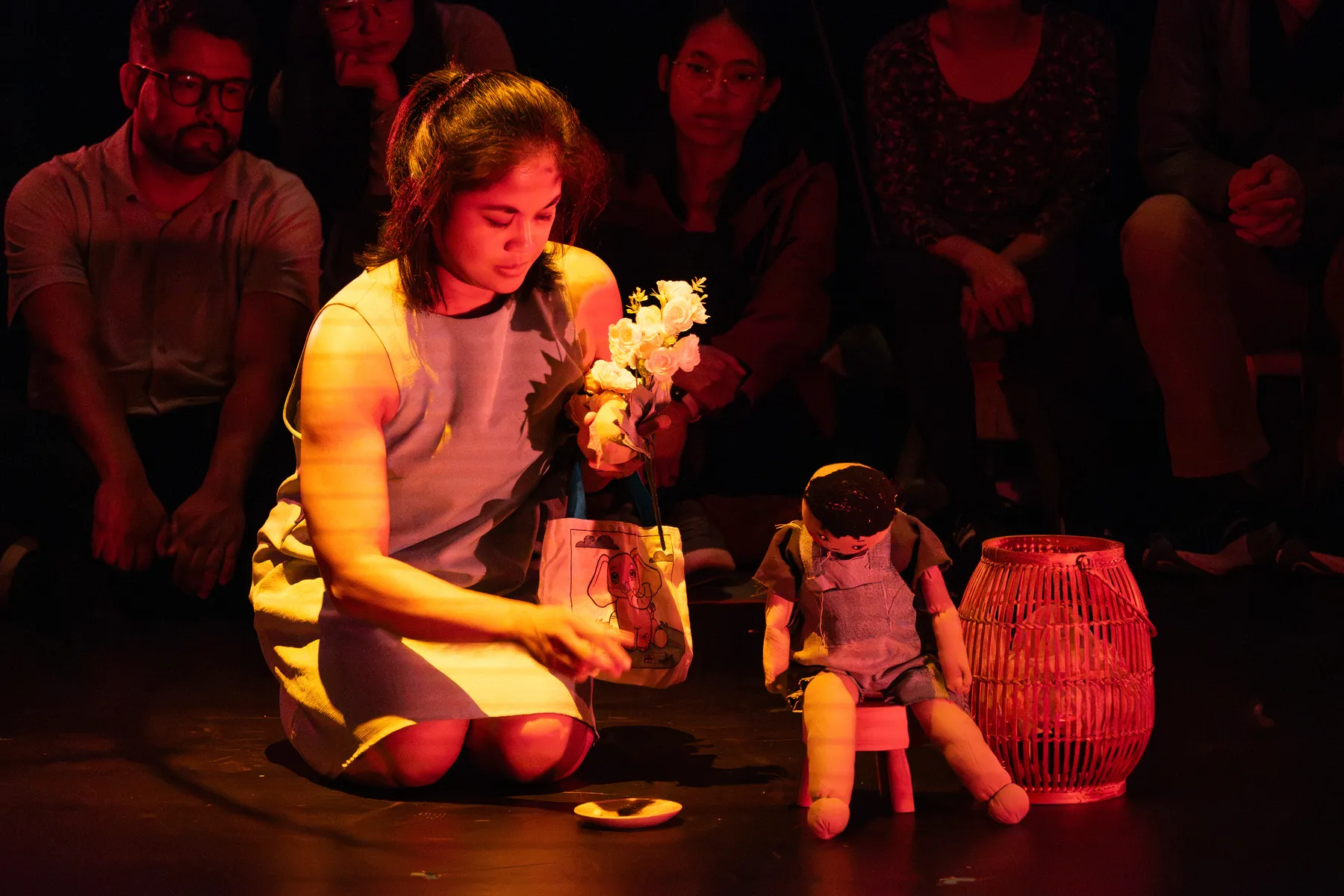

A doll sits on a chair in the middle of the Waterfront Theatre stage. He's quaint, plainly-stitched, and the beating heart of the set. Dozens of audience members are ushered onstage to sit around him. Actors circle him, purple and orange lights highlighting his stage presence. Even before the audience gets their bearings, this doll is alive. Soul Maker at the Vancouver Fringe Festival deals with the soul inside the doll, the life it had, and what it means to let a lost loved one go.
Written by UBC acting alum Ripley Twardzik Ching and directed by Evelyn Chew, the play follows Florentine (called TingTing by her family) as she navigates her grief surrounding her younger brother's early death. The core of the production is the aforementioned doll, which Florentine — played by Lissa Neptuno — learns is housing her brother Didi’s spirit. Soul Maker references Singaporean and Malaysian myths about where spirits reside and how we pull them back. As said in this play, art is an expression of the soul; logically, it can house a soul within.
The set itself was gorgeous. For a Fringe production, I wasn’t expecting anything memorable. These are productions with a fixed and finite budget, and several shows share each venue. Despite these limitations, set designer Stephanie Zheng made a billowing cloth tent which hung over the characters and filled the space brilliantly. The set also included room for audience members to sit onstage, creating a distinct experience for select attendees based on where they were sat.
Simple yet homey lighting warmed the play’s atmosphere. Lighting designer Christian Ching used two orange and purple backlights that gave the production the colour palette of a burning sunset. When prop fire was present — crafted from some sort of lightbulb in lanterns or cans — every other light dimmed and made the objects look realistically ablaze. It was understated and elegant.
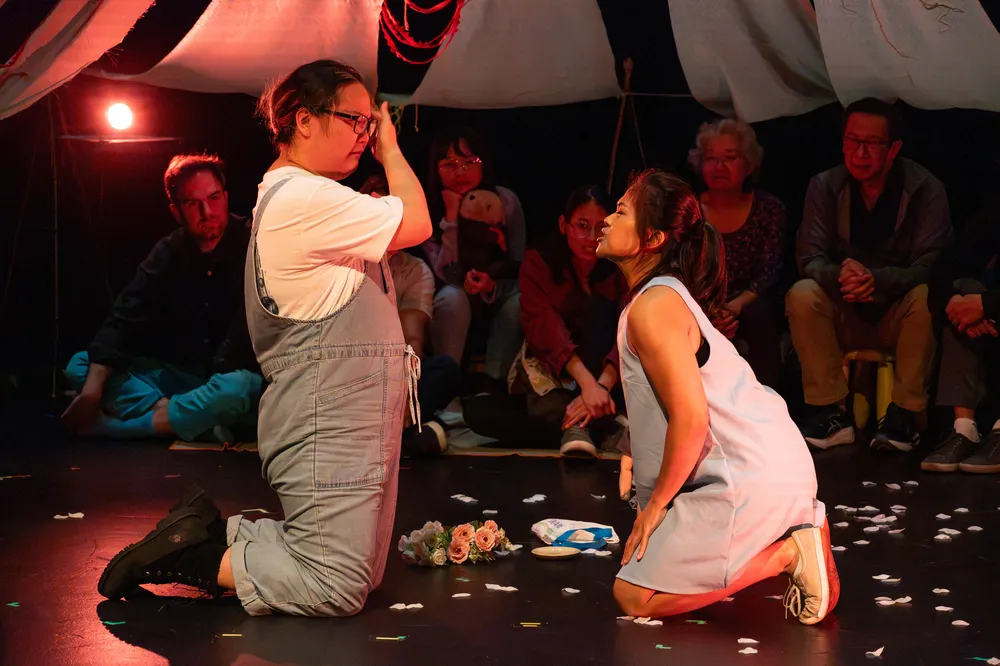
Soul Maker references Singaporean and Malaysian myths about where spirits reside and how we pull them back.
In terms of narrative, the show is unstuck in time — we jump between Florentine as a child starting to process her brother’s death, and as an adult desperately clinging to his spirit. We see her at his wake quickly sewing the doll, and as a collector of children’s toys when she’s grown up.
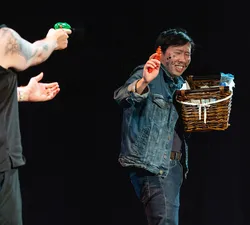
When she invites a handyman named Richard (Joey Lim Jin Yen) to her house, Didi takes control of his body and sees his sister again for the first time since his death. They play for a moment, then he begs her to burn the doll his soul is trapped in before being shunted from Richard’s body. He needs to be released from this mortal world to be freed from pain, and Florentine is the only one who can do it.
This is the heart of Soul Maker’s premise: how can you let go of someone you love? Twardzik Ching has done a wonderful job of using the doll motif as externalized grief. Florentine doesn’t want to let go of the doll, turning it into a very clear symbol of her memory and loss.
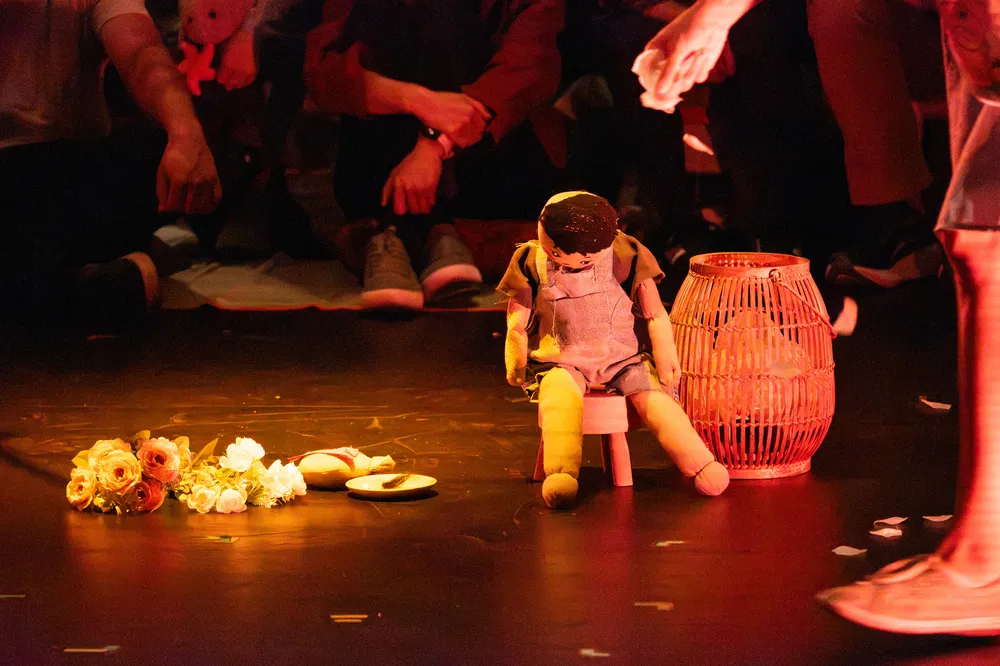
The show deals with the soul inside the doll, the life it had, and what it means to let a lost loved one go.
Other characters tell Florentine how to feel about grief constantly. Her family tries to comfort her and tell her there's a heaven. Her friend Helena (Talia Peck) tells her that you can’t stop giving love to people, because love is an infinite resource; it doesn’t dry up when there’s no longer an outlet. Characters expound on grief in distinct and nuanced ways. These different perspectives were engaging as an audience member because of the wide range of diverse opinions they represented.
These monologues on grief are the production at its best — Twardzik Ching knows how to pull the heart with deeply-considered and nuanced prose. But the play often and ineffectively makes use of humour, undercutting these heart-wrenching moments of grief. This play finds its strength in its melancholy, and unfortunately exhausts a lot of effort playing into poorly-executed goofy comedy. The Fringe website describes the show with the key words “grief, wacky, [and] uplifting.” A stronger version of Soul Maker would have emphasized the first and last adjectives the most.
My favourite part of the production was easily Neptuno’s portrayal of Florentine. She can go from young TingTing to adult Florentine in a moment, and we see these as two separate people. The unstuck nature of the narrative is predominantly sold by her stellar character work. I truly believe she is both the child that lived and the adult that trudged into the years after.
The show rests completely on her shoulders in the final scene. Onstage, it's just her and the doll she sets ablaze. She yells about how she wishes she could have changed the outcome of what happened, and the survivor’s guilt she feels about her brother's cancer. My breath was caught in my chest throughout this entire scene. She cries real tears over the burning doll — we feel her anger, joy, and pain as she tries to move on.
Soul Maker, like many Fringe shows, is a passion project. The production plants you in a world of folklore and ghosts and pulls you in and out of grief with a direct and tender hand. The best art is filled with soul, and this show is filled with spirit.