
Joy is the main thing I look for when watching a movie. Family films in theatres as of late focus on short-term happiness, mild gags, and mediocre ideologies, which do little to challenge the viewer. Coyote vs. Acme — through perfect slapstick and a messaging greatly substantiated by its own production history — delivers exactly what I was looking for. I saw the joy of the indomitable human spirit in each anvil crash and dynamite explosion, delivered by a coyote who had a perfect, absurdist passion for life.
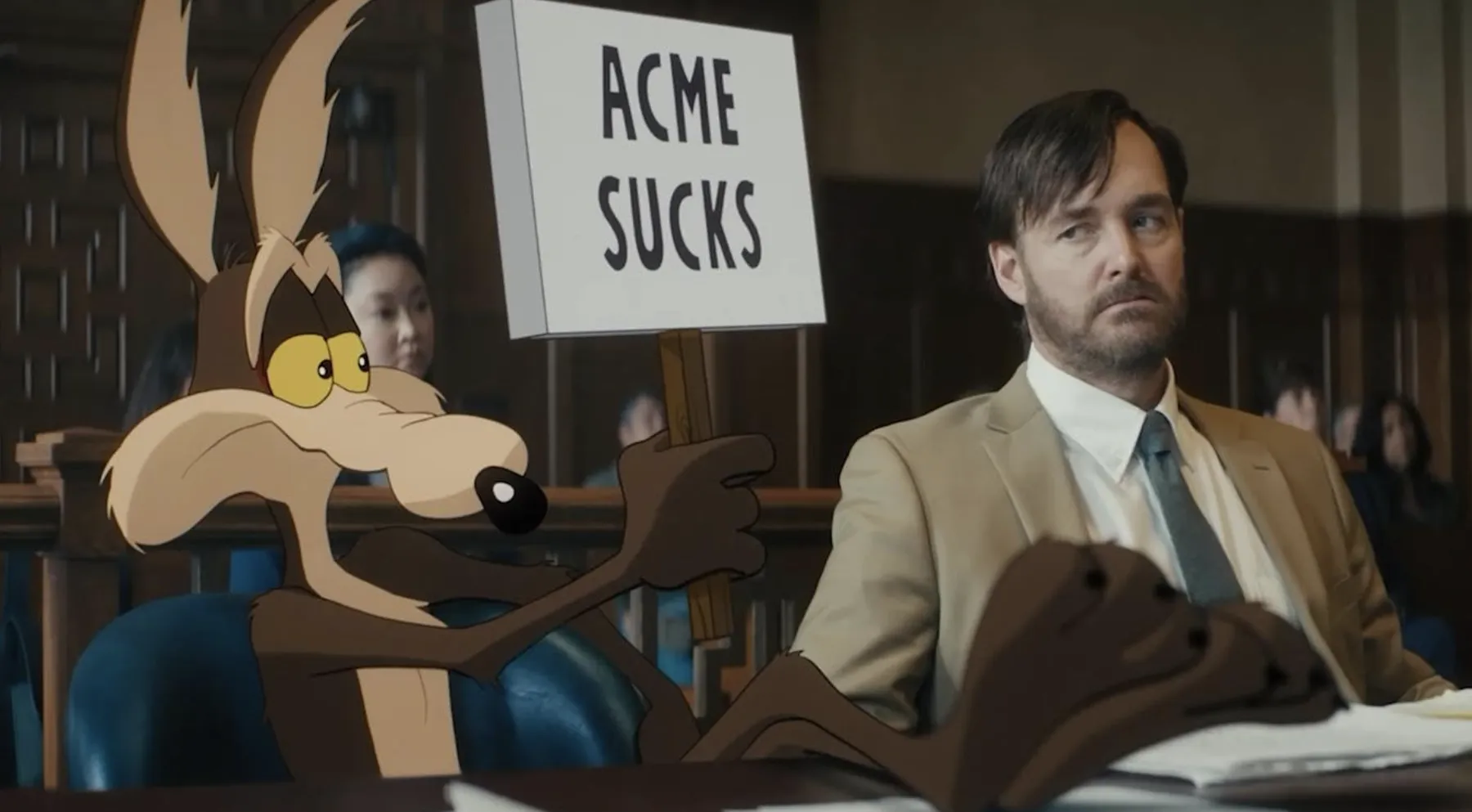
The film, directed by Dave Green, is a live-action legal drama with integrated Looney Tunes characters. It centres on Wile E. Coyote, famed pursuer of the Road Runner, who silently communicates through picket signs. He finds and coerces lawyer Kevin Avery, played by Will Forte, into suing megacorporation Acme for decades of faulty cartoon products. Together, they must fight through the apathetic American legal system to attempt to get some justice.
The film reframes Acme into a modern political context run by terrifying economic empires. Instead of the faceless company of the animated franchise that made “cartoon products” (anvils, dynamite, and other items), this version of Acme is a conniving conglomerate distilled in sleek American form. They still sell their catapults and rocket boots alongside military weaponry, like Palantir or Raytheon with a cartoonish side hustle.
As the film launches into its hijinks, we discover how deep Acme’s corruption goes and what they’ve been willing to do to keep profits high. Cartoon characters in this world are treated as unkillable — hit them with a missile or flatten them with a truck, and they’ll still stand up in a second — so corporate machinations present real stakes for our coyote.
Coyote vs. Acme is slapstick created by smart people. The filmmakers use obsessive comedic heightening and well-timed jokes to build upon already established ones.
We’ve seen each Road Runner gag a thousand times: Coyote has a weapon, Coyote is a finger’s length away from catching Road Runner, Road Runner “meep-meeps” in his face, and somehow Coyote’s Acme device explodes, rendering him useless. We know that Coyote is going to fall off the cliff, we know that the dynamite he’s holding will detonate in his face, and Coyote vs. Acme honours this premise.
At one point, Coyote hits a cliff with a helicopter. A lesser comedy would stop the camera there and let us bask in Coyote’s misfortune and a decently timed explosion. Instead, the camera keeps going at the speed it was before Coyote crashed, leaving him behind. The filmmakers let our brains figure out what happened and laugh in time with the film.
The film starts with a sequence similar to the cartoon’s formula, but instead of an explosion from a mistimed cherry bomb, it ends with Coyote being shot at by a military fighter jet, then hit by a house-sized boulder and a semi-truck.
I will say, some of the character work was more utilitarian than emotionally complex. Characters’ arcs are wrapped up neatly and the non-comedic dialogue serves merely as a vehicle to the next joke. However, the writers still manage to nail the film’s emotional core, centred around Coyote. The structure, comedy, and heart of this film save whatever loose dialogue hangs limply in the script.
That this film is in theatres is a miracle. The movie was completed in 2023 and ready to hit theatres, but WarnerMedia unceremoniously shelved it after their new CEO David Zaslav was appointed during their merger with Discovery. Even though it performed well with test audiences and had the undying love of its creative team, that wasn’t enough to save it. It was just one of several WarnerMedia films, like Batgirl or Scoob! Holiday Hunt, killed in post-production to save money.
Fan backlash was immediate and filled with fury. Eric Bauza, the new voice for most of the main Looney Tunes roster, made his feelings known during a 2024 Annie Awards speech. In Daffy Duck’s voice, he said, “I hate to be political, but release Coyote vs. Acme!” Filmmakers like Phil Lord and Christopher Miller, and even U.S. House representative Joaquin Castro from Texas, took to X to fight for the film. Famously, one dedicated fan protested in the pouring rain outside of Warner Bros., wearing a Wile E. Coyote costume and holding a sign that read “Release Me!”
Because of this backlash, Warner Bros. quickly sought a buyer for the film. Nearly two years later, Ketchup Entertainment bought Coyote vs. Acme’s distribution rights for $50 million, $115 million less than Zaslav’s current yearly salary. Coyote fighting a megacorporation is not some nebulous, hypothetical concept — it's what the filmmakers had to go through.
My favourite part of the film, and the reason I’ve been obsessively thinking about it since my viewing, was how directly it frames Wile E. Coyote as Sisyphus. The Greek figure, famous for his punishment of eternally rolling a boulder up a hill, is referenced in the plot — Acme’s conspiracy is even called “Project Sisyphus” — the poster art, and in its main character’s wants and desires. Through this constant reference, the filmmakers turn Coyote into Camus’s specific interpretation of the Sisyphus myth: a model of absurdist philosophy where happiness is found not in the task’s completion, but in the struggle to push the boulder.
Road Runner represents Coyote’s fruitless geas. Avery, his lawyer, asks Coyote why he constantly pursues the bird and he holds up a blank sign, taps it and shrugs. He doesn’t know why and can’t begin to explain it — it's the wordless fire that drives his madness. We know that this chase is pointless. He will be thwarted by the bird’s speed or his own technological failures time and time again. That's the game. But Coyote always has hope the game can be won. The film even ends with a postscript that says that Wile E. Coyote will catch the Road Runner soon, maybe even tomorrow.
If this movie had a typical release free of turmoil, I still would have loved it. Because of this film’s unconventional release, however, I rally behind it. Its entire ideology was proven before it even hit cinemas — fans had to fight against corporate meddling and financial optimization to procure and protect a piece of art. It became a chase, an insurmountable task overcome through luck, providence and fans’ perseverance. In its creation and tumultuous history, the filmmakers made a coyote out of us all.